
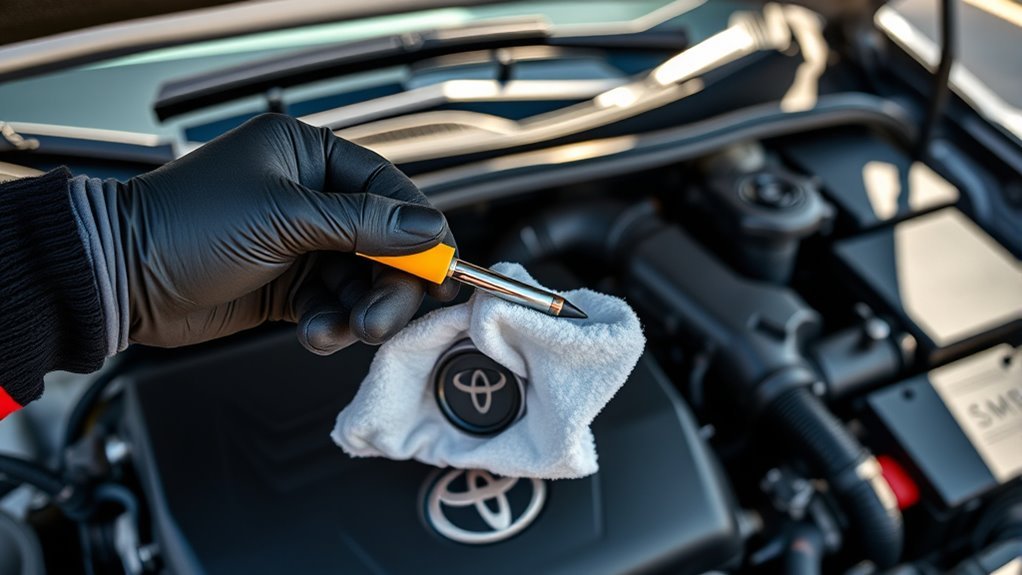
Checking the engine oil on a Toyota RAV4 takes only a few minutes, but it can prevent expensive engine damage. The safest method is simple: park on level ground, let the engine sit briefly after shutdown, read the dipstick correctly, and add only the oil grade recommended for your model year.
Quick Answer
To check Toyota RAV4 engine oil, park on level ground, warm the engine, turn it off, and wait about five minutes. Pull the dipstick, wipe it clean, reinsert it fully, then pull it again. The oil should be between the low and full marks. Add the correct oil only if the level is low.
Key Takeaways
- Always check oil with the RAV4 parked on level ground for the most accurate dipstick reading.
- Toyota’s late-model RAV4 manuals say to warm the engine, shut it off, wait about five minutes, then check the dipstick.
- The oil level should be between the low mark and the upper refill/full mark — not below low and not above full.
- Many newer RAV4 models use SAE 0W-16 oil, but you should confirm the exact grade in your owner’s manual.
- Toyota recommends checking engine oil regularly, commonly once a month, and replacing oil and filter on the schedule for your driving conditions.
At a Glance
| Time Required | 5–10 minutes |
| Difficulty | Easy |
| Tools Needed | Clean lint-free rag or paper towel, gloves, funnel, correct engine oil if topping off |
| Cost | Free to check; only the cost of oil if the level is low |
How to Check Engine Oil on a Toyota RAV4: Quick Steps
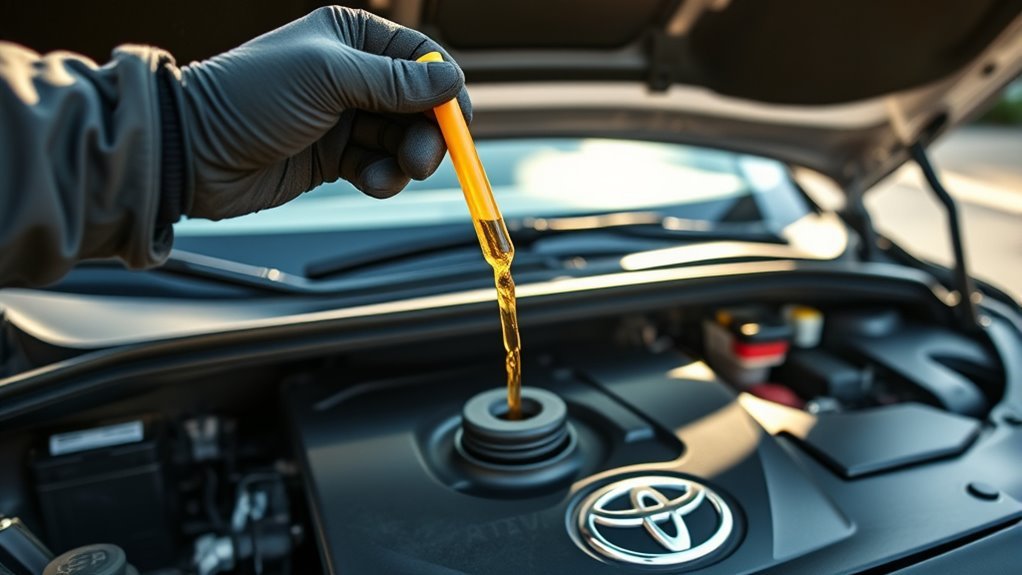
- Park on level ground. A slope can make the oil collect to one side of the pan and give a false reading.
- Warm the engine, then shut it off. Toyota’s owner information for late-model RAV4s says to warm the engine, turn it off, wait about five minutes, and then check the dipstick.
- Open the hood and find the dipstick. The handle is usually brightly colored and easy to reach near the front area of the engine bay.
- Pull, wipe, and reinsert the dipstick. Wiping it first clears old oil from the stick so the second pull gives the real reading.
- Pull it again and read the level. The oil should sit between the low mark and the upper refill/full mark.
- Add oil only if needed. If the oil is below or near the low mark, add the same type of oil already in the engine, using the viscosity listed in your owner’s manual.
- Recheck after topping off. Add oil in small amounts, wait a minute, reinsert the dipstick, and check again to avoid overfilling.
Warning: Do not drive with the oil level below the low mark or with the oil-pressure warning light on. Low oil or low oil pressure can cause severe engine damage. Pull over safely, shut the engine off, and check the oil before continuing.
When to Check RAV4 Oil: Timing and Safety
For the most reliable reading, check the oil when the vehicle is parked on a flat surface and the engine has been turned off long enough for oil to drain back into the oil pan. Toyota’s late-model RAV4 manual instructions call for warming the engine, shutting it off, waiting about five minutes, and then checking the oil level on the dipstick.
Check After the Engine Has Been Off Five Minutes
Waiting about five minutes matters because oil is still draining through the engine immediately after shutdown. If you pull the dipstick too soon, the reading can look lower or smeared because some oil has not returned to the pan yet.
Always Check on Level Ground
Level ground is just as important as timing. If the RAV4 is parked uphill, downhill, or sideways on a curb, the oil may shift in the pan and make the dipstick reading look inaccurate. Park flat, shift into Park, set the parking brake, and keep loose clothing away from the engine bay.
Avoid Checking Immediately After Hard Driving
If you just finished highway driving, towing, climbing hills, or driving in very hot weather, give the engine a few minutes to settle before touching anything under the hood. Hot engine parts can burn your hands, and rushed readings are easier to misread.
Pro Tip: Check your RAV4 oil at the same time each month and before long road trips. A consistent routine makes it easier to spot slow oil consumption or a small leak early.
Find the Dipstick and Oil Fill
Open the hood and stand in front of the engine bay. On most Toyota RAV4 models, the engine oil dipstick has a brightly colored loop or handle. The engine oil filler cap is usually on top of the engine and marked with “engine oil,” “oil,” or an oil-can symbol.
Locating the Dipstick
The dipstick is your direct oil-level gauge. Pull it straight out while holding a rag under the end so oil does not drip onto belts, hoses, or painted surfaces. If you are unsure which handle is the engine oil dipstick, check the “Do-it-yourself maintenance” or “Engine compartment” section of your RAV4 owner’s manual.
Finding the Oil Fill Cap
The oil fill cap is where you add oil if the dipstick shows the level is low. Before adding oil, confirm the correct oil grade for your model. Toyota owner information for many late-model RAV4 models lists SAE 0W-16, ILSAC GF-6B multigrade engine oil as the recommended viscosity, with SAE 0W-20 allowed temporarily if 0W-16 is unavailable and then replaced with 0W-16 at the next oil change. Older RAV4 engines may use different oil, so verify your exact model year.
Step-by-Step Dipstick Check
Use this method every time so you do not mistake a smear on the dipstick for the true oil level.
- Prepare the vehicle. Park on level ground, warm the engine, shut it off, and wait about five minutes.
- Open the hood safely. Make sure the hood is latched open and stable before reaching into the engine bay.
- Pull the dipstick. Hold a rag or paper towel under the tip as you remove it.
- Wipe it clean. Clean the whole marked area so the next reading is clear.
- Reinsert it fully. Push the dipstick all the way back into the tube. A partially inserted dipstick can give a false reading.
- Pull it out again. Hold it level and look at both sides of the marked area.
- Read the lowest clear oil line. The correct reading is where the oil film consistently reaches on the dipstick, not a random smear higher up.
- Reinsert the dipstick fully. Do not leave it loose after checking.
Note: Dipstick shapes vary by model year and engine. Some use holes, notches, dots, or stamped low/full marks. Your goal is the same: keep the oil level inside the safe range shown on your dipstick.
Read the Dipstick: What the Marks Mean
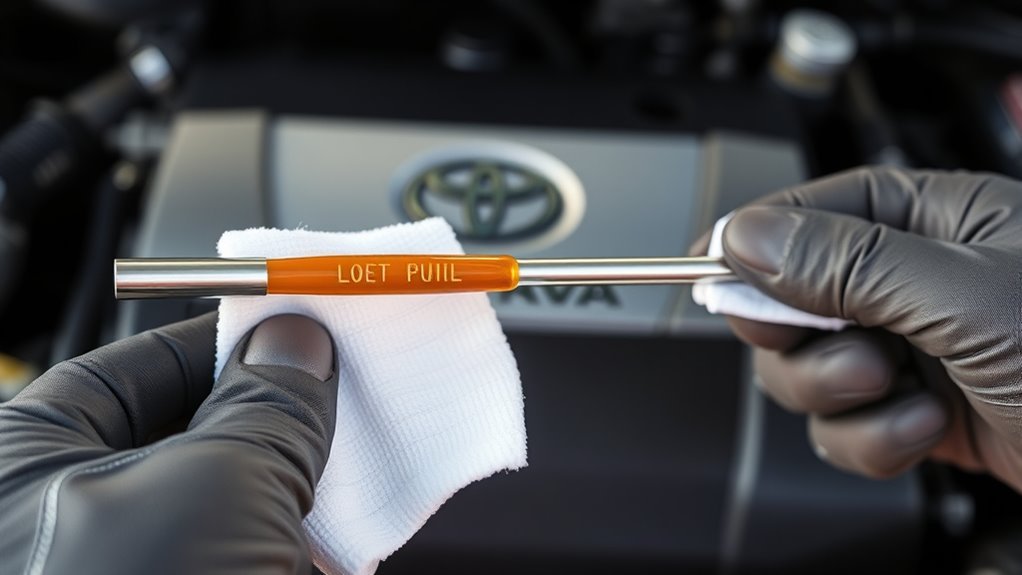
The lower mark shows the minimum safe oil level. The upper mark shows the refill upper limit or full range. A good reading is between the two marks, ideally closer to the upper mark without going above it.
| Dipstick Reading | What It Means | What to Do |
|---|---|---|
| Below the low mark | Oil level is too low | Add the correct oil in small amounts and recheck. Inspect for leaks if it keeps dropping. |
| Between low and full | Normal operating range | No oil is usually needed unless it is near low and you are about to take a long trip. |
| Near the upper mark | Ideal level | Reinsert the dipstick and continue routine checks. |
| Above the upper mark | Oil may be overfilled | Do not keep adding oil. If clearly overfilled, have excess oil drained or contact a technician. |
Toyota’s maintenance guide emphasizes routine engine oil level checks because low oil can lead to oil starvation, oil gelling, severe engine damage, and repairs that may not be covered if caused by lack of proper maintenance.
What Oil Color and Smell Tell You About Condition
The dipstick also gives you a quick look at oil condition. Color alone does not diagnose everything, but it can tell you when to investigate further.
- Amber to light brown oil: Often normal, especially after a recent oil change.
- Dark brown or black oil: Can be normal as oil ages, but if it is also thick, gritty, or overdue for service, schedule an oil change.
- Milky, tan, or foamy oil: May indicate coolant contamination. Avoid extended driving and have the vehicle inspected.
- Burnt smell: Can point to overheating, old oil, or excessive friction. Check service history and inspect for leaks.
- Gritty texture: May mean contamination or debris. Do not ignore it.
Warning: Milky oil, metal flakes, a strong burnt smell, or a persistent oil warning light are not normal maintenance items. Stop driving as much as practical and get a professional diagnosis.
When to Add Oil, How Much, and Which Oil to Use
Add oil only when the dipstick shows the level is below or near the low mark. Use the same oil type already in the engine when possible, and always match the viscosity and oil grade listed for your exact RAV4 model year.
[Products Worth Considering]

Castrol EDGE 0W-20 advanced full synthetic motor oil is engineered for drivers seeking strong wear protection, excellent viscosity control, and thermal stability. It delivers superior performance in critical engine areas, including fuel economy, high-temperature protection, sludge control, and wear defense. Designed for extended oil-change intervals, it helps keep modern engines running smoothly under demanding conditions.

These adjustable oil filter pliers are designed to help remove engine filters, conduit, and fittings with better reach and control in tight spaces. The bent head design improves access, while soft nonslip grips add leverage and comfort during use. Built with high carbon steel and a Permalock fastener, they offer dependable strength and long-lasting performance.

Castrol GTX Full Synthetic 5W-30 motor oil is designed to deliver maximum engine protection in severe driving conditions. It helps fight wear, control sludge, and resist viscosity breakdown while supporting longer intervals between oil changes. Formulated to meet or exceed key industry and vehicle manufacturer specifications, it offers dependable performance for modern engines.
How Much Oil to Add
Do not pour in a large amount all at once. Start with about half a quart, wait a minute, and recheck the dipstick. If it is still low, add another small amount and check again. This controlled approach helps prevent overfilling.
Which Oil to Use
For many newer Toyota RAV4 models, Toyota lists SAE 0W-16 as the preferred oil viscosity. In some manuals, SAE 0W-20 may be used only when 0W-16 is unavailable, with 0W-16 required again at the next oil change. Because RAV4 oil specifications vary by model year and engine, the safest answer is always your owner’s manual or Toyota’s official Manuals and Warranties page.
Avoid Overfilling
Too much oil can foam, raise crankcase pressure, trigger warning lights, or damage engine components. If the level is clearly above the refill upper limit, do not try to fix it by driving. Have the extra oil removed.
RAV4 Oil Change Schedule and Service Tips
Checking oil level is not a replacement for oil changes. Toyota’s maintenance guide for recent RAV4 models lists scheduled maintenance every 5,000 miles or six months, with engine oil and filter replacement at regular mileage/time intervals. Under normal conditions, oil and filter replacement appears at 10,000 miles or 12 months, while special operating conditions can require more frequent oil changes.
[Products Worth Considering]

The EcoNour foldable car windshield sun shade helps block UV rays and reduce interior heat, keeping your vehicle cooler while protecting the dashboard and seats from sun damage. Its compact, collapsible design makes it easy to install, remove, and store, and the broad coverage is ideal for many cars and SUVs.

P&S Brake Buster is a professional-grade wheel and tire cleaner that cuts through brake dust, grime, oil, and light corrosion for a thorough, factory-fresh clean. Its non-acid formula is safe for chrome, aluminum, painted, powder-coated, and steel wheels, while the foaming action helps lift stubborn buildup from hard-to-reach areas. Trusted by detailing pros, it can be used full strength or diluted for flexible cleaning power.
Normal Service vs. Special Operating Conditions
Special operating conditions can include frequent dusty-road driving, towing, using a car-top carrier, heavy vehicle loading, repeated short trips in freezing weather, and extensive idling or low-speed driving. If most of your driving fits those conditions, Toyota’s maintenance log may call for engine oil and filter replacement at shorter intervals.
Keep Maintenance Records
Write down the date, mileage, oil type, filter used, and where the service was performed. Toyota’s maintenance guide says owners should keep detailed records because damage caused by lack of proper maintenance is not covered under warranty.
Low-Oil Troubleshooting and Warning Light Actions
If your RAV4 oil level keeps dropping between oil changes, do not just keep topping it off forever. A slow drop may be normal on high-mileage engines, but repeated low readings can also point to a leak, oil consumption, or an overdue service issue.
If the Oil Level Is Low
- Add the correct oil in small increments.
- Recheck the dipstick until the level is back in the safe range.
- Look under the vehicle for fresh oil spots.
- Inspect around the oil filter, drain plug, valve cover area, and oil filler cap for wet oil.
- Schedule service if the level drops again quickly.
If the Oil Light Comes On
An oil warning light may indicate low oil pressure, not just a low oil level. Pull over safely, turn the engine off, and check the dipstick. If the oil is low, add the correct oil before restarting. If the oil level is normal but the warning light stays on, do not keep driving; contact a qualified technician or Toyota dealer.
If You Added Too Much Oil
If the dipstick reads slightly above the top mark, check again after a few minutes on level ground to confirm. If it is clearly overfilled, the safest fix is to drain the excess oil. Overfilled oil can cause foaming and poor lubrication.
Common Mistakes to Avoid
- Checking on a hill: Even a small slope can skew the reading.
- Reading the first pull: Always wipe, reinsert, and read the second pull.
- Adding oil too fast: Small increments prevent overfilling.
- Using the wrong oil grade: Always verify the viscosity and oil grade for your model year.
- Ignoring repeated low readings: Repeatedly low oil needs inspection, not just more oil.
- Driving with the oil-pressure light on: This can cause serious engine damage.
Frequently Asked Questions
How often should I check the oil in a Toyota RAV4?
A good habit is to check it once a month and before long trips. Toyota’s maintenance guide also emphasizes routine engine oil level checks as part of proper vehicle care.
Should I check RAV4 oil hot or cold?
For many late-model RAV4s, Toyota says to warm the engine, shut it off, wait about five minutes, and then check the dipstick. The key is to let the oil drain back into the pan before reading it.
What oil does a Toyota RAV4 take?
Many newer RAV4 models use SAE 0W-16 oil meeting Toyota’s required grade, but the correct oil depends on model year and engine. Check your owner’s manual before buying or adding oil.
Can I use 0W-20 instead of 0W-16 in a RAV4?
Some late-model Toyota manuals allow SAE 0W-20 temporarily if SAE 0W-16 is unavailable, but they also say it should be replaced with SAE 0W-16 at the next oil change. Follow the manual for your exact vehicle.
How do I know if my RAV4 needs an oil change?
Check the maintenance reminder, mileage, date of last service, and oil condition. Dark oil alone is not always an emergency, but gritty oil, burnt smell, low level, warning lights, or overdue mileage means you should service it promptly.
What happens if I overfill the engine oil?
Overfilling can cause oil foaming, poor lubrication, leaks, smoke, or warning lights. If the dipstick is clearly above the upper mark, have the excess oil removed before driving far.
Conclusion
Checking the oil on a Toyota RAV4 is one of the simplest ways to protect the engine. Park level, wait about five minutes after shutdown, wipe and reread the dipstick, and keep the oil between the low and full marks. Use the oil grade listed for your model, add only small amounts when needed, and take warning lights or repeated low readings seriously.
Sources
- Toyota Owners — 2024 RAV4 Maintenance Data — supports dipstick timing, oil level checking, and recommended oil viscosity information.
- Toyota Owners — 2025 RAV4 Engine Compartment and Adding Engine Oil — supports locating the oil fill area, adding oil, and avoiding overfill.
- Toyota 2024 RAV4 Warranty and Maintenance Guide — supports monthly oil-level checks, maintenance records, scheduled maintenance, and special operating conditions.
- Toyota Owners — Manuals and Warranties — source for verifying the exact owner’s manual and oil specification for each RAV4 model year.



[…] inspection, and a visual brake inspection. In Toyota’s checked 2024 gas and hybrid guides, engine oil and filter replacement is listed at 10,000 miles or 12 months under normal use, but certain […]