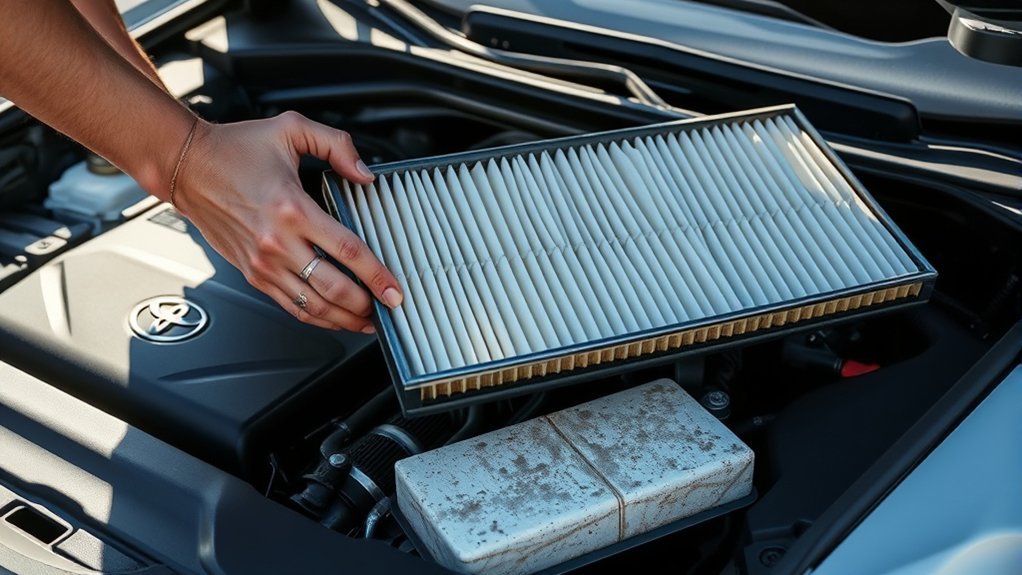
Changing the engine air filter on a Toyota Camry is one of the easiest maintenance jobs most owners can do at home. The filter sits inside the air filter housing in the engine bay and helps keep dust, grit, leaves, and other debris from entering the engine. The exact housing clips and filter shape can vary by model year and engine, so always confirm the correct replacement filter before you begin.
Quick Answer
To change a Toyota Camry engine air filter, park on level ground, turn the engine off, open the hood, release the air filter housing clips or fasteners, lift the cover, remove the old filter, clean loose debris from the housing, seat the new filter, and close the housing securely.
Key Takeaways
- Use a filter that matches your Camry’s model year, engine, and VIN; not every Camry uses the same filter.
- Most Camry engine air filter replacements require only basic hand access, though some housings may use clips, latches, or screws.
- Toyota maintenance guidance for recent Camrys lists engine air filter replacement at scheduled intervals and more frequent inspection in dusty or muddy conditions.
- A clogged air filter can hurt performance, but modern fuel-injected cars usually should not be promised a fuel-economy boost from a new filter.
At a Glance
| Time Required | 10 to 20 minutes |
| Difficulty | Easy DIY maintenance |
| Tools Needed | Usually none; a flathead screwdriver or socket may help if your housing uses tight clips or screws |
| Cost | Commonly about $15 to $35 for the filter, depending on brand and model fitment |
Understanding Why Engine Air Filter Maintenance Matters
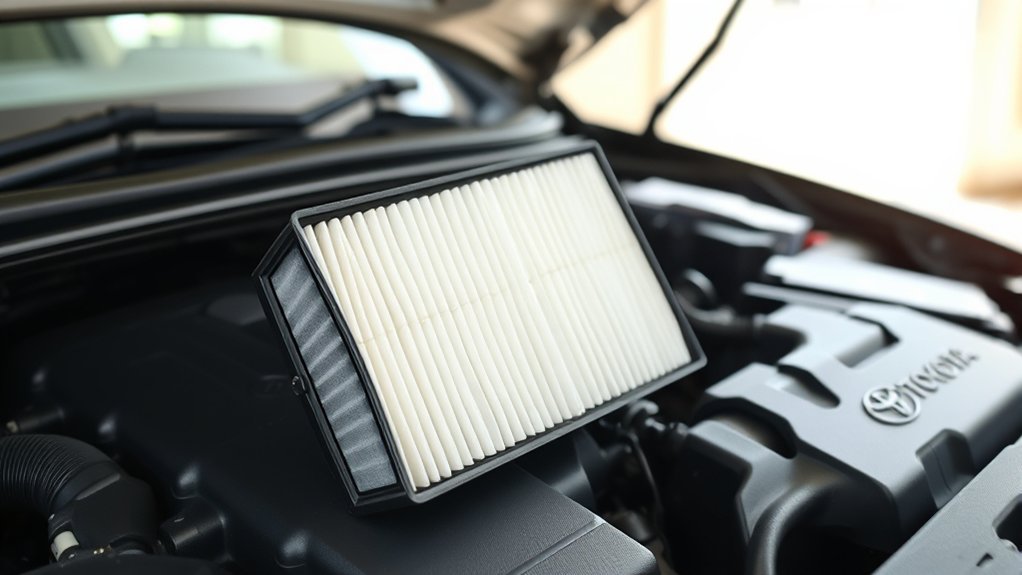
Your Camry’s engine air filter protects the engine from airborne dirt and debris while still allowing enough air into the intake system. When the filter is badly clogged, airflow can be restricted, which may reduce throttle response, acceleration, and overall drivability.
Be careful with fuel-economy claims. According to FuelEconomy.gov, replacing a clogged air filter on modern fuel-injected, computer-controlled gasoline vehicles generally improves performance rather than fuel economy. That means a new filter is still worthwhile, but it should not be sold as a guaranteed MPG upgrade for a modern Toyota Camry.
A clean, properly fitted engine air filter helps protect the engine. A clogged filter can hurt performance, but modern Camry owners should follow the maintenance schedule instead of relying on exaggerated MPG promises.
Before You Start: Confirm the Right Filter
Do not buy a filter by the word “Camry” alone. Toyota has used different engines, trims, and hybrid layouts across model years, and the correct filter can vary. Use your vehicle’s model year, engine, trim, and ideally the VIN when checking fitment.
You can verify maintenance information through the Toyota Owners manuals and warranties portal. If you are buying an OEM filter, Toyota’s official parts site also lets you search compatible Toyota engine air filters by vehicle.
Note: This article is about the engine air filter under the hood, not the cabin air filter behind the glove box. The cabin air filter cleans air for the passenger compartment; the engine air filter protects the engine intake.
[Products Worth Considering]

KAX CA12377 engine air filter is designed as a replacement for select Toyota and Lexus vehicles, helping deliver cleaner airflow to the engine for smoother operation and maintained performance. Its resin-impregnated fiber paper media and 3-layer composite construction are engineered to meet or exceed OE air filter requirements with low resistance and high efficiency. Built for dependable fit and recommended periodic replacement, it supports long-term engine protection across a wide range of compatible models.

KAX CA12377 Premium Engine Air Filter is designed as a replacement for select Toyota and Lexus vehicles, helping keep harmful particles out of the engine while supporting steady airflow. Its high-efficiency filtration and longer service life can help improve acceleration, maintain consistent performance, and support better fuel economy. Built for broad vehicle coverage, it offers dependable protection for everyday driving and extended maintenance intervals.

This A-Premium engine air filter is designed to help deliver cleaner airflow to compatible Toyota, Lexus, Scion, and Pontiac vehicles. It supports a wide range of fitments across select Camry, RAV4, Avalon, Matrix, Venza, ES350, tC, xB, and Vibe models, making it a convenient replacement choice. Built for straightforward maintenance, it is intended for regular service intervals to help keep engine intake performance on track.
Tools You’ll Need for the Job
Most Toyota Camry engine air filter changes are simple, but it helps to have a few basic supplies ready before you open the air box.
| Tool or Supply | Purpose |
|---|---|
| Correct replacement engine air filter | Replaces the dirty or damaged filter |
| Clean cloth or shop towel | Wipes dust from the air filter housing |
| Flathead screwdriver | Helps release stubborn clips on some housings |
| Socket or nut driver | Useful only if your Camry’s air box has screws or bolts |
| Safety gloves | Keeps hands clean and helps avoid scrapes |
A vacuum can help remove loose debris around the outside of the housing, but do not vacuum directly into an open intake tube. If the filter is removed, keep debris away from the intake opening.
[Products Worth Considering]

ECOGARD XA5786 is a premium engine air filter designed to help protect your engine by trapping dust, dirt, pollen, and road particles before they enter the intake system. It supports smooth airflow for consistent engine response and fuel efficiency, and it is intended for regular replacement to help maintain reliable performance and engine longevity.

This A-Premium engine air filter helps deliver cleaner airflow to compatible Toyota and Lexus vehicles while supporting engine efficiency and long-term performance. Its fine cellulose filter media is designed to capture harmful particles before they reach internal engine components, and the two-piece pack makes routine maintenance more convenient. Replace it at regular service intervals to help keep your engine running smoothly.

【Fitment for Toyota Models / Not fit for Hybrid】fit for 2019-2022 Avalon, 2018-2024 Camry, 2020-2026 Highlander, 2024-2026 Grand Highlander, 2019-2025 RAV4, 2023-2026 GR Corolla
Step-by-Step Guide to Removing the Old Filter
Work slowly and avoid forcing plastic clips. Air filter housings are usually sturdy, but old plastic can become brittle from heat and age.
[Products Worth Considering]

【Fitment for Toyota Models / Not fit for RAV4 XLE models】fit for 2018-2026 Camry Hybrid, 2019-2022 Avalon Hybrid, 2019-2026 Corolla (not fit for Hybrid), 2022-2026 Corolla cross, 2019-2026 RAV4 Hybrid, 2021-2024 RAV4 Prime, 2020-2026 Highlander Hybrid, 2024-2026 Grand Highlander Hybrid XLE/Limited 2.5L (not for 2.4 Hybrid), 2021-2026 Sienna, 2021-2024 Venza, 2018-2022 C-HR, 2023-2026 Crown, 2025-2026 Crown Signia Hybrid

[Vehicle Fitment]: CA10171 Compatible with Toyota Camry GAS 2007-2017 2.4/2.5L , Venza 2009-2015 2.7L

【Compatible with Toyota】2018-2025 Camry 2.5L Hybrid,2019-2022 Avalon 2.5L Hybrid,2019-2025 Corolla 1.8L (not fit for Hybrid),2019-2025 Corolla 2.0L (not fit for Hybrid),2018-2022 C-HR 2.0L,2020-2025 Highlander 2.5L Hybrid,2019-2025 RAV4 2.5L Hybrid,2021-2025 RAV4 Prime 2.5L Hybrid,2021-2025 Sienna 2.5L Hybrid,2021-2025 Venza 2.5L Hybrid. 【Compatible with Lexus】2019-2025 ES300h 2.5L,2022-2025 NX350h 2.5L,2022-2025 NX450h 2.5L.
Step 1: Park Safely and Open the Hood
Park the Camry on a level surface, shift into Park, set the parking brake, and turn the engine off. Let the engine cool if you have just driven. Open the hood and secure it with the prop rod if your model uses one.
Warning: Do not work around a hot engine, moving belts, fans, or loose wiring. Never start the engine while the air filter housing is open or the filter is removed.
Step 2: Locate the Air Filter Housing
The engine air filter housing is a black plastic box in the engine bay connected to the intake duct. It is usually near one side of the engine compartment. Follow the large intake hose from the engine toward the air box if you are unsure.
Step 3: Release the Housing Clips or Fasteners
Release the clips, latches, or screws holding the top of the air filter housing closed. Some Camry models use simple spring clips. Others may use a slightly different latch or fastener layout.
If a wiring harness or connector is close to the housing, move it gently only as much as needed for access. Do not yank wires, pry on connectors, or disconnect anything unless it clearly blocks the housing from opening.
Step 4: Lift the Cover and Remove the Old Filter
Lift the air box cover just enough to slide the old filter out. Do not bend the intake hose sharply. Pull the filter straight up or out, depending on how it sits in the housing.
Look at how the old filter is seated before removing it completely. Notice the gasket position, filter shape, and any tabs or corners that help it fit only one way.
Inspecting the Old Filter
Inspect the old engine air filter for heavy dirt, leaves, oiliness, tears, crushed pleats, or a damaged rubber seal. Toyota’s maintenance guidance says to check the engine air filter for damage, excessive wear, and oiliness, and to replace it if needed.
A light layer of dust is normal. A filter packed with dirt, dark debris, leaves, or insects should be replaced. If you see oil soaking, rodent damage, or debris inside the clean side of the air box, inspect the intake area more carefully before closing everything up.
Installing Your New Air Filter: A Simple Guide
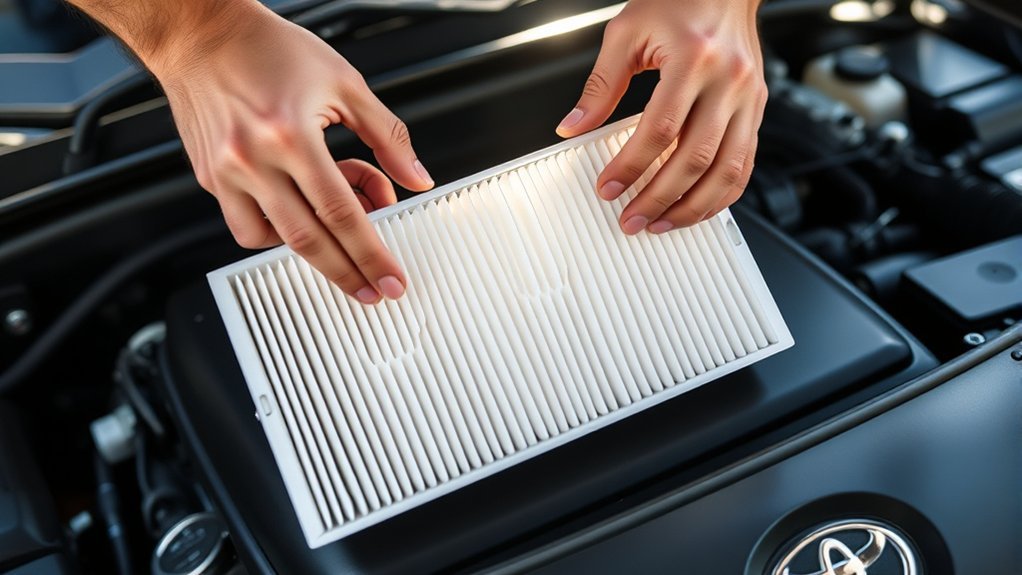
Before installing the new filter, wipe loose dust and leaves from the lower air box with a clean cloth. If debris is sitting near the intake opening, remove it carefully so it does not fall into the intake tube.
Proper Filter Orientation
Set the new filter into the housing the same way the old one came out. Some filters have an airflow arrow or molded shape that makes the direction obvious. Others rely on the rubber seal, tabs, or corners to fit correctly.
- Match the new filter to the old filter before installation.
- Make sure the rubber gasket sits flat all the way around.
- Do not fold, pinch, or crush the filter edge.
- Do not trim the filter to make it fit.
- If the air box will not close easily, remove the filter and reseat it.
Securing the Filter
Once the filter is seated, lower the air box cover carefully. The cover should sit flat without a gap. Reattach the clips, latches, or screws in their original positions.
| Action | Why It Matters | What to Check |
|---|---|---|
| Seat the filter fully | Prevents unfiltered air from bypassing the filter | Gasket is flat and even |
| Close the housing evenly | Keeps the intake sealed | No visible gaps around the lid |
| Lock clips or screws | Prevents vibration and air leaks | Each fastener is back in place |
Final Fit Check
Run your fingers around the air box cover and confirm it is closed evenly. Check that the intake hose is still connected and that no wiring harness is pinched under the housing cover.
Pro Tip: If the housing clips feel unusually hard to close, the filter is probably not seated correctly. Do not force the lid; reopen the box and check the gasket and corners.
Securing the Filter and Reattaching Components
After the new filter is installed, double-check every part you touched. If you moved a wiring harness, put it back in its original route. If you loosened a screw or latch, make sure it is fully secured. If you disconnected a connector because it truly blocked access, reconnect it until it clicks.
| Component | Action Required | Verification Method |
|---|---|---|
| Engine air filter | Confirm proper seating | Filter edge sits flat in the housing |
| Air box cover | Close and secure all clips or fasteners | No gaps around the cover |
| Intake hose | Confirm it was not pulled loose | Hose is seated and clamp is in place |
| Wiring nearby | Route away from pinch points | No wires trapped under the air box lid |
| Engine bay | Remove tools and rags | Nothing loose remains near belts or fans |
Best Practices for Handling Wiring During Filter Replacement
Some Camry engine bays have wiring close to the air filter housing. Treat it gently. A broken connector or pinched harness can create problems that are much more expensive than the filter itself.
- Move wiring only when needed for access.
- Hold connectors by the plastic body, not by the wires.
- Do not use pliers on electrical connectors unless the service procedure specifically calls for it.
- Keep wiring away from the air box seal before closing the cover.
- After closing the housing, look again for pinched wires or loose connectors.
When to Replace Your Air Filter?
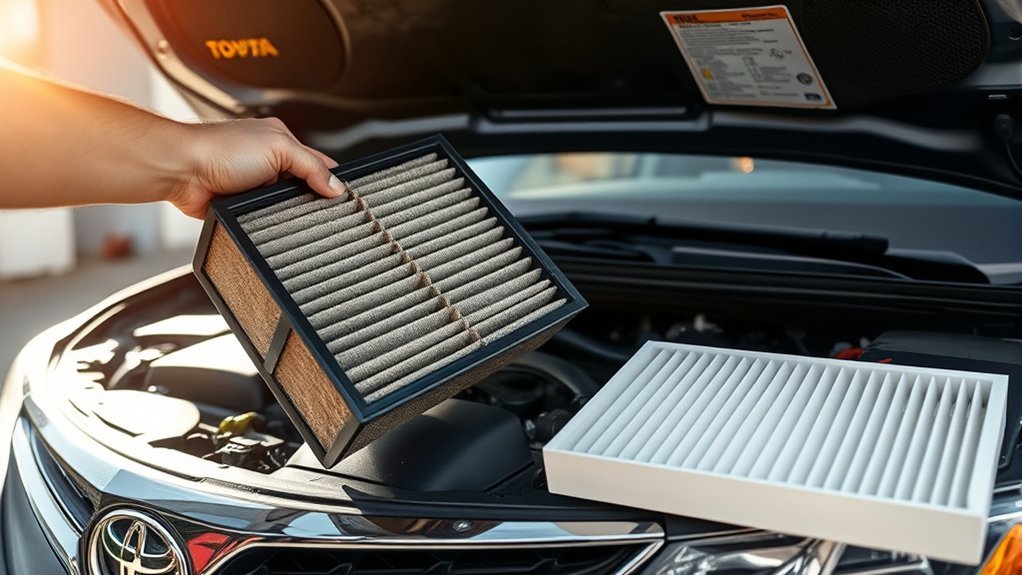
For recent Camry models, Toyota’s maintenance guide lists the engine air filter as a scheduled maintenance item and also calls for inspection under special operating conditions such as driving on dirt, dusty, muddy, or melted-snow roads. Check your own owner’s manual or maintenance guide because the exact schedule can vary by model year and market.
As a practical rule, inspect the engine air filter during routine service and replace it sooner if it is dirty, damaged, oily, wet, torn, or no longer sealing properly. Drivers in dusty rural areas, desert climates, construction zones, wildfire-smoke seasons, or heavy pollen conditions may need to inspect it more often.
Do not wait for a dashboard warning light specifically for the engine air filter. Treat the filter as a scheduled and visual-inspection maintenance item.
Signs Your Camry May Need a New Engine Air Filter
A dirty filter is not always obvious from the driver’s seat, but these signs are good reasons to inspect it:
- The filter looks dark, packed with dust, or full of leaves and bugs.
- The rubber seal is cracked, crushed, or no longer sitting flat.
- The engine feels less responsive than usual during acceleration.
- You hear unusual intake noise after the air box was opened.
- The air box clips are loose or the cover has a visible gap.
- You recently drove through heavy dust, ash, sand, or muddy roads.
What Happens If You Don’t Change Your Air Filter?
If you ignore a dirty engine air filter long enough, the engine may have to pull air through a restricted filter. That can reduce performance and throttle response. In severe cases, a damaged or poorly seated filter can also allow debris past the filter, which is exactly what the filter is supposed to prevent.
A clogged filter is not usually an emergency, but it should not be neglected. The U.S. Department of Energy has noted that replacing a clogged air filter on modern fuel-injected vehicles can improve performance even when it does not improve fuel economy.
- Restricted airflow can reduce acceleration.
- A damaged seal can allow unfiltered air into the intake.
- A loose housing cover can create intake noise or air leaks.
- Debris inside the housing can shorten the life of the new filter.
- Neglected maintenance can make later diagnosis harder.
Troubleshooting After Replacement
If something feels wrong after the new filter is installed, stop and recheck your work before driving far.
| Problem | Likely Cause | Fix |
|---|---|---|
| Air box will not close | Filter is upside down, crooked, or the wrong part | Remove and reseat the filter; confirm part fitment |
| Loud intake noise | Housing clip, lid, or intake hose is loose | Recheck clips, screws, hose, and gasket seal |
| Check engine light appears | Loose intake hose or disconnected sensor nearby | Inspect connectors and hose clamps; seek diagnosis if the light remains |
| New filter seems too large or small | Wrong filter for model year, engine, or hybrid/gas version | Use VIN-based fitment and replace with the correct part |
How to Dispose of Your Old Air Filter Responsibly
After changing your air filter, place the old one in a bag so dirt and debris do not scatter around your garage or driveway. Most disposable paper engine air filters go in regular trash unless your local waste authority or auto parts store offers a recycling option.
If the filter is oily, wet with chemicals, or contaminated by something other than normal road dust, check your local disposal rules. Many communities have specific guidance for automotive waste.
| Disposal Method | Description | Best For |
|---|---|---|
| Regular trash | Bag the old paper filter before disposal | Normal dry dust and debris |
| Local recycling program | Use only if your area or parts store accepts filters | Communities with filter recycling |
| Hazardous waste guidance | Check local rules if the filter is oily or chemically contaminated | Unusual contamination |
Frequently Asked Questions
How often should I check my Toyota Camry engine air filter?
Inspect it during routine maintenance and sooner if you drive in dusty, muddy, sandy, or heavy-pollen conditions. For recent Camrys, Toyota maintenance guidance lists scheduled replacement and more frequent inspection under special operating conditions, so check your model year’s maintenance guide.
Can I clean my engine air filter instead of replacing it?
If your Camry uses a standard disposable paper filter, replacement is usually the better choice. Tapping out loose debris may help you inspect it, but washing it or blasting it with compressed air can damage the filter media. Reusable performance filters are different and should be cleaned only according to the filter maker’s instructions.
What type of air filter is best for my Camry?
The best filter is one that fits your exact model year, engine, and housing correctly. A quality OEM or reputable aftermarket filter should seal flat, match the old filter’s shape, and meet the vehicle’s fitment requirements. Use VIN-based fitment when possible.
Does a new engine air filter improve fuel efficiency?
On modern fuel-injected cars, replacing a clogged air filter is more likely to improve performance or acceleration than fuel economy. FuelEconomy.gov says replacing a clogged air filter on modern fuel-injected, computer-controlled gasoline engines does not improve fuel economy, though it can improve acceleration.
Will changing the engine air filter affect my warranty?
Doing routine maintenance yourself does not automatically void your warranty. The FTC says a dealer generally cannot deny warranty coverage simply because someone other than the dealer performed maintenance. However, a wrong part or improper installation could affect a related claim if it causes damage.
Why won’t my Camry air filter housing close after replacement?
The filter may be crooked, upside down, not fully seated, or the wrong part for your Camry. Remove it, compare it with the old filter, check the gasket, and reseat it before closing the lid. The housing should close without force.
Conclusion
Changing your Toyota Camry engine air filter is a quick maintenance task that can help protect the engine and keep airflow where it should be. The key is using the correct filter, seating the gasket properly, and closing the housing without pinching wiring or leaving gaps. Check the filter during routine service, inspect it more often in dusty conditions, and rely on Toyota’s maintenance guidance instead of waiting for symptoms.
Sources
- Toyota 2025 Camry Warranty & Maintenance Guide — engine air filter inspection and replacement schedule guidance.
- Toyota Owners Manuals and Warranties — official Toyota owner manual and warranty resource portal.
- Toyota Genuine Engine Air Filters — official Toyota parts fitment resource.
- FuelEconomy.gov Gas Mileage Tips — modern air filter replacement and fuel-economy guidance.
- U.S. Department of Energy: Modern Cars, Air Filters, and Performance — performance vs. fuel-economy findings for modern vehicles.
- Federal Trade Commission Auto Warranty Tips — routine maintenance and warranty-rights guidance.