
Choosing between 4H and 4L comes down to one question: do you need speed with extra traction, or slow-speed torque and control? Use 4H for slippery or loose surfaces where you still need normal driving speed. Use 4L for steep, rough, stuck, or heavy-pulling situations where slow control matters more than momentum.
Quick Answer
Use 4H for extra traction at normal or moderate speeds on snow, gravel, dirt, sand, or light mud. Use 4L for low-speed, high-torque driving such as steep climbs, controlled descents, deep ruts, rock crawling, getting unstuck, or pulling a heavy load slowly.
Key Takeaways
- 4H is the traction mode for higher-speed slippery or loose surfaces.
- 4L is the torque mode for slow, technical, heavy, or steep situations.
- Avoid using part-time 4WD on dry, high-traction pavement unless your owner’s manual says it is allowed.
- Most vehicles require a stop, Neutral, and a deliberate shift before entering 4L.
- Exact speed limits and shift steps vary by make, model, transfer case, and tire setup.
At a Glance
| Best For | Choosing the right 4WD mode before snow, mud, hills, towing, or off-road obstacles |
| Difficulty | Beginner to intermediate |
| Tools Needed | Owner’s manual, tire gauge, basic recovery gear for off-road use |
| Main Risk | Using the wrong mode on high-traction pavement or shifting into 4L incorrectly |
Quick Answer: When to Use 4H vs 4L
Use 4H when you need extra traction but still need to keep moving at a normal or moderate pace. Common examples include snowy roads, loose gravel, dirt trails, sandy tracks, wet grass, and light mud. In many vehicles, 4H can be selected while moving, but the allowed speed varies. For example, some Toyota part-time 4WD systems allow shifting from 2H to 4H below 62 mph, while other vehicles have different limits.
Use 4L when the vehicle needs more pulling power and finer throttle control at low speed. This is the right choice for steep climbs, steep descents, deep mud, rock crawling, heavy low-speed towing, or controlled recovery when a tire is slipping. 4L is not for highway driving or fast dirt-road travel.
Warning: Do not treat one online speed number as universal. Your vehicle’s owner’s manual is the final authority for 4H shift speed, 4L engagement steps, towing limits, and whether your system can be used on dry pavement.
[Products Worth Considering]
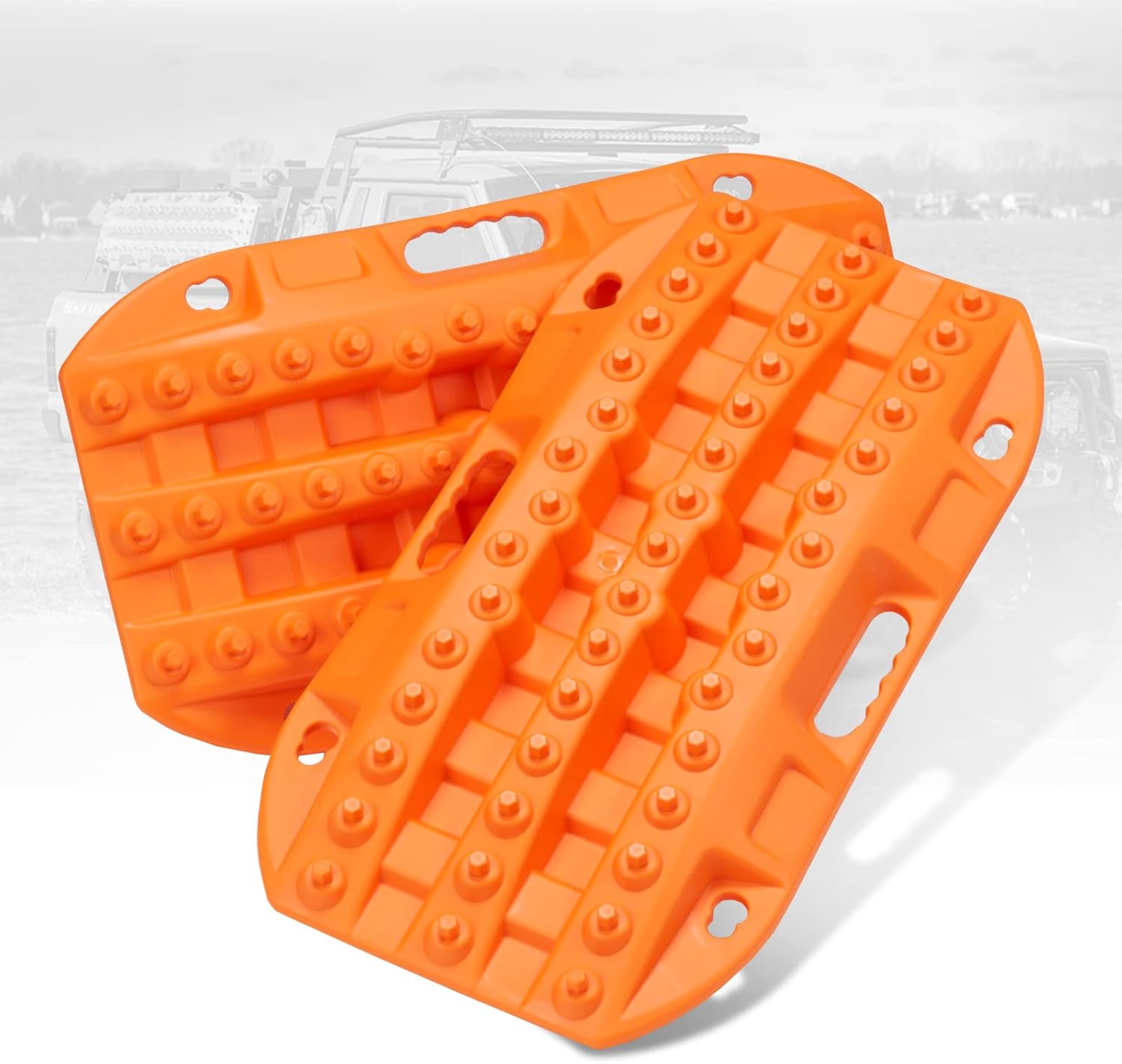
These short off-road traction boards are designed to help ATV and UTV drivers recover from mud, sand, and snow with added convenience and portability. Built with strengthened teeth and a stable bottom channel design, they help prevent wheel slip and improve traction in tough terrain. Made from durable automotive-grade polypropylene, they are lightweight, easy to clean, and suited for year-round use in extreme temperatures. Built-in shovels, ergonomic handles, and nesting storage make them practical for compact vehicle setups.

These X-BULL recovery traction tracks help drivers get unstuck from sand, snow, mud, or ice with a stable U-shaped elastic design and a wavy ramp that makes tire entry easier. Built from reinforced nylon, they are flexible, impact-resistant, and designed to perform in extreme temperatures while providing reliable emergency traction for a wide range of vehicles.

BUNKER INDUST off-road traction boards help vehicles regain grip in mud, sand, and snow with a double-sided diamond array and cross-shaped teeth for improved bite and stability. Built from upgraded automotive-grade polypropylene, they resist UV damage, cold-weather brittleness, and wheel-spin heat while remaining flexible enough to handle demanding recovery situations. Contoured ramps, ergonomic handles, and multiple mounting points make them practical to use, store, and retrieve when adventure turns into recovery.
4H vs 4L Comparison Table
| Feature | 4H | 4L |
|---|---|---|
| Main purpose | Extra traction while maintaining speed | Maximum torque and low-speed control |
| Best terrain | Snow, gravel, dirt, sand, light mud | Rocks, steep hills, deep ruts, deep mud, hard pulling |
| Speed | Moderate to normal speeds, within manual limits | Slow, controlled speeds only |
| Torque | Normal high-range gearing | Low-range gearing multiplies wheel torque |
| Typical shift method | Often shift-on-the-fly, depending on model | Usually stop, shift to Neutral, then engage 4L |
| Avoid using for | Dry pavement in many part-time systems | High-speed driving, dry pavement, normal road travel |
What 4L Does: Torque, Limits, and Best Terrain
The 4L setting, also called four-wheel drive low or low range, uses the transfer case to multiply torque at the wheels. That torque boost helps the vehicle move slowly without forcing the driver to use heavy throttle. The result is better control when traction is poor, the grade is steep, or the tires need to crawl over obstacles.
Use 4L for controlled, technical driving where torque matters more than speed. Toyota describes 4L as the setting for maximum power and traction, including climbing or descending steep hills, off-road driving, and hard pulling in sand, mud, or deep snow. Exact wording and operation vary by vehicle, but the principle is the same: 4L is for slow work.
- Use 4L for steep climbs, steep descents, deep ruts, rocks, and boulder fields.
- Use 4L when you need controlled pulling at low speed, such as a slippery boat ramp or heavy off-road load.
- Shift into 4L only by the method in your owner’s manual; many systems require a complete stop and Neutral.
- Stay slow and smooth. Fast driving in 4L can reduce control and strain the drivetrain.
- Avoid 4L on dry, high-traction pavement unless the manual specifically allows it.
Pro Tip: In 4L, use gentle throttle and let the low gearing do the work. Spinning the tires usually digs holes, breaks traction, and makes recovery harder.
[Products Worth Considering]

These off-road traction boards are designed to help vehicles recover from mud, sand, and snow with reliable grip and easier ramp-up. Their double-sided diamond construction, cross-shaped teeth, and contoured ramps improve traction while the durable polypropylene build stays flexible in harsh conditions. Convenient mounting points, ergonomic handles, and a visible leash make them practical to carry, store, and retrieve when recovery is needed.

This recovery tow strap kit is built for dependable vehicle recovery and towing in demanding conditions. The heavy-duty strap features fortified reinforced loops and high break strength for secure pulls, while the included D-ring shackles add versatility and reliable connection options. Designed for trucks, SUVs, ATVs, UTVs, and boats, it also includes protective isolators and a storage bag for safer, quieter transport and easy organization.
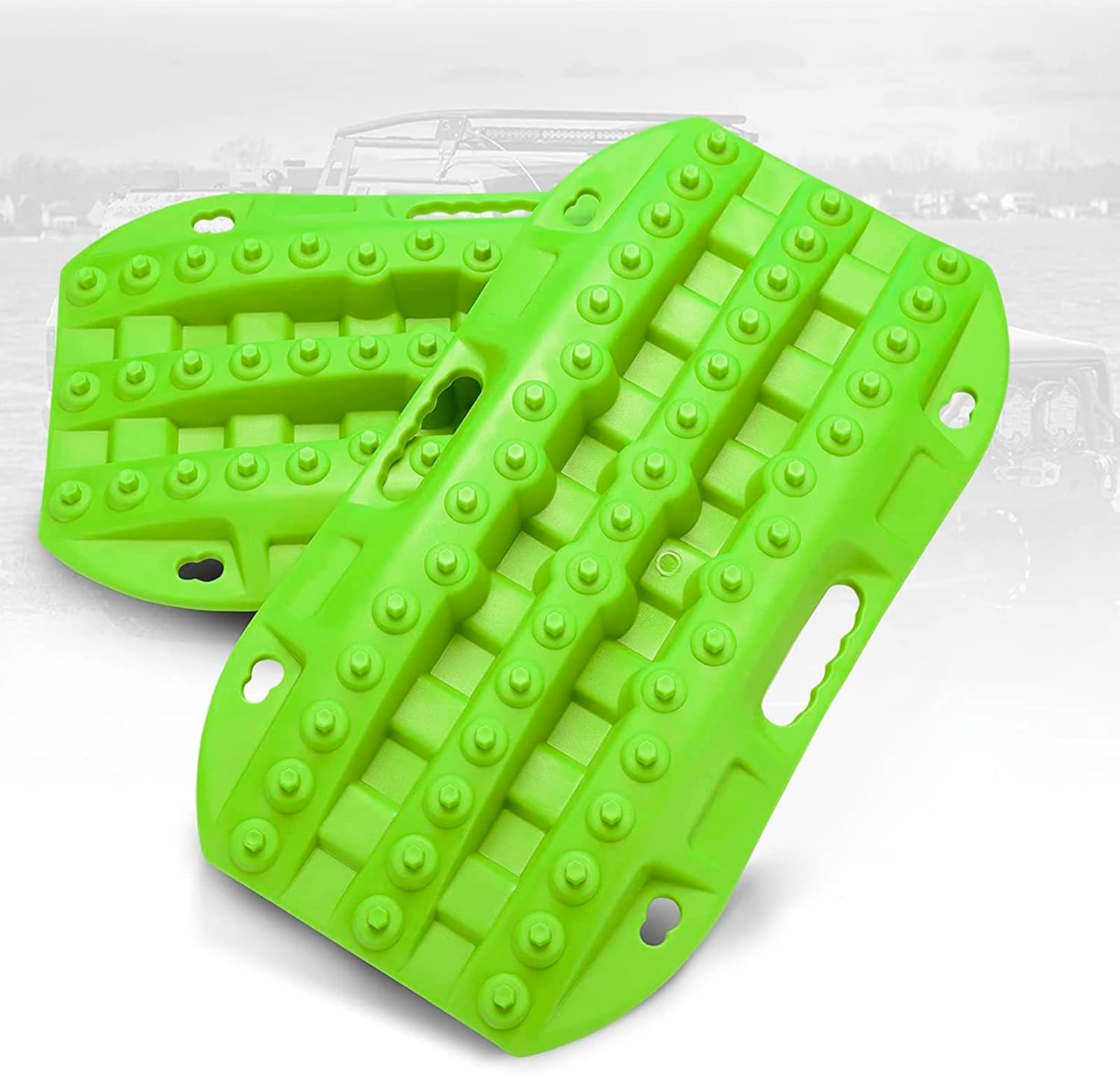
These short recovery traction boards are designed to help ATVs, UTVs, and other off-road vehicles regain grip in mud, sand, and snow. Built with strengthened teeth and a durable polypropylene construction, they provide reliable traction, easy handling, and year-round performance in tough conditions. Their nested, space-saving design and integrated shovels make them practical for carrying and using on remote adventures.
What 4H Does: Traction, Speed Range, and Common Uses
Where 4L slows the vehicle down for torque and control, 4H gives you four-wheel traction while keeping the transfer case in high range. That means the vehicle can move at normal or moderate speeds while sending power to both axles.
Use 4H on surfaces where the tires can slip slightly, such as snow, gravel, dirt, sand, or muddy trails. It helps the vehicle keep momentum and reduces the chance that one axle will lose traction and stop the vehicle. 4H is often the best setting for routine winter roads and easy trail sections.
Many systems allow 4H engagement while moving, but the speed limit is not the same for every vehicle. Some owner’s manuals allow shifts into 4H at higher road speeds; others require slower speeds. If your vehicle has a lever, selector dial, buttons, 4A mode, locking hubs, or a center differential lock, read the manual before assuming the shift method.
4H vs 4L: Torque, Gear Ratios, and Drivetrain Impact
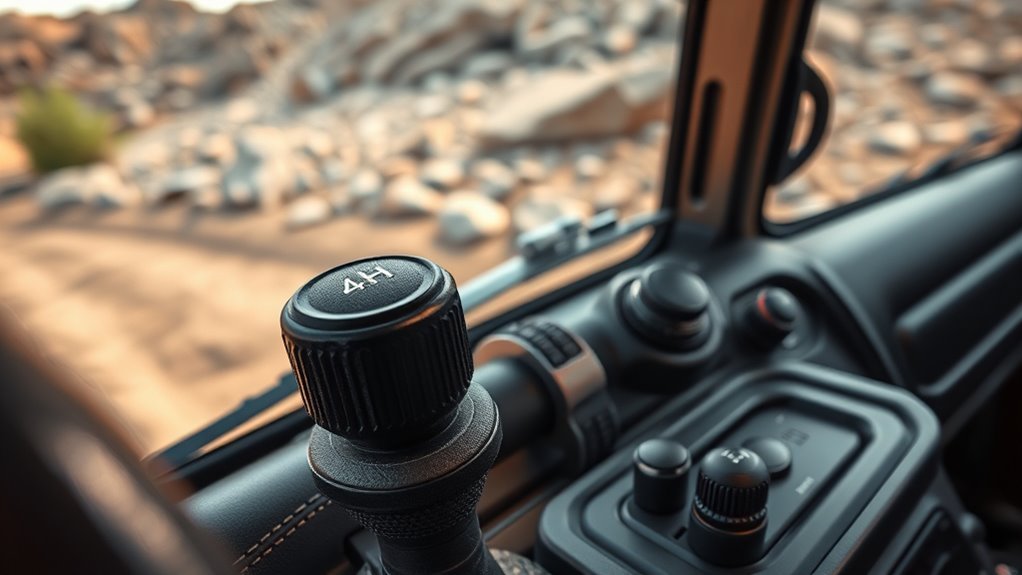
Both 4H and 4L can send power to all four wheels, but they do it through different gearing. In 4H, the transfer case stays in high range, so the vehicle feels closer to normal driving. In 4L, the transfer case shifts into a lower gear range, which multiplies torque and slows the vehicle’s response.
That gearing difference affects the drivetrain. 4H is usually easier on the vehicle at travel speeds because it does not multiply torque as aggressively. 4L gives far more control at low speed, but it also increases driveline load if used incorrectly. That is why 4L should be reserved for slow, deliberate driving.
Part-time 4WD systems deserve special care. When the front and rear axles are locked together on dry pavement, the tires may not be able to slip enough to relieve driveline stress. This can cause binding, hopping, hard steering, and wear. Full-time 4WD and AWD-style systems may work differently because they can include a center differential or automatic clutch system.
Note: If your vehicle has 4A or Auto 4WD, that setting may be designed for changing conditions where pavement alternates between dry, wet, icy, and snowy. It is not the same as locked 4H on a traditional part-time system.
Real-World Scenarios: Snow, Mud, Hills, and Towing
When you face snow, mud, steep grades, or heavy towing, pick the mode based on the surface, speed, and load.
[Products Worth Considering]

This adjustable tri-ball trailer hitch gives you flexible towing support with three hitch ball sizes and a 4.5-inch rise and drop for level hauling across different vehicles and trailers. Built for durability and convenience, it includes a tow hook, D-ring shackle, and a secure locking system for dependable towing, recovery, and off-road versatility.

Built for towing, winching, and off-road recovery, this D-ring shackle set delivers dependable strength in a compact, easy-to-use design. The drop-forged steel construction and protective coated finish help provide reliable performance and resistance to rust in demanding outdoor conditions. Compatible with Jeeps, ATVs, UTVs, trucks, trailers, and SUVs, it is a practical recovery accessory for everyday trail and rescue use.

This 2-piece suspension tool set combines a compact strut spreader with a high-leverage lower control arm prying tool to help speed up safe suspension service. Designed for many FWD, import, and domestic vehicles, it supports strut, hub, ball joint, and control arm work while helping reduce the risk of damage to surrounding components. Heavy-duty steel construction makes it a dependable choice for mechanics and serious DIY suspension repair.
Snow and Ice
Use 4H for most snowy roads because it gives extra traction while letting you maintain safe road speed. Use 4L only for very slow work, such as crawling through deep drifts, climbing a steep snowy track, or easing down a slippery grade.
Mud and Ruts
Use 4H for shallow mud or trails where momentum helps. Use 4L when the mud is deep, the ruts are steep, or you need careful wheel placement. If the tires are spinning fast, stop and reassess instead of adding more throttle.
Steep Climbs and Descents
Use 4L for steep climbs because the low gearing gives the tires more controlled torque. Use 4L for steep descents because it can improve engine braking and reduce overuse of the brake pedal. Use 4H for gentler grades where traction is the main issue and speed remains moderate.
Towing and Pulling
Use 4H for traction when towing on loose or slippery surfaces at normal low-to-moderate speeds. Use 4L only for low-speed pulling, such as moving a trailer up a steep dirt slope, pulling out of deep sand, or easing a boat up a slick ramp. Do not use 4L for highway towing.
Rock Crawling and Obstacles
Use 4L for rocks, ledges, washouts, and boulder fields. The goal is slow tire placement, not wheel speed. Keep your thumbs out of the inside of the steering wheel, use a spotter when needed, and avoid sudden throttle inputs.
How to Switch Between 4H and 4L Safely
Before shifting, check your owner’s manual. The steps below are common, but they are not universal.
- For 2H to 4H: Reduce speed to the manual’s limit, keep the wheels as straight as practical, and select 4H. Wait for the 4H indicator to confirm engagement.
- For 4H to 4L: Bring the vehicle to a complete stop unless your manual says otherwise.
- Shift the transmission to Neutral: This helps the transfer case complete the range shift in many vehicles.
- Select 4L: Use steady pressure on the lever, dial, or button. A light clunk may be normal.
- Wait for confirmation: Check the dash indicator before driving.
- Drive slowly: Use smooth throttle and braking. Do not use 4L for road-speed driving.
If 4L will not engage, do not force the lever or repeatedly stab the throttle. Some systems need the gear teeth to line up. A common manual procedure is to move the vehicle slightly, return to Neutral, and try the shift again. If warning lights remain on or the shift still fails, stop and inspect the manual before continuing.
Part-Time 4WD vs Full-Time 4WD: Why It Matters
The right 4WD mode depends on the type of system your vehicle has.
- Part-time 4WD: Usually has 2H, 4H, Neutral, and 4L. It is made for loose or slippery surfaces, not dry pavement, unless the manual says otherwise.
- Full-time 4WD: Can often drive all four wheels on pavement because it uses a center differential or similar system.
- 4A or Auto 4WD: Automatically sends power to the front axle when needed. It can be useful in mixed conditions.
- Center differential lock: Locks front and rear speed difference on some full-time systems. Use it only where tire slip is possible.
- Axle differential lock: Locks left and right wheels on an axle. Use it only for severe traction loss and disengage it once clear.
If the steering feels tight, the vehicle hops in turns, or the drivetrain feels wound up on pavement, you may be in the wrong locked mode for the surface.
Common Mistakes and Quick 4WD Safety Tips
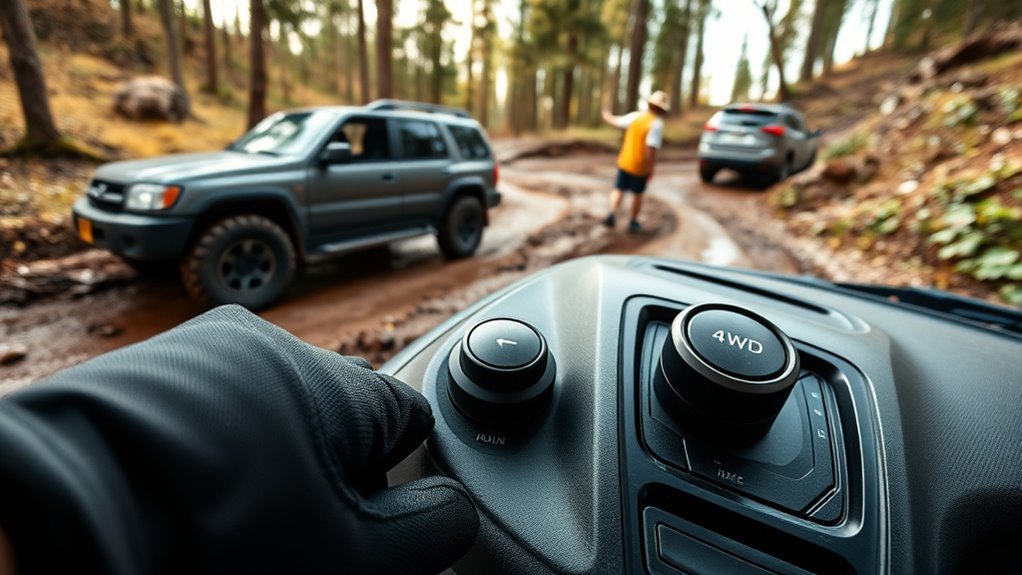
Most 4WD problems come from using the right mode at the wrong time or shifting too quickly. Avoid these common mistakes:
- Driving fast in 4L: 4L is for slow torque and control, not speed.
- Using locked 4WD on dry pavement: Many part-time systems can bind on high-traction surfaces.
- Waiting too long to shift: Select 4H before the road becomes slick, and select 4L before the obstacle, not halfway through it.
- Using throttle instead of traction: Spinning tires can make mud, snow, or sand worse.
- Ignoring tires: Mismatched sizes, low pressure on pavement, or overinflated tires off-road can reduce traction and stress the system.
- Forgetting recovery gear: Carry a rated recovery strap, gloves, shovel, tire gauge, compressor, and recovery boards when off-roading.
Warning: Never attach a recovery strap to a tow ball, bumper cover, suspension arm, or unknown tie-down point. Use rated recovery points and keep people clear of the recovery line.
Frequently Asked Questions
What is the difference between 4H and 4L?
4H uses high-range gearing for extra traction at normal or moderate speeds. 4L uses low-range gearing to multiply torque for slow, controlled driving on steep, rough, stuck, or heavy-pulling terrain.
Should I use 4H or 4L in snow?
Use 4H for most snowy roads because it improves traction while allowing safe travel speed. Use 4L only for slow situations such as deep snow, steep climbs, controlled descents, or getting unstuck.
Can I drive in 4H on dry pavement?
Not in many part-time 4WD systems. Dry pavement can cause driveline binding because the tires cannot slip enough to release stress. Full-time 4WD, AWD, and some Auto 4WD systems may be different, so check your owner’s manual.
Do I need to stop before shifting into 4L?
Usually, yes. Many vehicles require a complete stop, transmission in Neutral, and a deliberate shift into 4L. Some systems have special procedures, so follow the exact instructions in your manual.
When should I use diff lock with 4H or 4L?
Use a differential lock only when wheel slip is severe and you need both wheels on an axle, or both axles through a center lock, to turn together. Use it slowly, avoid tight turns on high-traction surfaces, and turn it off once traction improves.
Is 4L better for towing?
4L can help with low-speed pulling, such as a steep dirt driveway, boat ramp, sand, mud, or recovery situation. It is not for highway towing. For normal towing speeds, use the mode recommended by your owner’s manual.
Conclusion
Use 4H when the surface is slippery or loose but you still need normal or moderate speed. Use 4L when the vehicle needs slow torque, careful wheel control, and maximum pulling power. Snowy roads, gravel, and light trails usually call for 4H. Rocks, deep mud, steep grades, stuck vehicles, and low-speed heavy pulling usually call for 4L.
The most important rule is simple: match the mode to the surface and the speed. Then confirm the exact shift procedure in your owner’s manual, because 4WD systems vary widely between brands, models, and trim levels.
Sources
- Toyota 2025 4Runner Hybrid Owner’s Manual: Four-Wheel Drive System — backs 4H shift-speed example and 4L use for maximum power and traction.
- Ford Service Content: Using Four-Wheel Drive — backs model-specific range-shift behavior and Neutral/range-shift caution.
- Ford Owner Manuals Portal — supports checking the exact manual for model-specific 4WD procedures.
- Toyota 4Runner Full-Time 4WD System Reference — backs the distinction between normal high-range driving and locked modes for slippery/off-road surfaces.


[…] to the transfer case’s low-range four-wheel-drive mode. A steady 4LO or L4 light usually means low range is engaged. A blinking light can be normal while the system is shifting, but if it keeps blinking, […]
[…] by brake-based traction control, while off-road trims may add a selectable rear locker. Full-time 4WD models may use a center differential or center-locking system to manage front-to-rear torque, not to lock […]