If your Toyota Camry’s washer fluid is not spraying, the cause is usually simple: low fluid, frozen fluid, a blown fuse, a weak washer pump, a disconnected hose, or clogged nozzles. Start with the easy checks before replacing parts. Also, use the fuse chart for your exact Camry model year because fuse locations and ratings can vary.
Quick Answer
If your Camry washer fluid will not spray, check the fluid level first, then look for frozen fluid, listen for the washer pump, inspect the fuse, follow the hoses for leaks or disconnections, and check the nozzles. Do not keep running the washer switch when the tank is empty.
Key Takeaways
- Both nozzles failing at the same time usually points to fluid level, frozen fluid, fuse, pump power, or a disconnected main hose.
- One weak or uneven nozzle usually points to a clogged nozzle, kinked hose, or damaged nozzle line.
- Always confirm fuse location and amperage in your exact Camry owner’s manual or fuse-box cover.
- Avoid poking washer nozzles with pins or hard objects, because the nozzle opening can be damaged.
At a Glance
| Time Required | 10–30 minutes for diagnosis; longer if the pump must be replaced |
| Difficulty | Easy for fluid, fuse, hose, and nozzle checks; moderate for pump replacement |
| Tools Needed | Washer fluid, flashlight, owner’s manual, fuse puller or needle-nose pliers, paper towels, small funnel, and optional multimeter |
| Cost | Low for washer fluid or a fuse; varies if a pump, nozzle, hose, or shop diagnosis is needed |
Identifying Common Washer Fluid Problems
When your Camry’s washer fluid is not spraying, work from the easiest and cheapest checks to the more involved ones. This saves time and helps you avoid replacing a good washer pump by mistake.
| Symptom | Most Likely Cause | First Check |
|---|---|---|
| No sound and no spray | Empty tank, blown fuse, bad pump, or wiring issue | Check fluid, fuse, and pump connector |
| Pump hums but no fluid sprays | Frozen fluid, clogged hose, disconnected hose, or blocked nozzle | Inspect hoses and nozzles |
| Only one nozzle sprays | Clogged nozzle or kinked branch hose | Check that nozzle and its hose |
| Fluid leaks under the bumper or wheel area | Cracked reservoir, loose pump grommet, or disconnected hose | Look for wet spots and washer-fluid smell |
Warning: Do not hold the washer switch down repeatedly if the reservoir is empty. Toyota warns that operating the washer switch continually with an empty tank can overheat the washer fluid pump.
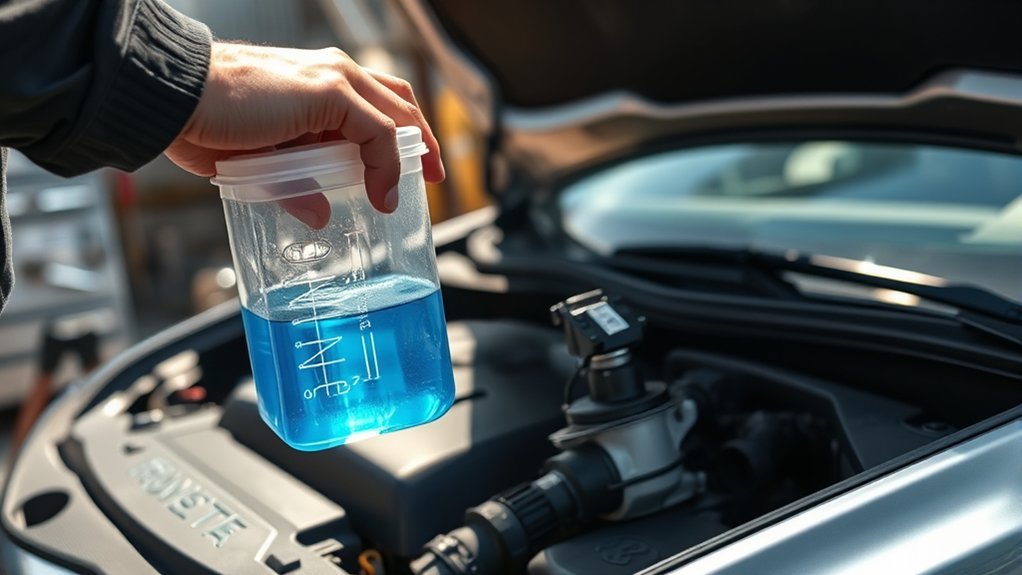
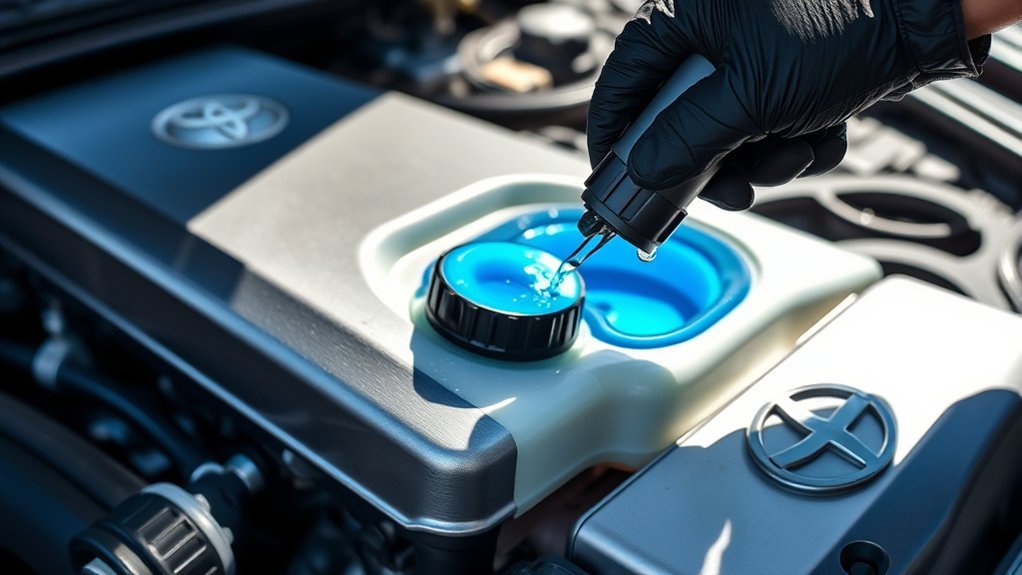
Start by checking the reservoir. If it is empty, refill it with the right windshield washer fluid and test the system briefly. If the reservoir is full, listen for the washer pump when you pull the washer lever. A humming sound means the pump is trying to work, so the issue may be frozen fluid, a hose leak, or clogged nozzles. Silence usually points to a fuse, wiring, switch, or pump problem.
How to Check Your Washer Fuse
A blown fuse can stop the washer pump from running. The important part is this: do not rely on a universal fuse-slot description for every Camry. Fuse-box layouts can vary by year and trim, so check your fuse-box cover or the Toyota owner’s manual for your exact vehicle.
- Turn the vehicle off before opening the fuse box.
- Find the washer-related fuse using the fuse-box cover or owner’s manual.
- Use the fuse puller or a suitable small tool to remove the fuse carefully.
- Inspect the metal strip inside the fuse. If it is broken, the fuse is blown.
- Replace it only with a fuse of the same amperage rating shown for your Camry.
- Test the washer briefly after replacement.
Note: If the new fuse blows again, do not keep replacing it. A repeated blown fuse can mean a shorted pump, damaged wiring, or another electrical fault that needs proper diagnosis.
[Products Worth Considering]

[Easy to Use]: Thin tips and offset handles allow for easier use than traditional pliers. The clamp head is convenient for entering and leaving a small space Where human hands and other tools cannot reach, And is not easy to damage the relays and Fuses.𝐏𝐥𝐞𝐚𝐬𝐞 𝐛𝐮𝐲 𝐛𝐲 𝐋𝐙𝐋𝐈𝐍𝐘𝐉𝐋𝐎𝐍𝐆 𝐬𝐭𝐨𝐫𝐞.

【Quality Material】:This car fuse puller is made of high-quality plastic ABS, which is lightweight and flexible, strong and wear-resistant, not easy to break, and can be used stably for a long time.

🎚️【Clip to Take Easily】 This automotive fuse puller pliers are small but no loss of design, blue PVC shell, simple and fashionable, wrapped in the handle, non-slip and wear-resistant, slim tip with curved hook design, more convenient for us to go deep into the small space to take out the relays and fuses, saving time for maintenance!
Diagnosing a Faulty Washer Pump
The washer pump pushes fluid from the reservoir through the hoses and out of the nozzles. Before replacing it, confirm that fluid can reach the pump, power can reach the pump, and the hoses are not blocked or disconnected.
[Products Worth Considering]

Fitment: Replacement for Toyota Prius 2004-2014 Camry 2007-2017 FJ Cruiser 2007-2014 Corolla 2009-2016 Highlander 2004-2013 Sienna 2004-2014, Lexus ES350 2007-2014, Ford Fusion 2006-2016 and more other car models

💦 Buyer's Guide: If you buy it you will receive 1pcs 12V windshield washer pump with size 3.04*1.14*0.76 inch and 1pcs rubber grommet. OEM#85330-60190, 85330-AE010, 85330-60180, 85330-21010. Please check the OEM number and compatible models carefully before you place an order to avoid not working properly after purchase.

【Function】A ABIGAIL Windshield Washer Pumps provide pressure that enables pumps fluid from washer fluid reservoir, through the washer nozzle, onto your windshield to help wash away dirt.
Common Symptoms to Identify
A faulty washer pump often shows up as no pump sound, no spray from either nozzle, or weak flow even when the reservoir is full. But those symptoms can also come from a blown fuse, frozen fluid, loose connector, cracked reservoir, leaking grommet, or disconnected hose.
- No pump noise: check the fuse, connector, and pump power.
- Pump noise but no spray: check for frozen fluid, blocked hoses, and clogged nozzles.
- Fluid dripping under the car: inspect the reservoir, pump seal, and lower hose connection.
- Weak spray: check for low fluid, dirty nozzle openings, kinked hoses, or a tired pump.
Checking Electrical Connections
Inspect the washer pump connector for looseness, corrosion, broken locking tabs, or damaged wires. A loose connector can prevent the pump from operating even when the fuse is good.
| Step | Action |
|---|---|
| 1 | Confirm the vehicle is off before touching the connector. |
| 2 | Look for corrosion, broken plastic, loose pins, or damaged wiring. |
| 3 | Reconnect the plug firmly until it seats securely. |
| 4 | If you are comfortable using a multimeter, check for voltage at the connector while someone briefly activates the washer switch. |
| 5 | If voltage is present but the pump does not run, the pump is likely faulty. If voltage is not present, the issue may be upstream in the fuse, switch, relay, or wiring. |
Testing Washer Fluid Flow
To test fluid flow, fill the reservoir, activate the washer briefly, and watch the hoses. If the pump runs but no fluid reaches the windshield, disconnecting the outlet hose at the pump or a nearby joint can help confirm whether fluid is leaving the pump. Have a towel ready because fluid may spill.
Pro Tip: If the pump works only after the car warms up or after the reservoir thaws, the problem was likely frozen fluid, not a failed pump.
Check for Frozen Washer Fluid
Cold weather can make washer fluid problems look like a bad pump. If summer fluid, plain water, or diluted fluid freezes in the reservoir or hoses, the pump may hum but nothing sprays.
- Park the Camry in a warm garage or sunny spot and let the reservoir and hoses thaw naturally.
- Do not pour boiling water on plastic parts, glass, or nozzles.
- Once thawed, spray briefly to move fluid through the system.
- Refill with washer fluid rated for your local winter temperatures.
- If the pump ran for a long time while frozen, retest later because the pump may have overheated or weakened.
Use real windshield washer fluid rather than plain water for normal driving. Washer fluid helps clean road film and, in winter formulas, helps reduce freezing risk. Store it safely because many washer fluids contain methanol, which is poisonous if swallowed.
Inspect Hoses, Leaks, and Nozzles
If the pump runs but spray is weak or missing, follow the washer hoses from the reservoir toward the hood. Look for loose fittings, split rubber, kinked lines, disconnected tee fittings, or fluid pooling under the front bumper or wheel-well area.
- Disconnected hose: reconnect it and test again.
- Cracked hose: replace the damaged section with washer-rated hose.
- Leaking pump grommet: replace the rubber seal where the pump enters the reservoir.
- Blocked tee or check valve: clean or replace the small plastic fitting if fluid reaches it but does not pass through.
- Dirty nozzle surface: wipe around the nozzle opening with warm water and a soft cloth.
Warning: Do not force a pin, needle, or hard object into a washer nozzle. Toyota cautions that blocked nozzles can be damaged by trying to clear them with a pin or other object.
Step-by-Step Guide to Replacing Your Washer Pump
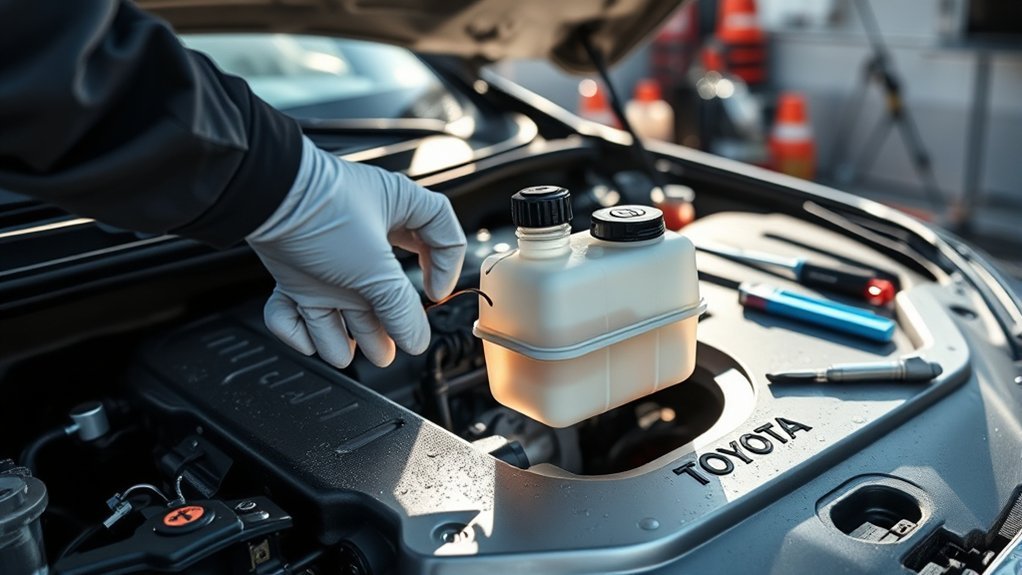
Replace the washer pump only after you have confirmed the reservoir has fluid, the fuse is good, the connector is secure, and the hoses/nozzles are not blocked. On many Camry model years, the pump is mounted low on the washer reservoir and may be accessed through the front wheel-well splash shield, but the exact access point can vary.
- Confirm the correct replacement pump for your Camry’s year, engine, and body style.
- Park on a flat surface, turn the vehicle off, and let the area cool.
- Turn the front wheels for access if the pump is behind the wheel-well liner.
- Remove the needed clips or screws from the splash shield carefully.
- Place a drain pan or towels under the reservoir because washer fluid may spill.
- Disconnect the electrical connector from the old pump.
- Disconnect the washer hose and remove the pump from the reservoir grommet.
- Inspect the grommet and replace it if it is hard, cracked, loose, or leaking.
- Install the new pump, reconnect the hose, and reconnect the electrical plug securely.
- Refill the reservoir, check for leaks, and test the washer system briefly.
If the pump is hard to reach, the connector does not match, or the washer system still does not work after replacement, stop and use a service manual or a qualified technician. Guessing at wiring or forcing a connector can create a bigger repair.
[Products Worth Considering]

Exact Fit for Specific Vehicles - Compatible for Toyota RAV4 2000-2005, for Toyota Echo 2000-2005, for Toyota Sienna 1998-2003, for Toyota Solara 1999-2008, for Toyota Corolla 2003-2008, for Toyota Celica 2003-2005, for Toyota Tundra 2000-2006, for Toyota Matrix 2003-2008, for Toyota Camry 1992-2006, for Toyota 4Runner 1992-2002, for Toyota Land Cruiser 1998-2007. Full compatibility list available in "Technical Details". Verify your vehicle's make, model, year, and OE reference number (OE# 85330-02020 ) before purchase.
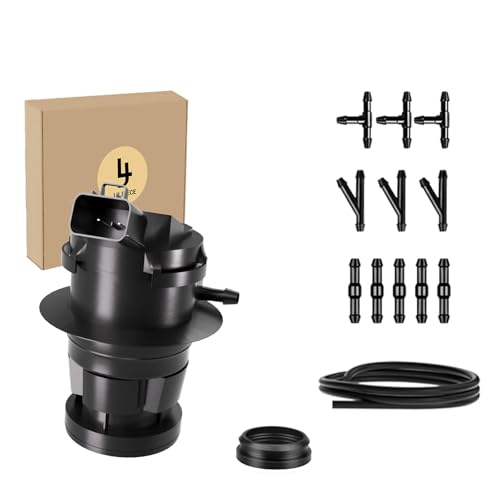
Compatible with: Replacement for 2004-2011 Toyota Prius, 2007-2017 Toyota Camry, 2007-2014 Toyota FJ Cruiser, 2009-2016 Toyota Corolla,2006-2016 Ford Fusion, 2007-2014 Lexus Es350

【Replacement Part Number】 The windshield washer pump replacement OEM#85330-60190, 85330-60180, 85330-AE010, 85330-21010. Its size is 3.03x1.54 inch. Before purchasing, please carefully check the OEM number and compatible car model of the product to avoid any incompatibility.
Ensuring Proper Electrical Connections for the New Pump
After installing a new pump, the electrical connector must be fully seated. A pump that is new but not connected correctly will act like a failed pump.
- Make sure the connector is clean and dry before reconnecting it.
- Confirm the plug clicks or seats firmly without forcing it.
- Route wiring away from sharp edges, moving parts, and the tire area.
- Check that the splash shield is reinstalled so road spray does not soak the connector.
If the old connector is melted, corroded, or loose, replacing the pump alone may not fix the problem. The connector or wiring may need repair.
How to Properly Test Your Washer System After Replacement
After replacing the pump, hose, fuse, or nozzle, test the washer system in short bursts. Do not hold the washer switch for a long time.
- Fill the reservoir with the correct washer fluid.
- Look under the reservoir and pump area for leaks.
- Pull the washer lever briefly and listen for smooth pump operation.
- Confirm both windshield nozzles spray evenly.
- Check the hose route again if the pump runs but spray is weak.
- Reinstall any clips, splash shields, and covers that were removed.
A strong, even spray from both nozzles usually means the repair worked. If the spray is still uneven, the nozzle angle, branch hose, or check valve may still need attention.
How to Keep Your Washer System Running Smoothly
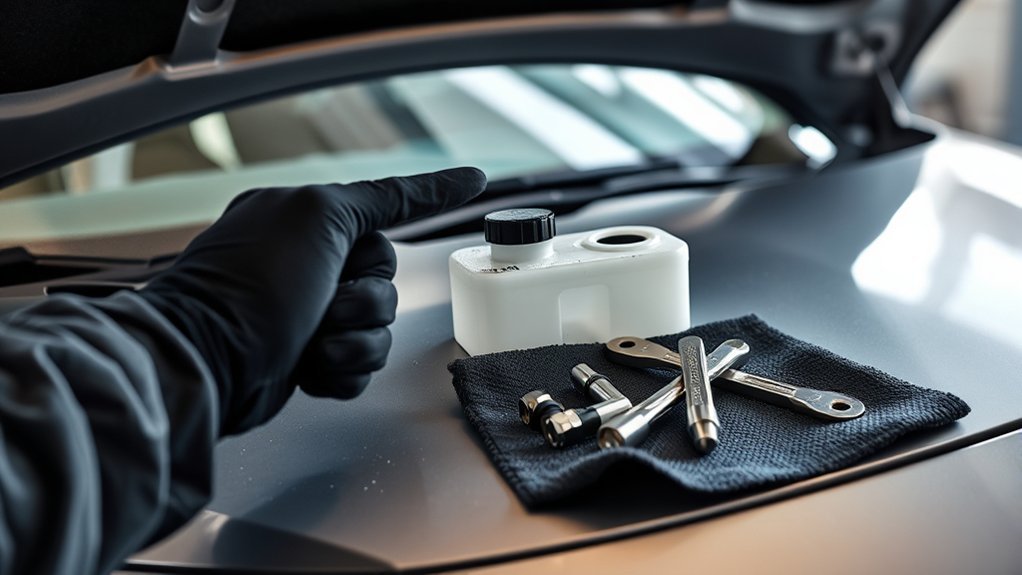
Basic maintenance can prevent most washer-fluid problems. Check the fluid level monthly, top it off before long trips, and switch to winter-rated washer fluid before freezing weather arrives.
- Use the right fluid: choose washer fluid suited to your weather, especially in freezing temperatures.
- Keep the reservoir clean: avoid pouring dirty or mixed fluid into the tank.
- Watch for leaks: a sudden drop in fluid level usually means a cracked hose, loose pump seal, or damaged reservoir.
- Clean around nozzles: wipe away wax, dirt, and road grime from the nozzle area.
- Test before storms: check the washer system before winter driving or a long highway trip.
Note: Windshield washer fluid can contain methanol. Keep it in the original container, close the cap tightly, and store it away from children and pets.
Troubleshooting Persistent Washer Problems?
If your Camry washer fluid still will not spray after the basic checks, narrow the problem by separating electrical issues from fluid-flow issues.
Check Electrical Connections
If there is no pump sound, focus on the electrical side. Recheck the fuse, the pump connector, and the visible wiring near the reservoir. If a multimeter shows power and ground at the pump connector but the pump does not run, the pump is likely bad. If there is no power at the connector, the issue may be in the switch, fuse circuit, relay, body control wiring, or harness.
Inspect Washer Fluid Level
Even a small amount of fluid at the bottom of the reservoir may not be enough if the car is parked on a slope or the pump inlet is uncovered. Fill the tank and test again briefly. If the fluid disappears quickly, look for leaks around the pump grommet, reservoir seam, lower hose, and wheel-well area.
Know When to Call a Professional
Stop DIY troubleshooting and call a Toyota dealer or qualified mechanic if the fuse keeps blowing, wiring is damaged, the nozzle remains blocked after gentle cleaning, the pump access requires removing parts you are not comfortable removing, or the washer system still fails after a confirmed pump replacement.
Frequently Asked Questions
How often should I check my Camry washer fluid level?
Check it about once a month, before long trips, and before freezing weather. Also check it anytime the spray becomes weak, uneven, or delayed.
Can I use plain water instead of washer fluid?
Plain water may work briefly in mild weather, but it does not clean road film as well and can freeze in cold temperatures. Use proper windshield washer fluid, especially in winter.
What type of washer fluid is best for my Camry?
Use a quality windshield washer fluid rated for your climate. In freezing weather, choose a winter-rated formula. In warm weather, a standard washer fluid or bug-removing formula is usually suitable.
Are there seasonal considerations for washer fluid use?
Yes. Winter driving needs freeze-resistant washer fluid. Summer driving may need fluid that removes bugs, pollen, and road grime. Avoid leaving plain water in the system before a freeze.
How can I tell if the washer nozzles are clogged?
If the pump runs and fluid reaches the hood area but one nozzle has no spray or a weak spray pattern, that nozzle or its branch hose may be clogged. Clean around the nozzle gently, but do not push a pin into the opening.
Why did both washer nozzles stop working at the same time?
When both nozzles stop at once, the issue is usually shared by the whole system: low fluid, frozen fluid, a blown fuse, a bad pump, a disconnected main hose, or a wiring problem.
Conclusion
A Camry washer fluid problem is easiest to solve when you diagnose it in order: fluid level, frozen fluid, fuse, pump sound, hoses, leaks, and nozzles. Avoid universal fuse-location advice, do not run the pump continuously when the tank is empty, and do not poke blocked nozzles with pins. With careful checks, many washer problems can be fixed quickly and safely.
Sources
- Toyota Owners: 2025 Camry Hybrid windshield wipers and washer — washer operation cautions, empty-tank pump warning, and blocked-nozzle warning
- Toyota Owners: checking and replacing fuses — fuse inspection and same-amperage replacement guidance
- Toyota Owners: manuals and warranties — model-specific Toyota owner’s manual access
- Poison Control: windshield washer fluid — methanol safety and storage guidance
- MedlinePlus: windshield washer fluid poisoning — methanol toxicity information