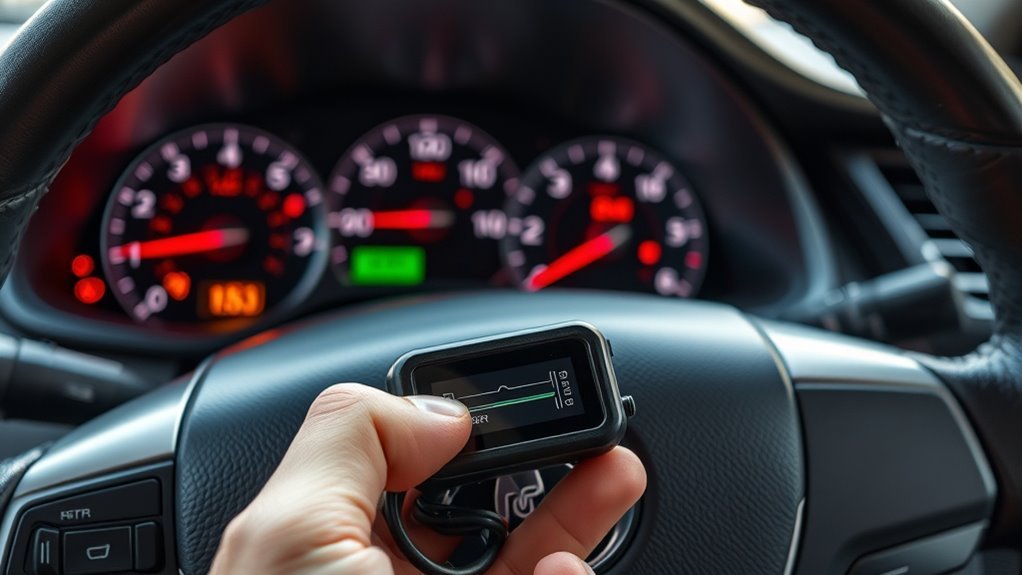
If your Camry Hybrid’s MPG drops, the gasoline engine runs more often, or you see a “Check hybrid system” light, you’re likely facing battery degradation and should get diagnostics. You may also notice erratic state-of-charge displays, delayed throttle response, reduced regenerative braking, or frequent engine-on time at low speeds. Do a visual battery check and monitor fuel use, then consult a certified hybrid technician for module testing and costed repair versus replacement options—keep going to learn recommended next steps.
3-Minute Checklist: Is Your Camry Hybrid Battery Failing?

Wondering whether your Camry Hybrid’s battery is on its last legs? Start a focused, minute checklist: monitor fuel economy for any sustained drop in MPG, since reduced efficiency often correlates with shrinking battery lifespan. Check the dash for a “check hybrid system” warning and treat it as an immediate diagnostic trigger. Observe charging behavior during routine drives—erratic state-of-charge swings indicate aging cells. Note increased reliance on the gasoline engine or abrupt changes in acceleration; these are performance indicators linked to battery degradation. Use these maintenance tips: log MPG and charge patterns weekly, scan for fault codes with an OBD-II hybrid-capable reader, and schedule a professional hybrid-system inspection when anomalies appear. Budget proactively for replacement costs to avoid compounding failures. You’ll preserve mobility and autonomy by acting on data quickly, keeping control over repairs and timeline rather than letting a failing battery dictate them.
Common Symptoms: Fuel Economy, Engine Use, and Sluggishness
Watch for a sustained reduction in fuel economy, as a hybrid battery that can’t hold charge forces the gasoline engine to run more and increases fill‑ups. You’ll also notice the engine running more frequently during low‑speed or stop‑and‑go conditions, which indicates the electric motor’s contribution has diminished. Finally, sluggish or delayed acceleration under throttle input signals the battery isn’t supplying adequate assist, degrading overall performance.
Reduced Fuel Economy
If your Camry Hybrid suddenly starts consuming noticeably more gasoline, it likely means the hybrid battery is losing capacity and the gasoline engine is compensating, especially at low speeds; you’ll see MPG drop and more frequent trips to the pump as a direct result. You’ll notice sluggish acceleration and delayed throttle response as the battery fails to supply electric assist. Track MPG, driving conditions, and refill frequency to quantify decline. Early monitoring preserves battery lifespan and lets you apply targeted maintenance tips to defer replacement and regain control.
| Symptom | Emotional trigger |
|---|---|
| Falling MPG | Frustration |
| More refills | Constraint |
| Sluggish throttle | Impatience |
| Unexpected engine use | Urgency |
Increased Engine Runtime
A steady rise in engine-on time is one of the clearest indicators that your Camry Hybrid’s high-voltage battery is losing effectiveness; as the battery fails to supply sufficient electric torque, the gasoline engine runs more frequently and for longer durations to maintain performance. You’ll notice reduced engine efficiency and a measurable drop in MPG because the system shifts load to the internal combustion engine when battery output falls. Frequent engine activation during low-speed or electric-expected operation signals degraded battery capacity and a shortened battery lifespan. Monitor runtime patterns and fuel consumption metrics to confirm the trend. Acting early preserves mobility freedom and limits repair costs: document occurrences, compare to baseline efficiency, and consult a technician to assess cell imbalance or capacity fade.
Sluggish Acceleration Response
When your Camry Hybrid’s acceleration feels sluggish, it’s often because the high-voltage battery can’t provide the electric torque the control system expects, so the gasoline engine must fill the gap and you notice delayed throttle response. You’ll detect slower launch and delayed throttle mapping when battery performance degrades; the hybrid control module commands electric assist but gets reduced current, forcing more frequent ICE engagement. That shift lowers fuel economy and increases engine runtime during low-speed driving. You should run hybrid diagnostics to quantify state-of-charge variance, cell imbalance, and available power under load. Interpreting those results lets you reclaim driving freedom: replace the failing pack before performance loss constrains your mobility, restores responsive torque delivery, and optimizes fuel-efficiency outcomes.
Dashboard Warnings That Point to Your Camry Hybrid Battery
Watch the hybrid system warning closely—it’s your primary indicator that the hybrid battery or associated electronics may be malfunctioning. The battery charge indicator (battery symbol) will also illuminate when charging or health issues arise, and repeated check engine light activations often correlate with hybrid battery faults that require diagnostic scanning. Consult the owner’s manual for the exact meanings of these lights and seek prompt professional evaluation when they appear.
Hybrid System Warning
1 clear dashboard warning you shouldn’t ignore is the “check hybrid system” light, which signals that the hybrid battery or its control components need immediate diagnostic attention. When you see it, treat hybrid system maintenance as urgent: a simultaneous battery symbol or check engine light often indicates measurable battery performance issues requiring code retrieval with diagnostic tools. You should perform battery performance monitoring to identify voltage deviations, cell imbalances, or control module faults before they escalate. Diagnostics supply fault codes that pinpoint failing modules, sensor errors, or charging abnormalities so you can act decisively. Prompt intervention limits collateral damage, preserves system efficiency, and defends your autonomy by avoiding prolonged dependency on costly repairs or immobilization. Trust warnings and respond quickly.
Battery Charge Indicator
After you acknowledge a “check hybrid system” alert, the next dashboard cue to monitor is the battery charge indicator—the illuminated battery symbol often flags immediate hybrid-battery issues that need diagnosis. You should treat that symbol as a priority signal: it typically denotes poor battery performance or malfunctioning hybrid components that demand professional evaluation. If you notice frequent gasoline-engine engagement at low speeds or rapid swings in displayed charge levels, those are measurable signs the pack isn’t holding energy and charge maintenance is compromised. Consult the owner’s manual for exact icon definitions, then obtain diagnostic testing to quantify state-of-charge variability and cell imbalance. Acting promptly preserves drivetrain efficiency, minimizes fuel dependence, and restores the operational freedom you expect from your Camry hybrid.
Check Engine Light
While a steady check engine light can indicate many faults, you should treat it as a potential sign of hybrid-battery degradation when driving a Camry Hybrid. You’ll see a “check hybrid system” warning if the battery or related components falter; don’t dismiss it. Persistent illumination often reflects declining battery performance that disrupts the electric-gasoline synergy, reducing responsiveness and increasing fuel use. Use diagnostic tools promptly to read specific error codes tied to the hybrid pack, inverter, or sensor failures. Consult the owner’s manual for light definitions, then act: schedule professional evaluation or service. Ignoring warnings limits your mobility and autonomy; addressing them early preserves efficiency and keeps you in command of your vehicle’s performance.
Erratic Charging and Regenerative Braking Signs

Erratic charging behavior—such as rapid fluctuations in displayed state-of-charge or repeated charging/discharging events during short trips and idle periods—usually indicates degraded hybrid battery cells or inconsistent energy storage, and you should treat it as a warning sign. You’ll notice inconsistent charging patterns that reflect declining battery health; these patterns undermine regenerative braking effectiveness and reduce the system’s ability to capture kinetic energy during deceleration. Monitor for sudden SOC swings, diminished brake energy recovery, and concurrent drops in fuel economy.
- Rapid state-of-charge oscillations during low-demand driving
- Reduced or absent regenerative braking feedback at deceleration
- Repeated charge/discharge cycles on short trips or idle
- Noticeable decline in fuel economy tied to charging irregularities
Act quickly: documenting these symptoms supports timely diagnostics and assertive maintenance. Prioritize professional assessment to confirm cell imbalance or degradation, and pursue repairs that restore efficient energy flow and preserve your vehicle’s autonomy and freedom of movement.
At-Home Checks Before Booking Service
Before booking service, you should perform a quick visual battery inspection for corrosion, loose connectors, or fluid leaks that could indicate failure. Monitor your fuel economy over several drives—a clear drop in MPG often correlates with hybrid battery degradation. Finally, note any dashboard warnings, particularly the “check hybrid system” light, and record conditions when they occur to provide technicians precise diagnostics.
Visual Battery Inspection
A quick visual check of your Camry’s hybrid battery can reveal early signs of trouble that warrant professional service. You’ll perform focused, at-home battery maintenance tips that save time and clarify inspection frequency: check the case for swelling, leakage, or corrosion; confirm terminals are clean and tight; scan wiring for discoloration or frays; and verify vents are unobstructed.
- Swelling, leakage, corrosion on the case
- Loose or dirty terminals and connectors
- Frayed wiring harness or discoloration
- Blocked cooling vents or unusual sounds
If you detect hissing, bubbling, or any damage, stop driving and book service. These observations are diagnostic prompts, not repairs; they empower you to demand thorough professional evaluation and safe resolution.
Monitor Fuel Economy
When you track your Camry Hybrid’s MPG regularly, you’ll spot meaningful declines that often point to battery degradation rather than engine issues. Monitor fuel economy with a fuel economy app or a manual log to create a baseline and detect deviations before trips. Note increased frequency of gas stops and higher consumption on short runs; those patterns suggest the battery isn’t holding charge and require battery maintenance attention. Watch for fluctuating MPG readouts—intermittent charging can show as inconsistent figures. These fuel efficiency tips let you separate fuel-system faults from hybrid-system decline so you can book service deliberately. If readings degrade consistently despite proper driving and tires, schedule professional evaluation of the hybrid battery.
Check Warning Lights
If you see the battery symbol or a “check hybrid system” light illuminate, don’t ignore it—these indicators often point directly to hybrid-battery issues and merit immediate at-home checks. You should perform a focused inspection: consult your owner’s manual for precise warning light meanings, scan the dashboard diagnostics with an OBD-II tool, and log any recurrent activations. That data empowers you to demand accurate repairs and avoid unnecessary replacements.
- Check owner’s manual for specific warning light meanings.
- Run dashboard diagnostics to retrieve error codes.
- Note frequency and driving conditions when lights occur.
- Escalate to a qualified hybrid specialist if alerts persist.
Act decisively and autonomously; early intervention protects your freedom from costly failures.
Mechanic Diagnostics for Camry Hybrid Battery: Codes, Load & Module Tests
Because hybrid systems are diagnostic-heavy, you’ll rely on specific codes, load tests, and module-level checks to determine a Camry battery’s health and required repairs. You use diagnostic tools to pull error codes that map to battery performance parameters—state of charge, voltage imbalance, and communication faults—so you can target interventions rather than guess. Load testing then verifies the pack’s ability to accept and deliver current under controlled conditions, revealing modules that can’t sustain rated output despite nominal voltages. Module testing isolates individual cells or submodules to quantify internal resistance, capacity variance, and thermal anomalies; this pinpoints failing segments that degrade overall pack function. Regularly scheduled diagnostics catch early degradation, enabling you to act before systems cascade into larger failures. Interpreting codes alongside load and module data gives you an evidence-based plan for maintenance, repair, or targeted module replacement, preserving mobility and autonomy while avoiding unnecessary full-pack disposal.
Camry Hybrid Battery: Repair vs. Replacement (Cost Ranges)
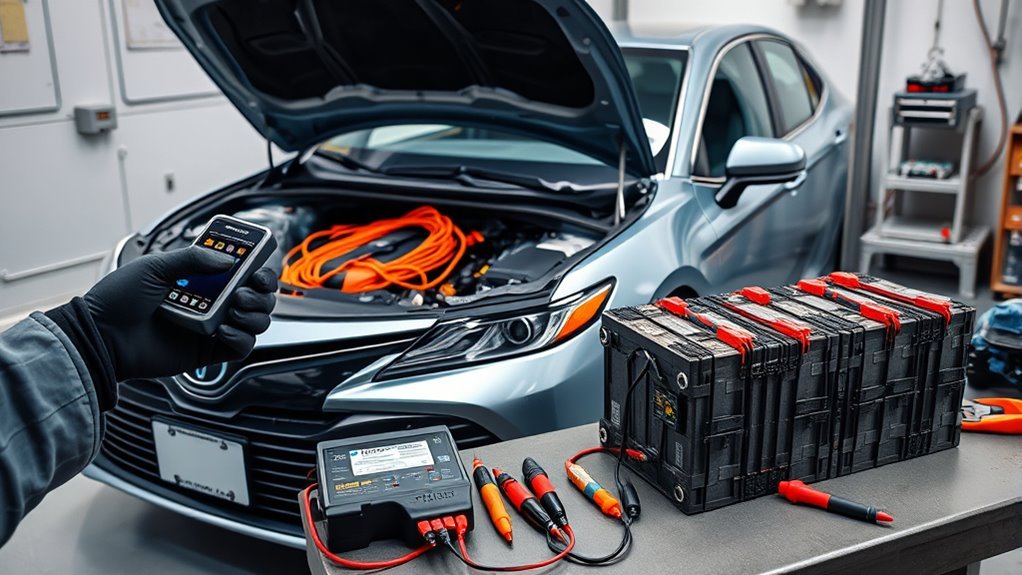
Deciding between repairing and replacing a Camry hybrid battery comes down to measured degradation, warranty status, and cost-effectiveness: full-pack replacement typically runs $2,000–$3,500 depending on model year and labor, while targeted repairs or module swaps often cost $500–$1,500 but may only restore usable life temporarily. You’ll evaluate state-of-health data, cell variance, and warranty coverage (often up to 8 years/100,000 miles) to choose between repair options and replacement costs. Consider long-term value: a full replacement restores factory capacity and resale value; repairs can bridge time with lower upfront expense.
Weigh measured degradation, warranty, and costs: repair for short-term savings, full replacement for lasting value.
- Inspect cell voltage spread and load-test results first.
- Prioritize warranty-covered solutions when eligible.
- Use module-level repairs for localized failures only.
- Factor labor, diagnostics, and anticipated longevity into decisions.
Act decisively to reclaim operational autonomy: choose the option that minimizes total cost of ownership while restoring reliable hybrid performance.
How to Extend Camry Hybrid Battery Life
When you adopt a few targeted habits and maintenance checks, you can greatly extend your Camry hybrid’s battery life and preserve its performance. You’ll monitor fuel economy and driving patterns; steady drops signal battery stress so you’ll act early. Follow battery maintenance tips: routine electrical and cooling-system inspections prevent thermal and charge imbalances. Use hybrid driving techniques like smooth acceleration and anticipating stops to maximize regenerative braking and reduce mechanical load. Avoid excessive short trips that prevent full charge cycles. Park in moderate temperatures or use shade/garage storage to limit thermal degradation. These steps free you from premature replacements and keep range predictable.
| Action | Impact |
|---|---|
| Monitor fuel economy | Early detection, decisive intervention |
| Electrical/cooling checks | Prevent thermal and charge failures |
| Regenerative braking | Recapture energy, lower strain |
| Moderate parking temps | Preserve capacity, extend life |
Apply these measures consistently; they’re technical, actionable, and empower you to maintain autonomy over your vehicle’s longevity.
Choosing a Trustworthy Camry Hybrid Battery Service
Extending your Camry hybrid’s battery life lowers the chance you’ll need a premature replacement, but eventually you may still need professional service — and choosing the right provider matters. You should prioritize service center selection that demonstrates clear battery expertise, tools, and diagnostic systems calibrated for Toyota hybrid architecture. Verify certifications, affiliations, and specific hybrid training before committing; those credentials signal adherence to industry standards and safer procedures.
Extending your Camry Hybrid’s battery life helps delay replacement — choose a certified, hybrid-trained service center with Toyota-calibrated diagnostics.
When evaluating candidates, gather objective data: reviews, pricing, warranty terms, and technician experience. Compare providers but favor proven competence over the lowest bid to avoid cascading failures from improper replacement.
- Look for hybrid specialization and calibrated diagnostic equipment
- Confirm certifications or recognized affiliations
- Read recent customer reviews and case examples
- Request explicit warranty and labor terms
You deserve autonomy over your vehicle choices; pick a provider who empowers you with transparent data, technical explanations, and documented procedures so you can drive forward with confidence.
Warranty, Remanufactured Options, and What to Expect Next
Although a manufacturer warranty often covers Toyota hybrid batteries for 8 years or 100,000 miles (and in some states up to 10 years or 150,000 miles), you’ll still want to confirm your specific coverage and any transfer or prorate details before authorizing work. Verify warranty coverage early; check VIN-specific terms, transferability, and any prorated reimbursement that affects out-of-pocket cost. If warranty has lapsed, evaluate remanufactured options: they typically cost less than new units and carry 1–3 year warranties, making them viable for owners prioritizing cost-effectiveness and continued mobility. You should obtain a detailed estimate comparing new versus remanufactured total lifecycle costs relative to vehicle value. Always consult a qualified hybrid specialist to verify diagnosis, review incentives, and confirm correct installation. After replacement, expect a short break-in interval while the battery synchronizes with vehicle systems; monitor performance and request follow-up calibration if you notice atypical behavior. This approach preserves your autonomy and minimizes financial risk.
Frequently Asked Questions
How Do I Know When My Hybrid Battery Needs Replacing?
You’ll know when performance decline becomes persistent: reduced MPG, frequent warning lights, sluggish acceleration and erratic charging indicate end of battery lifespan; act promptly to restore reliability, prolong autonomy, and avoid sudden drivability loss.
What Is the Battery Warning on a Toyota Camry?
Like a fading lighthouse, the battery warning on a Toyota Camry signals hybrid technology or related system faults; you’ll see a dashboard light prompting diagnostic testing, emphasizing battery maintenance to restore performance and preserve your driving freedom.
How Do You Know if Your Toyota Hybrid Battery Is Dying?
You’ll know your Toyota hybrid battery is dying if battery health declines, you experience performance issues like sluggish acceleration and erratic charging, dashboard warnings appear, and fuel economy worsens—act quickly to reclaim control and avoid costly failure.
Conclusion
If your Camry Hybrid shows multiple signs—worse fuel economy, frequent gas-engine use, erratic charging, or dashboard warnings—don’t wait. For example, a 2014 Camry owner ignored mild sluggishness until the hybrid system failed; replacing the battery restored city MPG from 38 to 45 and eliminated limp-home mode. Act after simple at-home checks, compare remanufactured versus new units and warranties, and choose a certified hybrid specialist to guarantee proper diagnostics, safe high-voltage handling, and calibrated replacement.