If your Camry Hybrid’s MPG drops, the gasoline engine runs more than usual, or a hybrid-system warning appears, the high-voltage battery may be weakening—but it is not the only possible cause. Tire pressure, cold weather, brake drag, a weak 12-volt battery, cooling-fan blockage, sensors, or inverter-related faults can create similar symptoms. Use the checks below to spot warning signs safely, then confirm the problem with proper hybrid diagnostics before paying for a repair or replacement.
Quick Answer
The most common signs of Camry Hybrid battery trouble are a steady MPG drop, rapid charge-level swings, more gasoline-engine use at low speeds, sluggish acceleration, reduced regenerative braking, and hybrid-system warning messages. Do not open the battery pack yourself. Log symptoms, check safe basics, scan codes, and have a hybrid-trained technician confirm the fault.
Key Takeaways
- One symptom alone does not prove the hybrid battery is bad; look for a pattern across MPG, charge behavior, engine runtime, and warning lights.
- Toyota’s current hybrid battery coverage for 2020 and newer Toyota hybrids is 10 years or 150,000 miles, whichever comes first, but older vehicles and warranty details should be checked by VIN.
- A 12-volt battery problem can mimic bigger hybrid-system trouble, so it should be tested before replacing the high-voltage battery.
- The safest at-home checks are logging fuel economy, reading warning messages, checking vents, and scanning codes—not touching orange cables or opening the battery case.
At a Glance
| Time Required | 10–20 minutes for safe checks; longer for professional diagnostics |
| Difficulty | Easy for symptom logging; advanced for hybrid battery testing |
| Tools Needed | Fuel log or app, tire-pressure gauge, flashlight, and a hybrid-capable scan tool if available |
| Cost | Free for basic checks; diagnostic and battery repair costs vary by shop, model year, and warranty status |
3-Minute Checklist: Is Your Camry Hybrid Battery Failing?

Start with the safest checks first. You are looking for a repeated pattern, not a one-time odd reading after a cold start, short trip, or long uphill drive.
| Check | What to watch for | What to do next |
|---|---|---|
| Fuel economy | A steady MPG drop over several tanks with no change in route, tires, weather, or driving style | Compare your results with your normal baseline and the official EPA estimate for your model year and trim. |
| Engine runtime | Gas engine runs more often at low speeds where electric assist used to carry more load | Record when it happens: cold start, hill climb, highway, stop-and-go, or after the car sits. |
| Charge display | Rapid swings from high to low charge during gentle driving | Have battery block voltages and state-of-charge behavior checked with Toyota-capable diagnostics. |
| Dashboard warnings | “Check Hybrid System,” master warning, malfunction indicator, or charging-system warning | Read the message, follow the owner’s manual, and scan for diagnostic trouble codes. |
| Cooling airflow | Blocked rear-seat or cabin battery vents, pet hair, dust, or unusual fan noise | Clear visible obstructions only; do not remove high-voltage battery covers unless qualified. |
Warning: Do not open the hybrid battery case, unplug orange high-voltage cables, touch the service plug, or probe battery terminals. Toyota’s Camry Hybrid manual identifies the hybrid system as a high-voltage system, so internal battery testing belongs to trained hybrid technicians.
Common Symptoms: Fuel Economy, Engine Use, and Sluggishness
A weak high-voltage battery can reduce electric assist, but the symptoms overlap with other problems. Treat the signs below as clues that justify diagnostics, not as proof that the battery pack must be replaced.
Reduced Fuel Economy
A sustained MPG drop is one of the easiest problems to notice. A healthy Camry Hybrid should stay close to your normal real-world baseline for the same route, season, tires, and driving style. For context, official EPA ratings vary by model year, trim, and drivetrain; the 2025 Camry HEV listings on FuelEconomy.gov range from 44 to 51 MPG combined depending on configuration.
If your fuel economy drops for two or three tanks in a row, check simple causes first: tire pressure, roof racks, dragging brakes, old spark plugs, dirty filters, winter fuel, extreme temperatures, and short-trip driving. If those are normal and the engine is running more often, the hybrid battery, battery cooling system, inverter, or control electronics may need testing.
Increased Engine Runtime
More gasoline-engine runtime can happen when the hybrid battery is no longer delivering enough usable power, but it can also be normal in cold weather, during cabin heating, when the battery state of charge is low, or during highway driving. The warning sign is a clear change from your car’s usual behavior.
Pay attention to low-speed driving. If the engine now starts almost immediately in parking lots, school lines, or stop-and-go traffic where the car previously moved quietly on electric assist, write down the conditions. A technician can compare your notes with battery state-of-charge data, battery block-voltage spread, and hybrid-control codes.
Sluggish Acceleration Response
Delayed throttle response or weak launch from a stop can happen when the high-voltage battery cannot supply expected electric assist. It can also come from engine, transmission, throttle, brake, or sensor faults. Do not jump straight to replacement based only on feel.
The better test is data under load. A hybrid-trained shop should check diagnostic trouble codes, freeze-frame data, battery block voltages, internal resistance, cooling-fan operation, and available power during acceleration. If the battery is failing, the data should show abnormal voltage sag, imbalance, or capacity loss rather than just a vague performance complaint.
Dashboard Warnings That Point to Your Camry Hybrid Battery
Dashboard warnings are important, but they do not all mean the same thing. A warning light can point to the hybrid battery, 12-volt battery, inverter, engine controls, throttle controls, charging system, brake system, or a sensor. Toyota’s owner guidance says warning lights and messages should be followed according to the display and manual, and serious warnings may require stopping safely and contacting a Toyota dealer.
Hybrid System Warning
A “Check Hybrid System” or hybrid-system malfunction message is the strongest dashboard clue that the hybrid control system has detected a fault. That fault may involve the high-voltage battery, but it may also involve the inverter, cooling system, wiring, control modules, or related sensors.
Do not clear the code and keep driving without saving the information. Ask the shop for the exact diagnostic trouble codes, freeze-frame data, and test results. That information protects you from replacing a battery pack when the real issue is a fan, sensor, 12-volt battery, or wiring fault.
Battery or Charging System Warning Light
A battery-shaped warning light can be confusing because it does not automatically mean the high-voltage hybrid battery has failed. On Toyota vehicles, a charging-system warning can point to the vehicle’s charging system and may require immediate attention. Read the message on the multi-information display and follow the owner’s manual.
Note: The Camry Hybrid has both a 12-volt battery and a high-voltage hybrid battery. A weak 12-volt battery can trigger odd warnings, no-start problems, and module communication issues, so have it tested before approving a high-voltage battery replacement.
Check Engine Light
The check engine light can appear for many reasons. In a Camry Hybrid, it may be tied to engine controls, electronic throttle controls, emissions components, or hybrid-system faults. The light is a reason to scan the car, not a reason to assume the traction battery is bad.
If the light is flashing, the car drives poorly, or a warning message tells you to stop, pull over safely and follow the manual. If the light is steady and the car drives normally, schedule diagnostics soon and avoid heavy loads until you know what the code means.
Erratic Charging and Regenerative Braking Signs

Erratic state-of-charge behavior can be a strong clue. If the display quickly jumps from high to low during gentle driving, or if the car repeatedly charges and discharges on short, flat trips, the battery may have cell imbalance or reduced usable capacity. However, state-of-charge movement is normal during hills, braking, acceleration, and climate-control use.
Regenerative braking can also feel different when the hybrid battery is full, too cold, too hot, or unable to accept charge normally. Brake-system issues can cause similar symptoms, so reduced regen should be diagnosed together with brake and hybrid-system data.
- Rapid charge-level swings during gentle, low-demand driving
- Gas engine starting more often when the charge display looks low
- Reduced regenerative-braking feel that repeats across normal drives
- MPG decline that appears at the same time as odd charge behavior
- Battery cooling fan noise, dust buildup, or blocked cabin vent areas
Pro Tip: Take a short video of the charge display only when it is safe and legal to do so. A technician can use that pattern, along with scan data, to decide whether the problem is battery capacity, cooling, control logic, or another system.
At-Home Checks Before Booking Service
Before booking service, do the checks that are safe for an owner. The goal is to give the technician useful evidence while avoiding high-voltage components.
Safe Visual Inspection
Do not inspect the internal hybrid battery case, terminals, modules, or orange high-voltage cables. Instead, check the areas you can see without removing high-voltage covers:
- Make sure cabin or rear-seat battery cooling vents are not blocked by bags, blankets, dust, or pet hair.
- Look for obvious water intrusion in the cabin or trunk area.
- Listen for unusually loud cooling-fan noise from the rear-seat area.
- Notice burning smells, electrical odors, or warning messages after rain, heat, or long drives.
- Check tire pressure and look for dragging brake symptoms, because both can reduce MPG.
If you smell burning, see smoke, hear arcing, or receive a warning that tells you to stop, stop driving when safe and call for professional help.
Monitor Fuel Economy
Track MPG for at least two tanks of fuel or several normal commutes. Write down outside temperature, route, tire pressure, and whether the cabin heat or air conditioning was used heavily. This helps separate normal seasonal MPG changes from a real hybrid-system problem.
A single bad tank is not enough. A steady drop that appears with sluggish acceleration, charge swings, and more engine runtime is more meaningful.
Check Warning Lights
Write down the exact warning message, not just the warning icon. If the car displays “Check Hybrid System,” “Hybrid System Malfunction,” “Charging System Malfunction,” or a master warning, record when it happened and whether the car entered reduced-power mode.
Use the Toyota Owners warning-light guidance for your model year and follow the action shown on the display.
Scan for Codes With the Right Tool
A basic parts-store scanner may read general engine codes but miss hybrid-specific battery data. If you scan at home, save every code before clearing anything. For hybrid battery diagnosis, the tool should be able to read Toyota hybrid-control modules, battery block voltages, battery temperature sensors, and freeze-frame data.
Common hybrid-battery-related code families can include battery deterioration, voltage imbalance, or isolation faults, but the exact code matters. Never replace the battery based only on a generic description.
Mechanic Diagnostics for Camry Hybrid Battery: Codes, Load & Module Tests
A good hybrid diagnosis should produce numbers, not guesses. Ask the shop or dealer what tests they ran and what the results were. A proper inspection may include:
- Diagnostic trouble codes from the hybrid control, battery, engine, brake, and body modules
- Freeze-frame data showing temperature, state of charge, speed, load, and voltage at the time of the fault
- Battery block-voltage comparison to look for weak or imbalanced blocks
- Internal-resistance or load testing to see how the pack performs under demand
- Battery temperature-sensor readings
- Cooling-fan operation and airflow inspection
- 12-volt battery and charging checks
- Inspection for water intrusion, corrosion, wiring damage, or previous poor repairs
If a shop recommends replacement, ask for the evidence: the codes, voltage spread, failed test values, and warranty status. This turns the conversation from “your battery is bad” into a clear repair decision.
Camry Hybrid Battery: Repair vs. Replacement (Cost Ranges)
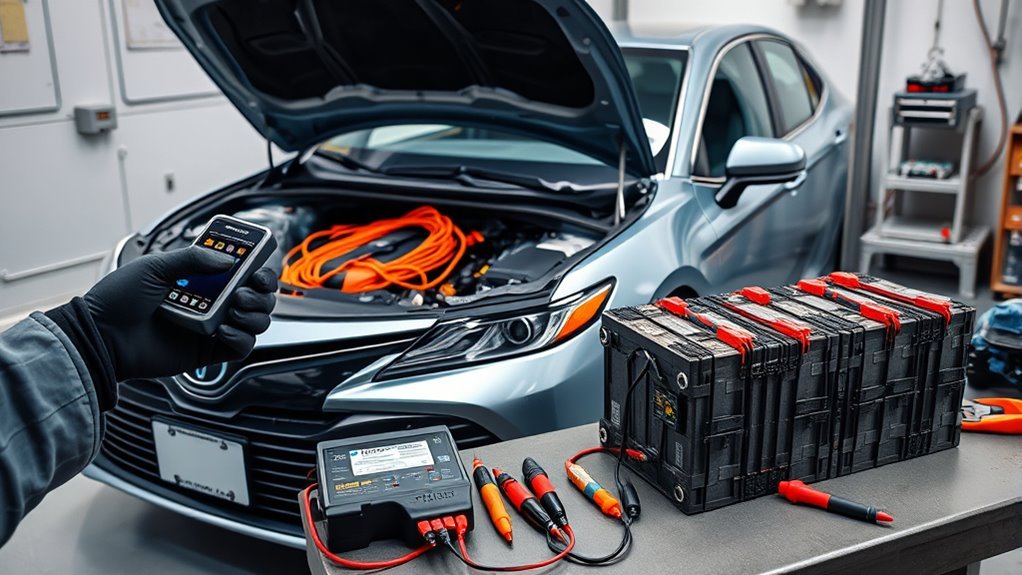
Repair versus replacement depends on the age of the car, diagnostic results, warranty status, local labor rates, and whether the replacement is new, remanufactured, or used. Pricing varies widely, so treat any online number as a rough planning range until you have itemized quotes.
| Option | Best when | Main tradeoff |
|---|---|---|
| Warranty repair | The vehicle is within Toyota hybrid battery coverage or an extended warranty | You must follow warranty terms and use approved diagnosis/repair channels. |
| New battery pack | You want the longest expected service life and plan to keep the car | Highest upfront cost, but usually the strongest long-term option. |
| Remanufactured pack | The car is out of warranty and you need lower upfront cost | Quality and warranty length vary by supplier. |
| Module-level repair | One or a few modules test weak and the rest of the pack is healthy | May be temporary if the rest of the pack is aged or imbalanced. |
| Used battery | You need the lowest short-term price and accept higher risk | Unknown history, shorter warranty, and possible repeat labor. |
Do not choose the cheapest battery option until you compare total cost: diagnosis, parts, labor, warranty length, expected life, and whether the shop will stand behind the repair.
[Products Worth Considering]

FOXWELL NT201 is an easy-to-use OBD2 scanner designed to help drivers quickly read and clear check engine codes, view live engine data, and check emissions readiness. Its color screen, one-key I/M readiness test, and broad compatibility with most gasoline vehicles since 1996 make it a practical tool for everyday diagnostics and maintenance. With plug-and-play operation and lifetime free updates, it offers a simple way to understand vehicle issues without expensive shop visits.

This plug-and-play OBD2 scanner helps drivers quickly read and clear engine error codes while providing live data, freeze frame information, I/M readiness, and MIL status for more confident troubleshooting. It adds a built-in voltage test and clear status indicators to support electrical checks and faster diagnostics, making it a practical choice for home users, car enthusiasts, and repair professionals. Compatible with most OBDII vehicles since 1996 and designed with an easy-to-use interface, it offers broad coverage and simple operation in one compact tool.

This enhanced OBD2 scanner helps drivers quickly diagnose check engine light issues, read and clear trouble codes, and check emissions readiness before a smog test. It also adds EVAP and O2 sensor testing, live data, freeze frame capture, and a one-click battery health check in a simple plug-and-play tool with a bright color screen.
How to Extend Camry Hybrid Battery Life
You cannot stop battery aging completely, but you can reduce heat stress and catch problems early.
- Keep battery cooling vents clear, especially if you carry pets or dusty cargo.
- Do not ignore cooling-fan noise, hybrid warnings, or repeated MPG drops.
- Maintain tire pressure and brakes so the hybrid system is not working harder than necessary.
- Use smooth acceleration and early braking to support regenerative braking.
- Avoid letting the vehicle sit unused for very long periods when possible.
- Park in shade or a garage during extreme heat when practical.
- Follow Toyota’s maintenance schedule and keep service records.
Good habits will not save a battery that has already failed, but they can help the system operate in a healthier temperature and load range.
Choosing a Trustworthy Camry Hybrid Battery Service
Choose a shop that can show hybrid-specific skill, not just general repair experience. A trustworthy service provider should be willing to explain the diagnostic data and give you written options.
- Ask whether the technician has Toyota hybrid training or equivalent hybrid certification.
- Confirm the shop has scan tools that can read Toyota hybrid battery data.
- Ask for code printouts, block-voltage data, and test results.
- Compare warranty terms on new, remanufactured, used, and module-level repairs.
- Ask whether calibration, cooling-fan cleaning, and post-repair testing are included.
- Check recent reviews that mention hybrid battery work specifically.
Favor clear documentation over the lowest quote. Poor diagnosis can turn a smaller electrical or cooling problem into an unnecessary battery replacement.
[Products Worth Considering]

The ANCEL AD410 PRO combines engine diagnostics and 12V battery testing in one easy-to-use tool, helping you read and clear check engine codes while checking battery health, cranking, and charging performance. It also provides live data, freeze frame details, and I/M readiness checks to help you diagnose issues faster and prepare for emissions testing. With plug-and-play operation, a clear screen, and broad vehicle compatibility, it is a practical solution for home mechanics and everyday drivers.

Turn your iPhone, Android device, or Windows PC into a professional-grade diagnostic scan tool with this Bluetooth OBD2 adapter. It is designed for broad vehicle compatibility and supports popular apps for deeper diagnostics, live data, and code clearing. Built-in protections and firmware updates help keep your vehicle and scanner safe while delivering reliable performance.

This WEJOWE OBD2 scanner helps drivers quickly identify check engine causes, read and clear trouble codes, and view live vehicle data with built-in DTC lookup. It also includes battery voltage testing, I/M readiness checks, freeze frame retrieval, and support for printing diagnostic reports to help simplify repairs and maintenance. Designed for most OBDII vehicles since 1996, it offers an easy-to-use solution for DIY car diagnostics.
Warranty, Remanufactured Options, and What to Expect Next
Before paying for any major repair, check coverage. Toyota states that starting with the 2020 model year, every Toyota hybrid battery warranty increased to 10 years from the date of first use or 150,000 miles, whichever comes first. You can review Toyota’s current hybrid battery warranty information at Toyota Support. Older Camry Hybrid models may have different coverage, so verify your warranty by VIN, model year, in-service date, and warranty guide.
Also check for open recalls or service campaigns before approving paid work. Toyota provides an official Safety Recalls & Service Campaigns lookup by VIN.
If the car is out of warranty, compare new and remanufactured options carefully. A lower-priced remanufactured battery can make sense for an older vehicle, but the warranty length, supplier reputation, and installer skill matter. After repair or replacement, the shop should clear codes, confirm battery cooling operation, road-test the car, and verify that state-of-charge behavior and engine runtime are normal.
[Products Worth Considering]

This mass air flow sensor is designed to replace compatible OEM parts for a wide range of Toyota and Lexus vehicles, helping restore accurate airflow readings and smoother engine operation. It is computer-tested for stable signal output, fast response, and improved fuel efficiency, while also supporting reliable performance under demanding driving conditions. The easy-install design makes replacement straightforward, and a 12-month warranty adds extra peace of mind.

The FOXWELL NT301 is a plug-and-play OBD2 code reader designed to help drivers and home mechanics diagnose check engine light issues with ease. It reads fault codes, clears emissions-related warnings, displays live sensor data in graph form, and shows I/M readiness so you can quickly check vehicle status before an emissions test. With broad compatibility across many OBD2 vehicles and a clear color screen, it offers a practical, user-friendly way to monitor and troubleshoot engine performance.

The VDIAGTOOL VD10 is an easy-to-use OBD2 code reader designed to help drivers quickly diagnose check engine issues and keep vehicles running smoothly. It reads and clears trouble codes, shows live data, freeze frame information, and I/M readiness status, while also providing built-in DTC definitions for faster troubleshooting. With broad OBDII protocol compatibility, plug-and-play operation, and support for multiple languages, it is a practical diagnostic tool for everyday car owners and DIY mechanics.
Frequently Asked Questions
How do I know when my Camry Hybrid battery needs replacing?
You may need replacement when diagnostic testing confirms weak battery blocks, abnormal voltage imbalance, reduced usable capacity, or repeated hybrid-battery fault codes. Symptoms such as poor MPG, charge swings, and sluggish acceleration are warning signs, but replacement should be based on scan data and load testing.
What is the battery warning on a Toyota Camry?
A battery-shaped warning or charging-system message does not automatically mean the high-voltage hybrid battery has failed. It can point to the charging system or another electrical fault. Read the exact message, follow the owner’s manual, and scan the vehicle before replacing parts.
How do you know if your Toyota hybrid battery is dying?
Common signs include a steady MPG drop, rapid state-of-charge swings, more gasoline-engine use at low speeds, reduced electric assist, weak acceleration, and hybrid-system warnings. The only reliable confirmation is a hybrid battery diagnostic test that checks codes, block voltages, temperature, resistance, and performance under load.
Can a bad 12-volt battery cause hybrid warning lights?
Yes. A weak 12-volt battery can cause no-start problems, warning lights, communication faults, and strange electronic behavior. Have the 12-volt battery tested before assuming the high-voltage hybrid battery is the problem.
Is it safe to drive with a Check Hybrid System warning?
It depends on the message and how the car behaves. If the car loses power, overheats, flashes warnings, or tells you to stop, pull over safely and follow the manual. If the warning is steady and the car drives normally, schedule diagnostics promptly and avoid pushing the vehicle until the fault is identified.
Should I repair modules or replace the whole Camry Hybrid battery?
Module repair can be cheaper when failure is isolated, but it may be temporary if the rest of the pack is old or imbalanced. A full new or high-quality remanufactured pack usually costs more upfront but may provide better long-term reliability. Decide after reviewing diagnostic data, warranty coverage, vehicle value, and written repair warranties.
Conclusion
If your Camry Hybrid shows several signs at once—worse fuel economy, more gasoline-engine runtime, erratic charge display, sluggish response, and hybrid-system warnings—take it seriously, but do not assume the battery pack is the only possible cause. Start with safe owner checks, test the 12-volt battery, save warning messages and codes, verify warranty and recall status, then get a hybrid-trained diagnosis. The right data will tell you whether you need a simple fix, cooling-system service, module-level repair, remanufactured pack, or full battery replacement.
Sources
- Toyota Support: Hybrid warranty coverage — verifies 2020+ Toyota hybrid battery warranty wording.
- Toyota Owners: 2025 Camry Hybrid warning lights — supports warning-light and stop-safely guidance.
- Toyota Owners: 2025 Camry Hybrid system precautions — supports high-voltage hybrid-system safety warnings.
- FuelEconomy.gov: 2025 Toyota Camry EPA MPG listings — supports MPG baseline comparisons by trim and drivetrain.
- Toyota Safety Recalls & Service Campaigns lookup — supports VIN-specific recall and service campaign checks before major repairs.