Why Does a Toyota Camry Hesitate When Accelerating?
Last updated: July 31, 2026
Source basis: This guide uses Toyota maintenance and safety documents, Toyota technical service information hosted by NHTSA, Toyota and NHTSA recall tools, and generic OBD-II references. Exact repair procedures vary by VIN and powertrain.
If a Toyota Camry hesitates when accelerating, first check whether the accelerator pedal is obstructed, record the exact speed and operating condition, and scan all accessible powertrain modules before clearing codes. Common causes include an ignition misfire, unstable fuel delivery, an intake leak, incorrect airflow or throttle data, weak 12-volt power, a conventional transmission fault, or a hybrid-control problem.
Powertrain and model year matter. Older Camrys were sold with several gasoline engines and conventional automatic transmissions, while hybrid versions use different charging and driveline systems. The 2025-2026 U.S. Camry uses an all-hybrid powertrain, so conventional alternator and stepped-transmission assumptions do not always apply. Toyota describes the current Camry as an all-hybrid model on its official Camry specifications page. Specified 2018-2019 Camrys with an A25A engine may also match a Toyota ECM-calibration bulletin for hesitation from a slow roll or rolling stop.
Quick Answer
Scan for current, pending, history, and manufacturer-specific codes before replacing parts. Then check for a flashing warning light, restricted pedal travel, loose intake plumbing, damaged vacuum hoses, obvious leaks, ignition misfire data, abnormal fuel trims, and powertrain-specific faults. If a 2018-2019 A25A-equipped Camry hesitates at 6 mph or below or after a 3-1 downshift, ask Toyota to check whether T-SB-0152-19 Rev1 and its ECM calibration apply. Do not continue driving if the Camry shakes severely, loses acceleration in traffic, smells like fuel, leaks fuel, shows a flashing check-engine light, or has obvious transmission or transaxle slip.
Key Takeaways
- Identify the Camry year, engine, and gasoline or hybrid powertrain before testing.
- Record codes and freeze-frame data before clearing anything or disconnecting the battery.
- Check the accelerator-pedal area and driver’s floor-mat placement before deeper diagnosis.
- Check whether the Toyota slow-roll hesitation bulletin applies to a qualifying 2018-2019 A25A-equipped Camry.
- Do not apply conventional alternator or transmission assumptions to every hybrid Camry.
- Stop driving when hesitation creates unsafe acceleration, severe shaking, fuel leakage, or obvious driveline slip.
What’s in This Article
- Why Does My Camry Hesitate When Accelerating?
- Quick Diagnostic Checklist for Camry Hesitation
- Identify Your Camry Powertrain First
- Could a Toyota Service Bulletin Explain the Hesitation?
- Before You Start Testing
- When Does the Camry Hesitate?
- Can Plugs, Coils, Injectors, or the MAF Cause Hesitation?
- Could Fuel Delivery Be the Cause?
- Could the Transmission or Hybrid Transaxle Cause It?
- Can Airflow or a Vacuum Leak Cause Hesitation?
- Can 12-Volt Power or Sensor Data Cause Hesitation?
- Low-Risk DIY Tests You Can Run at Home
- What If Your Camry Hesitates With No Code?
- Repair and Maintenance Plan
- Frequently Asked Questions
- Conclusion
- References
Quick Diagnostic Checklist for Camry Hesitation
Match the symptom to the first safe test. This narrows the problem faster than inspecting every possible component in random order.
| What You Notice | First Systems to Check | Best First Action |
|---|---|---|
| Severe shaking, jerking, or a flashing check-engine light | Ignition misfire, injector fault, mechanical cylinder problem | Stop driving, record codes, and arrange diagnosis |
| Pedal travel feels restricted or the driver’s floor mat is out of position | Floor mat, pedal area, trim, or another physical obstruction | With the vehicle off, remove loose objects and secure the correct mat away from both pedals |
| A 2018-2019 Camry with an A25A engine hesitates from a slow roll, at 6 mph or below, or after a 3-1 downshift | ECM calibration and Toyota T-SB-0152-19 Rev1 applicability | Ask Toyota to confirm the VIN, VDS, engine, transaxle serial information, and current ECM calibration |
| A pause when you press the accelerator, without a clear shift flare | Throttle data, airflow, fuel trim, intake leak, fuel delivery | Scan codes and inspect the intake tract |
| Engine speed rises but road speed does not follow on a gasoline-only model | Transmission slip or delayed engagement | Avoid hard acceleration and obtain transmission diagnosis |
| The problem appears only after warm-up or under load | Heat-sensitive ignition coil, fuel-delivery fault, sensor drift, driveline fault | Compare cold and hot scan data under the same conditions |
| No generic code appears | Pending or enhanced code, mechanical fault, intermittent wiring, normal-versus-abnormal hybrid behavior | Check pending data and scan all available modules |
Write down the engine temperature, fuel level, warning lights, road load, weather, and whether the issue occurs from a stop, during a shift, or after the engine warms. For the most useful repair-order description, also record vehicle speed, accelerator input, RPM behavior, and whether the event followed a downshift, refueling, or hybrid engine start. Keep every reading before and after a repair so you can prove whether the change helped.
[Products Worth Considering]

The FOXWELL NT301 is a plug-and-play OBD2 code reader designed to help drivers and home mechanics diagnose check engine light issues with ease. It reads fault codes, clears emissions-related warnings, displays live sensor data in graph form, and shows I/M readiness so you can quickly check vehicle status before an emissions test. With broad compatibility across many OBD2 vehicles and a clear color screen, it offers a practical, user-friendly way to monitor and troubleshoot engine performance.

The BLCKTEC 440 Bluetooth OBD2 scanner helps drivers and DIY mechanics quickly read and clear trouble codes, monitor live data, and check emissions readiness with confidence. Its color display, graphing capabilities, and battery and charging system testing make it a versatile diagnostic tool for OBD-compliant vehicles. Designed for plug-and-play convenience, it runs directly from your vehicle and includes support for report sharing and ongoing updates.

The ANCEL AD310 is a compact, easy-to-use OBD II code reader designed to help drivers quickly identify check engine light causes, read and clear fault codes, and review key vehicle data. It supports major OBD2 protocols and works with many 1996-and-newer cars, light trucks, SUVs, and other OBD2 vehicles. Built for fast diagnostics at home or on the go, it runs directly from the vehicle and provides clear results on a large screen.
Identify Your Camry Powertrain First
Find the model year, VIN, engine or hybrid designation, and drivetrain before following a repair procedure. Your owner’s manual, maintenance guide, registration information, and VIN-specific Toyota records can help confirm the configuration.
| Camry Type | Diagnostic Difference | Important Caution |
|---|---|---|
| Gasoline-only Camry | May use a conventional alternator and stepped automatic transmission, depending on year | Use the exact engine and transmission service data |
| Earlier Camry Hybrid | Uses hybrid control, motor-generators, an inverter/converter, and a hybrid transaxle | Do not apply gasoline-only charging tests to the high-voltage system |
| 2025-2026 U.S. Camry | All-hybrid powertrain | Scan hybrid-control modules and follow current Toyota procedures |
Hybrid Warning: A Camry Hybrid contains high-voltage DC and AC circuits. Never touch, disconnect, probe, or remove orange-colored wiring, connectors, covers, or high-voltage components. Hybrid-system testing belongs with a trained technician using Toyota procedures.
Normal hybrid engine start-stop operation and changing engine speed can feel different from a conventional automatic transmission. However, a repeatable loss of accelerator response, warning message, severe surge, abnormal vibration, or stored hybrid-control code still needs diagnosis. See the site’s Camry transmission-types guide for the main differences between conventional automatics and hybrid transaxles.
Could a Toyota Service Bulletin Explain 2018-2019 Camry Hesitation?
Yes, but only when the vehicle and symptom match the bulletin. Toyota T-SB-0152-19 Rev1 covers specified 2018-2019 Camrys with an A25A engine and listed VDS codes. Toyota describes hesitation from a slow roll or rolling stop under one or more of these conditions:
- Driving at 6 mph or below.
- Immediately following a 3-1 downshift.
- Using less than 40% accelerator-pedal input.
The bulletin directs a technician to confirm the condition, transaxle information, and ECM calibration with Toyota equipment. When applicable, the repair is an ECM calibration update followed by specified drive patterns. It is not a blanket transmission replacement, and it does not apply to every 2018-2019 Camry.
Review the NHTSA-hosted Toyota T-SB-0152-19 Rev1 document, then ask Toyota to check the VIN, VDS, engine, transaxle serial information, current calibration, repair history, and current coverage. A technical service bulletin is not the same as a safety recall, so it may not appear as an open recall in a VIN-only search.
Before You Start Testing
Park on a level surface, set the parking brake, and let hot components cool. Wear eye protection around the battery, fuel system, and moving engine parts. Keep flames, cigarettes, heaters, and sparks away from gasoline and fuel vapors.
With the vehicle off, inspect the accelerator-pedal area. Remove loose objects and confirm the correct driver’s mat is secured without overlapping another mat or touching either pedal.
Before opening the hood, record these details:
- Vehicle identity: model year, VIN, engine or hybrid powertrain, and drivetrain.
- Exact symptom: delay, stumble, jerking, loss of power, shift flare, restricted pedal travel, or warning message.
- Operating condition: cold start, warm engine, uphill load, passing, stop-and-go traffic, or hybrid engine engagement.
- Recent changes: repairs, battery replacement, air-filter work, refueling, collision damage, added floor mats, or disconnected wiring.
Gather a basic OBD2 scanner, a digital multimeter, a flashlight, and the correct Toyota manual. A basic reader may show generic engine codes but miss Toyota-enhanced, transmission, hybrid-control, or network faults.
Check the VIN through Toyota’s recall and service-campaign lookup and the NHTSA recall database. A VIN recall search generally shows unrepaired safety recalls, not every technical service bulletin or non-safety campaign. Use NHTSA’s year, make, and model search to review manufacturer communications, and ask Toyota to check the VIN, calibration ID, and campaign history. NHTSA also notes that some newly announced recalls may not immediately include every affected VIN, so check again if Toyota or NHTSA announces a relevant campaign.
Warning: Stop DIY testing if you smell fuel, see a fuel leak, notice severe shaking, lose acceleration in traffic, or suspect high-voltage damage. Do not watch live data while driving. Use a passenger, a recording function, or a qualified technician.
When Does the Camry Hesitate?
The moment the hesitation occurs helps separate engine, airflow, electrical, hybrid-control, and driveline faults. Reproduce the symptom only when it is safe to do so.
- From a stop: note whether the engine stumbles, the accelerator feels unresponsive, the pedal travel feels restricted, or the vehicle pauses before moving.
- From a slow roll: record the exact speed, accelerator input, and whether a 2018-2019 A25A-equipped Camry has just completed a downshift.
- During a gear change: note whether engine speed flares, engagement is delayed, or the vehicle shifts harshly.
- During sustained load: hesitation on hills or while passing can expose weak ignition, inadequate fuel delivery, or a driveline fault.
- After warm-up: compare cold and hot behavior because heat can affect coils, wiring, sensors, fuel pressure, and transmission operation.
- During hybrid transitions: record warning messages, battery-state behavior, engine engagement, and whether accelerator response actually drops.
- After refueling: record the station, fuel grade, amount added, and how soon the symptom began.
Also record whether the check-engine light is off, steadily illuminated, or flashing. Do not assume the absence of a warning light proves that the engine, transmission, or hybrid system is fault-free.
Can Plugs, Coils, Injectors, or the MAF Cause Hesitation?
Ignition and fuel-metering faults often become more noticeable under load. Review misfire counts, fuel trims, and cylinder-specific codes before removing parts.
Inspect spark plugs for worn electrodes, oil fouling, fuel wetness, cracked porcelain, or heavy deposits. Use the exact plug type and interval in the maintenance guide. Toyota’s 2023 Camry maintenance guide calls for spark-plug replacement at 60,000 miles on the 2GR-FKS V6. This is an engine-specific example, not a universal 2023 Camry interval. Toyota’s 2025 Camry maintenance chart lists replacement at 120,000 miles. Follow the guide for your exact year and engine.
A weak ignition coil may work at idle but fail when cylinder pressure rises during acceleration. When access and service information allow, a technician may compare coil output or move a suspected coil to another cylinder and see whether the cylinder-specific fault follows it. Do not clear the original code or freeze-frame data before recording it.
Injector diagnosis should rely on misfire data, balance testing, electrical testing, fuel trims, or another repeatable result. Do not replace or clean injectors solely because the car hesitates.
Inspect the mass airflow sensor (MAF) and its connector for contamination, damaged wiring, or oil film. Use only cleaner specifically approved for MAF sensors. Do not touch the sensing element or spray unrelated solvents into the housing.
Could Fuel Delivery Be the Cause?
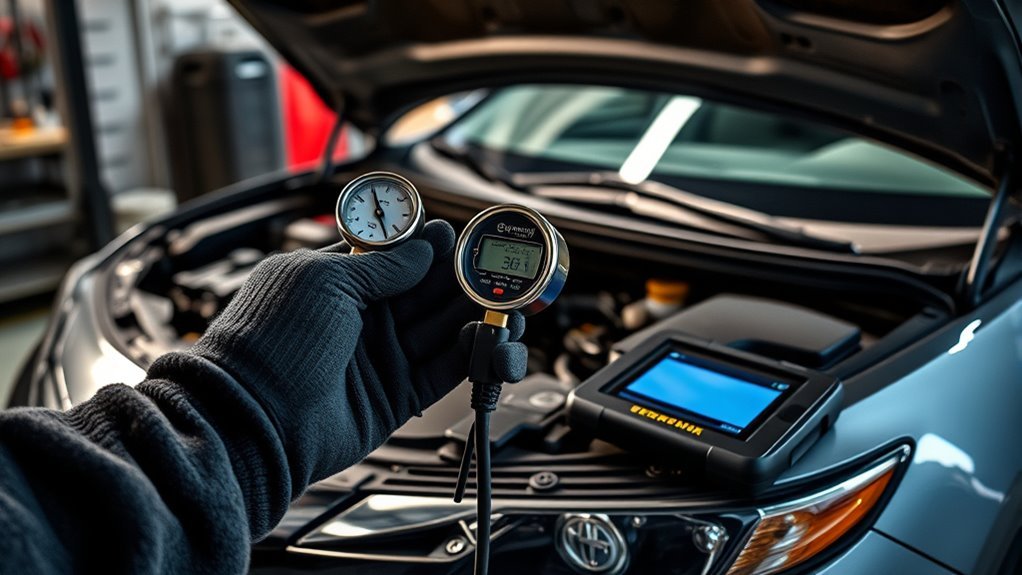
A weak pump, electrical supply problem, restricted fuel path, pressure-control fault, or injector problem can cause hesitation when fuel demand rises. Confirm ignition and intake integrity before assuming the fuel pump has failed.
If the hesitation began immediately after refueling, keep the receipt and record the station, fuel grade, amount added, and distance driven before the symptom appeared. Do not pour several additives into the tank. A shop may need to check fuel quality, pressure, fuel trims, injector operation, and relevant EVAP data. If the Camry also became hard to start, idled roughly, or produced an EVAP-related code after filling the tank, include that pattern in the repair order. Do not assume contaminated fuel without testing.
Fuel-pressure specifications and test points vary by Camry year, engine, and fuel-system design. Compare every reading with Toyota service data for the exact VIN, engine, and fuel circuit. Do not use a generic pressure range.
- Inspect accessible fuel-system wiring, fuses, connectors, and visible lines without opening the pressurized circuit.
- Check scan data for lean operation, abnormal fuel trims, misfires, and pressure-related codes where supported.
- Look for dampness, fuel odor, or leakage around accessible connections without touching a leaking component.
- Review the owner’s manual and maintenance guide before assuming the vehicle has a routine external fuel-filter interval.
Do not loosen fuel lines, open a high-pressure circuit, or connect a gauge unless you have the exact Toyota pressure-release and test procedure. Many owners should leave pressure and injector-flow testing to a qualified shop.
Could the Transmission or Hybrid Transaxle Cause It?
A driveline fault can feel like engine hesitation. On a gasoline-only Camry, delayed engagement, an obvious flare between shifts, harsh shifting, or rising engine speed without matching road speed can point toward a conventional transmission problem. See the separate Camry hard-shifting guide when harsh engagement or a repeatable shift event is the main symptom.
A hybrid Camry uses a different transaxle and control strategy. Changing engine speed alone does not prove that the transaxle is slipping. Scan the hybrid-control, motor-generator, battery, and transaxle systems before applying conventional transmission conclusions.
On a qualifying 2018-2019 A25A-equipped Camry, slow-roll hesitation may involve the ECM calibration described in Toyota T-SB-0152-19 Rev1. Confirm that branch before treating the symptom as proof of internal transmission failure.
| Checkpoint | Safe Diagnostic Action |
|---|---|
| Fluid or case leakage | Inspect the ground and accessible case areas, then use the Toyota procedure for the exact unit |
| Shift or engagement behavior | Record delays, harsh engagement, flare, warning messages, and operating temperature |
| Stored control-system faults | Scan transmission or hybrid modules with a compatible tool |
| Service history | Compare completed services with the correct Toyota maintenance guide |
Some Camry transmissions and hybrid transaxles use sealed inspection or fill procedures. Toyota’s 2025 guide directs owners to inspect sealed driveline components for leakage and obtain dealer inspection when leakage is suspected. Other model years may use different procedures. Do not guess fluid level from color or smell when the factory procedure requires a specified temperature, fill point, or scan-tool step.
If the vehicle slips, loses drive, bangs into gear, or cannot accelerate predictably, avoid further road testing and arrange professional diagnosis.
Can Airflow or a Vacuum Leak Cause Hesitation?
Unmetered air, a restricted filter, a damaged intake tube, or incorrect throttle and MAF data can disturb the air-fuel mixture. Begin with a visual inspection before cleaning or replacing anything.
Check the intake tube, clamps, airbox, vacuum hoses, and accessible manifold connections. Look for splits, collapsed sections, loose fittings, disconnected hoses, and signs that a part was disturbed during recent service.
Throttle Body Cleaning
Carbon around the throttle plate can contribute to poor response or unstable idle, but cleaning is not the correct fix for every hesitation complaint. First inspect throttle-related codes, accelerator-pedal data, commanded throttle angle, and the intake path.
Follow the procedure for the exact Camry. Do not force the electronic throttle plate, flood the electronic housing, or use abrasive tools. Some configurations may require an idle or throttle-body relearn after service.
- Inspect first: check deposits, connectors, wiring, and intake-hose fit.
- Clean only when supported: use the approved cleaner and method without soaking electronics.
- Verify the result: compare idle, codes, fuel trims, and accelerator response before and after service.
Intake Manifold and Vacuum Leaks
A leak after the MAF sensor can allow air into the engine without being measured correctly. Possible clues include a hissing sound, lean fuel trims, unstable idle, or a hesitation that changes with engine temperature.
A professional smoke test can locate small leaks more reliably than spraying chemicals around a running engine. Repair the failed hose, seal, or gasket, then confirm that fuel trims and drivability improve.
Air Filter Condition
Inspect both sides of the air filter for dirt, oil, water, damaged seals, or collapsed pleats. Also check that the airbox closes fully and that the intake tube has not been left loose after service.
- Remove the filter according to the owner’s manual.
- Inspect the airbox seal and intake connections under good light.
- Replace a damaged or heavily restricted filter with the correct part.
- Recheck acceleration under the same safe conditions.
Can 12-Volt Power or Sensor Data Cause Hesitation?
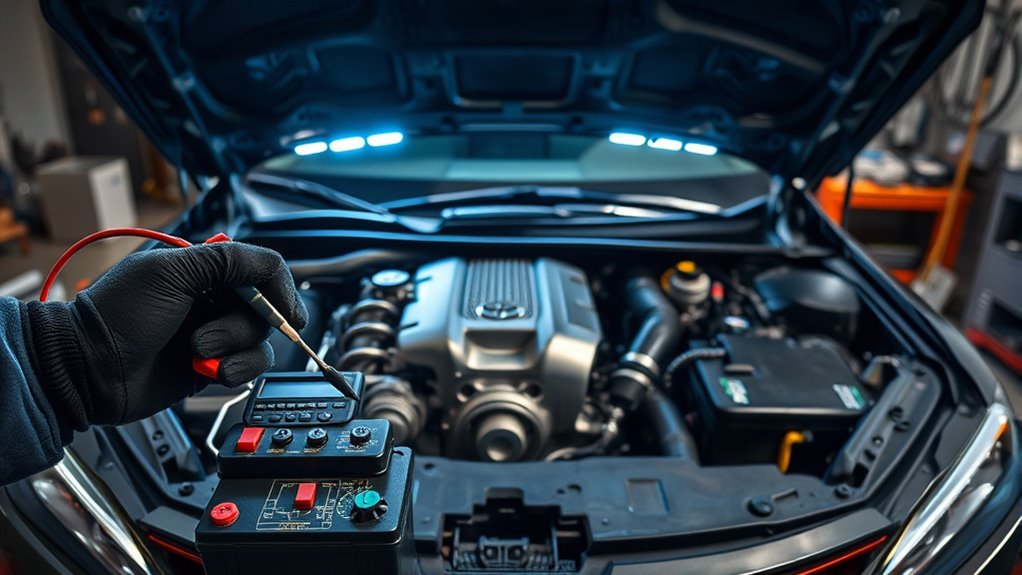
Low or unstable 12-volt power can create misleading codes, communication faults, or erratic module behavior. Identify the charging architecture before testing. Many gasoline-only Camrys use a conventional alternator, while hybrid models use an inverter/converter and DC-to-DC charging system.
Do not judge every Camry by one universal voltage range. Battery state, temperature, electrical load, charging strategy, meter accuracy, and powertrain design affect the reading. Compare test results with Toyota service information for the exact vehicle.
Battery and 12-Volt System Health
- Inspect accessible 12-volt battery terminals, grounds, and cables for looseness or corrosion.
- Load-test the 12-volt battery with equipment and limits appropriate for that battery type.
- On a gasoline-only model, test the conventional charging system according to its service procedure.
- On a hybrid, evaluate 12-volt charging in the correct operating mode without touching high-voltage components.
Repair confirmed power or ground faults before replacing airflow, throttle, or oxygen-related sensors.
Sensor Faults and Generic Code Examples
Retrieve current, pending, history, and manufacturer-enhanced diagnostic trouble codes where your tool supports them. Review freeze-frame information before clearing anything. A code identifies a monitored circuit or operating condition; it does not prove that the named sensor has failed.
Compare throttle position, accelerator-pedal position, MAF data, air-fuel ratio or oxygen-sensor data, and fuel trims under the same condition that triggers hesitation. Look for a repeatable signal dropout or implausible relationship rather than replacing a component from one code.
| System | Generic OBD-II Examples | Diagnostic Direction |
|---|---|---|
| Throttle-position circuit | P0120 to P0124 | Check signal movement, reference voltage, wiring, and Toyota-specific definitions |
| Oxygen or air-fuel feedback | P0130 to P0167 | Identify the exact sensor and circuit before testing response, heater wiring, or exhaust leaks |
| System voltage | P0560 to P0563 | Test the 12-volt battery, connections, grounds, and correct charging architecture |
| MAF circuit | P0100 to P0104 | Inspect wiring, intake leaks, contamination, and signal plausibility |
Confirm every definition and test sequence in Toyota repair information. The generic family alone is not a Camry-specific diagnosis.
Low-Risk DIY Tests You Can Run at Home
Limit home testing to low-risk inspections unless you have the correct tools, training, and Toyota procedure. Work on a cool vehicle when possible and keep the parking brake engaged.
- Identify the vehicle: record the VIN, model year, engine or hybrid powertrain, and drivetrain.
- Check the pedal area: with the vehicle off, remove loose objects and confirm the correct driver’s mat is secured away from both pedals.
- Scan before clearing: save current, pending, history, enhanced, and freeze-frame information.
- Check the model-specific bulletin branch: if the vehicle is a 2018-2019 Camry with an A25A engine and slow-roll hesitation, ask Toyota to confirm T-SB-0152-19 Rev1 applicability and calibration history.
- Inspect warning signs: stop if the check-engine light flashes, the vehicle shakes severely, or fuel is leaking.
- Inspect the intake: check the airbox, filter, intake tube, clamps, vacuum hoses, and connectors.
- Check accessible 12-volt connections: look for corrosion, looseness, damaged grounds, or obvious cable faults.
- Review misfire and fuel-trim data: compare cold, warm, idle, and light-load behavior without watching the tool while driving.
- Inspect accessible plugs and coils only when appropriate: follow the exact removal, torque, and part specifications.
- Leave pressurized and high-voltage tests to trained technicians: do not open fuel circuits or hybrid components without the factory procedure.
After any repair, repeat the same safe test condition and compare codes, fuel trims, misfire data, and vehicle response. A repair is not confirmed merely because the warning light was cleared.
[Products Worth Considering]

The ZMOON ZM201 is a plug-and-play OBD2 code reader designed to quickly diagnose check engine issues on compatible vehicles after 1996. It reads and clears engine fault codes, displays live data and freeze frame information, checks I/M readiness, and helps you identify problems before visiting a repair shop. With a color screen, intuitive controls, and built-in DTC database, it offers an easy-to-use solution for DIY drivers and car owners who want reliable engine diagnostics.

FOXWELL NT201 is an easy-to-use OBD2 scanner designed to help drivers quickly read and clear check engine codes, view live engine data, and check emissions readiness. Its color screen, one-key I/M readiness test, and broad compatibility with most gasoline vehicles since 1996 make it a practical tool for everyday diagnostics and maintenance. With plug-and-play operation and lifetime free updates, it offers a simple way to understand vehicle issues without expensive shop visits.

This ignition coil pack and pre-gapped spark plug set is designed for select 3.5L V6 Toyota and Lexus models, helping restore smooth engine performance and reliable starting. Built to meet or exceed OEM specifications, it can help fix common issues like misfires, rough idle, poor fuel economy, and reduced power. The complete 6-piece set offers a convenient replacement solution for compatible vehicles.
What If Your Camry Hesitates With No Code?
A basic scanner showing no confirmed code does not rule out a fault. The issue may be intermittent, outside generic emissions monitoring, mechanical, or stored in a module the tool cannot access.
- Check pending and history codes: the fault may not have matured into a confirmed code.
- Scan additional modules: transmission, hybrid, battery, throttle, and network faults may require Toyota-capable equipment.
- Compare cold and hot data: record when the hesitation starts and which values change at the same time.
- Inspect mechanical basics: pedal obstruction, intake leaks, fuel delivery, compression, exhaust restriction, and driveline faults may need direct testing.
- Preserve evidence: do not disconnect the battery or erase data before a technician reads it.
Could a Mechanical Engine Fault or Restricted Exhaust Cause Hesitation?
Yes. Low compression, valve-timing problems, a mechanically weak cylinder, or restricted exhaust flow can reduce acceleration even when a basic scanner shows no confirmed code. These faults should be proven with the correct test rather than guessed from a sensor reading.
A shop may use compression or leak-down testing, intake-vacuum analysis, exhaust-backpressure testing, pressure transducers, or oscilloscope waveforms. Seek this level of diagnosis when ignition, intake, electrical, fuel-trim, bulletin, and driveline checks do not explain a repeatable loss of power.
If the symptom is repeatable but no code appears, a shop can use recording scan tools, oscilloscopes, pressure equipment, smoke testing, and Toyota-specific data to capture the fault while it occurs.
Repair and Maintenance Plan
Repair only the fault supported by inspection or test results. Reasonable first repairs may include securing a loose intake hose, correcting an improperly positioned floor mat, replacing a damaged vacuum line, installing the correct clogged air filter, repairing a corroded 12-volt connection, replacing a plug or coil that failed a repeatable test, or completing an applicable ECM calibration update through Toyota.
Follow the maintenance guide for the exact Camry. Toyota’s official maintenance guidance directs owners to the applicable manual because service requirements differ by vehicle. Do not apply one spark-plug, transmission-fluid, fuel-filter, or charging-system rule to every Camry generation.
Seek professional diagnosis when you need fuel-pressure testing, fuel-quality analysis, injector balance testing, smoke testing, compression or leak-down testing, exhaust-backpressure testing, oscilloscope analysis, sealed-transmission service, hybrid-system work, ECM calibration confirmation, or manufacturer-specific module access.
Keep the original scan report, measurements, repair invoice, mileage, refueling details, bulletin or calibration information, and post-repair results. Those records help prevent repeated parts replacement if the hesitation returns.
[Products Worth Considering]

This plug-and-play OBD2 scanner helps drivers quickly read and clear engine error codes while providing live data, freeze frame information, I/M readiness, and MIL status for more confident troubleshooting. It adds a built-in voltage test and clear status indicators to support electrical checks and faster diagnostics, making it a practical choice for home users, car enthusiasts, and repair professionals. Compatible with most OBDII vehicles since 1996 and designed with an easy-to-use interface, it offers broad coverage and simple operation in one compact tool.

This Yuirote universal car motor diagnostic tool helps drivers quickly detect engine fault codes and identify system issues for routine inspections and maintenance. It also supports electronic parking brake reset and emergency release functions, making it useful for handling EPB-related problems without a repair shop visit. Its compact, ergonomic design and broad vehicle compatibility make it a practical choice for car owners and DIY repair enthusiasts.

The KZYEE KS40 helps diagnose weak spark plugs, ignition coil problems, and misfires by simulating real engine conditions under load. With adjustable RPM testing and dual-port comparison, it makes it easier to spot hidden ignition faults quickly and accurately. Its enclosed spark-proof design supports safer testing for both professionals and DIY users across a wide range of 12V gasoline engines.
Frequently Asked Questions
What causes a Toyota Camry to hesitate when accelerating?
A Camry may hesitate because of an ignition misfire, unstable fuel delivery, an intake or vacuum leak, restricted accelerator-pedal travel, incorrect MAF or throttle data, a weak 12-volt electrical system, an ECM-calibration issue on certain models, or a transmission, transaxle, or hybrid-control fault. The correct test path depends on the model year and powertrain.
What should you check first when a Camry hesitates?
Record the model year and powertrain, inspect the accelerator-pedal and floor-mat area, scan all accessible modules, save pending and freeze-frame data, and check for severe misfire, leaks, loose intake plumbing, damaged vacuum hoses, and obvious 12-volt connection problems. Do not clear codes before recording them.
Is there a Toyota service bulletin for Camry acceleration hesitation?
Yes. Toyota T-SB-0152-19 Rev1 covers specified 2018-2019 Camrys with an A25A engine that hesitate from a slow roll or rolling stop, including listed conditions at 6 mph or below, after a 3-1 downshift, or below 40% pedal input. A Toyota technician must confirm the VIN, VDS, transaxle information, and ECM calibration because the bulletin does not apply to every Camry.
Why does my Camry hesitate with no check-engine light?
The fault may be intermittent, pending, mechanical, stored in a non-engine module, or outside the data available to a basic scanner. Check pending and history codes, compare live data when cold and warm, inspect the pedal area, review model-specific bulletins, and use a Toyota-capable scan tool when the symptom continues.
Is it safe to drive a Camry that hesitates?
Do not keep driving if the Camry loses acceleration in traffic, shakes severely, smells like fuel, leaks fuel, shows a flashing check-engine light, slips badly, loses drive, or displays a hybrid-system warning. Mild but repeatable hesitation still deserves prompt diagnosis before it worsens.
Can a dirty throttle body cause Camry hesitation?
Carbon buildup can contribute to poor throttle response or unstable idle, but it is not the only cause. Check codes, accelerator and throttle data, intake leaks, MAF readings, and fuel trims before cleaning the throttle body.
Can a bad transmission or hybrid transaxle cause hesitation?
Yes. A conventional transmission can cause delayed engagement, shift flare, harsh shifts, or slip. A hybrid transaxle or control fault can also reduce response, but normal hybrid engine-speed changes should not be diagnosed as conventional transmission slip without codes and powertrain-specific testing. Certain 2018-2019 Camry slow-roll complaints may also require ECM-calibration verification before internal transmission failure is assumed.
Why does my Camry hesitate only after it warms up?
Heat can expose a weak ignition coil, intermittent wiring, sensor drift, fuel-delivery problem, intake leak, mechanical problem, or driveline fault. Compare cold and fully warm codes, misfire counts, fuel trims, sensor signals, and operating conditions to find the value that changes with the symptom.
Safety Disclaimer: This article provides general information and does not replace Toyota repair information or diagnosis by a qualified technician. Stop driving and obtain professional help if acceleration becomes unsafe, the check-engine light flashes, the vehicle shakes severely, fuel leaks, the driveline slips, or a hybrid-system warning appears.
Conclusion
A hesitating Camry needs a powertrain-specific diagnosis rather than a list of guessed parts. Identify the year and gasoline or hybrid system, inspect the pedal and floor-mat area, preserve codes and freeze-frame data, match the symptom to the first safe test, check whether model-specific Toyota guidance applies, and verify every specification in Toyota service information.
Begin with low-risk checks such as pedal clearance, intake plumbing, accessible wiring, 12-volt connections, codes, misfire data, and fuel trims. A qualifying 2018-2019 A25A-equipped Camry with slow-roll hesitation should also be checked against T-SB-0152-19 Rev1. Leave pressurized fuel work, sealed driveline service, mechanical engine testing, ECM reprogramming, and hybrid high-voltage diagnosis to trained technicians. When hesitation affects safe acceleration, stop testing on the road and arrange a professional inspection.
References
- 2026 Toyota Camry Specifications and Features – Toyota Motor Sales, U.S.A., accessed July 31, 2026.
- 2025 Camry Warranty & Maintenance Guide – Toyota Motor Sales, U.S.A.
- 2023 Camry Warranty & Maintenance Guide – Toyota Motor Sales, U.S.A.
- T-SB-0152-19 Rev1: Hesitation on Acceleration From a Slow Roll or Rolling Stop – Toyota Motor Sales, U.S.A., hosted by NHTSA.
- Basic Car Maintenance Tips & Services Checklist – Toyota Motor Sales, U.S.A., accessed July 31, 2026.
- Toyota Safety Recall and Service Campaign Lookup – Toyota Motor Sales, U.S.A., accessed July 31, 2026.
- Vehicle Recall and Manufacturer Communication Lookup – National Highway Traffic Safety Administration, accessed July 31, 2026.
- Generic On-Board Diagnostic Trouble Code List – Delaware Division of Motor Vehicles, accessed July 31, 2026.