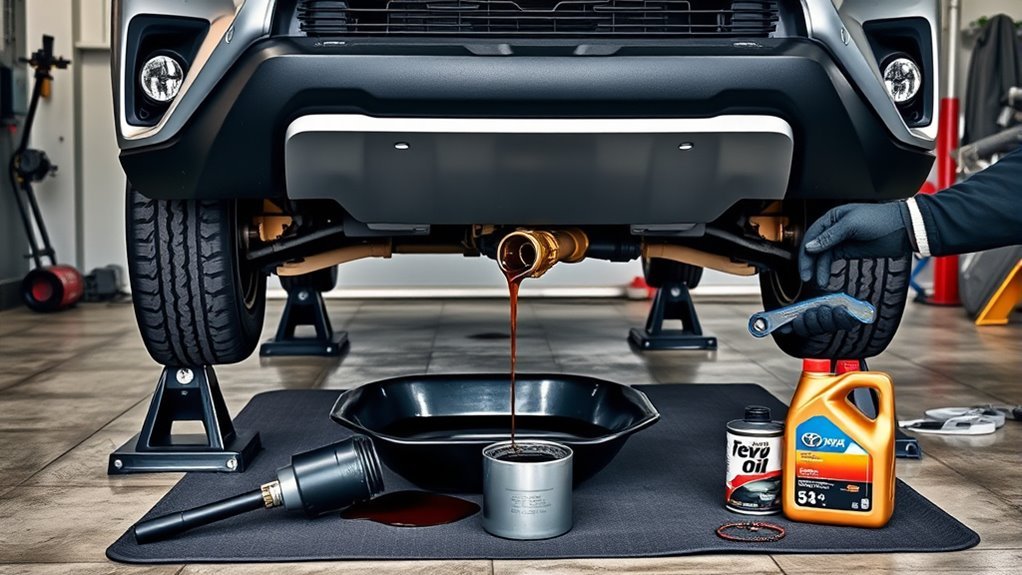
Your RAV4’s VSC light means the vehicle stability control/ABS system detected a fault that limits traction and yaw control. Start with quick checks: gas cap, parking brake, brake fluid, and pedal feel. Scan ABS/VSC and engine codes (e.g., C12449) with an OBD‑II/ABS tool; common causes are wheel speed sensors and brake pedal switch failures. You can replace accessible sensors or the switch yourself, clear codes with a capable scanner, and test drive to confirm—keep going to learn fault‑specific steps.
What the VSC Light on a Toyota RAV4 Means
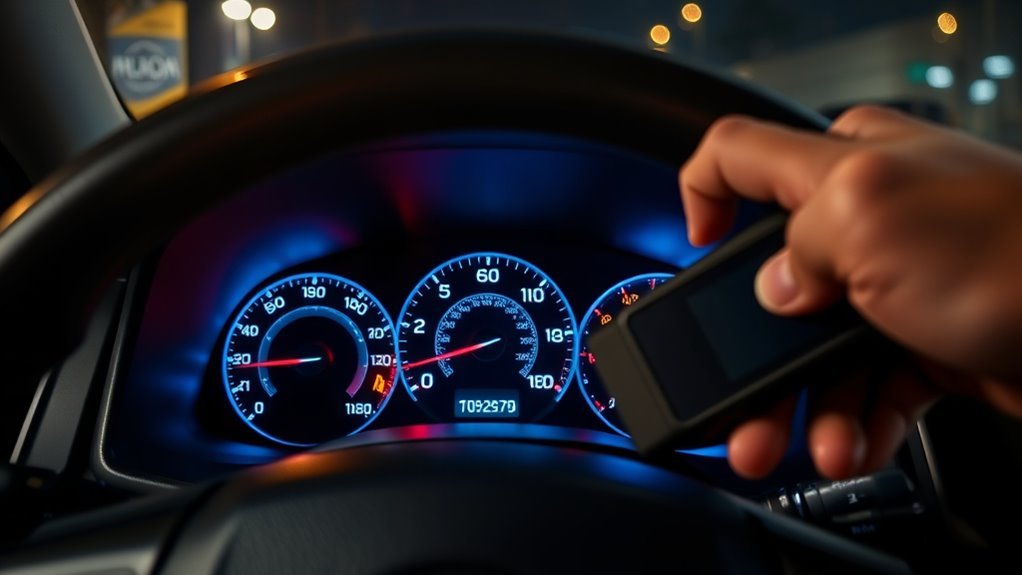
When the VSC (Vehicle Stability Control) light comes on in your Toyota RAV4, it’s warning you that the stability control system has detected a fault—commonly with wheel speed sensors or the brake pedal switch—so the system may not be able to manage traction and yaw. You should treat this as a functional limitation: stability control uses inputs from wheel speed sensors and the brake pedal switch to modulate braking and engine torque. A sensor malfunction, most often a defective wheel speed sensor (about 63% of reported cases), will degrade the system’s ability to detect slip and correct vehicle orientation. If the VSC and Check Engine lights coincide, expect engine-related faults to be influencing control performance. The lamp can extinguish after a restart but will likely recur if the root cause remains. Diagnostic trouble codes, such as C12449 for the brake pedal switch circuit, narrow your repair focus. You’ll want targeted diagnostics rather than guesswork to restore autonomous safety functions.
Quick Checks Before You Open the Hood
Before you pop the hood, do a few quick checks you can complete from outside the engine bay: verify the gas cap is tight, confirm the parking brake is fully released and brake fluid level is within range, and tap the brake pedal to see if the pedal switch feels normal. Tighten the gas cap if loose—this simple step can prevent a Check Engine Light that may cascade into VSC warnings. Visually confirm brake fluid sits between MIN and MAX; low brake fluid often correlates with braking faults and warning lights. Make certain the parking brake disengages fully; a stuck lever will trigger stability control alerts. Press the brake pedal several times and note resistance and travel; a soft or inconsistent feel can indicate master cylinder or pedal switch issues. While driving, listen for abnormal noises or vibrations at the wheels—these hint at sensors or bearings that affect the VSC. Finally, restart the vehicle to see if lights reset; this distinguishes transient faults from persistent failures.
Read OBD‑II and ABS/VSC Codes (Including C12449)
Grab an OBD‑II reader and plug it into the diagnostic port (near the hood release) to pull both engine and ABS/VSC codes—this will reveal stored fault numbers like C12449 tied to the brake pedal switch circuit. You’ll confirm OBD II importance immediately: a code reader shows ABS/VSC faults that stop traction control working. Read and record codes, note freeze frame data, and prioritize safety-related entries such as C12449 (brake pedal switch open). That code signals the switch fails to tell ABS/ESC your brake inputs, risking stability control loss.
| Code | System | Impact |
|---|---|---|
| C12449 | ABS/VSC | Brake switch open |
| P0300 | Engine | Misfire — drivability |
| C0035 | ABS | Wheel speed sensor |
| U0100 | Network | ECU comms failure |
Document results, share with your mechanic, and use the code reader to track recurrence. This empowers you to demand accurate repairs and reclaim control of safety systems.
Clear Codes Safely: Battery, Jumper, and Scanner Methods
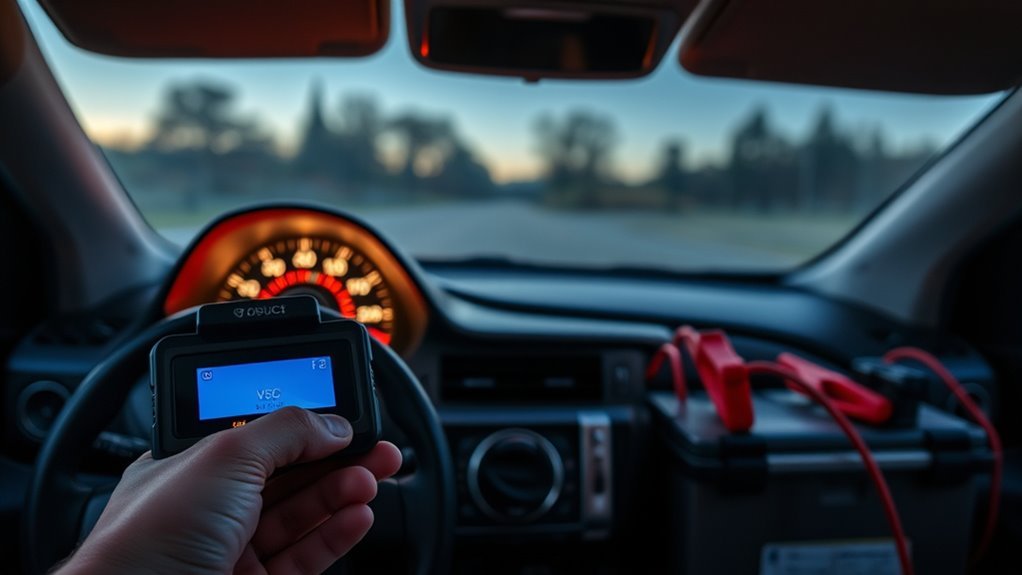
Although disconnecting the battery for a few minutes will reset many engine control memory values, it won’t clear ABS/VSC fault codes stored in their separate module, so you’ll need the jumper method or a proper scanner to fully erase C- and U-class faults. Use battery disconnect only for ECM resets; it won’t erase ABS/VSC stored codes. For ABS/VSC, employ the jumper method: bridge pins 4 and 13 on the diagnostic port to access non-CEL codes, read flash patterns, then clear per factory sequence. A modern OBDII code reader with ABS/VSC capability is preferred — it reads and erases engine, C- and U-class faults, and confirms code counts post-clear. Fuse removal (targeted ECM or ABS fuses) can clear some memories but risks unintended resets; remove power only with ignition off and note radio/security presets. After clearing, verify repairs by driving and monitoring for code return. Regular, controlled clearing liberates you from phantom warnings while ensuring faults truly are resolved.
Common Causes of VSC/ABS Warnings on a 2006 RAV4
Start by checking the brake pedal switch — code C12449 often means an open circuit in that switch and will light both VSC and ABS. Inspect wheel speed sensors and wiring next, since about 63% of ABS faults trace to defective or contaminated sensors causing erratic speed signals. Addressing these two areas, plus routine sensor and bearing maintenance, resolves most VSC/ABS warnings.
Brake Pedal Switch
When your 2006 RAV4 triggers the VSC or ABS lights, check the brake pedal switch first, since an open or faulty switch (diagnostic code C12449) directly interrupts the brake lamp circuit and disables stability control inputs. You’ll want focused brake switch troubleshooting: inspect the switch under the dash, verify connector integrity, and test continuity when the pedal’s depressed. A failed switch commonly causes simultaneous warning lights and limits traction control.
- feel the plastic retainer nut securing the switch beneath the pedal
- visualize disconnecting the wiring harness to check for corrosion
- imagine using a multimeter to confirm open vs. closed states
- picture the switch adjusting until it actuates reliably
- see a clean new unit snapping into place using switch replacement tips
Restore control; reclaim safe mobility.
Wheel Speed Sensors
Wheel speed sensors monitor each wheel’s rotation and feed real-time data to the skid control ECU; if a sensor fails, gets contaminated, or loses signal, the ECU can’t accurately modulate ABS or VSC, triggering the warning lights. You rely on these sensors for stable braking and traction; about 63% of ABS reports trace back to defective wheel speed sensors. Failures can illuminate ABS, traction control, and VSC simultaneously, degrading safety systems. For liberation from persistent warnings, perform regular sensor maintenance: inspect connectors, clean reluctor rings, and remove debris. Use targeted troubleshooting techniques—scan for fault codes, compare wheel speed readings, and swap connectors—to isolate the faulty unit before replacing components or pursuing complex electrical repairs.
Why the Brake Pedal Switch (C12449) Trips VSC Faults
Because the brake lamp switch is the primary input that tells the vehicle whether the brakes are applied, an open-circuit fault (C12449) interrupts that signal and forces the VSC to enter a fail-safe state. You rely on consistent brake switch functionality; a circuit interruption severs communication between the brake system and VSC, so the controller loses a crucial binary input and treats braking status as unknown. That ambiguity disables automated interventions to protect traction and stability, so VSC, ABS, and traction warnings illuminate together. You should understand the system logic: the ECU needs a definitive brake-on/off signal to permit normal VSC strategies.
An open brake-switch circuit leaves the ECU blind, forcing VSC/ABS into fail-safe mode until signal integrity is restored
- Imagine a binary wire carrying permission or veto for stability control.
- Picture the ECU losing a critical sensory channel in traffic.
- Envision traction control staying dormant without brake status.
- See dashboard lamps asserting control when inputs vanish.
- Visualize liberation from risk once the signal integrity is restored.
Restore signal integrity to regain freedom from warning-lamp restraint.
Test and Replace the Brake Pedal Switch : Step‑by‑Step
You’ve seen how an open brake lamp switch (C12449) forces the VSC into fail‑safe mode; now you’ll verify and replace that switch to restore normal ABS/VSC function. Locate the brake pedal switch under the dash, clipped with a plastic retainer nut. Visually inspect for damage, corrosion, or a loose connector. For brake switch testing, depress the pedal repeatedly while an assistant watches the brake lights or use a multimeter across the switch terminals: expect continuity when the pedal is pressed (or released depending on design). If the circuit remains open or intermittent, prepare for switch replacement.
To replace, disconnect the battery, unplug the switch connector, remove the retainer nut, swap in the OEM switch, reseat the nut, reconnect, and restore battery power. After installation perform multiple brake applications to confirm reliable contact and that VSC/ABS/CEL warnings clear. Proper brake switch testing and timely switch replacement restore traction control and ABS, returning mechanical freedom and safety.
Check Wheel Speed Sensors, Wiring, and Connectors
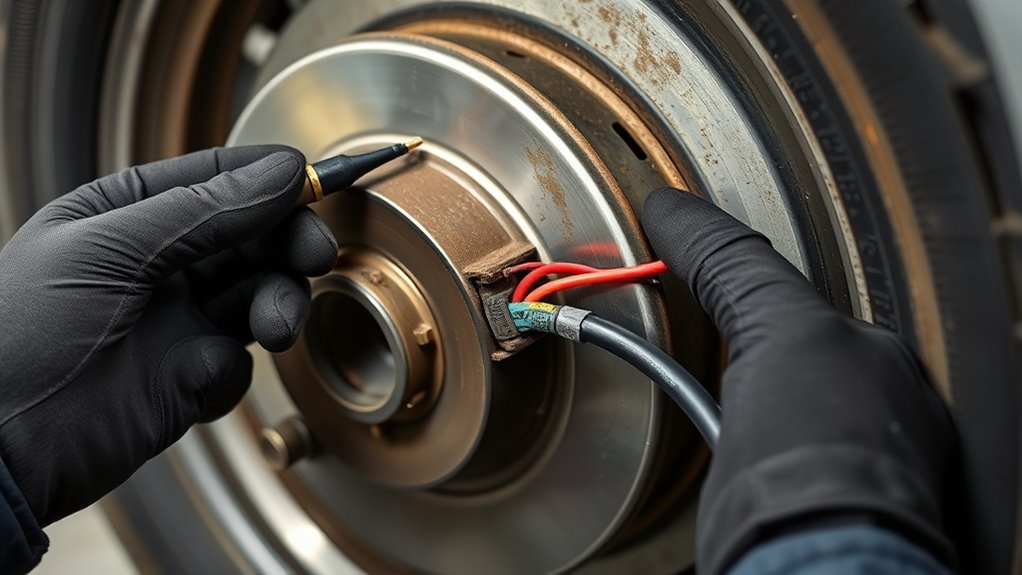
When diagnosing VSC/ABS warnings, start by inspecting each wheel speed sensor, its wiring harness, and connectors for damage, corrosion, or contamination that can interrupt the signal to the skid control ECU. You’ll perform sensor maintenance and wiring inspection to restore reliable wheel-speed data flow. Use an OBDII reader to pull fault codes that localize the faulty sensor or circuit. Clean sensors with appropriate solvent, check air gaps, and verify connector pins for continuity and corrosion. If cleaning or repair doesn’t clear codes, replace the defective sensor to regain VSC/ABS function.
- A soiled sensor lip clogged with debris, hiding a 63% probable fault cause.
- A frayed harness rubbing against suspension components.
- Corroded connector pins with green/white oxidation.
- Bent or missing reluctor ring teeth altering pulse timing.
- A clean sensor reinstalled with correct air gap and secure clip.
Act decisively: accurate diagnosis and targeted sensor maintenance free you from recurring warnings and restricted mobility.
When to DIY vs. When to Visit a Mechanic or Dealer (RAV4)
If the VSC and CEL set a code for a brake pedal switch or a clearly identified wheel speed sensor fault, you can replace those accessible parts yourself with an OBDII reader and basic tools. If codes indicate multiple systems, complex wiring faults, intermittent resets, or you experience reduced braking or steering feel, see a mechanic or dealer immediately for safety and advanced diagnostics. Document intermittent events and codes before you go so the technician can reproduce and trace deeper electrical issues.
When To DIY
Because many VSC triggers on a RAV4 are caused by simple, measurable faults, you can often troubleshoot and fix them yourself—start with an OBDII scan to read DTCs, check the gas cap for a seal issue (a common CEL cause), and inspect obvious components like the brake pedal switch or wheel speed sensors. Use VSC troubleshooting tips and follow DIY safety precautions: work on a cooled vehicle, use jack stands, and disconnect the battery for electrical work. Replace a failed brake pedal switch (e.g., C12449 open circuit) or tighten/replace a loose gas cap before escalating. If multiple lights persist or you feel shaking at speed, stop and seek professional diagnosis.
- OBDII reader connected
- Worn wheel speed sensor exposed
- Faulty brake pedal switch removed
- Loose gas cap threads
- Car stable on jack stands
When To See Dealer
Although some VSC faults are simple enough to handle at home, you should take your RAV4 to a dealer or qualified mechanic whenever the VSC light stays on after basic checks (OBDII scan, gas cap, brake pedal switch), when the VSC illuminates alongside the Check Engine or ABS lights, or when driveability issues (shaking, reduced braking performance, or erratic traction control) occur. You’ll need professional diagnostics for C12449 or persistent codes, open circuits, and wheel-speed sensor failures. Use VSC troubleshooting tips to confirm simple fixes first, then escalate.
| Issue | Recommended action |
|---|---|
| VSC + CEL/ABS | Dealer diagnostic scan |
| Persistent VSC | Professional repair |
| Driveability faults | Immediate service |
Discuss dealer service options; insist on documented faults and liberated decision-making.
Verify the Repair and Prevent the VSC Light From Returning
When you finish replacing the brake pedal switch, immediately verify the repair by driving the vehicle and observing whether the VSC, ABS, or traction control lights reactivate. You’ll test brake performance and confirm VSC troubleshooting success by performing repeated, controlled stops at low speeds while noting pedal feel, response, and warning light status. Scan with an OBDII reader to clear old codes and watch for new diagnostic trouble codes that could signal hidden faults. Inspect brake fluid level and around calipers for leaks; any loss or seepage can re-trigger the system. Include wheel speed sensor checks and routine brake-component maintenance to lock in reliability and freedom from recurring faults.
- Firm, repeatable pedal strokes on dry pavement
- OBDII reader displaying no VSC/ABS codes
- Brake fluid reservoir at proper level, no wet spots
- Clean, intact wheel speed sensors at each hub
- Consistent stopping distances without warning-lamp flicker
Follow this regimen to secure lasting repair and reclaim confident control.
Frequently Asked Questions
Why Is the VSC Light on in My RAV4?
Your VSC system light’s on because the traction control detected faults—often wheel speed sensors, brake pedal switch, or engine/ABS issues. You should scan codes, inspect sensors, and fix the root cause to reclaim control and freedom.
How Do You Fix the VSC Light on a Toyota?
Fix it by diagnosing faults: check brake system switches and brake pedal switch first, scan OBDII for DTCs, inspect wheel speed sensors and bearings, tighten the gas cap, replace faulty parts, then test traction control while driving.
Can I Drive My Toyota With the VSC Light On?
Yes — you can drive with the VSC system light on, but you shouldn’t ignore it. It’ll often allow basic operation, yet driving safety can be compromised; check codes, address faults promptly to regain full control.
Conclusion
The VSC light is a dashboard compass: when it glows, it warns you the vehicle’s stability control has lost its bearing. You’ve checked basics, scanned and cleared codes, tested the brake pedal switch and wheel sensors, and repaired faulty wiring or parts as needed. Treat fixes like recalibrating an instrument—precise, methodical, documented. If uncertainty or persistent codes remain, hand it to a dealer or trusted technician to restore reliable steering and safety.