
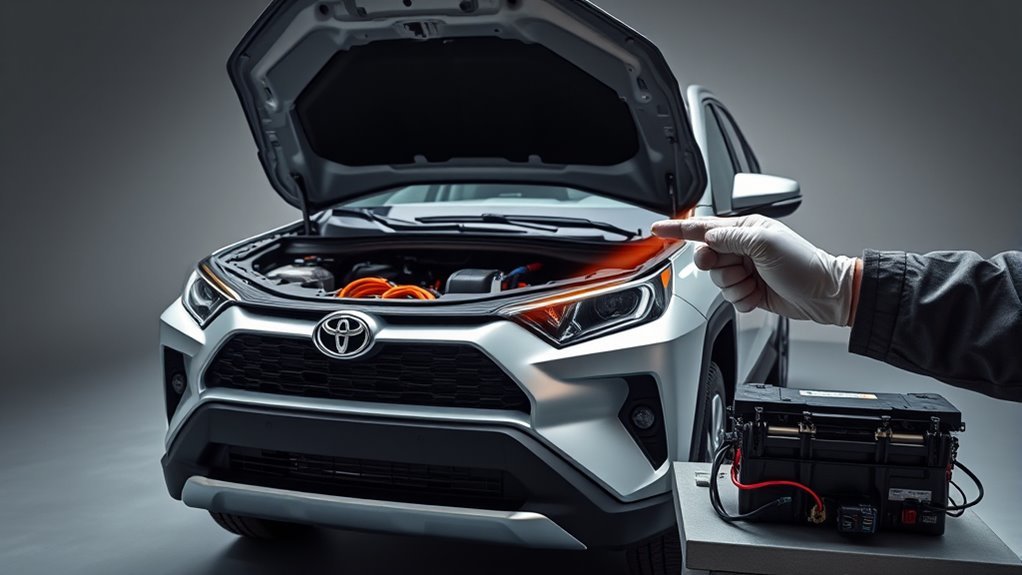
You’ll find the RAV4 Hybrid uses a series‑parallel power‑split design that routes torque mechanically, electrically, or combined to minimize losses. Its MG1 starts the Atkinson engine and manages charging while MG2 supplies drive torque and regen; an inverter bridges the battery and motors. A self‑charging battery and power‑split planetary gear optimize efficiency across EV, gas, and hybrid modes, with an independent rear motor for AWD. Keep going and you’ll uncover detailed startup, mode, and regen behaviors.
RAV4 Hybrid Design: Series‑Parallel Basics

Because Toyota combines mechanical and electrical pathways, the RAV4 Hybrid uses a series‑parallel architecture that optimizes power flow between the gasoline engine and electric motors. You’ll see series parallel efficiency in action as the system decides whether to route torque mechanically, electrically, or split it across both sources to minimize losses. You’ll rely on the planetary gear set as the core power‑split device: it mediates engine speed, generator torque, and wheel output to match demand with minimal frictional and conversion penalties. Hybrid powertrain dynamics become a control problem you can trust—MG1 manages engine start and battery charge, while MG2 supplements propulsion during acceleration and regenerative braking returns energy to the battery. You’ll experience seamless shifts among electric‑only, gas‑only, and combined modes without manual intervention, preserving momentum and reducing fuel use. The result is a liberated driving experience where energy flows adaptively, prioritizing efficiency and responsiveness over fixed mechanical constraints.
Key Components : Battery, Inverter, MG1/MG2 & Power‑Split Gear (Roles & Maintenance Signs)
While each component performs a distinct function, they work as an integrated system that balances energy flow between the engine and the wheels: you rely on a self-charging hybrid battery that receives energy from the engine and regenerative braking, so you won’t need external charging. The inverter converts DC to AC, preserving inverter efficiency and supporting the 12‑volt system. MG1 starts the engine silently and manages battery charging; MG2 delivers propulsion torque to augment performance and efficiency. The power‑split (planetary) gear allocates torque between engine and motors to optimize fuel use.
- Battery: monitor state-of-charge trends to predict battery lifespan; consistent regeneration and engine charging maintain usable capacity.
- Inverter & MGs: watch for unusual inverter noises and any loss of MG2 acceleration—these reduce inverter efficiency and propulsion reliability.
- Power‑split gear: listen for atypical gear noises and heed battery or hybrid-system warnings; early diagnosis preserves drivability and freedom.
Startup, Driving Modes, and How Power Flows in Normal Operation
Having covered each hardware element and its warning signs, let’s look at how they come alive when you start and drive the RAV4 Hybrid. Your startup sequence begins with a push of the start button; ECUs wake, run self-checks, and verify hybrid EV battery status before enabling drive. The inverter converter comes online to manage voltage and keep the 12‑volt battery charged.
In normal operation, you control selectable driving modes that bias the system toward efficiency or performance while you remain liberated from constant gear management. Power distribution shifts dynamically: the hybrid EV battery feeds the inverter, MG1 can spin to silently start the Atkinson engine or charge the battery, and MG2 supplements torque under acceleration. The Atkinson engine contributes when load or battery state demands, its cam timing tuned for lower emissions and economy. Energy flows are constantly optimized by control logic across ECUs to maximize efficiency and responsiveness without sacrificing drivability or your freedom to choose how you move.
How RAV4 Regenerative Braking Recharges the Hybrid Battery (What to Expect)
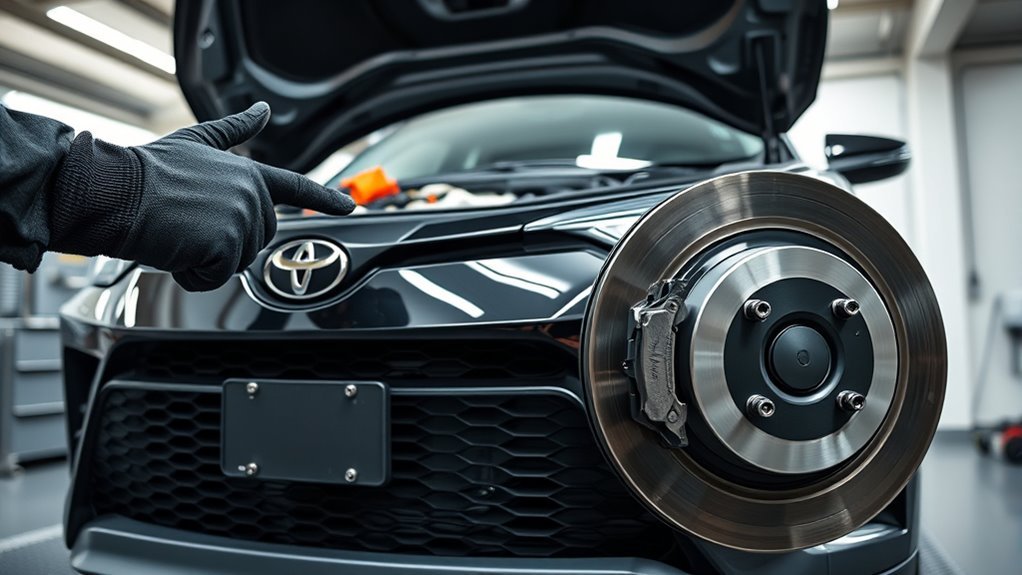
When you lift off the accelerator or apply the brakes, the RAV4’s regenerative system shifts MG2 into generator mode to convert kinetic energy into electrical energy that recharges the hybrid battery. You’ll feel a controlled deceleration as MG2 harvests motion, replacing some hydraulic brake work and improving braking efficiency. The vehicle’s ECUs blend regen and friction braking seamlessly, so you keep authority while maximizing energy capture during coasting and stop‑and‑go traffic. Expect higher state‑of‑charge retention, better fuel economy, and reduced wear on brake components.
- Measure: sensors and ECUs monitor speed, pedal input, and battery state to modulate regen torque for peak energy capture.
- Shift: at higher deceleration demands, friction brakes supplement MG2; control logic prioritizes safety and efficiency.
- Outcome: repeated urban braking cycles let you reclaim substantial kinetic energy, sustaining the hybrid battery and extending range.
This system frees you from excess consumption by converting routine deceleration into reusable electrical energy.
RAV4 Hybrid AWD: Rear Motor, Behavior, and Real‑World Benefits
Because the RAV4 Hybrid’s AWD uses an independent rear motor-generator rather than a mechanical driveshaft, you get on-demand rear torque, regenerative energy capture at the rear axle, and improved traction without a heavy, complex transfer case. You’ll notice rear motor performance that’s instant and controllable: the unit can engage independently to supply torque to the rear wheels when sensors detect slip or when driving demands require extra grip. That independence enables targeted traction management strategies without mechanical drag or significant weight penalties, preserving fuel efficiency.
During deceleration or coasting the rear motor regenerates energy to the hybrid battery, increasing system efficiency and extending your range. In practical terms you gain confidence in adverse weather, predictable handling during evasive maneuvers, and improved off-road capability on loose surfaces. The system’s minimal mass and electronic control let you prioritize responsiveness and liberation from conventional drivetrain compromises while maintaining economy and stability.
Frequently Asked Questions
What Are the Different Levels of a Toyota RAV4 Hybrid?
You get LE, XLE, XLE Premium, Adventure, and Limited trims; you’ll assess Trim Levels, Performance Features, Safety Ratings, and Interior Options analytically, so you can choose the model that maximizes capability, comfort, and independent mobility.
Conclusion
You’ve seen how the RAV4 Hybrid’s series‑parallel architecture coordinates battery, inverter, MG1/MG2 and the power‑split gear to balance efficiency and performance. Expect regenerative braking to recapture energy and the rear motor to add on‑demand AWD traction. One compelling stat: the system can redirect up to ~94% of engine torque through MG2 during acceleration peaks, maximizing electric assist and reducing fuel draw. Monitor temps, noises and SOC for efficient, long‑lived operation.




[…] feature works. EV mode does not give you unlimited electric driving. It does not replace a plug-in hybrid system. You should use it for quiet, short maneuvers like parking or moving through slow streets. Do not […]