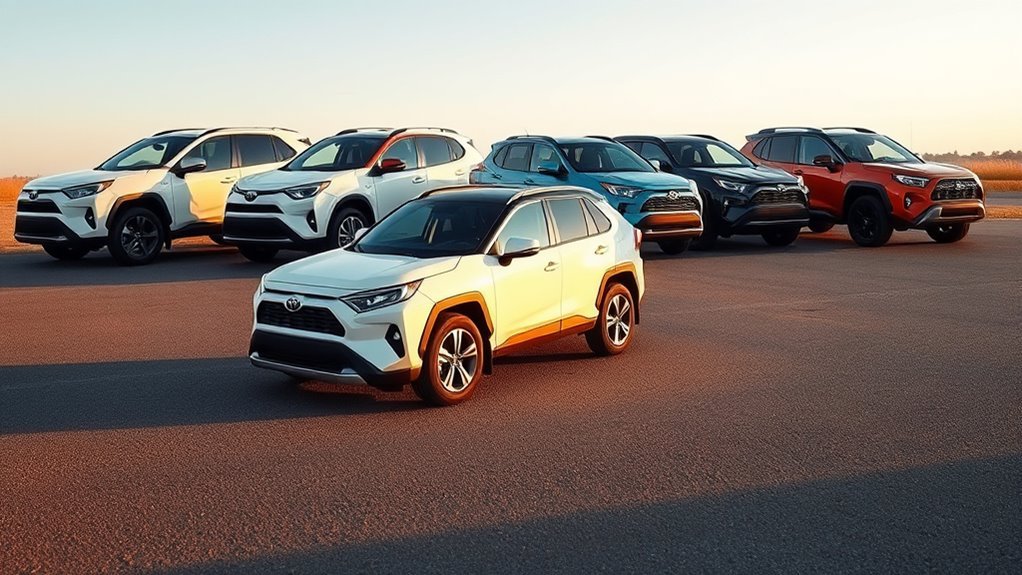
You’ll see the RAV4 evolve from a compact 1996 crossover into a versatile, electrified family SUV across six generations. Early models gave you a 2.0L with FWD or selectable AWD; later generations added 2.4L and 3.5L V6 options, hybrids, and a plug‑in Prime. The current TNGA‑K lineup (2019–2025) adds Dynamic Torque Vectoring AWD and TRD off‑road trim, while 2026 brings a full redesign and expanded electrification—keep going to get year‑by‑year details.
Quick RAV4 Generations Snapshot (1996–Present)
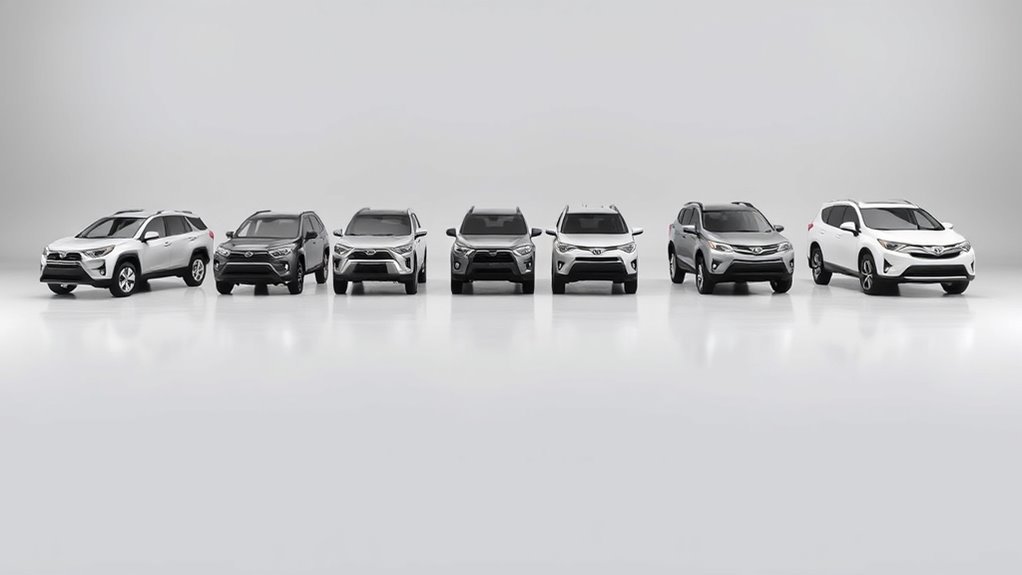
Although it’s evolved through five distinct generations since its 1996 U.S. debut, the RAV4 has consistently balanced carlike handling with SUV utility. You’ll see how Toyota advanced practicality and performance across clear phases: the original compact crossover offered two- and four-door choices to stake an urban-versatile claim; the second generation refined styling and added engine breadth, including a 2.4-liter Camry-shared unit; the third expanded interior space and introduced a potent 3.5-liter V6 for more spirited driving; the fourth removed the V6 and prioritized efficiency with a hybrid variant while modernizing design cues; the fifth embraced the TNGA-K platform, ruggedized the stance, and brought hybrid and plug-in hybrid options that helped it become a U.S. bestseller. This snapshot highlights RAV4 innovations that shifted priorities from size and power to efficiency and modular architecture, positioning Toyota to respond to shifting consumer demand and intensifying market competition without compromising the model’s liberating practicality.
What “RAV4” Means and How Drivetrains Evolved
You’ll want to start by noting that RAV4 stands for “Recreational Active Vehicle with 4-Wheel Drive,” a name that’s guided its market positioning since 1994. Trace the drivetrain timeline from the original 2.0-liter FWD/AWD options through the 2.4- and 3.5-liter upgrades and the shift to automatic transmissions for V6 models. Then compare AWD versus FWD choices and the recent addition of hybrid gas‑electric systems to show how utility and efficiency evolved.
Meaning Of RAV4
Because Toyota wanted a compact vehicle that could handle light off-road use while still driving like a car, it christened the model RAV4—short for “Recreational Active Vehicle with 4‑Wheel Drive”—a name that signals its SUV aspirations and initial AWD focus. You’ll track RAV4 history through engines and intent: a 1996 2.0L four, later 2.4L and a 3.5L V6, then a 2.5L four and hybrid/PHEV systems. That evolution shaped RAV4 features—cargo flexibility, carlike handling, and efficiency gains—so you can choose freedom without compromise. In RAV4 comparisons, fuel economy and drivetrain sophistication became decisive. In the RAV4 market, Toyota leveraged versatility and progressive powertrains to broaden appeal, liberating buyers from tradeoffs between capability and economy.
Drive System Timeline
When you trace the RAV4’s drivetrains, the name’s promise—Recreational Active Vehicle with 4‑Wheel Drive—shows how Toyota balanced everyday comfort with increasing capability: you see clear drive system advancements across generations. Early RAV4s (1996–2000) gave you simple drivetrain options—FWD or selectable 4WD—so you could choose freedom or efficiency. The 2001–2005 second generation kept FWD and AWD, added a stronger 2.4L engine for more confident motion. By 2006–2012, you gained a 3.5L V6 alongside efficient four‑cylinder choices, letting performance or economy guide your choice. In the fifth generation (2019–2025), Dynamic Torque Vectoring AWD sharpened handling and traction, liberating you to push limits with control. The timeline maps practical evolution, not hype.
AWD Vs. FWD Options
Curious which drivetrain fits your needs? You’ll find the RAV4—Recreational Active Vehicle with 4-Wheel Drive—has offered both AWD and FWD across generations so you can choose freedom over compromise. Early models let you pick FWD efficiency for urban driving and daily fuel savings, or AWD benefits for light trails. Later generations sharpened that choice: third-gen AWD improved traction control and handling, especially with the V6, while fifth-gen Dynamic Torque Vectoring ups off road capability and weather performance without surrendering agility. Assess your drivetrain preferences by prioritizing where you drive: pick FWD for economy and city life, or AWD for secure grip in poor weather and rough terrain. That clarity liberates your decision.
First Generation (1996–2000): Key Specs and Trims
You’ll find the first-gen RAV4 paired to a 2.0-liter inline-four making 121 hp, with your choice of front-wheel or four-wheel drive and the monocoque chassis that sharpened handling. Trim choices ranged from basic utilitarian packages to well-equipped LE/XE levels, and options included a brief two-door/convertible lineup before the U.S. market moved to four-doors only. Evaluating these engine, drivetrain, and trim trade-offs explains why the model won 1997 Automobile of the Year and reshaped the compact-SUV segment.
Engine And Drivetrain
A compact, efficient powertrain defined the first-generation RAV4: a 2.0‑liter inline‑four making 121 hp, offered with either front‑wheel or selectable four‑wheel drive and paired to a 5‑speed manual or a 4‑speed automatic. You get straightforward engine performance that favors economy and responsiveness over excess. The monocoque structure lightens weight, sharpening handling and aiding fuel efficiency (about 21–23 mpg), so you can move with less compromise. Drivetrain technology is simple, durable, and user-focused, letting you choose traction when needed without complexity.
- 2.0L I4 — 121 hp: balanced power for daily freedom
- FWD or selectable 4WD: control and versatility
- 5‑speed manual / 4‑speed auto: driver choice prioritized
- Monocoque lightness: improved handling and efficiency
Trim Levels & Options
Beyond its economical powertrain, the first‑generation RAV4 gave buyers straightforward choices in trim and body style that matched its practical engineering. You’d pick between two‑door (hardtop or soft‑top convertible) and four‑door bodies, and between FWD or AWD, aligning freedom of use with decisive simplicity. Base trims kept essentials; higher trims added air conditioning and upgraded audio, improving comfort without excess. Its compact footprint and nimble handling favored urban liberation and occasional light off‑roading, while interior features stayed functional and durable. Safety ratings were modest by today’s standards but adequate then, reinforcing sensible independence rather than indulgence.
| Trim | Key options |
|---|---|
| Base | Essential features |
| Mid | A/C, better audio |
| Top | AWD, extras |
| 2‑door | Hard/soft top |
| Drivetrain | FWD or AWD |
Second Generation (2001–2005): Safety and Redesign Highlights
While refining its silhouette and trimming body cladding, Toyota redesigned the RAV4 for 2001–2005 to deliver a cleaner, more modern look and greater interior space, and it upgraded safety and powertrain options to match shifting buyer expectations. You’ll notice safety advancements like Vehicle Stability Control and multiple airbags became standard, lifting crash performance and giving you confident control. Interior upgrades expanded passenger room and utility, so you can carry people and gear without compromise. Powertrain choices matured too: the longstanding 2.0-liter stayed available while a more efficient 2.4-liter arrived in 2004, improving performance and fuel economy. Toyota also streamlined the lineup, dropping the two-door for U.S. buyers to focus resources on the five-door’s versatility.
Cleaner lines, improved safety and space, and a stronger 2.4L option—Toyota focused the RAV4 on practical, modern versatility.
- Standard stability control and more airbags increased occupant protection.
- Enlarged cabin dimensions enhanced comfort and cargo flexibility.
- 2.4-liter engine (2004) boosted midrange power and efficiency.
- Single five-door focus aligned product with practical freedom.
Third Generation (2006–2012): Bigger Platform and V6 Option
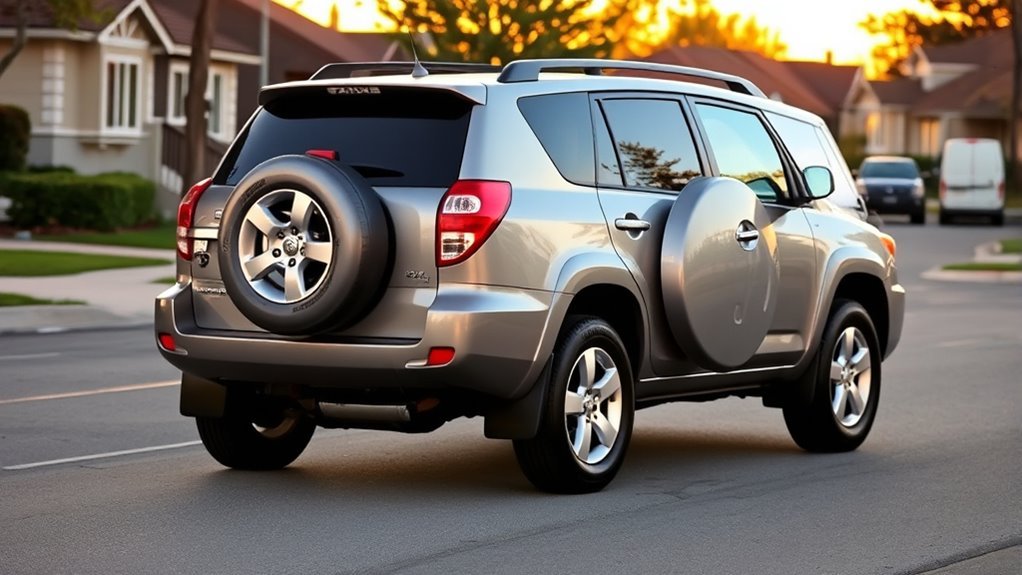
For 2006–2012 the RAV4 moved to a larger platform that boosted interior volume by about 21%, giving you noticeably more passenger room and cargo flexibility. You gain tangible interior upgrades: roomier seats, smarter storage, and a cabin that lets you reorganize life on the move. Cargo space expands meaningfully, so gear, groceries, or escape plans fit without compromise.
Engine performance scales up with an available 3.5-liter V6 delivering nearly 270 hp and a five-speed automatic that prioritizes smooth, confident acceleration. A four-cylinder remained for efficiency, while manual transmissions were dropped in favor of automatics for everyday ease.
Toyota also sharpened driving dynamics and stability, pairing responsive handling with practical safety features—airbags, stability control, and refined crash protection—so you can push boundaries with assurance. This generation balances freedom and logic: more room, stronger propulsion, and considered safety and cargo capacity for drivers who want capability without excess.
Fourth Generation (2013–2018): Redesign and Hybrid Debut
When the fourth-generation RAV4 debuted at the 2012 Los Angeles Auto Show, Toyota gave the model a sharper, more angular look, dropped the V6 in favor of a 2.5-liter four-cylinder with a six-speed automatic, and set the stage for a 2016 hybrid that raised output to 196 hp while improving fuel economy. You see a clear RAV4 redesign that strips excess and prioritizes efficiency and utility. Toyota removed the rear spare tire carrier for a cleaner hatch and kept a conventional roof-hinged liftgate. The 2015 refresh tightened styling and added tech that reinforced the model’s market position. The 2016 hybrid technology entry changes the equation: combined system output climbs, fuel use falls, and the RAV4 shifts toward liberated mobility for drivers who want less compromise.
- Angular styling and cleaner hatch
- 2.5L four-cylinder, six-speed automatic
- 2015 mid-cycle tech and styling updates
- 2016 hybrid technology, 196 hp and improved economy
Fifth Generation (2019–2025): TNGA‑K, Hybrid/Prime, TRD Off‑Road
The fifth‑generation RAV4, introduced in 2019 on Toyota’s TNGA‑K platform, sharpened driving dynamics and ride quality while broadening powertrain choice to meet varied buyer priorities. You’ll find clear Powertrain Options: a conventional gasoline engine, a 219‑hp RAV4 Hybrid, and the RAV4 Prime plug‑in hybrid that delivers 302 hp and roughly 42 miles of all‑electric range. Those choices free you from compromise—efficiency, performance, or electric driving are selectable without surrendering utility.
Toyota also addressed terrain, not just pavement. The TRD Off‑Road trim adds suspension tuning, rugged styling, and hardware that enhance Off Road Capabilities for real‑world trails, giving you confidence when you push limits. In 2023 Toyota Safety Sense 2.5 further strengthened active safety and driver assists, so you can explore with more assurance. The overall package is pragmatic and empowering: refined chassis dynamics, diversified powertrains, and dedicated off‑road intent let you choose how liberating your drive becomes.
Sixth Generation (2026–Present): Full Redesign and Electrified Lineup
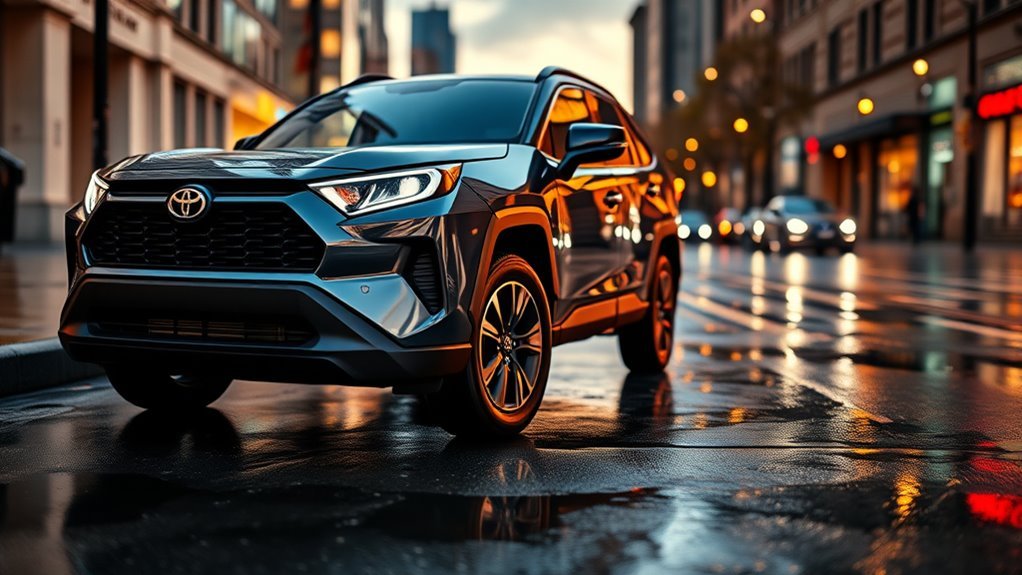
Building on the fifth generation’s broader powertrain choices and off‑road focus, Toyota reimagined the RAV4 for 2026 with a full redesign that prioritizes efficiency, technology, and sharper styling. You’ll find an electrified lineup centered on exclusive hybrid and plug‑in hybrid powertrains that push hybrid innovations while lowering emissions. The cabin and exterior are cleaner, more purposeful, and tuned for practical freedom.
Reimagined for 2026: a sharper, electrified RAV4 focused on efficiency, tech, and practical freedom.
- Hybrid architecture — optimized for efficiency and real‑world range, letting you go farther with less compromise.
- GR Sport trim — introduces race‑inspired touches and tangible performance enhancements for drivers who crave engagement.
- Tech and safety — expanded driver assistance builds on Toyota Safety Sense 2.5, giving you confident, liberated control.
- Market impact — refreshed aesthetics and versatile capability keep the RAV4 a best‑seller, appealing to buyers seeking autonomy and dependability.
You’ll appreciate a vehicle designed to liberate daily mobility without sacrificing economy, capability, or advanced safety.
How to Pick the Right RAV4 Year: Fuel Economy, Reliability, Resale
Want the best balance of fuel economy, reliability, and resale? You’ll choose by prioritizing: eco efficiency, proven durability, or lowest cost of ownership. Use fuel efficiency comparison and reliability ratings as your decision anchors. The fifth-generation (2019–2025) 2.5L hits 27–35 mpg; the 2016 hybrid posts ~33 city/30 highway. Third-generation models (2006–2012) score high on reliability ratings and low maintenance. Second-generation (2001–2005) suits budget seekers with 22–28 mpg and sensible costs. The 2020 model retains about 56% of its value after five years, so newer RAV4s protect resale.
| Generation | Fuel (mpg) | Strength |
|---|---|---|
| 2019–2025 | 27–35 | Fuel efficiency comparison winner for non-hybrid |
| 2016 (Hybrid) | 30–33 | Best hybrid economy |
| 2006–2012 | 22–28 | Reliability ratings strong |
| 2001–2005 | 22–28 | Budget-friendly resale |
Decide which metric frees you — economy, longevity, or investment — then pick the year that matches.
Frequently Asked Questions
What Years of RAV4 Are Different Generations?
You’ll find RAV4 generations by years: 1994–2000, 2000–2005, 2006–2012, 2013–2018, 2019–2025. You’ll assess RAV4 features and RAV4 comparisons to choose the liberated, best-fitting model.
What Years Are the 5th Generation RAV4?
The 5th generation RAV4 ran from 2019 through 2025. You’ll evaluate 5th Generation Features and RAV4 Performance critically, seeing improved power, hybrid efficiency, rugged styling, and refined off-road capability that liberates your driving choices.
What Is the Best Generation of the RAV4?
You’ll pick the fifth generation as best: performance comparison favors its 203‑hp engine and hybrid options, safety features are strongest, and its rugged, liberating design feels invigoratingly futureproof—like a pocket-sized steam engine.
Conclusion
Across decades, the RAV4’s steady evolution keeps delivering sensible choices whether you want thrift, comfort, or a bit more punch. You’ll find practical classics in older years, efficient hybrids in mid generations, and a bolder, electrified lineup now—each with predictable reliability and resale calm. Weigh fuel economy, features, and budget like you would a dependable map, and you’ll steer confidently to the RAV4 year that fits your daily route.