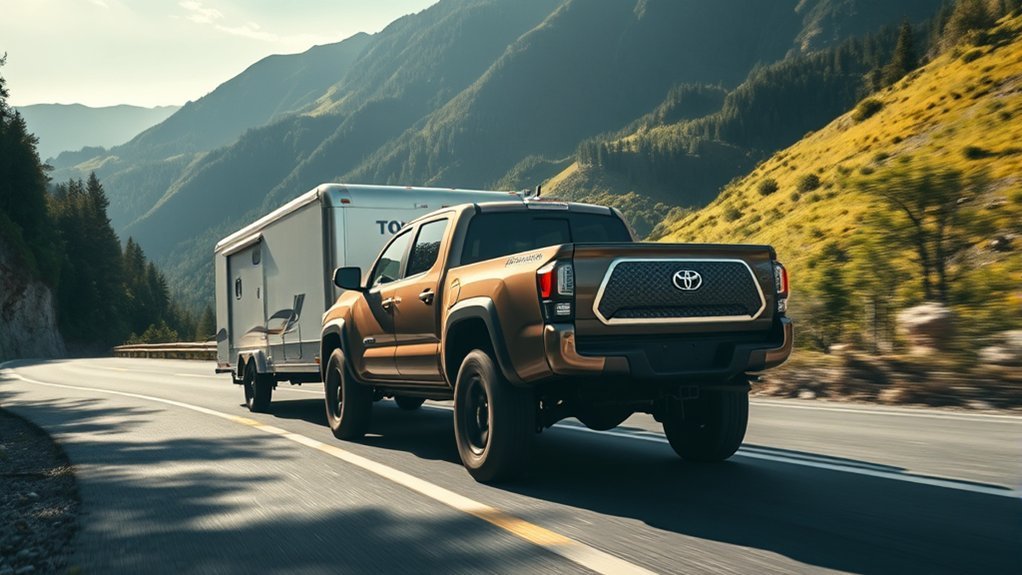
Trailer sway in a Toyota Tacoma is usually a setup problem, not a truck problem. The most common triggers are too little tongue weight, a rear-heavy trailer, an overloaded payload, low tire pressure, weak trailer brakes, or driving too fast for wind and road conditions. Before you tow, check your Tacoma owner’s manual, weigh the loaded trailer, and set up the hitch so the truck and trailer sit level.
Quick Answer
Trailer sway in a Toyota Tacoma is most often caused by poor weight distribution, especially too little tongue weight or too much cargo behind the trailer axle. For recent Tacomas, Toyota lists a conventional towing tongue-weight target of 9% to 11% of loaded trailer weight. Load correctly, use proper sway control, and slow down early.
Key Takeaways
- Use your Tacoma owner’s manual and door-jamb ratings first; towing capacity, payload, tongue weight, GVWR, GAWR, and hitch rating all matter.
- For recent Tacoma conventional towing, aim for Toyota’s 9% to 11% tongue-weight range unless your specific manual says otherwise.
- Rear-heavy loading is a major sway trigger. Keep heavier cargo low, secured, and forward of the trailer axle without exceeding tongue-weight or payload limits.
- Trailer Sway Control can help, but it does not replace proper loading, a rated hitch, working trailer brakes, correct tire pressure, and safe speed.
- If sway starts, hold the wheel straight, ease off the accelerator, avoid sudden steering, and use the trailer brake controller manually if equipped.
At a Glance
| Time Required | 30 to 90 minutes for a full pre-tow setup and scale check |
| Difficulty | Moderate; simple checks are easy, but hitch setup may require careful measuring |
| Tools Needed | Owner’s manual, tire pressure gauge, torque wrench, tongue-weight scale or public scale, cargo straps, brake controller if your trailer has electric brakes |
| Cost | Free if you already have the gear; otherwise varies by scale fee, sway-control device, brake controller, or weight-distribution hitch |
What Causes Trailer Sway in Toyota Tacoma?
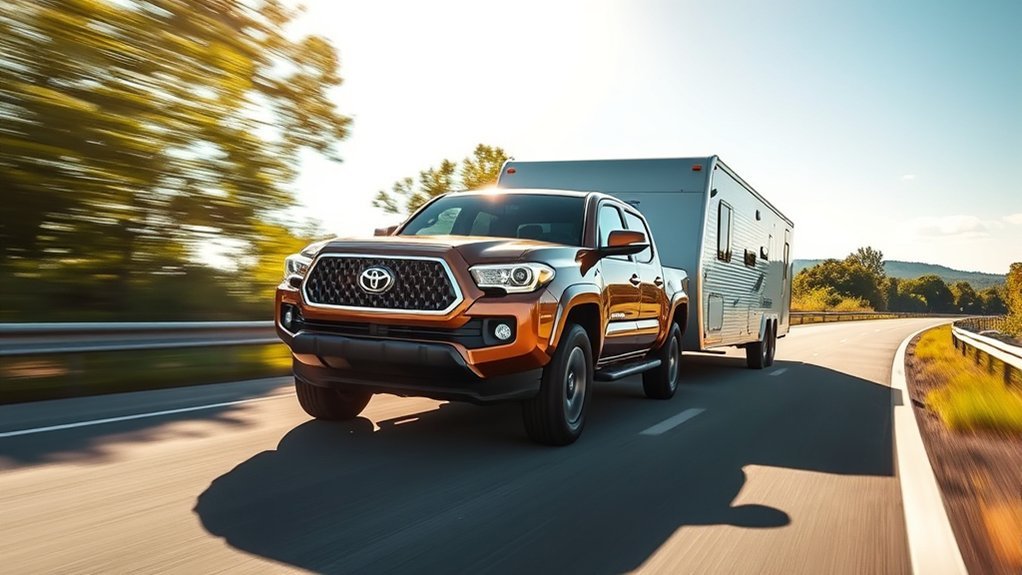
Trailer sway happens when the trailer starts moving side to side behind the Tacoma. A small wiggle can grow quickly if the trailer is loaded wrong, the hitch is not set correctly, or the driver reacts too sharply.
The biggest cause is improper weight distribution. Toyota’s 2026 Tacoma trailer-towing manual says conventional trailer weight should be distributed so the tongue weight is 9% to 11% of gross trailer weight. Too little tongue weight can let the trailer pivot and sway. Too much tongue weight can overload the rear of the truck, lighten the front axle, and make steering feel vague.
Other common sway causes include:
- Rear-heavy cargo: Too much weight behind the trailer axle can create a pendulum effect.
- Overloaded Tacoma payload: Tongue weight counts against the truck’s payload, along with passengers, cargo, accessories, and gear in the bed.
- Incorrect hitch height: A nose-high or nose-low trailer can reduce stability and cause uneven tire loading.
- Low tire pressure: Underinflated truck or trailer tires can reduce control and increase heat buildup.
- Weak or poorly adjusted trailer brakes: A heavy trailer can push the truck during braking if the brakes are not working correctly.
- Speed, wind, and passing trucks: Sway is more likely as speed rises, especially in crosswinds or when large vehicles pass.
- Loose cargo: Cargo that shifts during the trip can change tongue weight after you already started driving.
Warning: Do not judge safety by the Tacoma’s maximum tow rating alone. Toyota lists current 2026 Tacoma towing capability up to 6,500 lb and payload up to 1,705 lb when properly equipped, but your exact safe limit depends on trim, drivetrain, payload, passengers, cargo, hitch rating, trailer brakes, and the loaded trailer weight.
How to Prevent Trailer Sway Effectively
To prevent trailer sway with a Toyota Tacoma, start with the loaded trailer, not the empty trailer number on the brochure. The trailer’s real weight includes water, fuel, tools, camping gear, coolers, spare parts, and anything else you add before the trip.
[Products Worth Considering]

The Pigenius windshield sunshade protects your Tundra's interior from heat and UV damage while keeping the cabin cool. Its accordion design folds easily for storage and quick setup, and the triple‑laminate construction provides durable, reflective protection. Ideal for long trips and daily commutes, it guards dashboards, seats, and steering wheels from sun‑related wear.

Stay warm and keep control with the KVAEY fluffy steering wheel cover. Its high‑density plush provides a soft, comfortable grip while the anti‑slip rubber liner ensures safety during winter drives. Easy to install and fits 15‑inch wheels on cars, trucks, and SUVs, adding a cozy, stylish touch to any interior.

The SCUARI Wiper Arm Removal Tool offers a durable carbon steel construction and an adjustable knob for flexible height control, making it easy to detach wiper arms on cars, SUVs, and trucks. Its rotating handle and secure locking screw ensure safe, damage‑free removal, while the compact collar fits most standard wiper arm sizes. Ideal for both DIY owners and professional mechanics seeking quick, reliable service.
1. Confirm Every Weight Rating First
Before hitching up, check these ratings:
- TWR: Trailer Weight Rating, or the maximum loaded trailer weight your Tacoma can tow.
- GCWR: Gross Combined Weight Rating for the loaded truck and loaded trailer together.
- GVWR: Maximum loaded weight of the Tacoma itself.
- GAWR: Maximum weight allowed on each axle.
- Payload: The weight your Tacoma can carry, including people, cargo, accessories, and trailer tongue weight.
- Hitch and ball rating: The receiver, ball mount, hitch ball, and coupler must all be rated for the load.
Use the lowest rating in the whole system. A stronger hitch, suspension helper, or weight-distribution hitch does not increase Toyota’s vehicle ratings.
2. Set Tongue Weight Correctly
For recent Tacoma conventional towing, use Toyota’s 9% to 11% tongue-weight target unless your specific owner’s manual gives a different number. Here is what that means in real weight:
| Loaded Trailer Weight | 9% Tongue Weight | 11% Tongue Weight |
|---|---|---|
| 2,000 lb | 180 lb | 220 lb |
| 3,500 lb | 315 lb | 385 lb |
| 5,000 lb | 450 lb | 550 lb |
| 6,500 lb | 585 lb | 715 lb |
These numbers are only the tongue-weight calculation. You still must stay under your Tacoma’s listed maximum tongue weight, payload, rear axle rating, hitch rating, and trailer coupler rating.
3. Load the Trailer the Right Way
Place heavy items low and slightly forward of the trailer axle. U-Haul’s trailer loading instructions recommend loading about 60% of cargo weight in the front half of the trailer box and warn that rear-heavy loading can cause violent, uncontrollable sway.
- Keep heavy cargo low so the trailer’s center of gravity stays down.
- Secure all cargo so it cannot slide rearward during braking or over bumps.
- Balance weight side to side so one trailer tire is not carrying more load than the other.
- Do not use the trailer’s rear bumper or back wall for heavy storage unless the trailer manufacturer approves it.
- Recheck the load after the first few miles, especially after rough roads.
Pro Tip: If your Tacoma feels light in the steering, the headlights point upward, or the rear suspension squats heavily, stop and recheck tongue weight, payload, and hitch setup before continuing.
4. Use the Right Hitch and Sway Control
A standard weight-carrying hitch may be fine for lighter trailers, but heavier or longer trailers often need extra control. Toyota’s 2026 Tacoma manual says a sway control device with sufficient capacity is required when gross trailer weight is over 2,000 lb. Your trailer and hitch manufacturers may also require specific equipment.
A weight distribution hitch can help when the tongue weight is high enough to squat the rear of the Tacoma. It uses spring bars to spread load back toward the truck’s front axle and the trailer axles. When set up correctly, the truck and trailer should sit level, and the front fender height should return close to its unloaded measurement without being forced lower than stock height.
Common sway-control options include:
- Friction sway control: Helps damp side-to-side trailer movement on many bumper-pull trailers.
- Integrated sway-control weight distribution hitch: Combines load leveling with built-in sway resistance.
- Electronic trailer brake controller: Helps the trailer brake in proportion to the truck and may allow manual trailer-brake input during sway.
- Factory Trailer Sway Control: Helps the Tacoma respond when sway is detected, but it is not a fix for bad loading.
How Proper Weight Distribution Can Prevent Trailer Sway
Proper weight distribution keeps the trailer’s center of mass in a stable position. When the trailer is too light on the tongue, the trailer can yaw side to side more easily. When the trailer is too heavy on the tongue, the Tacoma’s rear axle can become overloaded and the front tires can lose some steering bite.
The goal is simple: keep the truck and trailer level, keep the tongue weight in the manual’s target range, and keep every axle and tire within its rating.
[Products Worth Considering]

Upgrade your vehicle's interior with this universal console cover that combines comfort and organization. The high‑quality microfiber leather resists spills and scratches while the thick memory foam core provides ergonomic support, reducing elbow fatigue on long drives. Dual side pockets keep essentials within reach, and elastic straps with non‑slip dots ensure a secure, tool‑free installation for any sedan.

Upgrade your 2026 Toyota RAV4 interior with this soft, breathable armrest cover that offers full protection against scratches, dirt, and wear. Made from eco‑friendly material, it fits the console perfectly and stays securely in place with elastic straps. Installation is tool‑free, providing added comfort and reducing fatigue during long drives.
How to Check Your Setup Before a Trip
- Load the trailer exactly as you will tow it. Include water, fuel, tools, food, luggage, and equipment.
- Weigh the loaded trailer. A public scale gives the best real-world number.
- Measure tongue weight. Use a tongue-weight scale, a suitable public scale method, or a professional trailer shop.
- Compare the result with Toyota’s tongue-weight target. For recent Tacomas, that target is 9% to 11% for conventional towing.
- Check truck payload. Add tongue weight, passengers, cargo, bed accessories, and aftermarket parts.
- Check axle loading. Make sure front and rear axle weights remain below GAWR.
- Adjust cargo placement slowly. Move cargo forward to add tongue weight or rearward only if tongue weight is too high.
- Secure everything. Straps, chocks, and tie-downs prevent the load from changing while you drive.
Too little tongue weight can cause trailer sway; too much can reduce weight on the Tacoma’s front wheels and make steering less responsive.
Why Upgrading Your Suspension Can Keep You Safer While Towing
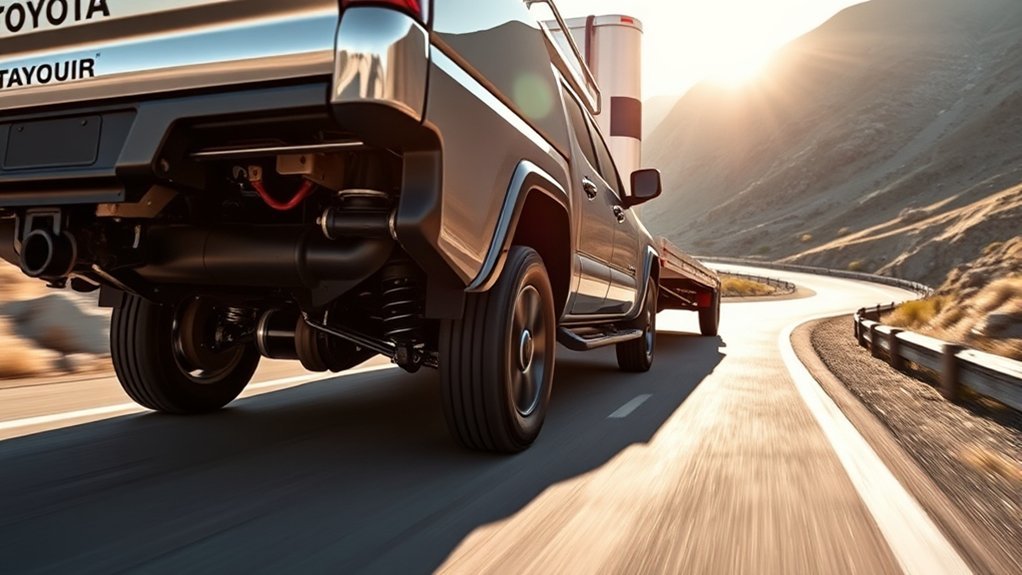
Suspension upgrades can help your Tacoma feel more controlled while towing, but they should be treated as support parts, not as a cure for sway. If the trailer is rear-heavy or the tongue weight is wrong, stiffer suspension will not solve the root problem.
Products such as Timbren SES, helper springs, air springs, upgraded shocks, or progressive bump stops may help reduce rear-end squat and keep the truck closer to level under load. That can improve headlight aim, steering feel, and ride control when the trailer is already within the Tacoma’s ratings.
Suspension upgrades may help with:
- Reduced rear-end squat: The truck stays closer to level under tongue weight.
- Better steering feel: Keeping weight on the front axle helps the Tacoma respond more predictably.
- Less bouncing: Better damping can reduce porpoising over dips and expansion joints.
- Improved ride control: The truck may feel less unsettled when loaded near its legal limits.
- Component protection: Quality support parts can reduce bottoming when used correctly.
Note: Suspension upgrades do not increase GVWR, GAWR, GCWR, TWR, payload, tongue-weight rating, tire rating, hitch rating, or brake capacity. Stay within the numbers printed for your exact Tacoma and trailer.
What Trailer Sway Control Does on a Tacoma
Toyota Trailer Sway Control is a driver-assist feature that helps when it detects trailer sway. Toyota’s Tacoma driving-assist system information explains that the system works with brake and stability-control functions. On recent Tacomas, it can help by selectively applying brake pressure and reducing driving torque when sway is detected.
That is useful, but it is reactive. It helps after sway starts. Your setup should prevent sway before the system needs to step in.
Do not rely on Trailer Sway Control to overcome:
- A trailer loaded too heavy in the rear
- Too little or too much tongue weight
- An overloaded Tacoma payload
- Underinflated tires
- Worn suspension or weak shocks
- A hitch or ball mount that is not rated for the trailer
- Trailer brakes that are not adjusted or not working
- Driving too fast for wind, traffic, or road conditions
Driving Tips to Manage Trailer Sway
When you tow a trailer, your Tacoma needs more room to accelerate, stop, turn, and recover from wind gusts. The NHTSA towing safety brochure advises moderate speeds, smooth steering, extra stopping distance, and slowing down when larger vehicles pass or wind buffeting occurs.
| Action | Purpose |
|---|---|
| Drive at a moderate speed | Sway becomes more likely as speed increases |
| Leave extra following distance | A loaded trailer needs more room to stop |
| Avoid sudden steering | Sharp inputs can start or worsen sway |
| Slow down for bumps, bridges, and railroad tracks | Rough surfaces can unsettle the trailer |
| Use the trailer brake controller correctly | Proper trailer braking helps control heavy trailers |
| Check mirrors often | Early trailer movement is easier to correct than full sway |
What to Do If Trailer Sway Starts
If the trailer starts swaying, stay calm and make small inputs. Panic braking or sharp steering can make the problem worse.
- Hold the steering wheel firmly. Keep the Tacoma pointed straight ahead.
- Ease off the accelerator. Let the rig slow down smoothly.
- Do not slam the tow vehicle brakes. Heavy braking can worsen sway.
- Use manual trailer brakes if equipped. Apply them gently and steadily through the brake controller.
- Avoid sudden steering corrections. Do not try to “chase” the trailer side to side.
- Pull over when safe. Recheck cargo placement, tongue weight, tires, hitch, and brake settings before continuing.
Warning: If sway repeats after you slow down, do not keep driving at highway speed. Stop in a safe place and fix the load, hitch, tire, or brake problem before continuing.
Pre-Trip Checklist for Safe Tacoma Towing
Use this checklist before every towing trip, even if the trailer felt fine last time.
- Confirm Tacoma, hitch, ball mount, hitch ball, and trailer ratings.
- Check loaded trailer weight and tongue weight.
- Confirm the Tacoma is not over GVWR, GAWR, payload, or GCWR.
- Make sure the trailer sits level when connected.
- Confirm the coupler is latched and pinned.
- Cross the safety chains under the tongue with enough slack for turns.
- Connect the breakaway cable to the truck, not to the safety chains.
- Test brake lights, turn signals, running lights, and hazards.
- Set and test the trailer brake controller at low speed in a safe area.
- Check truck and trailer tire pressure when tires are cold.
- Torque lug nuts to the truck and trailer manufacturer’s specs.
- Secure all cargo so it cannot slide, tip, or bounce loose.
- Raise and lock the trailer jack, stabilizers, and steps.
- Adjust mirrors so you can see down both sides of the trailer.
Troubleshooting If Your Tacoma Still Sways
If your Tacoma still feels unstable after basic setup, work through the problem in order. Do not start by buying parts until you know which factor is wrong.
| Symptom | Likely Cause | Fix |
|---|---|---|
| Trailer wiggles at highway speed | Low tongue weight or rear-heavy cargo | Move weight forward and remeasure tongue weight |
| Tacoma rear squats heavily | Too much tongue weight or overloaded payload | Reduce cargo, rebalance trailer, or use a properly rated WDH if allowed |
| Steering feels light | Front axle unloaded by excess rear load | Check axle weights and adjust hitch/load setup |
| Sway begins when trucks pass | Speed, wind, trailer length, or weak sway control | Slow down and confirm a rated sway-control device is installed |
| Trailer pushes during braking | Trailer brakes not working or controller gain too low | Test brakes at low speed and inspect the brake system |
| Trailer bounces or porpoises | Incorrect hitch height, weak shocks, or uneven load | Level the trailer, rebalance weight, and inspect suspension |
Frequently Asked Questions
What is the main cause of trailer sway?
The main cause is poor weight distribution, especially too little tongue weight or too much cargo behind the trailer axle. Speed, wind, low tire pressure, bad hitch setup, and weak trailer brakes can make sway worse.
What is Trailer Sway Control on a Toyota Tacoma?
Trailer Sway Control is a Toyota stability feature that helps when trailer sway is detected. It can use selective braking and reduced driving torque to help the driver regain stability. It helps, but it does not replace proper tongue weight, loading, hitch setup, trailer brakes, or safe speed.
How much tongue weight should a Tacoma trailer have?
For recent Toyota Tacoma conventional towing, Toyota lists a tongue-weight target of 9% to 11% of gross trailer weight. Always confirm the range in your exact owner’s manual and never exceed the Tacoma’s payload, axle, hitch, or tongue-weight ratings.
Does a weight distribution hitch stop trailer sway?
A weight distribution hitch can improve stability by restoring load to the Tacoma’s front axle and leveling the rig, but it is not a magic fix. The trailer still needs correct tongue weight, balanced cargo, proper tire pressure, working brakes, and a rated sway-control device when required.
Can suspension upgrades fix Tacoma trailer sway?
Suspension upgrades can reduce rear squat and improve ride control, but they do not fix poor loading. If the trailer is rear-heavy or the tongue weight is wrong, correct the load and hitch setup first.
Should I brake if my trailer starts swaying?
Do not slam the Tacoma’s brakes to control sway. Hold the steering wheel straight, ease off the accelerator, and let the rig slow smoothly. If you have an electric trailer brake controller, apply the trailer brakes manually and gently.
Conclusion
A safe Toyota Tacoma towing setup starts with measured weight, balanced cargo, correct tongue weight, and calm driving. Trailer sway is usually preventable when the trailer is loaded forward enough, the hitch is rated and level, the brakes and tires are checked, and the truck stays within its payload and axle limits. Use Trailer Sway Control as a backup safety aid, not as permission to tow an unstable load. Set up the rig carefully, drive at a moderate speed, and stop to fix any sway before it becomes dangerous.
Sources
- Toyota Owners: 2026 Tacoma Trailer Towing — Tacoma towing limits, tongue-weight guidance, weight-distribution setup, trailer brakes, and sway-control requirements.
- Toyota Owners: 2026 Tacoma Driving Assist Systems — Trailer Sway Control and related stability-control information.
- Toyota USA Newsroom: 2026 Tacoma — Current Tacoma maximum towing, payload, and available towing-assist features.
- NHTSA Towing Safety Brochure — General trailer weight, hitching, tire, braking, loading, and driving safety guidance.
- U-Haul Trailer User Instructions — Practical trailer loading guidance, including placing more cargo weight in the front half of the trailer.