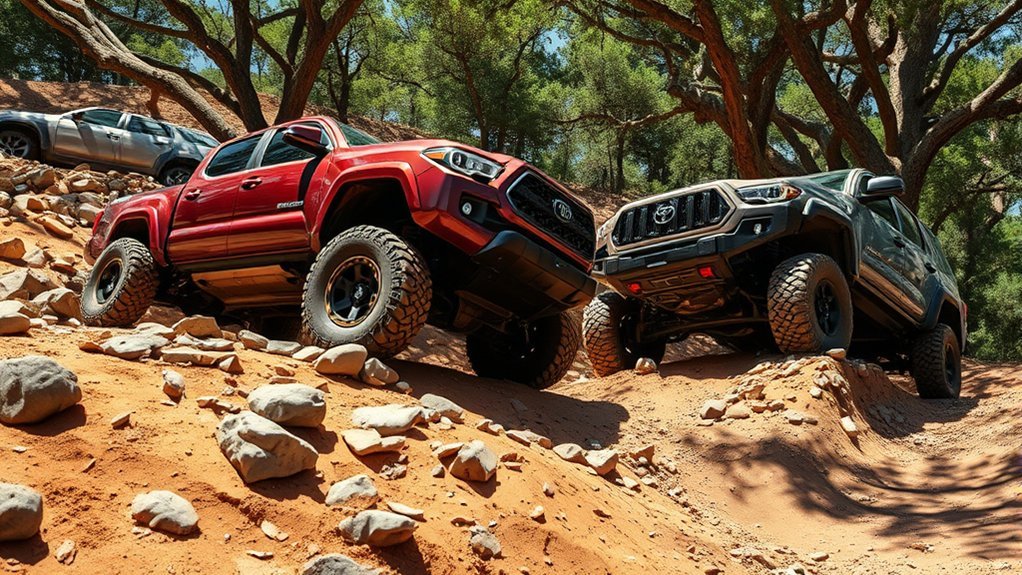
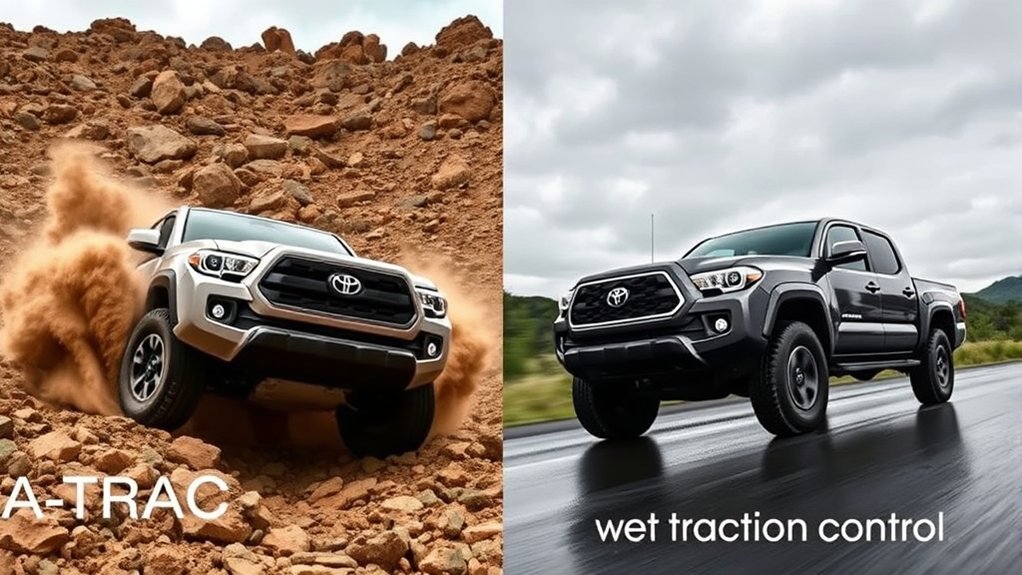
If you drive a Toyota Tacoma off pavement, the difference between A-TRAC and standard traction control matters. Both systems fight wheel spin, but they are built for different jobs: one is for slow, technical off-road traction, while the other is mainly for everyday stability on slippery roads.
Quick Answer
Toyota Tacoma A-TRAC is an off-road traction aid used on equipped 4WD models, usually in low-range four-wheel drive. It brakes spinning wheels to help send usable torque to wheels with grip. Standard traction control, or TRAC, works automatically during normal driving to reduce wheel spin on wet, icy, loose, or uneven roads.
Key Takeaways
- A-TRAC is the off-road tool: Use it for slow crawling, ruts, rocks, mud, snow, and uneven terrain where one or more wheels may lift or spin.
- TRAC is the everyday safety aid: Leave it on for normal driving, rain, ice, gravel, and slippery pavement.
- A-TRAC is not a mechanical locker: It can imitate some limited-slip behavior by braking a spinning wheel, but it does not physically lock an axle.
- Model year matters: Tacoma traction systems vary by trim, drivetrain, transmission, and generation, so always confirm the steps in your exact owner’s manual.
At a Glance
| Best For | Choosing the right Tacoma traction mode for road, trail, snow, sand, mud, and rocks |
| Difficulty | Easy, once you know which system does what |
| Tools Needed | Your Tacoma owner’s manual and the vehicle’s 4WD/TRAC/A-TRAC switches |
| Cost | No extra cost if your Tacoma is already equipped with the system |
Understanding the Basics of A-TRAC and Traction Control
TRAC, short for Traction Control, is part of Toyota’s normal driving-assist systems. Toyota describes TRAC as a system that helps maintain drive power and prevent the drive wheels from spinning when starting or accelerating on slippery roads. You can read Toyota’s description in the 2024 Tacoma driving assist systems manual.
A-TRAC, short for Active Traction Control, is different. On equipped Toyota 4WD trucks and SUVs, A-TRAC is meant for low-speed, low-traction situations. It uses brake pressure on a spinning wheel so the open differential can send more useful force to the wheel that still has grip.
Think of TRAC as your everyday slippery-road helper and A-TRAC as your slow-speed trail helper. TRAC is what you want when pulling away from a wet stoplight. A-TRAC is what you want when a Tacoma tire is spinning in a rut, snow pocket, muddy hole, or uneven rock section.
Note: Not every Tacoma has the same traction features. A-TRAC availability and activation steps vary by year, trim, drivetrain, and transmission. Use the Toyota manual for your exact truck before relying on any switch sequence.
How A-TRAC Enhances Off-Road Performance
A-TRAC helps most when the Tacoma is moving slowly and one or more wheels lose grip. In that moment, an open differential can send power to the easiest-spinning wheel. That is bad news off-road, because the wheel with the least traction may spin while the wheel on firmer ground does less work.
A-TRAC helps by applying brake force to the spinning wheel. That resistance encourages the drivetrain to push torque toward the wheel with better traction. The result can feel similar to a limited-slip effect, especially in slow technical driving.
Where A-TRAC can help:
- Rocky trails: when one wheel gets light or lifts slightly.
- Snow and ice off-road: when tires keep slipping at low speed.
- Mud and ruts: when one side of the truck has less grip than the other.
- Sand: when you need controlled wheel movement without digging too deeply.
- Steep uneven climbs: when steady throttle matters more than wheel speed.
A-TRAC is not magic, though. It still depends on tire grip, ground clearance, driver input, and momentum. If all four tires have poor grip, the system cannot create traction that is not there.
[Products Worth Considering]
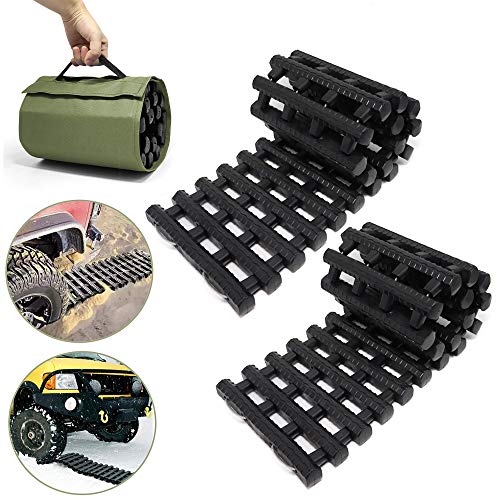
【High Strength Eco-Friendly TPR Materials】The 2 pack recovery traction tracks are constructed of indestructible UV-stabilized thermoplastic rubber (TPR) joined by a galvanized steel core which is anti-rust (0.15inch diameter steel) to deliver strongest traction and durability,and offers intrepid resistance against impact and flex during recovery.TPR is an environmentally friendly,non-toxic and recyclable new material,it is softer and more flexible than rubber,more durable and sturdy than PVC!

18X8.50-8 6PR Golf Cart Tires/ All-Terrain / Off-Road Tires/ Tubeless Tires. Non-directional tread pattern for universal mounting on golf cart wheels. golf cart tires are durable and affordable, making them a great choice for your golf cart. The golf cart wheel provides even traction and a smooth ride on most paved or unpaved surfaces. The golf cart tire is a general-purpose tire.

Cloud-Comfort & Built-In Suspension:The wide 20x4.0 tire absorbs shocks like a natural air spring, reducing vibration and protecting your body for a smooth, floating ride on any surface.
A-TRAC vs. Traditional Traction Control
The easiest way to separate the two is by use case. TRAC is for stability and wheel-spin control in normal driving. A-TRAC is for controlled movement in low-speed off-road driving.
| Feature | A-TRAC | Standard TRAC |
|---|---|---|
| Main purpose | Low-speed off-road traction | Everyday wheel-spin control |
| Best conditions | Rocks, ruts, mud, snow, sand, steep uneven terrain | Wet roads, icy pavement, gravel, loose surfaces, normal acceleration |
| How it helps | Brakes spinning wheels to help usable torque reach wheels with grip | Uses braking and power management to reduce drive-wheel spin |
| Driver action | Usually requires the correct 4WD range and switch activation on equipped trucks | Usually works automatically unless manually turned off |
| Speed range | Best for crawling and very low-speed trail work | Designed for normal driving conditions |
| What it is not | Not a substitute for a real front or rear locker | Not an off-road crawl system |
[Products Worth Considering]

【Please Note】①Fit for Toyota Tacoma 2024 2025 Double Cab Limited/SR/SR5/TRD Off-Road/TRD Sport. ②Fit Auto Tran, Not Fit Manual Tran. ③Fit Gas, Not fit Hybrid.

FITMENT: Trcuk running boards compatible with 2024-2026 Toyota Tacoma Xtra cab/Access cab with 2 full-size front doors and 2 half-size rear doors (please check the cab size picture).

Custom Fit: This front tow hook is compatible with the 2024-2026 Tacoma and 2025-2026 4Runner, meticulously designed for their front ends to perfectly match the vehicle's contours
Key Differences Explained
Standard traction control usually works quietly in the background. When it detects wheel spin, it can reduce drive power and apply braking to help the Tacoma stay controlled. That is exactly what you want on wet pavement or icy roads, where stability matters more than wheel speed.
A-TRAC is more trail-focused. Instead of mainly calming the truck down on the road, it helps the truck keep moving when traction is uneven from wheel to wheel. The goal is not speed. The goal is controlled forward movement.
Performance in Off-Road Conditions
Off-road, standard TRAC can sometimes feel too cautious because reducing engine power may kill momentum. That can be frustrating in loose sand, snow, or mud. Toyota even notes that when a vehicle is stuck in mud, dirt, or snow, turning TRAC off may make it easier to rock the vehicle free.
A-TRAC is usually the better choice when you are already in low-range 4WD and moving slowly through technical terrain. It lets the tires work one step at a time instead of allowing one wheel to flare up and waste motion.
Pro Tip: With A-TRAC, use steady throttle. Stabbing the gas can cause more wheel spin, more brake intervention, and more heat. Smooth pressure usually works better than trying to power through the obstacle.
How Standard Traction Control Helps in Everyday Driving
Standard traction control is one of those systems you may not notice until the road gets slick. On wet pavement, loose gravel, slush, or icy surfaces, TRAC helps reduce unnecessary wheel spin when you start moving or accelerate.
[Products Worth Considering]

STYLISH DESIGN: Upgraded all-black style to fit all colors of tacoma

part number: 15C629 15C710

Officially Licensed Toyota Tacoma: The perfect combination of authenticity and toughness packaged in an officially licensed Toyota Tacoma RC overlander truck. This rock crawler features the iconic rugged styling and durability of a Toyota truck in a manageable size.
Improved Traction Control
When a drive wheel starts spinning faster than it should, the system can use braking and power control to help the tire regain grip. This can make takeoffs smoother and help reduce sideways movement during acceleration.
For most drivers, the best setting is simple: leave TRAC on during normal driving. Toyota’s driving-assist warning language also reminds drivers not to rely too heavily on these systems because they are supplementary, not replacements for safe driving.
Enhanced Stability During Turns
TRAC works alongside other systems such as VSC, ABS, and brake assist. Toyota describes Vehicle Stability Control as a system designed to help the driver maintain vehicle control under adverse conditions, but Toyota also warns that speed, road conditions, weather, and steering input affect how well it can help. You can review Toyota’s safety-feature guidance here: Toyota vehicle safety features.
In plain English, these systems help, but they do not cancel physics. A Tacoma can still slide, hydroplane, or lose control if you drive too fast for the conditions.
Optimal Performance in Rain
In rain, standard TRAC is more useful than A-TRAC. It is designed for normal-road traction management, while A-TRAC is aimed at low-speed off-road use. Keep TRAC on, slow down, increase following distance, and make sure your tires are in good condition.
Tires matter more than any button. If the tread is worn, tire pressure is wrong, or tire sizes do not match, the traction and stability systems may not perform correctly. For tire safety basics, check the NHTSA tire safety guide.
When to Choose A-TRAC for Off-Road vs. Standard Traction Control?
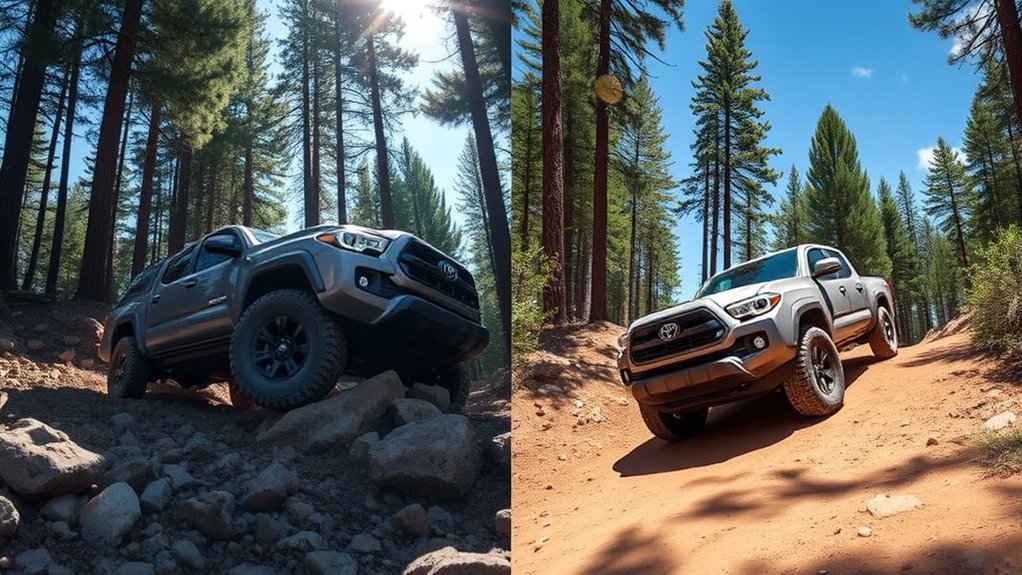
Choose A-TRAC when the Tacoma is on a trail, moving slowly, and fighting uneven traction. Choose standard TRAC when you are driving on pavement or normal loose surfaces and want the truck to manage wheel spin automatically.
- Use A-TRAC for technical crawling: rocks, ruts, offset holes, slow climbs, and uneven trails.
- Use A-TRAC in low-speed snow, mud, and sand: especially when one tire keeps spinning while another has grip.
- Use standard TRAC for everyday slippery driving: rain, packed snow, icy roads, gravel roads, and normal acceleration.
- Turn TRAC off only when needed: for example, if the truck is stuck and you need to rock it gently, as described in Toyota’s manual guidance.
Warning: Do not use traction-system buttons as a substitute for safe driving. Off-roading is inherently risky, and Toyota warns that abusive off-road use can cause vehicle damage or bodily harm. Wear seat belts, keep passengers inside the cab, and avoid high-speed off-road driving.
Common Scenarios for Engaging A-TRAC
A-TRAC shines when the truck is moving slowly and traction is split unevenly from tire to tire. Here are the most common situations where it can help:
| Scenario | Why A-TRAC Helps | Driver Tip |
|---|---|---|
| Deep sand | Reduces wasted wheel spin when one tire digs faster than the others | Use smooth throttle and avoid sudden stops |
| Snowy hills | Helps transfer effort away from a spinning wheel | Keep momentum gentle and steady |
| Rocky terrain | Helps when a tire gets light, lifts, or slips on rock | Crawl slowly and let the system work |
| Muddy ruts | Brakes the spinning wheel so the truck can pull from the tire with more grip | Avoid digging holes with heavy throttle |
| Offset holes | Improves control when opposite wheels carry different loads | Pick a careful line before relying on electronics |
How to Use A-TRAC Safely
The exact process depends on the Tacoma generation, trim, and transmission, but the general idea is the same: set the truck up for low-speed 4WD traction before pressing the A-TRAC switch.
- Stop or slow the truck as instructed in your manual. Many Tacoma systems require the vehicle to be stopped or nearly stopped before changing 4WD range.
- Select the proper 4WD range. On many A-TRAC-equipped Tacomas, the system is tied to low-range 4WD operation.
- Press the A-TRAC switch. Watch for the A-TRAC indicator light or message that confirms the system is active.
- Drive slowly. A-TRAC is for crawling and controlled traction, not speed.
- Use smooth throttle. Let the system brake the spinning wheel instead of forcing the truck with aggressive throttle.
- Turn it off when the obstacle is done. Return the Tacoma to the correct road-driving mode before normal-speed driving.
For newer Tacoma models, Toyota also offers systems such as Multi-Terrain Select and Crawl Control. Multi-Terrain Select adjusts wheelspin control, throttle, and braking for different surfaces, while Crawl Control can manage throttle and braking at low speeds so the driver can focus on steering.
A-TRAC vs. Rear Differential Lock
A-TRAC and a rear differential lock are not the same thing. A-TRAC is brake-based electronic traction control. A rear locker is a mechanical system that forces both rear wheels to rotate together.
Toyota’s Tacoma manual warns that when the rear differential is locked, systems such as ABS, brake assist, VSC, downhill assist, and TRAC may not operate. It also warns not to lock the rear differential until the wheels have stopped spinning and not to drive over 5 mph when the differential is locked. See Toyota’s rear differential lock system guidance for details.
| System | Best Use | Main Limitation |
|---|---|---|
| A-TRAC | Mixed low-traction trail conditions where individual wheels slip | Uses brakes, so heavy repeated use can build heat |
| Rear differential lock | Severe rear-wheel traction loss, such as one rear tire hanging or spinning freely | Only locks the rear axle and should not be used for normal driving or turning on high-grip surfaces |
Real-World User Experiences With A-TRAC Performance
In real off-road use, A-TRAC feels best when the driver stays patient. You may hear pulsing, grinding-like ABS pump sounds, or feel vibration through the truck. That can be normal when brake-based traction systems are working.
Drivers often notice A-TRAC most in three situations:
- A tire lifts or gets light: Instead of spinning freely, the system brakes it and helps the truck keep crawling.
- One side has less grip: In mud, snow, or off-camber ruts, A-TRAC can reduce wasted spin.
- Momentum is low: When you cannot use speed safely, A-TRAC helps the truck work slowly and deliberately.
The main mistake is expecting A-TRAC to replace good driving technique. Tire choice, tire pressure, line selection, ground clearance, and throttle control still matter. A-TRAC is a helper, not a rescue plan.
What to Watch Out for With A-TRAC and Traction Control
A-TRAC and TRAC are useful, but they both have limits. Knowing those limits can prevent frustration and reduce the risk of vehicle damage.
- Brake heat: A-TRAC uses the brakes. Long, repeated use can create heat, and the system may pause or warn you if it gets too hot.
- Too much throttle: Heavy throttle can overwhelm available traction and make the system work harder than necessary.
- Wrong mode: A-TRAC may not activate if the truck is not in the correct 4WD setting for your model year.
- System interaction: Locking the rear differential can disable or limit other systems on some Tacoma models.
- Tire mismatch: Different tire sizes, uneven wear, or wrong inflation can confuse traction and stability systems.
- False confidence: Electronic traction aids do not increase ground clearance, fix bad tires, or make high-speed off-roading safe.
Warning: If traction-control, ABS, brake, or 4WD warning lights stay on, do not ignore them. A malfunction in one system can affect the others. Have the Tacoma inspected before relying on A-TRAC, TRAC, Crawl Control, or the rear locker off-road.
Tips for Optimizing Traction in Various Conditions
The best Tacoma traction setup depends on the surface. Use this as a practical guide, then confirm the exact switch steps in your owner’s manual.
| Condition | Best Starting Point | Why |
|---|---|---|
| Wet pavement | TRAC on | Helps manage wheel spin during normal driving |
| Icy roads | TRAC on, slow speed, gentle inputs | Stability matters more than wheel speed |
| Loose gravel road | TRAC on unless stuck | Helps reduce unnecessary spin |
| Rock crawling | 4WD low with A-TRAC if equipped | Helps when individual wheels slip or lift |
| Deep sand | 4WD setting appropriate to terrain; A-TRAC or MTS if equipped | Smooth, controlled wheel movement helps avoid digging |
| Stuck in mud or snow | Consider turning TRAC off briefly to rock free | TRAC may reduce power when you need gentle back-and-forth movement |
The right traction system is the one that matches the surface: TRAC for everyday stability, A-TRAC for slow technical grip, and the rear locker only for the situations Toyota designed it for.
When airing down tires for off-road driving, use caution. Lower tire pressure can increase the tire’s footprint on sand, rocks, and trails, but driving too fast or returning to pavement without reinflating can damage tires and create a safety risk. Reinflate to the pressure shown on the vehicle tire placard before highway driving.
Frequently Asked Questions
Is AdvanceTrac the same as traction control?
No. AdvanceTrac is Ford’s name for an electronic stability-control system. Toyota uses terms such as TRAC for traction control, VSC for Vehicle Stability Control, and A-TRAC for Active Traction Control on some 4WD models. The systems are related in purpose, but they are not the same brand or setup.
Should traction control be on or off in a Tacoma?
Leave traction control on for normal driving, rain, ice, packed snow, and gravel roads. Turn it off only when the situation calls for it, such as gently rocking the truck out of mud, dirt, or snow. Turn it back on when you return to normal driving.
What does A-TRAC do in a Toyota Tacoma?
A-TRAC helps control wheel spin off-road by applying brake force to a slipping wheel. That resistance helps send more usable driving force to wheels with better grip, making it easier to crawl through rocks, snow, mud, ruts, and other low-speed traction problems.
Is A-TRAC the same as a locking differential?
No. A-TRAC is an electronic brake-based traction system. A locking differential is a mechanical system that forces both wheels on an axle to turn together. A-TRAC can imitate some limited-slip behavior, but it does not physically lock the axle.
Can I use A-TRAC on the highway?
No. A-TRAC is intended for low-speed off-road traction on equipped 4WD models. For highway driving, use the normal road-driving mode and leave standard TRAC and stability systems on unless the owner’s manual tells you otherwise for a specific condition.
Conclusion
A-TRAC and standard traction control are both useful, but they solve different problems. TRAC is the system you want for everyday traction and stability on slippery roads. A-TRAC is the system you want when the trail gets slow, uneven, and technical.
Use TRAC for normal driving. Use A-TRAC for crawling through low-speed off-road traction problems on equipped models. Use the rear differential lock only when the manual says it is appropriate. Most importantly, combine the right system with good tires, smart throttle control, and careful line choice. That is how you get the most from your Tacoma without asking the electronics to do all the work.
Sources
- Toyota Owners: 2024 Tacoma Driving Assist Systems — TRAC, VSC, ABS, warnings, and traction-control operation.
- Toyota Owners: 2024 Tacoma Rear Differential Lock System — rear-locker warnings, limits, and system interactions.
- Toyota Support: Multi-Terrain Select and Crawl Control — official explanation of off-road traction and crawl systems.
- Toyota Support: Vehicle Safety Features — VSC safety guidance and limitations.
- NHTSA Tire Safety — tire condition, inflation, and road-safety guidance.
- Toyota 2023 Tacoma eBrochure — Tacoma off-road features, Multi-Terrain Select, Crawl Control, rear differential lock, and official off-road warnings.