Use 4HI on your Toyota Tacoma whenever surfaces are loose, wet, snowy, icy, or muddy so both axles share torque for improved traction and higher‑speed stability without low‑range torque. Engage proactively if you notice wheelspin or loss of directional control, and avoid 4HI on dry pavement or during tight turns to prevent driveline binding and vibrations. Cycle 4WD monthly to keep linkages free; continue for guidance on shifting, tire impacts, and troubleshooting.
When to Use 4HI on a Toyota Tacoma

When driving on snow, mud, wet roads, or loose gravel, engage 4HI to increase traction and vehicle control without switching to low-range gearing; it’s meant for higher-speed stability on slippery or unpaved surfaces but should never be used on dry pavement because differing wheel speeds during turns will cause driveline binding and vibrations. You’ll select appropriate 4HI settings when surface slip exceeds two-wheel capability but doesn’t require low-speed torque; think sustained wet highways, packed snow, muddy tracks, or coarse gravel. Use it to stabilize yaw and reduce wheelspin while maintaining highway-capable speeds. Rotate into 4HI proactively rather than reacting to loss of control. Run 4HI at least ten miles monthly to keep transfer case components lubricated and seals seated, preventing mechanical failure. Study your Tacoma’s owner manual and practice engaging/disengaging 4HI to avoid common user errors that cause vibration or premature wear. This knowledge frees you from unnecessary risk and keeps mobility when terrain resists ordinary traction.
How 4HI Improves Traction on Snow, Ice, and Mud
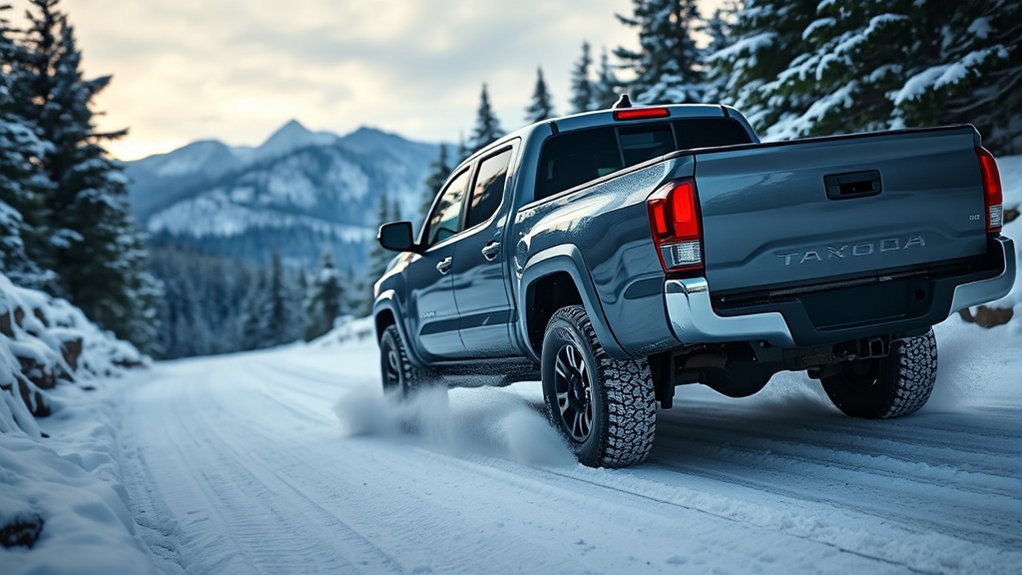
A four-wheel-drive mode like 4HI improves traction on snow, ice, and mud by sending torque to both front and rear axles, which reduces individual wheel slip and lets you maintain controlled acceleration and steering at higher speeds than 4LO allows. You’ll gain clear traction benefits: power distribution forces all four tires to share torque, lowering the chance of a single wheel spinning out on slippery surfaces. In snow and ice this stabilizes yaw and aids directional control; in mud it sustains forward momentum and prevents bogging. Because 4HI is usable at higher speeds, you can traverse light off-road sections and icy roads without sacrificing responsiveness. Using 4HI also reduces the odds of getting stuck in deep snow or slush by increasing bite across contact patches. Regular, appropriate engagement keeps the drivetrain active and can prevent mechanical seizing of 4WD components. Employ 4HI when you need liberated mobility and predictable traction on compromised roadbeds.
When Not to Use 4HI: Dry Pavement and Tight Turns
Don’t engage 4HI on dry pavement — the lack of tire slip causes drivetrain binding and vibrations. Avoid making tight or sharp turns while in 4HI, since the increased stress accelerates wear on differentials and the transfer case. Understand that Tacoma’s part-time 4WD is for loose or slippery surfaces, not hard, dry roads.
Avoid Dry Pavement
Because 4HI locks front and rear driveline behavior for traction, you should avoid using it on dry pavement and during tight turns to prevent drivetrain binding and accelerated tire wear. You’ll confront 4HI Misconceptions if you think it’s harmless anywhere; engaging it on high-traction surfaces removes necessary differential action, causing Drivetrain Damage and vibration. Don’t assume tires will slip enough to relieve torque—on dry asphalt they won’t, so stresses concentrate in joints, shafts, and transfer case. You should only enable 4HI in legitimately slippery environments: snow, mud, gravel, or off-road ruts. Regular, appropriate use preserves selector mechanism function and frees you from unexpected failures. Be deliberate: choose traction, not habit.
No Sharp Turns
You already learned why dry pavement is a bad place for 4HI; similarly, making sharp turns while in 4HI locks the front and rear drivetrains together and prevents the differential action needed for cornering. You shouldn’t execute tight maneuvers in 4HI because part-time 4WD forces equal wheel speeds, causing drivetrain binding, vibrations, and increased stress on u-joints and transfer case components. Use 4HI benefits only where traction deficits demand it: mud, snow, loose surfaces, or off-road obstacles. Know your Tacoma’s drivetrain mechanics and never engage 4HI on high-traction surfaces or during sharp turns. Maintain correct tire pressure and rotation to minimize uneven wear that amplifies binding. Liberate your driving by matching drive mode to terrain and protecting mechanicals.
Part‑Time vs Full‑Time 4WD on the Tacoma: What Owners Need to Know
Although both systems send power to all four wheels, the Tacoma’s Part‑Time and Full‑Time 4WD operate differently and you need to use them differently to avoid damage and maintain control. You should memorize drivetrain differences: Part‑Time 4WD mechanically locks front and rear axles for traction but creates driveline windup on high‑traction surfaces; Full‑Time 4WD uses a center differential or electronic coupling to balance torque and tolerate road grip. For terrain suitability, engage Part‑Time only on loose, slippery, or off‑road surfaces—mud, snow, gravel—where wheel slip exists. Using Part‑Time on dry pavement produces vibrations and accelerates wear. If your Tacoma has Full‑Time 4WD, use Auto or leave it engaged for mixed wet or snowy conditions; the system adapts torque distribution without your constant input. Know your trim, consult the manual, and choose the mode that preserves components and maximizes control. That knowledge frees you to push boundaries responsibly.
How to Shift Into 4HI Correctly (Step‑By‑Step)

Start by bringing the Tacoma to a stop or slow speed on a straight, firm surface and shift the transmission into neutral; this prevents transfer‑case shock and aligns internal gears for engagement. Confirm vehicle speed is below 62 mph (100 km/h). Select the correct control—mechanical lever or electronic switch—based on your model; know the feel and resistance beforehand. With transmission neutral, operate the control smoothly until the 4HI indicator illuminates. If using a lever, apply steady force; if a switch, press and hold briefly while monitoring feedback. Return the transmission to drive or gear appropriate for speed and resume motion.
Practice these shifting techniques to build confidence and freedom on varied terrain. Watch for common mistakes: attempting engagement at high speed, shifting on uneven or soft ground, or forcing a stuck selector. If engagement feels harsh or indicator fails, stop and inspect—don’t persist. Follow this methodical approach to preserve components and maintain mobility.
Monthly 4WD Engagement and Routine Maintenance for Tacomas
You should engage the Tacoma’s 4WD at least once a month for a minimum of 10 miles to keep linkages lubricated and prevent levers from seizing. Do this on straight, mild roads to avoid unnecessary drivetrain stress. Also rotate tires on the manufacturer’s schedule to maintain even wear and minimize vibrations that can affect 4WD performance.
Engage 4WD Monthly
Someone who’s serious about keeping a Tacoma’s 4WD reliable will engage the system at least once a month for about 10 miles to prevent seized linkages and guarantee smooth actuation. You’ll realize 4WD benefits immediately: routine motion preserves levers, seals, and actuators. Set engagement frequency as policy—monthly, short straight runs, mild conditions—to avoid undue stress, especially on older models. Learn the mechanical levers; they stick without use. Avoid rough terrain during checks; you’re validating function, not testing limits. Tire balance affects 4WD performance, so coordinate checks with maintenance schedules. Know system limits to prevent operator errors. The practice frees you from roadside surprises and preserves capability.
| Task | Distance | Condition |
|---|---|---|
| Engage 4WD | 10 mi | Straight |
| Inspect levers | – | Monthly |
| Check seals | – | Monthly |
Rotate Tires Regularly
Rotate your Tacoma’s tires on a regular schedule and couple that with the monthly 4WD engagement to maintain even wear, minimize driveline vibration, and preserve transfer case and differential health. You’ll drive 10 miles in 4WD monthly to keep mechanical levers free and verify system function. Rotate tires every 5,000–7,500 miles, confirm proper tire pressure before and after, and balance tires to prevent uneven loading that stresses the transfer case. Verify tire size consistency and perform an alignment check whenever you notice pull, uneven wear, or after suspension work. These steps free you from avoidable failures and keep control precise. Routine discipline preserves capability and reduces the chance of stuck components when you need 4HI.
- Rotate schedule
- Tire pressure & balance
- Alignment check
How Tires, Lifts, and Mods Affect 4HI Performance
Although 4HI is designed for higher-speed traction on mixed surfaces, tire size and suspension changes will directly alter its effectiveness, so you need to understand how each mod shifts load, traction, and geometry. Tire tread impact is immediate: larger, aggressive-tread tires increase ground bite but change rolling radius and slip characteristics, so 4HI engagement timing and steering feedback will differ. You must maintain correct inflation and rotation to minimize uneven wear that degrades traction and creates imbalance. Lift effects alter center of gravity and suspension geometry, increasing body roll and changing driveline angles; higher lifts can reduce 4HI stability in sharp maneuvers. Aftermarket diffs, driveshafts, and other mods can improve capability but require calibration—match gear ratios and balance components to avoid handling anomalies. Know the limits of each change, test progressively, and prioritize component compatibility. That approach preserves control and frees you to push capability without sacrificing safety.
Troubleshoot Vibration, Drivetrain Binding, and Noise in 4HI
When you feel vibration, hear clunks, or notice binding while in 4HI, treat it as a symptom—not normal operation—and stop using 4HI on hard, dry surfaces until you diagnose the cause. You’ll want to isolate vibration causes and perform disciplined drivetrain care to prevent damage and preserve freedom to drive where you choose. Start with basic checks and escalate methodically.
- Inspect tires, balance, and alignment: unbalanced wheels, uneven wear, or incorrect pressures often cause vibration; correct these first and retest in appropriate conditions.
- Examine driveshafts and U-joints: look for play, worn splines, or imbalance; slight misalignment or loose hardware produces clunks and resonance under load.
- Validate 4WD engagement behavior: note binding during turns—typical of part-time systems on high-traction surfaces; avoid 4HI on pavement and regularly cycle the system to prevent sticking.
If vibration or noise persists after these steps, document symptoms and seek evaluation to rule out mechanical defects.
When to Get a Professional Diagnosis vs. Simple Fixes

Curious whether you can fix the 4WD vibration yourself or need a pro? Start by isolating vibration causes: inspect tire pressure, tread wear, lug torque, and whether you engaged Part‑Time 4WD on dry pavement. Those common user errors account for many complaints and are reversible with basic tools and knowledge. If vibrations stop after correcting tires or disengaging 4WD, you’ve liberated yourself from unnecessary service visits.
If vibrations persist despite proper tire maintenance and routine service, seek a professional diagnosis. A technician will measure driveshaft balance, inspect U‑joints, transfer case engagement, and differential condition—components that require specialized tools and calibration. Also consult a pro if you frequently use 4WD and notice progressive performance changes; repeated stress can mask early mechanical failure. When in doubt, professional evaluation prevents misuse, limits collateral damage, and restores confident, independent vehicle control.
Frequently Asked Questions
When to Use 4WD High Tacoma?
Use 4WD High when you face off road conditions or slippery roads to improve traction control and stability; engage it for mud, snow, gravel, or steep inclines, but avoid dry pavement to prevent drivetrain stress.
Should I Daily Drive on 4H or 4L or 2H?
Only 2H: studies show AWD systems can cut fuel efficiency by ~10%. For daily driving considerations, you’ll use 2H to maximize fuel efficiency impact, avoid drivetrain wear, and keep handling predictable; 4H/4L are for hazards.
Do You Need to Stop to Switch to 4-Wheel Drive in Tacoma?
No, you don’t need to stop to shift to 4WD in a Tacoma; engage 4HI while moving slowly. Use proper shifting techniques below 60 mph for 4WD advantages, preserve drivetrain, and maintain liberation through competence.
Conclusion
Use 4HI when traction’s marginal—snow, packed ice, deep mud, or loose gravel—so you maintain control without the low‑speed torque of 4LO. Don’t use it on dry pavement or for tight turns. For example, Alex commutes through a morning snowpack: he shifts to 4HI at 35 mph, maintains steady throttle, and avoids wheelspin; the Tacoma tracks straight with reduced slippage. Check tires, engage monthly, and seek pro help for binding or vibration.