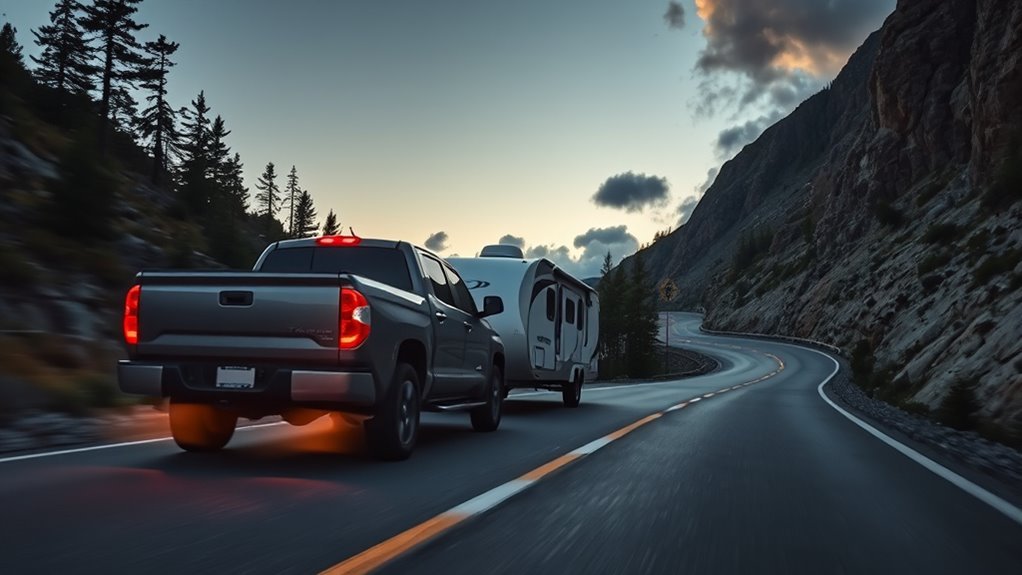
When towing a Tundra, use engine braking on long, steep descents—switch manually into S3 with Tow/Haul engaged so the transmission holds a lower gear and you get strong, consistent retarding force; avoid abrupt shifts that could unsettle a loaded trailer. Start engine braking early on sustained grades, especially with heavy or high‑CG loads or poor weather, to reduce brake heat and maintain control. Follow proper gear selection and monitoring for effective, stable downhill performance, and you’ll learn the finer adjustments next.
Tundra: When to Use Engine Braking on Long Downhills
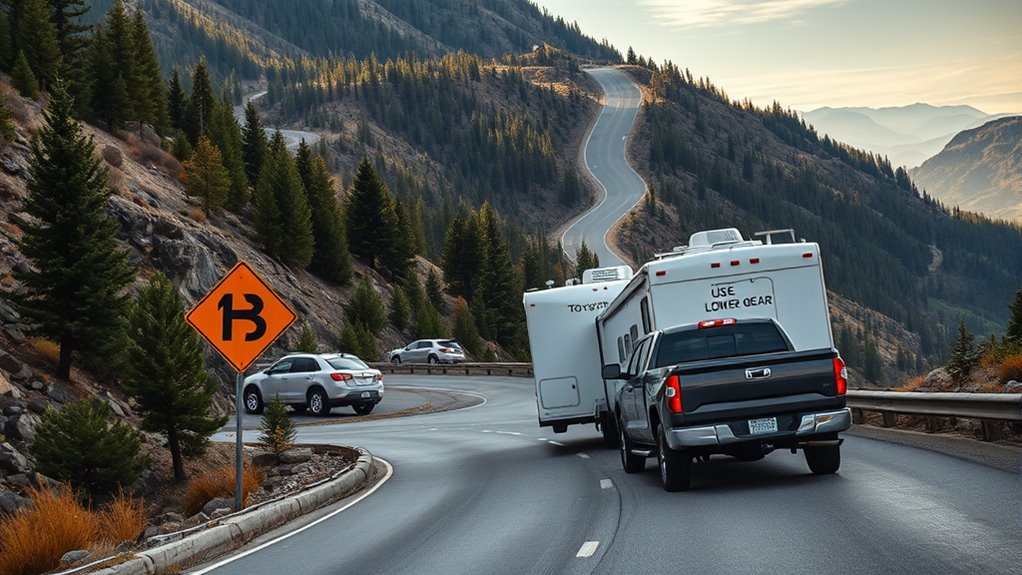
When descending long, steep grades while towing, engage S3 to use engine braking and prevent your Tundra’s service brakes from overheating. You’ll switch into S3 smoothly, letting the transmission hold higher rpm so engine braking benefits reduce reliance on the brake pedal. That lowers brake temperatures, limits fade, and preserves stopping power for critical maneuvers.
Maintain a controlled speed and monitor braking distance; engine braking gives you a steadier deceleration rate and improves downhill safety by increasing predictability for you and following traffic. Shift to S3 without abrupt inputs—jerky shifts can unsettle a loaded rig. Practice this technique on moderate slopes until you can deploy S3 confidently under load.
Treat engine braking as a primary strategy for long descents, not an afterthought. When you master S3 shifts and speed discipline, you free yourself from constant brake modulation, enhance control, and secure safer, more liberated towing operations.
How Tundra S Modes (S3 vs S4/S5) Affect Engine Braking
Although the S3, S4, and S5 modes all control shift behavior, they differ critically in how much engine braking you can deploy while towing. You’ll use S3 when you need drivetrain resistance to slow the rig: S3 benefits include reliable engine braking that reduces brake heat and gives precise speed control on long descents. S4 locks the transmission in fourth gear and removes engine braking, so you’ll rely more on service brakes and cadence; know the S4 limitations when planning downhill sections. S5 likewise disables engine braking by locking fifth gear and favors speed maintenance in rolling terrain rather than retardation.
Shift changes must be deliberate: move from drive to S4 smoothly to prevent destabilization, and downshift from S4 to S3 before steep declines to restore engine braking. You’ll prioritize S3 on steep downhill grades for safety and control, and reserve S4/S5 for uphill or steady-speed scenarios where braking contribution from the engine isn’t desired.
When to Default to Tow/Haul Mode
If you’re towing significant weight, default to Tow/Haul mode to give the transmission and throttle mapping the control they need for predictable shifts and stronger low-end response. You want consistent, repeatable behavior when hauling—Tow/Haul benefits include optimized shift points, firmer throttle calibration, and reduced gear hunting on grades. Engage it anytime you’ve got substantial mass behind you; the Tundra senses load percentage and throttle input, then adapts shift logic automatically to maintain torque where you need it. That reduces clutch wear, limits unnecessary downshifts, and preserves momentum on climbs without hunting between gears. For controlled descents it stabilizes engine braking inputs so you’re not chasing the transmission. Using Tow/Haul as your default when towing improves Towing efficiency and safety, letting you focus on line, speed, and liberation from reactive corrections. Make activation routine—mountain passes, loaded trailers, or heavy payloads—and trust the system to hold the gears and manage power delivery.
When to Shift From Drive Into S3
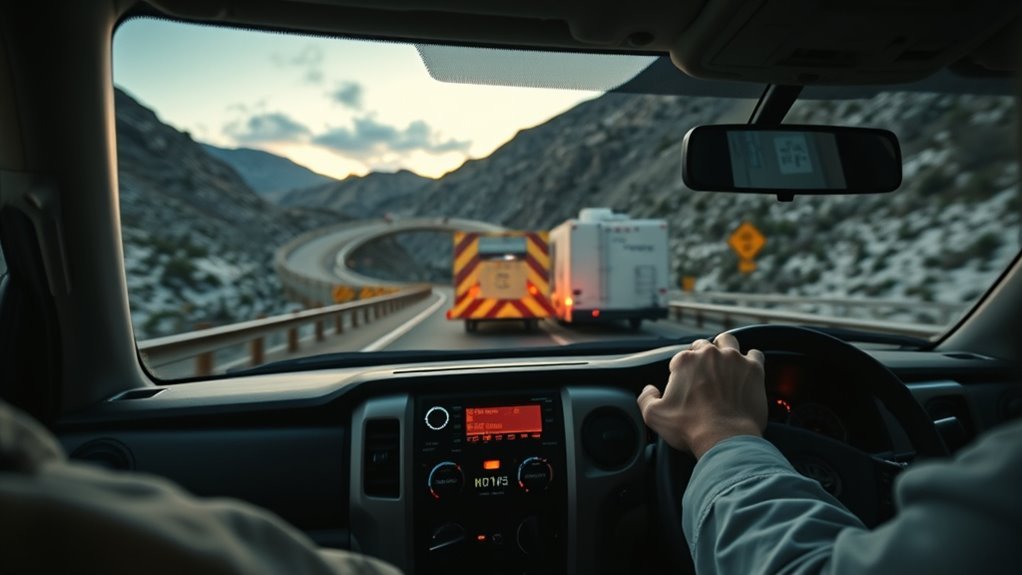
After you’ve set Tow/Haul for heavy loads, shift from Drive into S3 on steep downgrades so the engine provides consistent braking and takes load off the service brakes. You’ll use S3 to let the drivetrain absorb kinetic energy, preventing brake fade and preserving components. Make the gear selection deliberately and smoothly; abrupt shifts can unsettle the trailer and defeat stability control systems. Rely on the owner’s manual for thresholds, then trust audible and tactile feedback to time changes.
- Feel the truck settle as engine braking replaces constant brake pressure.
- Hear the controlled rumble that signals mechanical discipline, not panic.
- Sense the freedom of longer-lasting brakes and fewer maintenance stops.
- Know you’re commanding the descent with technical confidence.
Shift early on long, steep grades, monitor brake temperature, and blend throttle inputs. This preserves safety and grants you liberation through controlled, efficient towing.
How Load and Trailer Type Change Braking Needs
Because the load and trailer type change the forces your rig must manage, you’ll need to adapt braking strategy accordingly: heavier loads demand more braking power and earlier use of engine braking, trailers with high centers of gravity increase sway risk and require gentler, anticipatory deceleration, and trailers lacking their own brakes force the vehicle’s drivetrain and service brakes to absorb the full kinetic energy. You’ll assess load weight and trailer design pre-departure: heavier, tall-profile loads reduce braking efficiency and demand lower speeds, earlier downshifts, and staged engine braking. Prioritize load distribution to keep tongue weight within spec and minimize reciprocal motion. If the trailer has brakes, coordinate their gain with your engine braking to prevent fade; if it doesn’t, rely more on lower gears and pulse braking to control heat. For high-center-of-gravity units, ease torque inputs, use progressive engine braking, and monitor sway control systems. These safety considerations free you to maintain control and reduce reliance on service brakes in demanding towing scenarios.
Road, Weather, and Grade: When Engine Braking Is Essential
Having set load, trailer type, and brake coordination, you must now factor road grade and weather into when to engage engine braking. You’ll act decisively: on steep grades engine braking prevents brake overheating and preserves vehicle stability while towing heavy loads. Monitor gradient awareness and road conditions; a rising descent changes braking strategies instantly.
- Rain or snow amplify fear—weather impacts increase stopping distances, so engage engine braking early.
- Steep, long declines demand disciplined towing techniques to avoid brake fade and loss of control.
- Visible grade plus heavy load management calls for continuous speed control, not late panic braking.
- Choose engine braking to extend brake life and reinforce safety practices for you and your trailer.
You’ll use technical cues—grade percentage, feel, and wheel speed—to apply engine braking before traditional brakes overwork. This is liberation: control regained through precise, conservative braking strategies that prioritize safety practices and sustain vehicle stability.
How to Combine Transmission Downshifts With Engine Braking
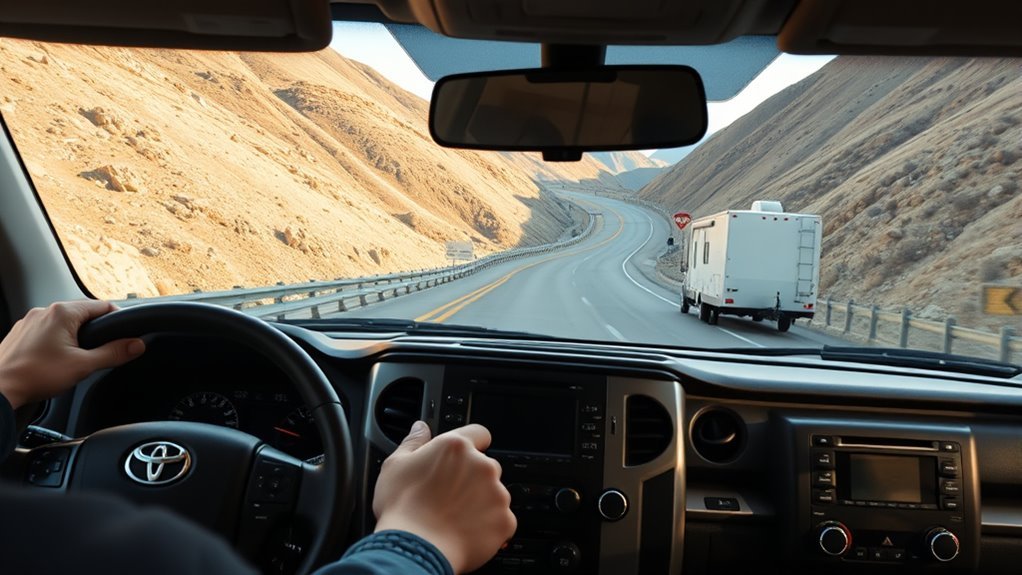
Match your gear selection to the grade so the engine’s RPM range provides predictable resistance without lugging. As you downshift into S4 or S3, smoothly blend throttle modulation with light brake inputs to maintain a steady descent and prevent overheating the service brakes. This coordinated approach maximizes engine braking effectiveness and keeps the tow rig stable on steep declines.
Match Gears To Grade
When you’re descending a steep grade with a trailer, downshift the transmission into S3 to engage engine braking and relieve the service brakes; S4 can be useful on moderate inclines but won’t provide the same retardation as S3. You’ll combine gear selection with terrain awareness to control speed, prevent brake fade, and keep the rig stable. Shift smoothly into S4 or S3 to avoid jolts that unsettle the trailer.
- Feel the truck hold speed without constant brake pressure.
- Trust precise downshifts to protect your brakes and cargo.
- Embrace control; select gears that match the slope’s demand.
- Let disciplined technique free you from constant worry.
Monitor speed, match gears to grade, and downshift early for predictable, liberating control.
Blend Throttle And Brake
Because controlled deceleration depends on both drivetrain and brakes, you’ll coordinate downshifts, engine braking, and light brake inputs to manage speed and heat while towing. Shift to S3 before a descent so engine braking assists braking, reducing fade and preserving stopping power. Activate tow/haul to sharpen throttle control and let the transmission choose hold gears for smoother downshift changes. Release the throttle gradually to let engine vacuum absorb speed; don’t lift abruptly or dump brakes. Apply light, progressive brake modulation to trim speed and maintain stability, not to do the bulk of deceleration. Learn how your Tundra responds across terrain and weights, then preselect gears and blend throttle and brakes confidently. That disciplined technique maximizes control, minimizes wear, and sustains freedom on the road.
Safety Checklist Before Relying on Engine Braking
Before you rely on engine braking on a descent, confirm your vehicle has the correct transmission modes—especially S3—and activate tow/haul to guarantee the system can hold gear and provide consistent retarding force. You’ll pair engine braking benefits with disciplined prep: inspect brakes, verify tow/haul engagement, know your load, and study the grade. Those steps free you from reactive panic and keep control.
- Feel confident: check pads, rotors, and fluid to avoid failure.
- Stay aware: calculate trailer weight; heavier loads demand stronger retarding force.
- Own the road: preview downhill length and pitch so you can use engine braking proactively.
- Be decisive: set S3 and tow/haul before descent to prevent gear hunting.
These safety considerations are technical and actionable. You’ll reduce brake fade, maintain stable speed, and preserve freedom on the road by executing this checklist before committing to engine braking while towing.
Quick Troubleshooting: Why Engine Braking May Feel Ineffective
If engine braking feels weak, first confirm you’ve selected the correct low gear (S3) so the engine can provide maximum retarding force. Check for transmission response delay—slow or hesitant downshifts will let speed build and negate engine braking. Address gear selection and transmission response promptly to restore predictable downhill control.
Low Gear Selection
When engine braking feels weak while towing, verify you’re in the correct low gear—higher gears dramatically cut the engine’s ability to absorb speed. You must confirm gear engagement in S3 for steep descents; S4 and S5 won’t help and will leave brakes working harder. Downshift smoothly from S4 to S3 to preserve stability and get full engine resistance. Check the transmission mode indicator and consult the owner’s manual to align braking techniques with towing demands.
- Feel the vehicle reclaim control as engine drag replaces brake fade.
- Trust precise gear engagement to free you from constant braking anxiety.
- Embrace S3 for sustained descent control and reduced heat stress.
- Know the sequence; downshift deliberately, avoid abrupt shifts that unsettle the rig.
Transmission Response Delay
Although the Tundra’s transmission prioritizes smooth shifts, that design can introduce a noticeable delay in downshifting under heavy tow loads, and you’ll feel reduced engine braking when the gearbox hesitates to select S3. When transmission lag prevents timely rpm rise, engine braking and overall braking efficiency drop on steep descents. Heavy loads amplify hydraulic and electronic control delays, so the auto-trans may not respond fast enough for safe deceleration. If you’re in S4 or S5, engine braking is effectively disabled and you rely solely on the transmission’s response. To regain control, manually downshift to S3 before the hill, monitor rpm and brake temp, and avoid late inputs. That proactive step restores engine braking authority and liberates your stopping strategy.
Frequently Asked Questions
What Is the Engine Braking in Tow Haul Mode?
Engine braking in tow haul uses the engine to slow your Tundra, reducing brake load and improving control on descents; it downshifts and holds gears, giving you predictable deceleration and greater safety while towing heavy loads.
How to Tow With a Toyota Tundra?
You tow a Toyota Tundra by engaging tow haul, selecting S3–S5 as terrain dictates, securing load, checking weight limits, monitoring brakes, using towing techniques and safety tips, and consulting the manual so you stay confident and liberated.
Conclusion
When towing your Tundra, use engine braking on long, steep descents to control speed and reduce brake fade — it’s your primary tool in Tow/Haul or S modes. Shift into S3 for moderate grades; drop to S4/S5 or manual downshifts on heavier loads or prolonged declines. Match downshifts to grade and trailer type, monitor temps, and follow the safety checklist. Engine braking is the anchor that keeps momentum honest; don’t rely on brakes alone.