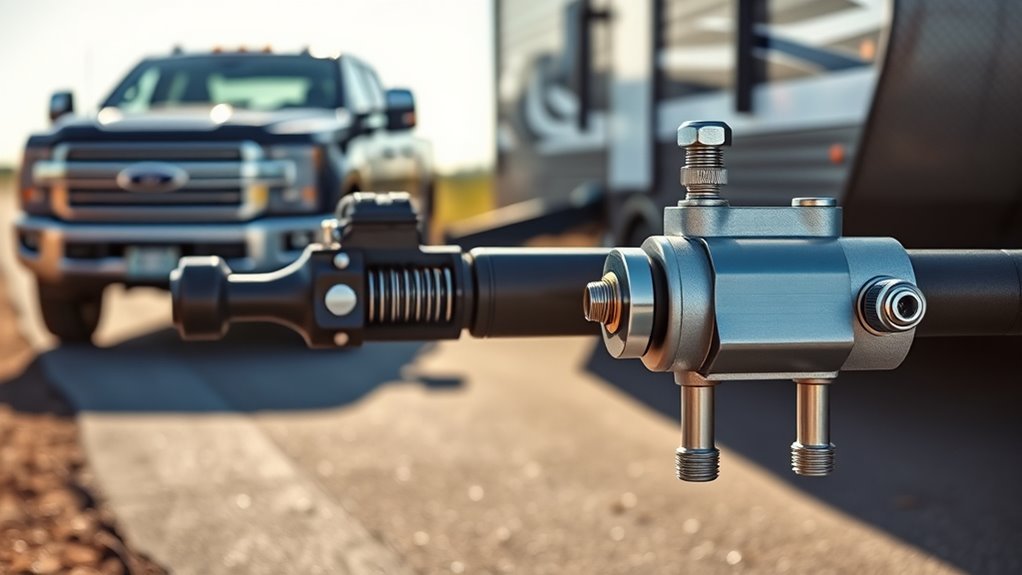
You need both clear vertical load control and lateral sway mitigation to tow safely: a weight-distribution hitch rebalances tongue weight across axles to restore steering, braking, and level ride for heavier trailers, while sway control systems arrest side-to-side motion from wind or passing vehicles. Use weight distribution when tongue weight or rear sag compromises handling, add sway control when lateral forces cause fishtailing. Combined they optimize stability; continue for setup, sizing, and adjustment guidance.
Do I Need a Weight Distribution or Sway Control?
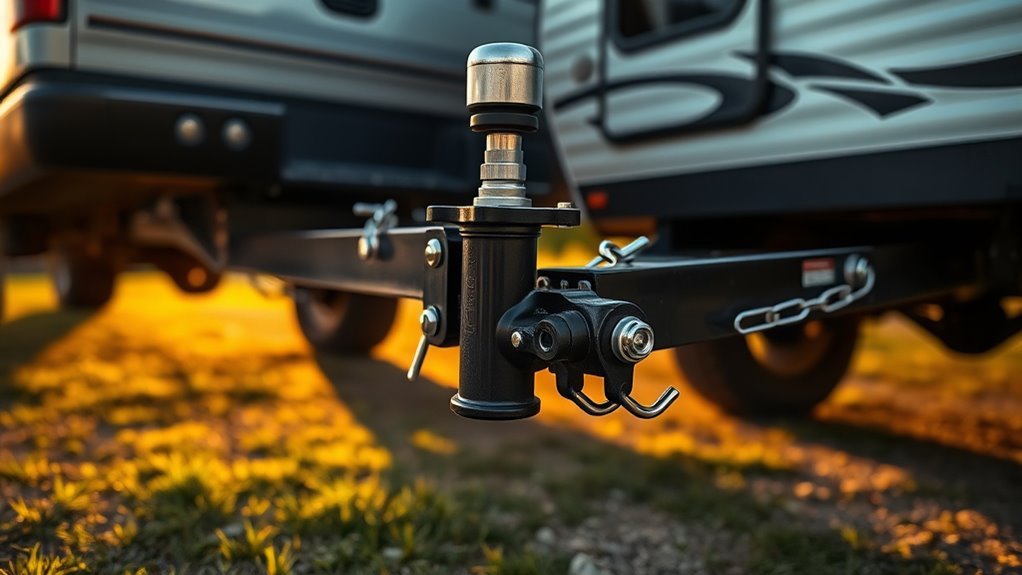
Wondering whether you need a weight distribution hitch, sway control, or both? You should assess load, trailer weight, and operating conditions. If your trailer exceeds 5,000 pounds, a weight distribution hitch is recommended because it redistributes tongue weight across axles, improving braking, steering response, and overall towing safety. But note: weight distribution improves handling and trailer stability in the vertical plane—it doesn’t inherently stop lateral sway. Sway control devices actively minimize side-to-side movement caused by wind, passing vehicles, or road irregularities, reducing fishtailing risk. For thorough control, you’ll pair systems or choose integrated solutions like the Hensley Arrow, which manages vertical and lateral forces together for seamless towing. You’ll prioritize a configuration that matches payload and anticipated conditions; heavier trailers and exposed routes demand both load redistribution and sway mitigation. That dual approach liberates you from reactive corrections, letting you tow with deliberate confidence and measurable safety margins.
Weight Distribution: What It Does & When to Use It
If your trailer causes rear sag, poor steering response, or compromised braking, you should consider adding a weight distribution hitch to restore proper axle loading. It uses spring bars to shift tongue weight forward and across the trailer axle, equalizing load among the tow vehicle’s front and rear axles and the trailer axle. You’ll need precise setup—measure tongue weight, select correct bar angle and sway bracket tension, and inspect hardware regularly to maintain safe handling.
When To Add One
When should you fit a weight distribution hitch? You should add one whenever your trailer’s gross weight approaches or exceeds 5,000 pounds, or when tongue weight compromises steering and braking within your vehicle’s towing capacity. Fit it if a trailer loads rear axle weight, causes nose-up attitude, or produces instability during maneuvers.
Install proactively for heavier travel or utility trailers and any rig with uneven loads; the hitch restores level posture and predictable dynamics. You’ll adjust spring bars precisely and verify settings each trip, since improper setup increases sway and degrades control. Routine hitch maintenance—inspection of brackets, fasteners, and bars—prevents failures. Choose installation as an act of liberation: regain confident control, broaden route options, and reclaim safe, lawful towing performance.
How It Redistributes Weight
Having added a weight distribution hitch to correct sag and restore handling, you’ll want to understand exactly how it reallocates forces across the rig. You shift tongue load from the tow vehicle’s rear axle toward the front axle and the trailer axle using spring bars that exert upward force on the trailer frame. That deliberate redistribution restores weight balance and improves axle alignment, reducing rear sag and enhancing steering response. The bars preload the hitch head, converting concentrated tongue weight into distributed axle loads so braking and cornering forces act predictably across all axles. You’ll gain liberated control when towing heavier trailers; however, precise adjustment is essential because incorrect settings can recreate sway or compromise safety despite the system’s design for tongue weights above 5,000 pounds.
Setup And Adjustment Tips
1 clear setup and precise adjustment are what let a weight distribution hitch do its job: you’ll level the trailer, transfer tongue load appropriately, and restore predictable axle loading so steering, braking, and suspension respond as designed. Match the hitch to gross and tongue weight, then use a scale to verify distribution before departure. You’ll set spring bar tension so the trailer sits level and front axle regain is measurable. Follow manufacturer specs for head height, shank drop, and bar angle. Implement hitch maintenance tips routinely—lubricate pivot points, inspect clips, and torque fasteners.
- Verify trailer level with tongue weight and gross weight measurements.
- Adjust spring bars incrementally; reweigh after each change.
- Recheck before long trips or load shifts.
- Document settings per load and follow adjustment techniques.
Sway Control: What It Does & When to Use It
Anyone towing a trailer should understand how sway control minimizes lateral movement to prevent fishtailing and loss of control, especially in crosswinds or when large vehicles pass. You’ll assess sway control benefits by examining how systems—friction pads or pivot-point designs—attenuate side-to-side motion and keep the trailer aligned behind the tow vehicle. Choose sway control systems that match your trailer dynamics: simple friction units add resistance; pivot systems, including advanced active units like the ProPride 3P®, reduce oscillation more consistently at highway speeds. You should add sway control when crosswinds, high-speed lane changes, or frequent overtaking create lateral excitation beyond what your tow vehicle and hitch alone can damp. Note that many weight distribution hitches lack integrated sway control, so plan a separate solution if you need both load leveling and lateral stability. Prioritize models proven to improve comfort and safety under the operational envelope you’ll routinely encounter.
Weight Distribution vs Sway Control : What Each Does Best
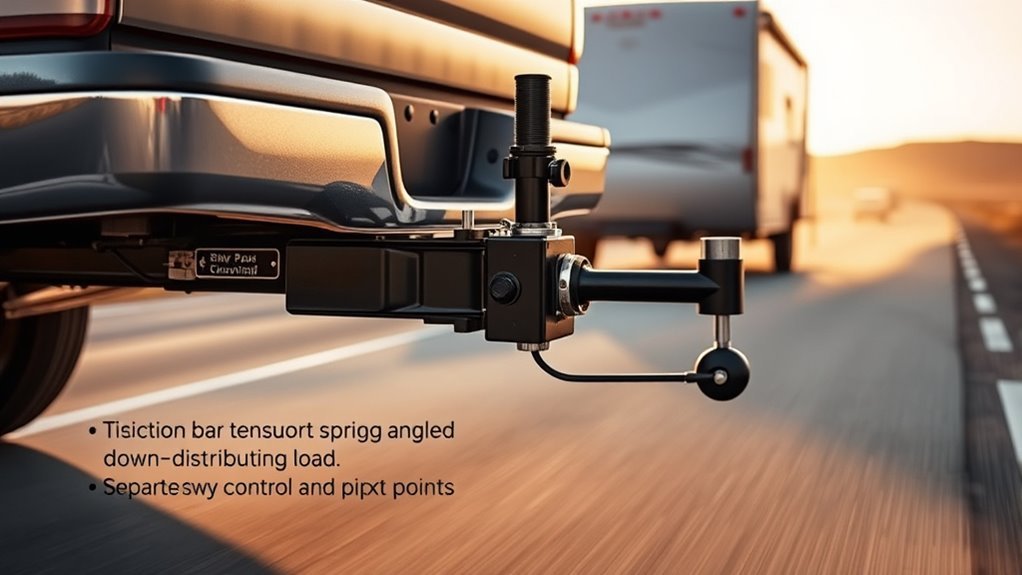
Because they address different forces, you should treat a weight distribution hitch and sway control as complementary systems rather than alternatives: you’ll gain distinct benefits from each when you prioritize towing safety and respect weight limits. A weight distribution hitch redistributes tongue load across all axles, restoring correct ride height, improving braking response, and sharpening steering authority under load. Sway control targets lateral disturbances—crosswinds, passing vehicles, uneven surfaces—damping side-to-side oscillation that a distribution hitch won’t stop. Choose based on the dominant risk you face: vertical load imbalance versus lateral instability.
- Weight distribution: optimizes axle load sharing, ride height, and braking stability to meet rated weight limits.
- Sway control: suppresses lateral motion, improving directional control during gusts or lane changes.
- Performance trade-off: distribution hitches enhance longitudinal dynamics but don’t mitigate yaw-induced sway.
- System selection: match equipment to the primary dynamic threat to maximize towing safety and personal autonomy on the road.
When to Use Both Together and Why It Helps
When you combine a weight distribution hitch with a sway control system, you’ll see measurable improvements in braking response because vertical load is redistributed to restore front-axle traction and braking balance. You’ll also reduce trailer sway by countering lateral forces with active or friction-based sway devices, keeping the trailer aligned behind the tow vehicle. For heavier trailers or variable road conditions, using both systems together provides complementary stability that enhances control and safety when braking and maneuvering.
Improved Braking Response
If you pair a weight distribution hitch with a sway control system, you’ll markedly improve braking response by more evenly moving tongue weight onto both vehicle axles and limiting lateral trailer movement during deceleration. You gain better steering authority and consistent brake load distribution, which enhances braking techniques and overall towing safety. Use both when hauling heavy loads, descending grades, or maneuvering through gusty corridors.
- Even axle loading reduces rear lift and improves tire traction under braking.
- Sway control maintains alignment, preventing lateral forces that compromise stopping distance.
- Integrated systems smooth deceleration pulses, reducing ABS engagement and instability.
- Combined setup broadens safe operating margins across speeds and road geometries.
This approach liberates you from reactive corrections, letting you control stops with predictability and confidence.
Reduced Trailer Sway
One clear rule: use both a weight distribution hitch and a sway control system whenever you’re towing a heavier trailer (generally over about 5,000 lb) or expecting crosswinds, passing traffic, or uneven pavement that can induce lateral oscillation. You’ll achieve measurable towing safety gains because the weight distribution hitch reallocates tongue load across axles, restoring proper ride height and steering geometry. The sway control then damps lateral forces—wind gusts, aerodynamic disturbances, and irregular pavement—preventing resonant side-to-side motion. Together they address orthogonal dynamics: vertical load balance and lateral energy dissipation, yielding consistent trailer stability and improved handling margins. You must regularly inspect and precisely set both systems; misadjustment degrades performance and can paradoxically increase sway risk during critical maneuvers.
Choose & Set Up the Right Hitch Combo for Your Trailer
Although selecting a hitch combo can seem straightforward, you should evaluate both weight distribution and sway control as an integrated system to guarantee predictable handling and axle load limits. You’ll match hitch types to your trailer types and vehicle compatibility, verify load capacity against actual tongue weight, and prioritize towing safety through correct installation tips and adjustment techniques. Set spring bars to level the trailer, confirm torque specs, and engage sway devices per manufacturer guidance.
Treat weight distribution and sway control as one system—match hitch type, verify tongue weight, install and adjust for safe, predictable towing.
- Assess: confirm vehicle compatibility, trailer types, and measured tongue weight against load capacity.
- Configure: choose hitch types that allow both spring-bar weight distribution and a compatible sway control unit.
- Install: follow installation tips—torque bolts, set spring-bar angle, level trailer, and test under controlled conditions.
- Maintain: implement a maintenance schedule—inspect wear, re-torque connections, and recalibrate adjustment techniques for varying loads.
You’ll gain liberated control on the road by treating setup as a precise, repeatable system.
Frequently Asked Questions
Can Either System Be Retrofitted to Older Trailers Safely?
Yes — you can retrofit either system to older trailers, but retrofit options vary; assess frame strength, tongue weight, attachment points, and wiring. Prioritize safety considerations, structural reinforcements, and certified installation to guarantee liberated, reliable towing.
Do Insurance Policies Require Weight Distribution or Sway Control?
Generally no — insurers rarely mandate weight distribution or sway control, but your insurance coverage can hinge on demonstrated towing safety; you should document proper equipment and maintenance to protect claims and preserve your autonomy on the road.
How Do Maintenance Schedules Differ Between the Two Systems?
Right off the bat, you’ll inspect and grease WD hitch components weekly, adjust spring bars monthly, while sway-control needs less frequent hardware checks and damper fluid inspections; maintenance tips focus on system longevity and freeing you from breakdowns.
Can Electronic Sway Control Replace Mechanical Sway Bars?
Yes, you can’t fully replace mechanical sway with electronic sway alone; electronic systems augment control and mitigation, but mechanical sway bars provide passive, reliable lateral stability you’ll still want for ultimate freedom and safety.
Are There Industry Standards or Certifications for These Devices?
Yes—you’ll find industry regulations and safety standards like SAE and RVIA guidelines, and sometimes FMVSS overlap; manufacturers follow certifications, testing protocols, and documented compliance, so you can insist on verified, traceable performance and safety.
Conclusion
You don’t always need both: weight distribution rebalances static and dynamic load for level towing, while sway control damps lateral oscillation for directional stability. Contrast the two—one redistributes mass fore‑aft, the other resists yaw—and you’ll see they solve different failure modes. Use weight distribution to restore hitch/axle geometry; add sway control when crosswinds, passing trucks, or trailer profile induce oscillation. Combined, they address load and motion, giving precise, predictable towing dynamics.