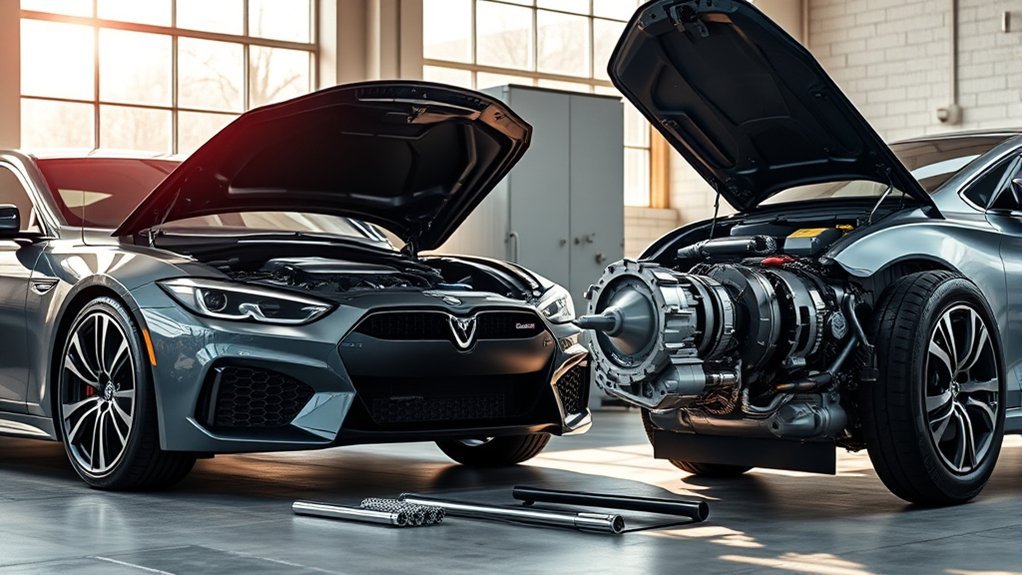
E-CVT, or Electronically Controlled Continuously Variable Transmission, offers a seamless alternative to traditional automatic transmissions by using a planetary gear set and dual electric motors. It adjusts gear ratios continuously, enhancing fuel efficiency and power delivery. Unlike conventional automatics, E-CVT eliminates shift shock for smoother acceleration and deceleration. This technology is particularly beneficial in hybrid vehicles, optimizing performance while reducing emissions. Learn how these differences can impact your driving experience and efficiency moving forward.
What Is E-CVT and How Does It Work?
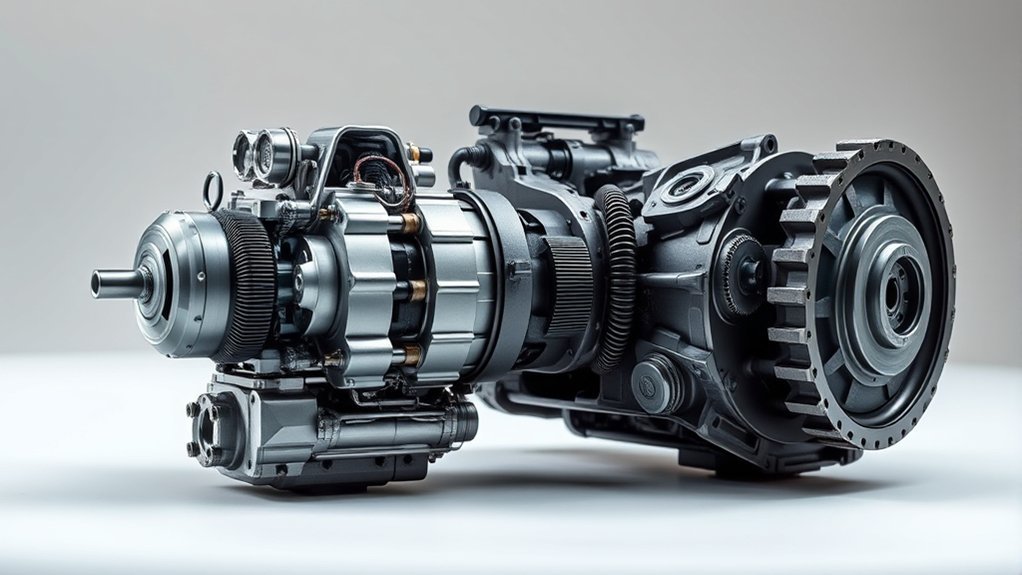
When you consider the mechanics of modern vehicles, E-CVT (Electronically Controlled Variable Transmission) stands out for its innovative design. Unlike traditional automatic transmissions, E-CVT employs a single planetary gear set, allowing for infinite gear ratios. This eliminates the need for pulleys and belts, enhancing reliability. It operates with two electric motors: a starter generator that engages the engine and charges the battery, and a traction motor that drives the wheels. This setup enables seamless power delivery, optimizing performance regardless of driving conditions.
E-CVT continuously adjusts gear ratios based on engine and wheel speeds, providing superior responsiveness. This design mimics traditional gear scenarios while maintaining independent control of wheel speed and engine RPM. The benefits of E-CVT are evident in hybrid vehicle applications, where fuel efficiency and performance are paramount, making it a compelling choice for those seeking liberation from conventional transmission limitations.
Key Differences Between E-CVT and Traditional Automatics
When you compare E-CVT and traditional automatic transmissions, you’ll notice significant differences in gear ratio flexibility, power delivery mechanisms, and overall efficiency. E-CVT employs a single planetary gear set for continuous adjustment, while traditional automatics shift between fixed ratios. This design not only enhances power delivery but also optimizes fuel efficiency, setting the two systems apart in performance.
Gear Ratio Flexibility
Understanding gear ratio flexibility reveals a fundamental difference between E-CVT and traditional automatic transmissions. E-CVT’s innovative design offers superior gear ratio dynamics, enhancing performance adaptability in various driving conditions. Here’s how:
- E-CVT utilizes a single planetary gear set for infinite gear ratios.
- Gear ratios continuously adjust based on engine and wheel speeds.
- The engine can decouple from the wheels in low-speed scenarios.
- E-CVT can mimic various traditional gear ratios through motor speed adjustments.
- It allows smoother acceleration and deceleration compared to abrupt shifts in traditional automatics.
This flexibility enables you to experience peak efficiency and performance, liberating you from the constraints of fixed gear ratios typical in traditional automatic transmissions.
Power Delivery Mechanisms
Power delivery mechanisms markedly differ between E-CVT and traditional automatic transmissions, impacting overall driving experience and efficiency. E-CVT utilizes a planetary gear set with both an engine and an electric motor, allowing for continuous variable gear ratios. This enables seamless power distribution and immediate torque management, leading to smoother acceleration. In contrast, traditional automatics rely on fixed gear ratios and hydraulic systems, resulting in abrupt power delivery during gear shifts. E-CVT’s ability to maintain high gear ratios at low engine RPM enhances fuel efficiency considerably. With its dual electric motors independently controlling driving and charging functions, E-CVT offers a level of responsiveness and adaptability that traditional automatics simply can’t match, liberating your driving experience from conventional limitations.
Efficiency and Performance
While both E-CVT and traditional automatic transmissions aim to enhance driving performance, their efficiency profiles markedly differ. E-CVTs leverage hybrid synergy for superior torque management, continuously adjusting gear ratios based on real-time conditions. This contrasts with the fixed steps of traditional automatics, which can waste energy during shifts. Key differences include:
- Higher efficiency through seamless ratio adjustments
- Reduced friction and wear, extending lifespan
- Enhanced fuel efficiency and lower emissions via electric propulsion
- Smoother acceleration, eliminating “shift shock”
- Instant torque delivery for quicker starts
These attributes make E-CVTs more efficient and responsive, particularly in hybrid and electric vehicles, aligning with modern demands for sustainability and performance.
Advantages of E-CVT: Efficiency and Performance
E-CVT systems offer significant advantages in fuel efficiency and performance by continuously optimizing engine output based on driving conditions. You’ll experience smoother power delivery without the disruptions of traditional gear shifts, enhancing overall driving comfort. Additionally, the adaptive capabilities of E-CVT allow for improved acceleration and efficiency, making it a compelling choice over conventional automatic transmissions.
Enhanced Fuel Efficiency
Modern vehicles equipped with E-CVT systems demonstrate a significant leap in fuel efficiency, particularly when compared to traditional automatic transmissions. This advanced technology employs several fuel optimization strategies, especially beneficial for hybrid vehicles.
- Continuously adjusts gear ratios for ideal engine performance
- Allows the engine to run at its most efficient RPM during acceleration
- Eliminates “shift shock,” maintaining steady fuel consumption
- Enables regenerative braking, enhancing energy recovery
- Achieves higher MPG ratings compared to conventional automatics
These factors contribute to the hybrid vehicle advantages, maximizing energy use and minimizing wasted fuel. As a result, E-CVT systems not only elevate driving efficiency but also align with sustainable practices, empowering you to drive smarter and greener.
2. Smooth Power Delivery
Smooth power delivery is a hallmark of E-CVT systems, greatly enhancing driving dynamics. By continuously adjusting gear ratios, E-CVT eliminates the “shift shock” found in traditional automatic transmissions, allowing for seamless shifts during acceleration. This means you experience dynamic acceleration without noticeable interruptions, especially at low speeds. The system’s ability to keep the engine at its most efficient RPM further enhances performance, adapting power delivery to your driving conditions without the constraints of fixed gears. Additionally, the integration of electric motors allows for regenerative braking, which not only boosts efficiency but also guarantees smooth shifts by recharging the battery during deceleration. Overall, E-CVT provides a more responsive, liberating driving experience.
3. Adaptive Performance Capabilities
While traditional automatic transmissions rely on fixed gear ratios, E-CVT technology revolutionizes power delivery by continuously adjusting the connection between engine output and wheel speed. This dynamic adaptability maximizes performance optimization, enhancing your driving experience through:
- Instant torque from dual electric motors
- Smooth acceleration without defined shifting points
- Low-speed operation solely on the traction motor for better fuel efficiency
- Regenerative braking to recharge the battery during deceleration
- Adaptive performance capabilities that fine-tune power delivery based on driving conditions
With these features, E-CVT facilitates adaptive driving, allowing for seamless shifts and superior handling compared to the sometimes jarring shifts of automatic transmissions. This results in a more responsive, efficient, and enjoyable ride.
Comparing Driving Experiences: E-CVT and Traditional Automatics
When you compare the driving experiences of E-CVT and traditional automatic transmissions, you’ll notice distinct differences in how power is delivered. E-CVT systems provide seamless acceleration smoothness by continuously adjusting gear ratios, allowing for a more fluid start, especially at low speeds. This contrasts with traditional automatics, which shift through defined gears, often resulting in noticeable power delivery changes and potential jerkiness.
While E-CVT offers a quieter operation due to less mechanical engagement, traditional automatics can produce more engine noise during shifts, affecting the overall user experience. However, some drivers might perceive E-CVT as less responsive, given the delayed power delivery compared to the immediate feedback from conventional automatics. Your driving preferences will ultimately dictate which system aligns better with your expectations for power responsiveness and driving comfort.
Addressing the ‘Rubber Band Feel’ in E-CVT Performance
The distinct driving experiences between E-CVTs and traditional automatic transmissions highlight a key challenge: the “rubber band feel” associated with E-CVT performance. This sensation arises from delayed power response due to continuous gear ratio adjustments, which can make acceleration feel less direct.
To address this issue, manufacturers implement several strategies:
- Software enhancements to mimic traditional transmission behavior
- Adjustments to electric motor responses for quicker power delivery
- Calibration of gear ratios to better align with driver expectations
- Improved driver feedback mechanisms for a more linear acceleration experience
- Consumer feedback integration to refine performance
Addressing the rubber band sensation is essential for consumer acceptance. Many drivers still prefer the immediate, linear acceleration feedback typical of conventional automatic transmissions. Leveraging these strategies can help bridge the gap between E-CVT technology and driver expectations, ultimately enhancing the overall driving experience.
Historical Development of E-CVT Technology
As the automotive industry evolved, the development of E-CVT technology emerged as an essential innovation in hybrid vehicle design. The concept gained traction with Ford’s 2005 Escape Hybrid, marking its first significant commercial application. However, Toyota has been leading E-CVT innovations since the 1990s, incorporating it into their Prius models to enhance fuel efficiency and reduce emissions. These systems evolved from traditional CVT technologies, shifting from belts and pulleys to a more efficient planetary gear set configuration. This change reflects the hybrid evolution, showcasing advancements in power management systems that optimize performance. Over time, E-CVT technology has tackled challenges like the “rubber band feel” of acceleration, prompting manufacturers to refine the user experience. As a result, E-CVT stands at the forefront of transmission advancements, representing a commitment to improved fuel tech and enhanced driving dynamics in modern vehicles.
When to Choose E-CVT vs. Automatics?
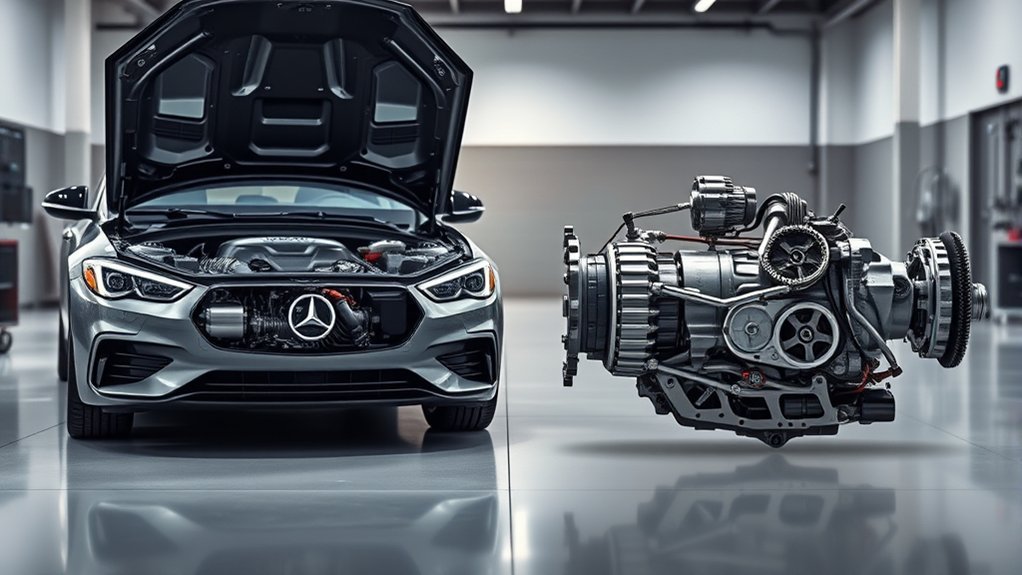
Which transmission option suits your driving needs best: E-CVT or automatic? Your choice largely depends on your driving preferences and specific scenarios. Consider these factors:
- E-CVT benefits: Offers smoother acceleration and deceleration through infinite gear ratio adjustments.
- Fuel efficiency: E-CVTs excel, especially in hybrid applications, by optimizing engine performance.
- User experiences: If you’re used to traditional gear shifting, you might find automatic transmissions more familiar.
- Performance scenarios: Automatics can provide quicker acceleration response, while E-CVTs focus on efficiency.
- Stop-and-go traffic: E-CVTs can run solely on electric power, enhancing efficiency and reducing emissions.
Ultimately, if you’re prioritizing fuel economy and smooth shifts, E-CVT may be your best bet. Conversely, if you prefer a more traditional driving experience with quicker responses, an automatic transmission could be the way to go. Choose wisely based on your unique driving needs.
Future of E-CVT: Trends and Innovations
While advancements in E-CVT technology continue to emerge, manufacturers are increasingly focusing on enhancing battery efficiency and integrating these systems with advanced hybrid technologies. Battery advancements will enable longer electric-only driving ranges, while torque optimization will accommodate higher torque levels from electric motors, improving performance across various conditions.
Future E-CVT systems will likely feature sophisticated control algorithms that enhance power delivery, minimizing the “rubber band feel” often associated with current models. Additionally, the integration of regenerative braking systems will boost energy recovery during deceleration, enhancing overall vehicle efficiency.
With the rise of autonomous driving, E-CVTs are expected to integrate seamlessly with AI-driven controls, improving responsiveness in real-time scenarios. These innovations will not only elevate the driving experience but also contribute to a more sustainable automotive future, aligning with your desire for liberation from traditional transmission limitations.
FAQs About E-CVT and Automatic Transmissions
What should you know about E-CVT and automatic transmissions? Understanding the differences can help you make informed decisions. Here are some common questions:
- E-CVT myths: Many believe E-CVT systems lack performance; however, they optimize fuel efficiency by continuously adjusting gear ratios.
- Driving feel: E-CVT’s “rubber band effect” can make acceleration feel less immediate compared to traditional automatic transmissions.
- Engine operation: E-CVT allows the engine to turn off during stops, enabling electric-only driving, which isn’t the case for conventional automatics.
- Maintenance: Automatic transmission maintenance is essential; neglect can lead to costly repairs, unlike E-CVT systems, which often require minimal upkeep.
- Application: E-CVT technology has been standard in hybrids since the 1990s, while automatic transmissions dominate gasoline vehicles.
Understanding these aspects can clarify your driving experience and maintenance expectations.
Frequently Asked Questions
Is ECVT More Reliable Than Automatic?
Yes, E-CVTs are generally more reliable than automatic transmissions due to their fewer moving parts and smoother power delivery. However, E-CVTs may lack some performance responsiveness, which can be considered a drawback for enthusiasts.
Is E-cVT Transmission Automatic?
Yes, an E-CVT transmission is automatic. It offers advantages like seamless acceleration and enhanced fuel efficiency, optimizing performance by continuously adjusting ratios. You’ll experience a smoother ride, liberating you from traditional shifting constraints.
Conclusion
In conclusion, while e-CVT and traditional automatic transmissions each have their strengths, e-CVT systems can enhance fuel efficiency by up to 30% compared to conventional automatics. This statistic underscores the potential for e-CVT to redefine driving dynamics, especially in hybrid vehicles. As technology advances, understanding these differences will help you make informed choices that align with your driving preferences and environmental goals. The future of e-CVT looks promising, paving the way for innovative automotive solutions.