You need to know actual payload capacity — GVWR minus curb weight — because it dictates how much people, cargo, and hitched gear you can safely carry. On 2024–25 Tundras trims vary: SR/SR5 about 1,940 lb, Capstone about 1,485 lb, others in between; cab and bed options slightly shift numbers. Verify via door sticker or certified scales, monitor tongue weight for towing, and distribute loads low and centered; keep going to learn practical checks and procedures.
Quick Answer: Toyota Tundra Payload Ranges and What Affects Them
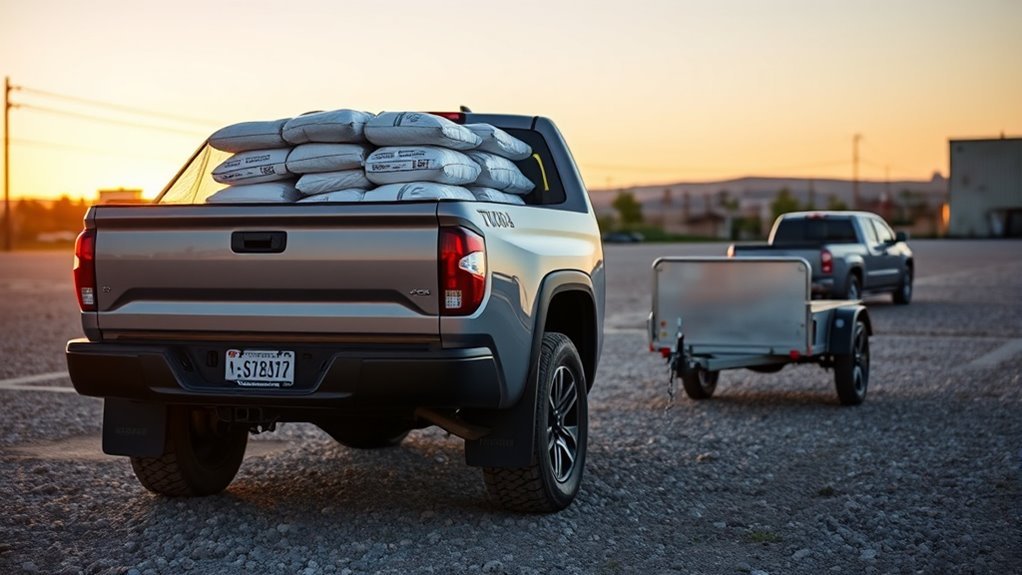
Wondering how much weight your Tundra can safely carry? You’ll see payload ranges from 1,485 pounds (Capstone) to 1,940 pounds (SR/SR5) in specified configurations. You’ll use capacity comparisons to evaluate trims: engine choice and added features change curb weight, lowering or raising usable payload. Don’t fall for payload misconceptions that treat a single number as universal; trim-level variance and factory options matter.
You’ll account for passengers, cargo, and hitch-supported items when calculating maximum payload, and you’ll apply precise measurements before loading. Exceeding limits risks structural damage, degraded stability, and legal exposure, so you’ll keep measured margins. You’ll also prioritize proper weight distribution—placing mass over the axle and balancing the bed—to preserve handling and braking performance. In short, you’ll rely on trim-specific figures, verify actual vehicle weight, and manage loads deliberately to maintain safety and autonomy.
What Payload Means (Vs. Towing, GVWR, and GCVWR)
Think of payload as the total live load your Tundra is allowed to carry—passengers, gear in the cab and bed, and any cargo-mounted accessories—and recognize that it differs fundamentally from towing, GVWR, and GCVWR. The payload definition centers on what stays with the vehicle; payload importance is that it directly affects handling, braking, and component longevity. You must distinguish these ratings analytically.
- Payload = weight carried on/in the vehicle (passengers + cargo + accessories)
- GVWR = maximum safe total vehicle weight (vehicle + payload)
- GCVWR = vehicle + trailer maximum combined weight
- Towing capacity = maximum trailer weight you can pull
- Exceeding payload risks structural and legal consequences
For the 2024 Tundra, payload ranges from about 1,485 to 1,940 lb; GVWR is 11,500 lb; GCVWR is 25,300 lb. Use these numbers to calculate safe loads: curb weight subtracted from GVWR yields available payload. This clarity liberates you to optimize load plans without compromising safety or compliance.
Exact Payload by Year, Trim, Cab, and Bed (2024–2025)
Although payload varies with model year, trim, cab, and bed length, you can narrow exact capacities for the 2024–2025 Tundra by referencing each configuration’s curb weight subtracted from the GVWR (11,500 lb); for 2024 specifically, SR and SR5 trims top out at 1,940 lb, Limited at 1,740 lb, 1794 Edition at 1,575 lb, and TRD Pro at 1,600 lb, with cab/bed combos further affecting those figures. You’ll use that same method for 2025: identify the exact curb weight for your chosen trim and cab/bed, then subtract from GVWR to get payload capacity. Trim variations drive most differences: SR/SR5 prioritize maximum payload, Limited reduces capacity for added features, 1794 Edition lowers capacity further for luxury content, and TRD Pro balances off-road equipment with moderate payload. Be methodical: list trim, cab, bed, find curb weight, subtract 11,500 lb. That analytical approach liberates you from guesswork and gives precise, repeatable payload figures for each Tundra configuration.
How to Verify Your Tundra’s Payload: Door Sticker and Weighing Steps
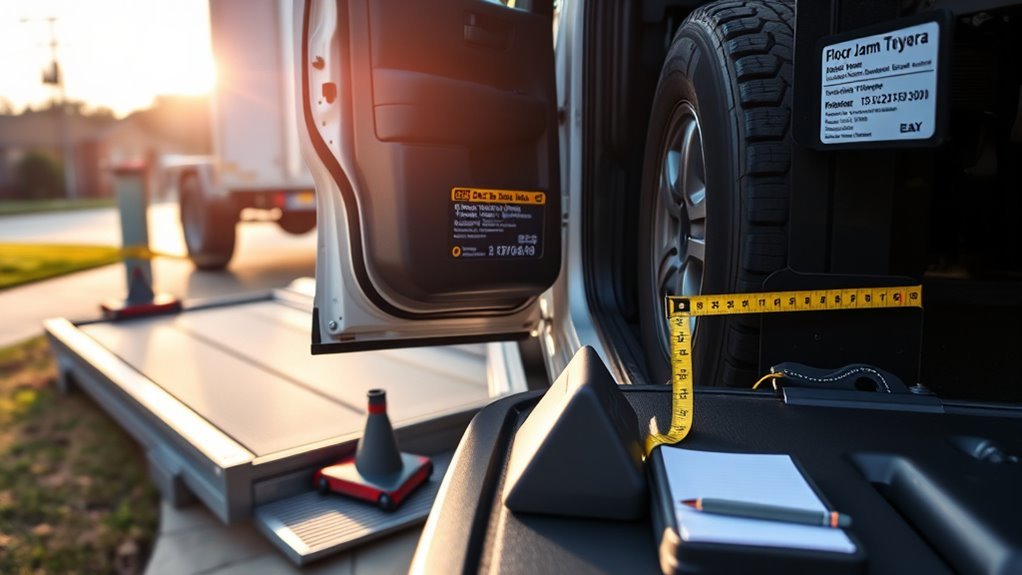
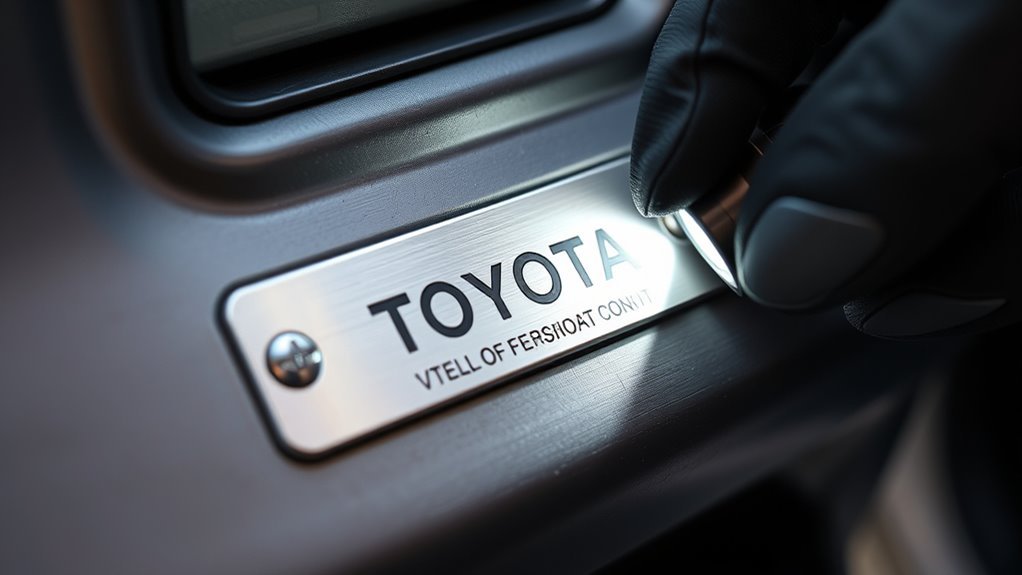
Start by locating the door sticker on the driver’s jamb to read the GVWR and curb weight so you can compute the maximum payload (GVWR minus curb weight). Then verify those figures with certified CAT-scale measurements of front axle, rear axle, and total vehicle weight both empty and with your typical load. Don’t forget to subtract occupant weight (for example, a 608 lb family) and any hitch-supported gear when calculating available cargo capacity.
Locate The Door Sticker
Begin by locating the door sticker on the driver’s side door jamb; it lists the Gross Vehicle Weight Rating (GVWR) and the Vehicle Capacity Rating you’ll use to verify payload. You’ll read the door sticker location and payload information precisely to determine limits. Note GVWR, Vehicle Capacity Rating, tire pressures, and axle weights printed there. Use the sticker as your authoritative baseline.
- Confirm GVWR value.
- Record Vehicle Capacity Rating.
- Observe axle weight limits.
- Note tire pressure specifications.
- Verify manufacture date for applicability.
You’ll then use these values to calculate payload: subtract your vehicle’s empty weight from GVWR to find allowable cargo and passengers. This approach gives you freedom from guesswork and guarantees safe, compliant loading.
Weigh At A Certified Scale
When you need a definitive payload figure, take your Tundra to a certified public scale and weigh it precisely: record the unloaded curb weights and individual front/rear axle readings, then load the truck with passengers, fuel, and cargo as you would for a trip and re-weigh to obtain the loaded axle and total vehicle weights. Start by confirming GVWR and curb weight on the door sticker, then use payload measurement techniques that compare those sticker values to your measured numbers. At certified scale locations, note empty and loaded total vehicle and axle weights, then subtract loaded weight from GVWR to compute available payload. Repeat periodically to monitor changes. This rigorous, actionable process frees you to carry what you need while staying within safe, legal limits.
How Payload Changes Tongue Weight, Load Balance, and Hitch Choice
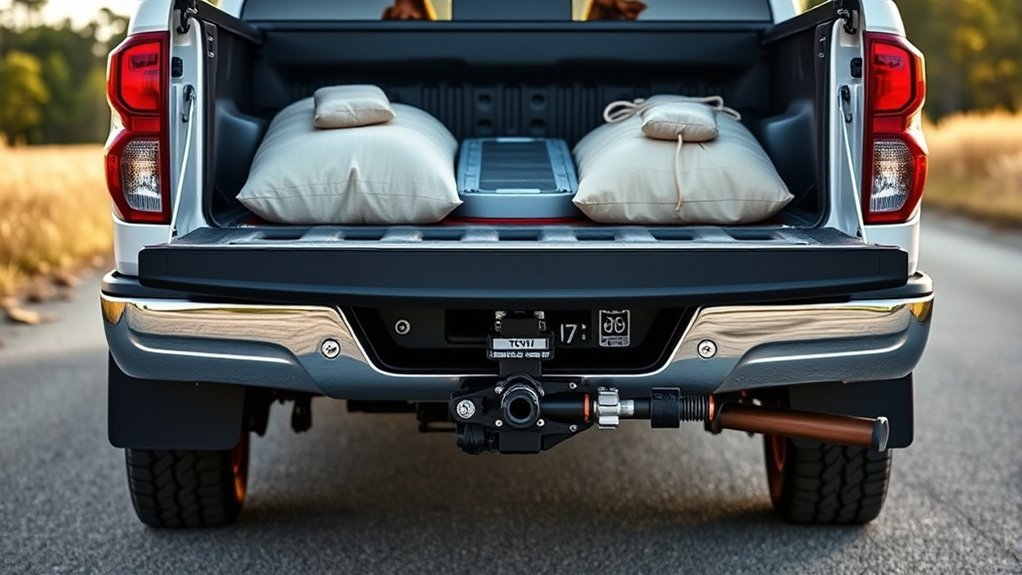
You’ll need to understand tongue weight basics—conventional trailers typically require 9–15% and fifth-wheel/gooseneck about 22.5%—because that percentage governs stability and how the load sits on the truck. Adjusting payload in the bed (passengers, cargo, hitch) shifts front/rear axle loads and can push axle ratings past safe limits. Select a hitch (and, if needed, a weight-distributing model) that compensates for altered load distribution to restore proper axle loading and towing dynamics.
Tongue Weight Basics
Tongue weight — the downward force the trailer tongue applies to your Tundra’s hitch — typically ranges from about 9–15% of trailer mass for conventional trailers and near 22.5% for fifth‑wheel/gooseneck setups, so changes in payload directly shift that force and the truck’s axle loads. You must monitor tongue weight relative to your Tundra’s payload limit to avoid overloading the rear or front axle, which degrades steering and braking. Use measured adjustments and the correct hitch type to reclaim control.
- Measure tongue weight with a scale
- Compare to Tundra payload capacity
- Prefer a weight-distribution hitch when needed
- Shift cargo to correct sag and pitch
- Never exceed manufacturer limits
Maintain precise load distribution to preserve stability and vehicle longevity.
Load Distribution Effects
Now that you’ve measured tongue weight and checked it against payload limits, focus on how shifting cargo and trailer load affects that force and the Tundra’s axle loads. You’ll analyze load distribution quantitatively: conventional trailers require 9–15% tongue weight while 5th wheel/gooseneck setups center near 22.5%, which changes front/rear axle loading and vehicle pitch. Weight shifting aft increases rear-axle load and reduces front traction; forward bias does the opposite. Cantilevered cargo further alters moments about the hitch, so small longitudinal moves produce large axle-load changes. Monitor axle ratings continually and avoid exceeding payload to prevent structural damage and legal exposure. Where imbalance persists, employ load distribution strategies to restore stability and reclaim control of your vehicle.
Hitch Selection Guidance
How does payload change your hitch choice and the resulting tongue weight on a Tundra? You must evaluate tongue weight (9–15% of trailer mass) against Tundra payload and hitch ratings to preserve handling and freedom of movement. Match hitch types to trailer class and vehicle limits: a conventional hitch supports up to 1,200 lbs tongue, 1,500 lbs with load distribution. Use load distribution hitches and correct towing accessories to rebalance axle loads when tongue weight approaches limits.
- Calculate tongue weight as 9–15% of trailer weight
- Check Tundra payload (1,485–1,940 lbs) before adding hitch load
- Match hitch type rating to trailer and payload
- Use load distribution to shift weight to front axle
- Inspect towing accessories for rated capacity and compliance
Practical Loading Checklist: People, Cargo Placement, and Weight Limits
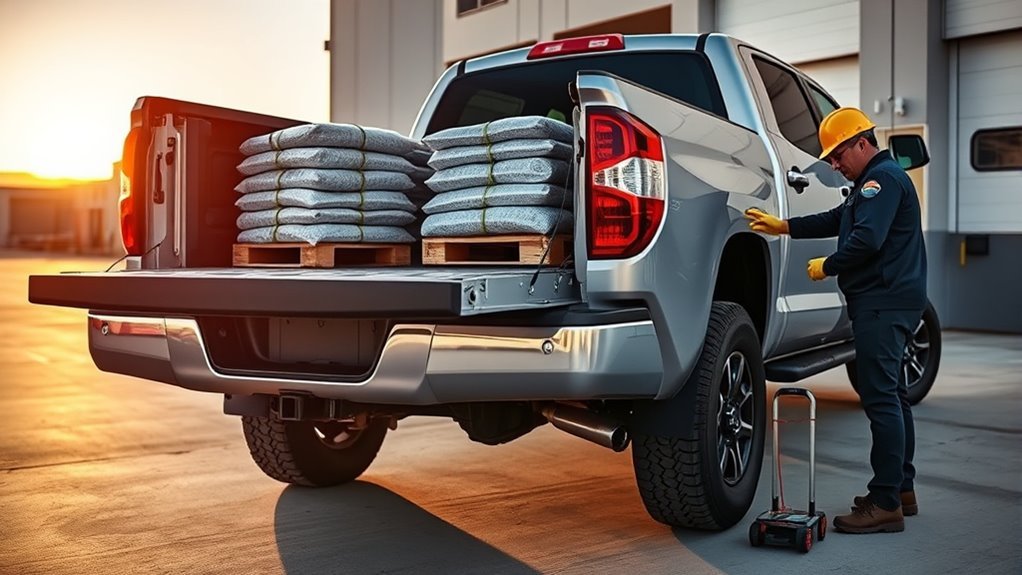
Start by quantifying every load component—passengers, bed cargo, and hitch-supported items—so you can compare the total against your Tundra’s rated payload (up to 1,940 lb on SR/SR5 trims). You’ll log individual weights, then apply cargo distribution and weight management principles: place concentrated mass over the rear axle and keep heavy items low and centered to minimize pitch and preserve steering axle load. Account for cantilevered loads that transfer weight rearward; measure tongue weight for hitched gear. Check the vehicle’s sticker for the definitive payload rating and subtract known curb weight and fluids to derive remaining capacity. Don’t exceed the published limit; overloads accelerate wear on frame, suspension, and tires. Use tie-downs to prevent dynamic shifting and reweigh after securing cargo. This checklist gives you a methodical, liberating workflow: quantify, distribute, verify, and adjust so you retain control and operate within engineered constraints.
Safety, Legal Limits, and Maintenance When Carrying Heavy Payloads
Because exceeding rated payloads accelerates wear and can compromise structural integrity, you should treat payload limits as strict operating parameters rather than flexible suggestions. You must honor published capacities—SR/SR5 up to 1,940 lb, Capstone 1,485 lb—because payload safety directly affects frame, suspension, tire life, and axle load. Legal implications aren’t theoretical: overloading can trigger fines, failed inspections, and liability in collisions. Monitor axle weight ratings and distribute mass to maintain stability; improper weight distribution increases rollover and brake fade risk. Follow maintenance tips to mitigate damage and preserve your autonomy on the road.
- Check axle loads with scales before heavy trips.
- Verify tire pressure and condition under rated loads.
- Inspect suspension and frame for deformation after heavy use.
- Rotate and size tires per manufacturer guidance.
- Document loads and service for legal protection.
Act decisively: respect weight distribution, stay within legal limits, and perform targeted maintenance to keep the Tundra reliable and your freedom uncompromised.
Frequently Asked Questions
What Does Payload Capacity Mean on a Pickup?
Payload capacity means the maximum weight your pickup can safely carry, combining payload specifications with passengers and cargo; you’ll manage loads precisely, practicing strict load management to avoid damage, instability, legal issues and preserve operational freedom.
Which Tundra Has the Highest Payload?
Like a freight-ready eagle, you’ll find the SR and SR5 lead: they’re rated highest at 1,940 pounds. You’ll assess Tundra trims and Tundra features analytically, choosing liberation through maximum payload efficiency and capability.
Are Toyota Tundras 1/2 Ton or 3/4 Ton?
They’re 1/2 ton trucks; your Tundra comparisons show payload specifics around 1,485–1,940 pounds, so you’ll get consumer-oriented capacity, precise GVWR limits, and analytical clarity to choose freedom over unnecessary heavy-duty bulk.
Conclusion
Think of your Tundra as a precision instrument: payload is the moving part that keeps performance, safety, and legality in tune. You’ll check the door sticker or weigh the truck, account for passengers, cargo distribution, and tongue weight, and pick the right hitch to maintain balance. Stay within GVWR/GCVWR limits, perform regular maintenance, and adjust loading patterns—do that, and your Tundra will deliver predictable, efficient hauling every time.