Changing the engine coolant in a Toyota Camry is a manageable DIY job if you work on a completely cool engine, use the correct coolant, and bleed the air out carefully afterward. The exact drain points, underbody fasteners, bleed points, and coolant capacity vary by model year and engine, so treat this guide as a safe drain-and-refill overview and confirm model-specific details in your owner’s manual or Toyota repair information before disconnecting any hoses.
Quick Answer
To change engine coolant on a Toyota Camry, let the engine cool completely, raise and support the front if needed, drain coolant from the radiator petcock into a drain pan, close the drain, refill with Toyota Super Long Life Coolant or an approved equivalent, bleed air, check for leaks, and recheck the level after cool-down.
Key Takeaways
- Never remove a radiator cap or pressurized coolant cap while the engine is hot.
- Use Toyota Super Long Life Coolant or a compatible ethylene-glycol coolant that meets Toyota’s long-life hybrid organic acid technology requirements.
- Many recent Camrys list the first engine coolant replacement at 100,000 miles or 120 months, then every 50,000 miles or 60 months afterward, but always confirm your model year.
- Old coolant is toxic, so seal it in a clean container and take it to an approved recycling or household hazardous waste site.
- Bleeding air and rechecking the level after the engine cools are just as important as draining and refilling.
At a Glance
| Time Required | 60–120 minutes, plus full engine cool-down time |
| Difficulty | Intermediate DIY |
| Tools Needed | Drain pan, hose, no-spill funnel, gloves, eye protection, jack stands, basic hand tools, and a sealed coolant container |
| Cost | DIY usually costs the coolant and supplies; shop pricing commonly varies from about $130 to $300+ depending on location and service depth |
Why Changing Your Camry’s Coolant Is Essential
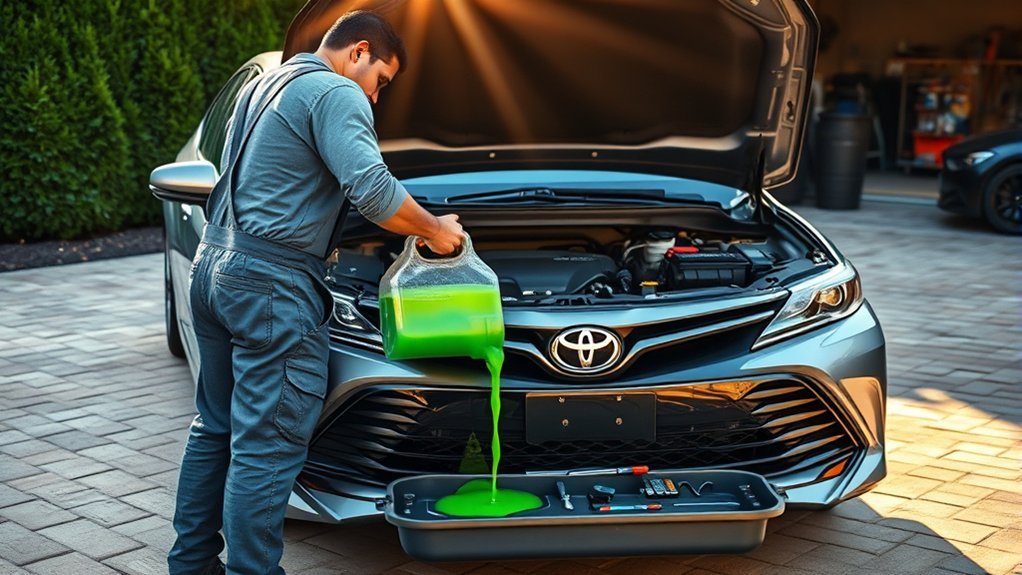
Your Camry’s coolant does more than keep the engine from overheating. It transfers heat, helps protect aluminum and rubber cooling-system parts, and raises the boiling point while lowering the freezing point of the fluid in the system. Over time, coolant additives wear down, and old or contaminated coolant can increase the risk of corrosion, deposits, poor heater performance, and overheating.
For many recent Toyota Camry models, Toyota lists the initial engine coolant replacement at 100,000 miles or 120 months, then every 50,000 miles or 60 months afterward when the correct Toyota Super Long-Life Coolant or equivalent is used. The 2025 Camry maintenance guide also separates engine/intercooler coolant from inverter/intercooler coolant on applicable hybrid systems, so hybrid owners should verify which cooling circuit is being serviced.
A coolant change is not just a refill. The job is only complete when the correct coolant is used, trapped air is removed, leaks are checked, and the level is rechecked after the engine cools.
Choose the Right Toyota Camry Coolant
Most modern Camrys call for Toyota Genuine Super Long Life Coolant or a similar high-quality ethylene-glycol coolant that matches Toyota’s non-silicate, non-amine, non-borate long-life hybrid organic acid technology requirements. Toyota’s maintenance interval is based on that coolant type; if another coolant is already in the car, the replacement interval and service approach may be different.
Note: Do not choose coolant by color alone. Pink, red, green, orange, and blue coolants can use different additive chemistry. Mixing incompatible coolant types can create sludge or reduce corrosion protection. If the coolant in your Camry is rusty, oily, sludgy, or the wrong type, a professional flush and inspection is safer than a simple drain-and-fill.
| Item | What to Use |
|---|---|
| Recommended coolant | Toyota Super Long Life Coolant or an equivalent Toyota-compatible long-life ethylene-glycol coolant |
| Water | Do not top off with plain tap water; use the specified premixed coolant unless your exact product and procedure require distilled water mixing |
| Coolant amount | Varies by model year, engine, and whether you drain only the radiator or the full system; have extra coolant ready and fill to the proper level instead of guessing by volume |
| Hybrid systems | Engine coolant and inverter/intercooler coolant may be separate circuits; do not service the wrong circuit |
Preparing for Your Camry’s Coolant Change
Before you begin, park on a level surface, set the parking brake, let the engine cool completely, and keep children and pets away from the work area. If you need to raise the front of the Camry, support it with jack stands on approved lift points. Never rely on a hydraulic jack alone while working under the vehicle.
Warning: Hot coolant is pressurized and can cause severe burns. Do not remove the radiator cap, pressure cap, or reservoir cap until the engine and radiator are fully cool. Coolant is also toxic if swallowed, so wipe spills immediately and store old coolant in a sealed, labeled container.
| Tool/Material | Purpose |
|---|---|
| Gloves and eye protection | Protect skin and eyes from coolant |
| Jack stands and wheel chocks | Safely support the vehicle if the front must be raised |
| Flat screwdriver or trim tool | Remove push clips without breaking them |
| Socket set | Remove splash shield bolts or screws; fastener count varies by model year |
| Drain pan | Catch old coolant cleanly |
| Short hose | Direct coolant from the radiator drain petcock into the pan |
| No-spill funnel | Refill and bleed air with less mess |
| Toyota-compatible coolant | Refill the cooling system with the correct fluid |
| Sealable container | Store used coolant for recycling or hazardous-waste disposal |
| Absorbent material | Clean spills; dispose of contaminated absorbent according to local rules |
[Products Worth Considering]

Ensure accurate engine cooling with Toyota's genuine water temperature sensor, designed for precise coolant monitoring and reliable performance. This OEM part fits seamlessly...
How to Safely Drain the Old Coolant
Work slowly and keep the drain area clean. Coolant that lands on the ground can attract pets and wildlife, and used coolant should not be poured into a storm drain, sink, toilet, yard, or trash container.
- Confirm the engine is cold. Touch the upper radiator hose carefully. If it is warm or firm from pressure, wait longer.
- Raise and support the front if needed. Some Camrys allow access from below only after removing the front splash guard or under-cover. The number of bolts and clips varies by model year and trim.
- Place a drain pan under the radiator drain. Attach a short hose to the radiator petcock if your Camry has one accessible, and aim the hose into the pan.
- Remove the radiator cap or pressure cap only when cold. This helps the coolant drain smoothly. Some models use a radiator cap; others may use a pressurized reservoir cap.
- Open the petcock carefully. Turn it counterclockwise by hand if possible. Do not force it with heavy pliers; old plastic drain fittings can crack.
- Let the coolant drain. Wait until the flow slows to a drip. A radiator drain-and-fill will not remove every ounce of coolant from the engine block, but it is suitable for routine maintenance when the existing coolant is the correct type and not contaminated.
- Close the drain. Tighten the petcock by hand until snug. Do not overtighten it.
- Inspect while access is open. Look for cracked hoses, loose clamps, crusty coolant residue, radiator damage, or a leaking water pump area.
Pro Tip: Measure how much coolant came out. It gives you a rough idea of how much fresh coolant should go back in before bleeding, but the final level should always be set by the radiator or reservoir markings after air is removed.
Step-By-Step Guide to Filling Your Radiator With Coolant
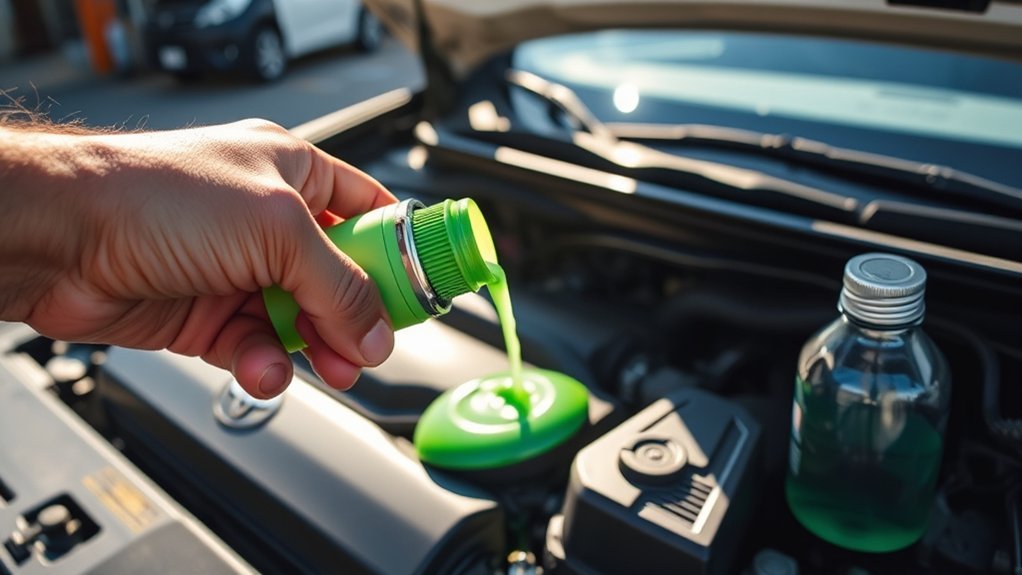
After the old coolant has drained and the petcock is closed, refill slowly. Pouring too fast can trap air pockets, which may cause overheating or poor heater performance after the job.
- Install a no-spill funnel. Fit it to the radiator filler neck or the correct pressurized fill point for your Camry.
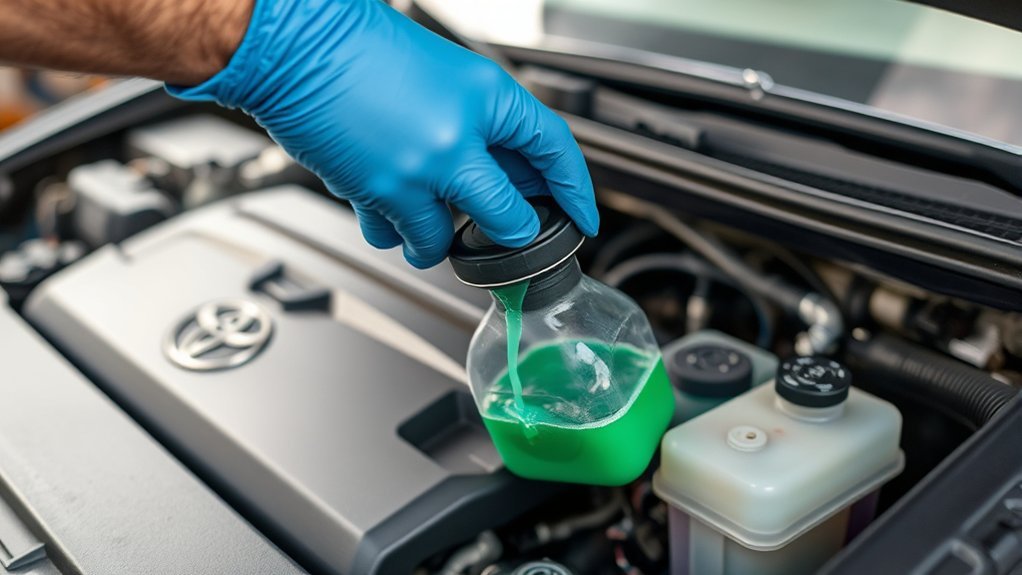
- Add coolant slowly. Use Toyota Super Long Life Coolant or a confirmed equivalent. Pause often so air can rise through the funnel.
- Use only factory-designated bleed points. Some engines may have a bleeder or small vent hose in the service procedure. Do not disconnect an EGR hose, throttle-body hose, or any coolant hose unless your exact Toyota repair procedure identifies it as the correct bleed point.
- Fill the reservoir. Add coolant to the “F,” “FULL,” or cold-fill mark on the overflow reservoir, depending on your model.
- Leave the funnel in place for bleeding. Keep extra coolant nearby so the funnel never runs dry while air is coming out.
Note: For full factory procedures, torque specs, bleed points, and hybrid cooling-circuit instructions, Toyota directs owners and repairers to its Technical Information System. This matters because Camry coolant routing changes by year, engine, and hybrid configuration.
Troubleshooting: How to Bleed Air From Your Cooling System
Air pockets are one of the most common problems after a coolant drain-and-fill. If air remains trapped, the temperature gauge may climb, the heater may blow cold, or the coolant level may drop after the first drive.
- Start the engine with the funnel installed. Keep the vehicle in Park, set the parking brake, and watch the temperature gauge.
- Set the cabin heat to hot. Use a low fan speed so you can feel when warm air arrives without making it harder to hear the engine.
- Let the engine warm up. As the thermostat opens, trapped air may bubble through the funnel. Add coolant as needed so the funnel does not run dry.
- Use controlled RPM only. Briefly hold the engine around 1,500–2,000 RPM if needed, using the accelerator or a helper. Do not wedge the throttle with a tool.
- Watch for stable heat and fewer bubbles. When the radiator fans cycle, the upper radiator hose is hot, the heater blows warm, and bubbling mostly stops, the system is usually close to bled.
- Install the cap and check for leaks. Shut the engine off, remove the funnel according to the funnel instructions, top the reservoir to the cold mark if needed, and install the cap securely.
- Recheck after cool-down. After a short drive and a full cool-down, verify the reservoir level again and inspect for leaks around the petcock, hoses, radiator, and water pump area.
Warning: If the temperature gauge rises above normal, the warning light comes on, the heater stays cold, or coolant pushes out of the funnel violently, shut the engine off and let it cool. Do not keep revving an overheating engine.
| Problem | Likely Cause | What to Do |
|---|---|---|
| Temperature rises quickly | Air pocket, low coolant, closed thermostat, or blocked flow | Shut off, cool down, recheck level, and bleed again |
| Heater blows cold | Air trapped in heater core or low coolant | Top off and bleed with heat set to hot |
| Bubbles never stop | Air still entering system or possible combustion-gas leak | Check cap, hoses, clamps, and consider professional pressure/block testing |
| Coolant leaks from petcock | Loose drain, damaged seal, or cracked fitting | Cool engine, inspect, reseat, or replace the drain fitting as needed |
| Reservoir level drops after one drive | Remaining air purged into reservoir or a leak | Top to cold mark once; if it keeps dropping, inspect for leaks |
How to Dispose of Old Coolant Safely
Used coolant must be handled like a hazardous automotive fluid. The EPA notes that common antifreeze is made with ethylene glycol, which is toxic to humans and animals, and used antifreeze may contain dissolved metals. Poison Control also warns that swallowing antifreeze can be dangerous even in small amounts.
- Pour old coolant into a clean, sealable container with a tight cap.
- Label the container “used engine coolant” and keep it away from children and pets.
- Do not mix coolant with oil, brake fluid, fuel, solvents, or washer fluid.
- Take it to a household hazardous waste facility, municipal recycling program, or auto shop that accepts used antifreeze.
- Absorb spills immediately and dispose of contaminated absorbent according to local waste rules.
Frequently Asked Questions
How often should I change the coolant on my Toyota Camry?
For many recent Toyota Camry models using Toyota Super Long Life Coolant or a proper equivalent, Toyota lists the first engine coolant replacement at 100,000 miles or 120 months, then every 50,000 miles or 60 months afterward. Older Camrys, non-original coolant, severe contamination, or hybrid cooling circuits may require different service guidance, so confirm your exact year and engine.
How much does it cost to replace coolant in a Toyota Camry?
A DIY drain-and-fill usually costs the coolant, a funnel, and disposal supplies. A shop service can vary widely by location, engine, and whether it is a basic drain-and-fill, full flush, pressure test, or hybrid-circuit service. A realistic shop range is often about $130 to $300+, and dealer or repair-estimator pricing can be higher in some areas.
Can I mix Toyota pink coolant with another coolant?
Avoid mixing coolant types unless the replacement coolant specifically states that it meets Toyota’s requirements. Color alone is not enough to prove compatibility. If the system contains unknown, rusty, oily, or mixed coolant, have the system inspected and flushed properly before refilling.
Do I need a full coolant flush or just a drain-and-fill?
A drain-and-fill is usually enough for routine maintenance when the existing coolant is the correct type and looks clean. A full flush is better when the coolant is contaminated, rusty, sludgy, mixed with the wrong coolant, or when a cooling-system repair introduced debris.
How do I know the cooling system still has air in it?
Common signs include a temperature gauge that rises above normal, poor cabin heat, gurgling sounds behind the dash, repeated coolant-level drops after cool-down, or bubbles continuing in the funnel long after the thermostat opens. Stop if the engine overheats and bleed again only after it cools.
Conclusion
Changing your Toyota Camry’s coolant protects the engine from overheating, corrosion, and avoidable cooling-system problems, but the details matter. Use the correct Toyota-compatible coolant, work only on a cold engine, drain the old fluid cleanly, refill slowly, bleed trapped air, and recheck the level after a full cool-down. If your Camry is a hybrid, has contaminated coolant, keeps overheating, or has a leak you cannot identify, the safest move is to have a qualified technician service the cooling system.
Sources
- Toyota 2024 Camry Warranty & Maintenance Guide — engine coolant interval and Toyota coolant specification language
- Toyota 2025 Camry Warranty & Maintenance Guide — current Camry coolant intervals and hybrid cooling-circuit distinctions
- Toyota Genuine Super Long Life Coolant — Toyota coolant product information
- Toyota Technical Information System Support — official source for model-specific repair procedures
- EPA Used Antifreeze Disposal Fact Sheet — antifreeze toxicity and recycling/disposal guidance
- Poison Control: Antifreeze Safety — safety risks from antifreeze exposure