
Last updated: July 14, 2026 [VERIFY: site metadata shows “Updated: Jul 13, 2026” — confirm and sync this date]
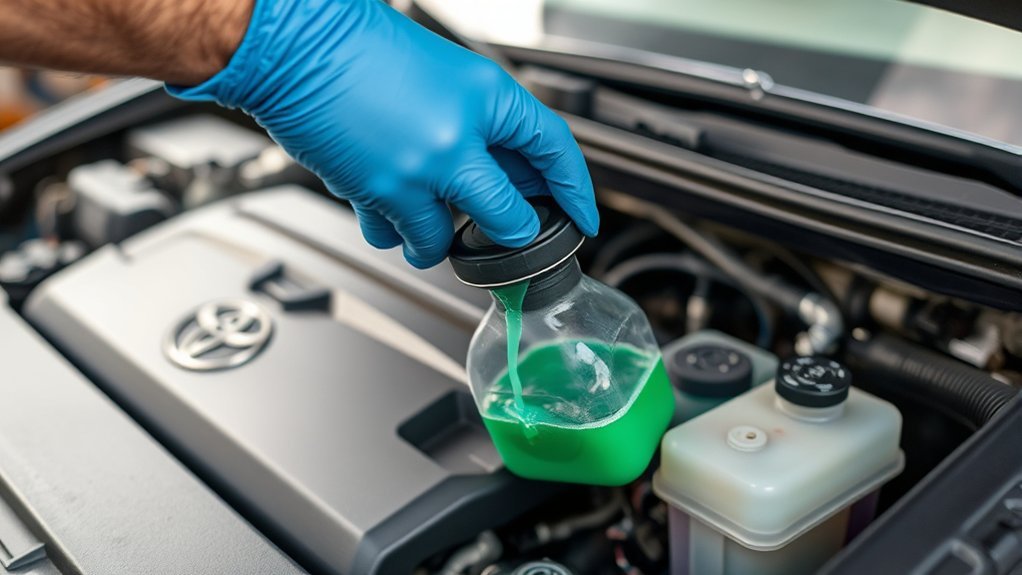
To change engine coolant on a Toyota Camry, work only on a completely cold engine, drain the radiator into a suitable pan, close the drain, refill with Toyota Super Long Life Coolant or a confirmed equivalent, and follow the air-bleeding procedure for your exact model. Drain points, fill points, capacities, underbody fasteners, and cooling circuits vary by model year and engine. Use this guide as a safe drain-and-refill overview, then confirm the exact procedure in your owner’s manual or Toyota repair information before opening the system.
Quick Answer
Let the engine cool completely, identify the correct cooling circuit, raise and support the front only if needed, drain the old coolant from the radiator petcock into a drain pan, close the drain, refill slowly with Toyota-compatible coolant, bleed air according to the model-specific procedure, check for leaks, and recheck the cold level afterward.
Key Takeaways
- Never remove a radiator cap or pressurized coolant cap while the engine is hot.
- Use Toyota Super Long Life Coolant or a compatible ethylene-glycol coolant that meets Toyota’s specified long-life coolant chemistry.
- Toyota’s 2024 Camry guide lists the first engine-coolant replacement at 100,000 miles or 120 months, then every 50,000 miles or 60 months.
- For the 2025 Camry, applicable inverter/intercooler coolant has a separate initial interval of 150,000 miles or 180 months.
- A routine drain-and-fill suits known, clean, compatible coolant. Unknown, rusty, oily, mixed, or sludgy coolant needs inspection and a model-appropriate service plan.
- Old coolant is toxic, so seal it in a clean container and take it to an approved recycling or household hazardous-waste site.
At a Glance
| Time Required | Varies by access and bleeding procedure; allow enough time for a complete engine cool-down |
| Difficulty | Intermediate DIY; professional service is safer when the cooling circuit or procedure is uncertain |
| Tools Needed | Drain pan, hose, no-spill funnel, gloves, eye protection, jack stands if needed, basic hand tools, and a sealed coolant container |
| Cost | Varies by coolant quantity, local labor rates, and whether the job is a drain-and-fill, full flush, diagnostic service, or hybrid-circuit service |
Why Does Toyota Camry Coolant Need Changing?
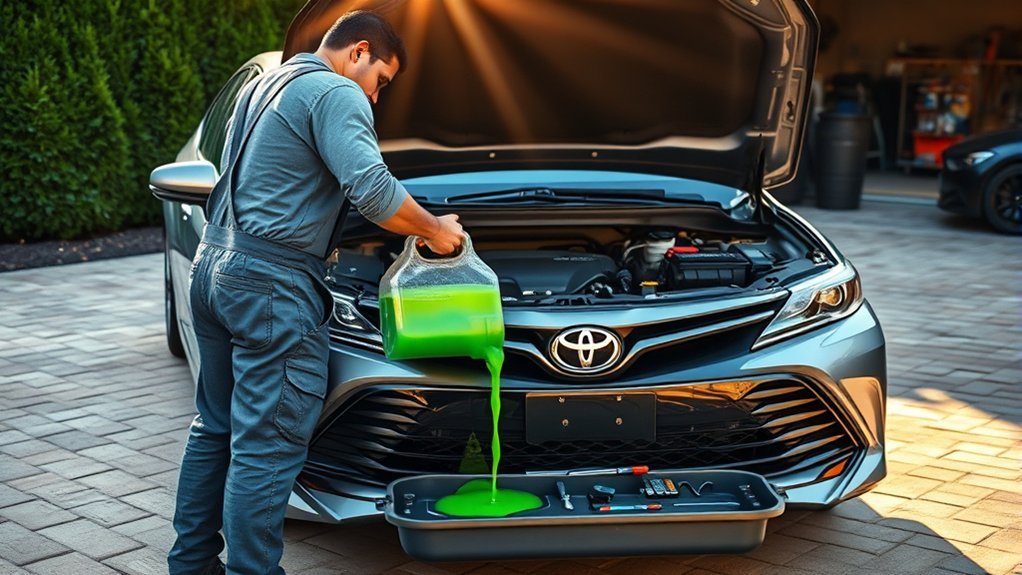
Your Camry’s coolant transfers heat, helps protect cooling-system parts, raises the fluid’s boiling point, and lowers its freezing point. Its protective additives gradually lose effectiveness. Old or contaminated coolant can contribute to corrosion, deposits, poor heater performance, leaks, and overheating.
Toyota’s 2024 Camry Warranty and Maintenance Guide lists the initial engine-coolant replacement at 100,000 miles or 120 months, followed by replacement every 50,000 miles or 60 months. The 2025 Camry guide separates applicable engine/intercooler coolant from inverter/intercooler coolant. The latter has an initial replacement interval of 150,000 miles or 180 months, followed by 50,000 miles or 60 months. This coolant interval is one piece of a much longer service timeline — see the full Toyota Camry maintenance schedule by mileage for everything else due alongside it.
A coolant change is not complete until you have used the correct fluid, removed trapped air according to the proper procedure, checked for leaks, and rechecked the level after the engine cools.
Do You Need a Drain-and-Fill, Flush, or Professional Service?
Choose the service by coolant condition and system type, not only by mileage. A radiator drain-and-fill replaces part of the coolant. A full-system service may be needed when the existing coolant is unsuitable or contaminated.
| Condition | Recommended Approach | Reason |
|---|---|---|
| Coolant is the correct type, clean, and due for routine maintenance | Model-appropriate drain-and-fill | Routine service does not always require removing every trace of coolant from the engine block |
| Coolant type is unknown or incompatible fluids may have been mixed | Inspection and model-appropriate flush | Mixing incompatible chemistry can reduce protection or create deposits |
| Coolant is rusty, oily, sludgy, or contains debris | Professional diagnosis before refilling | Contamination may indicate corrosion, an internal leak, or another cooling-system fault |
| You cannot identify the correct hybrid cooling circuit | Professional or Toyota repair-information-guided service | Engine, inverter, and intercooler circuits may have different fill points and intervals |
| The engine has overheated or repeatedly loses coolant | Diagnosis and pressure testing before routine service | Changing coolant alone will not repair a leak, flow restriction, failed cap, thermostat problem, or internal engine fault |
[Products Worth Considering]

The OEMTOOLS coolant vacuum refill kit helps quickly refill a vehicle’s cooling system while removing trapped air that can lead to overheating and engine damage. It also performs vacuum leak tests to help confirm system integrity and reduce the chance of repeat repairs. With multiple bushings, adapters, and a tapered cone seal, it is designed for flexible use on many radiator and coolant bottle necks.

This coolant electric water pump is designed as a replacement for select Toyota vehicles, helping maintain proper engine cooling performance and reliable temperature control. Built to OE specifications, it offers fitment support for compatible Avalon, Camry, and RAV4 models with 2.5L L4 engines. It also includes cross-reference part numbers for easier matching and comes with after-sales support for covered defects.

This coolant thermostat is a direct replacement designed for a wide range of Toyota, Lexus, and Scion vehicles. It helps maintain proper engine temperature, supports reliable cooling system performance, and installs easily without special tools or programming. Built to meet OEM standards, it offers durable, stable operation and dependable fitment for compatible models.
Which Coolant Does a Toyota Camry Use?
Most modern Camrys call for Toyota Genuine Super Long Life Coolant or a similar high-quality ethylene-glycol coolant that meets Toyota’s specified long-life chemistry. Toyota’s maintenance guides describe compatible coolant as non-silicate, non-amine, non-borate ethylene-glycol coolant with long-life hybrid organic acid technology. The 2025 guide also specifies non-nitrate chemistry.
Toyota’s published replacement intervals are based on Toyota Super Long Life Coolant or an equivalent meeting those requirements. If another coolant is already in the car, the replacement interval and service approach may differ.
Note: Do not choose coolant by color alone. Pink, red, green, orange, and blue fluids can use different additive chemistry. If your Camry contains rusty, oily, sludgy, mixed, or unidentified coolant, have the system inspected before performing a simple drain-and-fill.
| Item | What to Use or Confirm |
|---|---|
| Recommended coolant | Toyota Super Long Life Coolant or an equivalent that explicitly meets the Toyota coolant specification for your model |
| Water | Do not top off with plain tap water; use the specified premixed coolant unless the exact product and procedure require distilled-water mixing |
| Coolant amount | Confirm the capacity for your model year, engine, and circuit; a radiator drain-and-fill may require less than the system’s total listed capacity |
| Hybrid systems | Identify the engine, inverter, or intercooler circuit before opening a drain or fill point |
[Products Worth Considering]

This radiator burping funnel kit helps simplify coolant refilling, bleeding, flushing, and spill-free maintenance across a wide range of vehicles. Its translucent body with clear scale supports controlled filling, while multiple adaptors, caps, and extension pieces improve compatibility and access in tight engine bays. The built-in shut-off valve and rubber-gasket design help reduce spills and make cooling system service cleaner and more convenient.

This all-in-one radiator pressure tester and vacuum refill kit helps diagnose cooling system leaks, measure temperature, and refill coolant efficiently. It includes a wide range of adapters for broad vehicle compatibility, plus a pressure tester, vacuum refiller, thermometer, and storage case for organized use. Designed for DIY mechanics and professionals, it simplifies coolant service while reducing guesswork and unnecessary repairs.

The Funnel King 32950 Oil Drain Pan is a compact fluid catch basin designed for clean, easy draining during routine maintenance. Its open shape and pour edge help transfer used oil, coolant, and other shop fluids with less mess, while the lightweight polypropylene construction stands up to common automotive chemicals. Sized to fit under many cars and small engines, it is a practical choice for garages, workshops, and DIY oil changes.
What Should You Confirm Before Changing the Coolant?
Before buying supplies or removing an under-cover, identify the exact vehicle and procedure. Confirm each item below from the owner’s manual, maintenance guide, coolant label, or Toyota repair information.
- Model year, engine, and whether the Camry is gasoline-only or hybrid.
- The cooling circuit you intend to service.
- Approved coolant specification and whether the product is premixed.
- System capacity and the expected amount for the planned drain-and-fill.
- Radiator or circuit drain location, fill point, bleed points, and required bleeding method.
- Whether a splash shield must be removed and which approved lift points to use.
- Whether the factory procedure calls for special tools, a scan tool, or professional service.
Park on a level surface, set the parking brake, let the engine cool completely, and keep children and pets away from the work area. If you need to raise the front of the Camry, support it with jack stands on approved lift points. Never rely on a hydraulic jack alone while working under the vehicle.
Warning: Hot coolant is pressurized and can cause severe burns. Do not remove the radiator cap, pressure cap, or reservoir cap until the engine and radiator are fully cool. Coolant is toxic if swallowed, so wipe spills immediately and store old coolant in a sealed, labeled container.
| Tool/Material | Purpose |
|---|---|
| Gloves and eye protection | Protect skin and eyes from coolant |
| Jack stands and wheel chocks | Safely support the vehicle if the front must be raised |
| Flat screwdriver or trim tool | Remove push clips without breaking them |
| Socket set | Remove splash-shield bolts or screws; fastener type and count vary by model year |
| Drain pan | Catch old coolant cleanly |
| Short hose | Direct coolant from an accessible radiator drain petcock into the pan |
| No-spill funnel | Refill and bleed air with less mess when compatible with the designated fill point |
| Toyota-compatible coolant | Refill the cooling system with the correct fluid |
| Sealable container | Store used coolant for recycling or hazardous-waste disposal |
| Absorbent material | Clean spills and contain contaminated material for proper disposal |
[Products Worth Considering]

This spill-proof radiator coolant filling funnel kit helps you refill cooling systems cleanly while reducing trapped air pockets that can affect heater and engine performance. It includes a 5-inch extension bar and 45-degree elbow for easier access under shrouds or at awkward angles. Color-matched caps for dedicated adapters make setup simpler and more organized.

This coolant bypass valve is a direct replacement for select Toyota models, helping regulate coolant flow for stable engine temperature and dependable performance. Built from high-temperature, corrosion-resistant materials, it is designed to handle demanding driving conditions while supporting long-term durability. Its straightforward design also makes installation quick and hassle-free.

This engine water pump kit is designed to help maintain reliable cooling performance across a wide range of compatible Toyota, Lexus, Scion, and Pontiac vehicles. Built with aluminum and tested for leak-free operation, it offers a direct replacement solution that supports engine efficiency and long-term service life. The kit includes a professional water pump and gasket for a convenient installation-ready repair.
How Do You Safely Drain Old Toyota Camry Coolant?
Work slowly and keep the drain area clean. Coolant that reaches the ground can attract animals, and used coolant should not be poured into a storm drain, sink, toilet, yard, or ordinary trash container.
- Confirm the engine is cold. Carefully check the upper radiator hose. If it is warm or firm from pressure, wait longer.
- Raise and support the front only if required. Some Camrys require underbody access or removal of a splash guard. Follow the approved lift-point instructions for your model.
- Identify the correct drain. Confirm that you are opening the radiator or intended cooling-circuit drain, especially on a hybrid.
- Place a drain pan underneath. Attach a short hose to an accessible radiator petcock when the fitting is designed to accept one.
- Remove the designated pressure cap only when cold. Depending on the system, the fill point may be a radiator cap or pressurized reservoir cap.
- Open the drain carefully. Turn a plastic petcock by hand when possible. Do not force an aged fitting with heavy pliers.
- Let the coolant drain. A radiator drain-and-fill will not remove every ounce of coolant from the engine block, but it may be suitable for routine service when the existing coolant is known, compatible, and clean.
- Close the drain. Tighten it according to the model-specific procedure. Do not overtighten a plastic fitting.
- Inspect the accessible components. Look for cracked hoses, loose clamps, dried coolant residue, radiator damage, and signs of leakage around the water-pump area.
Pro Tip: Measure the amount that drains into the pan. It provides a rough comparison for the initial refill, but the final level must be set using the correct fill procedure and cold-level markings after trapped air is removed.
How Do You Refill a Toyota Camry With Coolant?
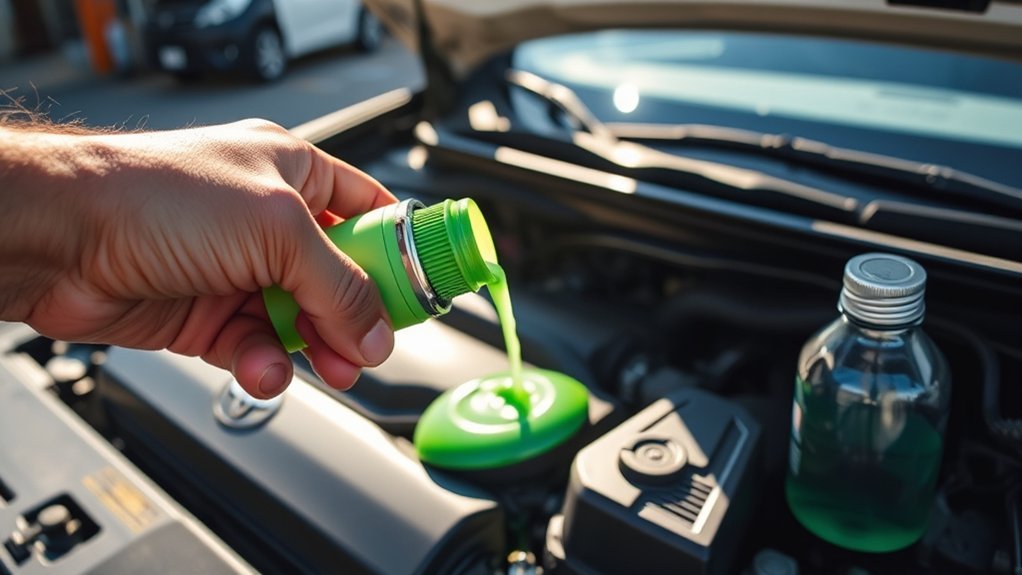
After the old coolant has drained and the correct drain is closed, refill slowly. Pouring too quickly can trap air, which may lead to poor heater performance, an unstable coolant level, or overheating.
- Install the correct filling tool. Fit a no-spill funnel to the radiator filler neck or designated pressurized fill point only when it is suitable for that system.
- Add coolant slowly. Use Toyota Super Long Life Coolant or a confirmed equivalent. Pause frequently so displaced air can rise.
- Use only factory-designated bleed points. Do not disconnect an EGR hose, throttle-body hose, heater hose, or other coolant hose unless the procedure for your exact engine identifies it as a bleed point.
- Fill the reservoir correctly. Add coolant to the “F,” “FULL,” or cold-fill mark specified for your model.
- Keep the fill point supplied during bleeding. Do not allow the funnel or designated fill point to run dry while air is leaving the system.
Note: Toyota provides model-specific repair procedures, torque specifications, fill points, and cooling-circuit instructions through its Technical Information System support information. Camry coolant routing and service methods vary by model year, engine, and hybrid configuration.
How Do You Bleed Air From a Toyota Camry Cooling System?
Air pockets are a common concern after opening a cooling system. Signs can include an unstable temperature indication, poor cabin heat, gurgling, or a coolant level that changes after the first complete heat-and-cool cycle.
- Begin with the model-specific procedure. Confirm whether your Camry requires engine-off filling, engine-on bleeding, a designated bleeder, a vacuum-fill tool, or another method.
- Use the required HVAC setting. Set the cabin temperature and fan only as directed by the procedure for your model.
- Monitor the system continuously. If the procedure requires warming the engine, watch the temperature indication and coolant level throughout the process.
- Follow the exact Toyota bleeding procedure. Do not use a generic RPM target, open a hose, or wait for a fan cycle unless the procedure for your model year and engine specifically requires it.
- Use observable checks only as confirmation. A stable coolant level, normal temperature indication, warm cabin heat, and fewer bubbles are useful checks, but they do not replace the model-specific procedure.
- Install the cap and inspect for leaks. Shut the engine off when directed, remove the funnel according to its instructions, adjust the reservoir to the proper cold mark when appropriate, and secure the cap.
- Recheck after a full cool-down. After the procedure and a short test drive, allow the engine to cool completely. Verify the reservoir level and inspect the petcock, hoses, radiator, and water-pump area.
Warning: If the temperature rises above normal, a warning appears, the heater remains unexpectedly cold, or coolant surges from the fill point, shut the engine off and let it cool. Do not continue revving or driving an overheating engine.
| Problem | Possible Cause | What to Do |
|---|---|---|
| Temperature rises quickly | Low coolant, trapped air, blocked flow, thermostat fault, or another cooling-system problem | Shut the engine off, let it cool, recheck the level, and follow the correct diagnostic or bleeding procedure |
| Heater remains cold | Low coolant, trapped air, restricted heater-core flow, or an HVAC-control issue | Stop if the engine temperature is abnormal; otherwise recheck the level and model-specific bleed steps |
| Bubbles do not stop | Air may still be entering the system, or combustion gas may be entering the coolant | Check the cap, hoses, and clamps; arrange pressure or combustion-gas testing if bubbling continues |
| Coolant leaks from the petcock | Loose drain, damaged seal, distorted fitting, or cracked plastic | Let the engine cool, inspect the fitting, and reseat or replace damaged parts as required |
| Reservoir drops after one drive | Remaining air may have purged, or the system may be leaking | Adjust the cold level once; investigate if the level continues falling |
What Should You Check After the Coolant Change?
Do not judge the job only by how much coolant went back into the system. After the engine has completed the required procedure and cooled fully, confirm the following:
- The pressure cap is installed securely.
- The reservoir is at the correct cold mark.
- No coolant is leaking from the drain, hoses, radiator, reservoir, or water-pump area.
- The temperature indication remains normal during the test drive.
- Cabin heat is consistent when requested.
- The coolant level does not continue dropping after subsequent full cool-downs.
When Should You Stop and Get Professional Help?
Stop the DIY procedure and arrange qualified service when the system does not behave normally or you cannot verify the correct circuit and method.
- The temperature rises above normal or an overheating warning appears.
- Coolant repeatedly surges from the fill point.
- Bubbles continue after the correct bleeding procedure has been completed.
- The coolant is oily, rusty, sludgy, or contains debris.
- The level continues falling after repeated cold checks.
- You cannot distinguish the engine, inverter, or intercooler cooling circuit.
- The factory procedure requires equipment or service information you do not have.
How Do You Dispose of Old Coolant Safely?
Common automotive antifreeze contains ethylene glycol, which is toxic to people and animals. Used coolant may also contain dissolved metals. Keep it contained and follow the collection rules for your area.
- Pour old coolant into a clean, sealable container with a tight cap.
- Label the container “used engine coolant” and keep it away from children and pets.
- Do not mix coolant with oil, brake fluid, fuel, solvents, or washer fluid.
- Take it to a household hazardous-waste facility, municipal collection program, or automotive business that accepts used antifreeze.
- Do not pour it into a sewer, storm drain, floor drain, toilet, yard, or onto the ground.
- Absorb spills immediately and dispose of contaminated material according to local requirements.
Frequently Asked Questions
How often should I change the coolant on my Toyota Camry?
Toyota’s 2024 Camry guide lists the first engine-coolant replacement at 100,000 miles or 120 months, then every 50,000 miles or 60 months. Older Camrys, different coolant, and hybrid cooling circuits may have different guidance, so verify the maintenance schedule for your exact model year.
Is coolant service different on a hybrid Toyota Camry?
Yes. A hybrid may have separate engine, inverter, or intercooler cooling circuits. For the 2025 Camry, Toyota lists the applicable engine/intercooler coolant’s initial replacement at 100,000 miles or 120 months and the applicable inverter/intercooler coolant’s initial replacement at 150,000 miles or 180 months. Confirm the circuit before draining or filling anything.
How much does it cost to replace coolant in a Toyota Camry?
The cost depends on coolant quantity, local labor rates, model access, and service type. A routine drain-and-fill, full flush, pressure test, contamination diagnosis, and hybrid-circuit service involve different work. Request a quote that states exactly which service and cooling circuit are included.
Can I mix Toyota pink coolant with another coolant?
Avoid mixing coolant unless the replacement product explicitly states that it meets the Toyota specification for your Camry. Color alone does not prove compatibility. If the system contains unidentified, rusty, oily, sludgy, or mixed coolant, have it inspected and serviced correctly before refilling.
Do I need a full coolant flush or just a drain-and-fill?
A drain-and-fill may be suitable for routine maintenance when the coolant is known, compatible, and clean. Inspection and a model-appropriate flush are safer when the fluid is unknown, mixed, rusty, oily, sludgy, or contaminated by a cooling-system repair.
How do I know the cooling system still has air in it?
Possible signs include an abnormal temperature indication, poor cabin heat, gurgling, continuing bubbles, or repeated coolant-level changes after full cool-downs. Stop if the engine overheats. Recheck the procedure only after the engine has cooled completely.
Can I use universal or aftermarket coolant instead of Toyota Super Long Life Coolant?
Only if the product’s label or manufacturer explicitly states it meets Toyota’s coolant specification for your model — non-silicate, non-amine, non-borate ethylene-glycol chemistry with long-life hybrid organic acid technology. A generic “universal” or “all-makes” coolant that doesn’t state Toyota compatibility can use a different additive package, which may reduce corrosion protection or react poorly if mixed with existing Toyota coolant. When in doubt, use Toyota Super Long Life Coolant or a confirmed equivalent rather than guessing from the color or the word “universal” on the label.
How do I check that my Camry’s coolant still protects against freezing?
A coolant refractometer or a set of antifreeze test strips, both inexpensive and available at auto parts stores, will read the freeze-protection point of the mixture in the cold system. Toyota Super Long Life Coolant is typically sold premixed to a specific freeze point, so if a test shows reduced protection, suspect dilution from added water rather than the coolant itself, and have the mixture corrected or replaced rather than just topped off.
Conclusion
Changing Toyota Camry coolant safely starts with identifying the exact model, engine, cooling circuit, fluid specification, and bleeding procedure. Work only on a fully cold engine, capture the old fluid cleanly, refill slowly, check for leaks, and verify the cold level after the service.
A routine drain-and-fill is suitable only when the existing coolant is known, compatible, and clean. Choose professional diagnosis when the coolant is contaminated, the level keeps falling, the engine overheats, or you cannot confirm the correct hybrid circuit.
Sources
- Toyota 2024 Camry Warranty & Maintenance Guide — engine-coolant interval and Toyota coolant-specification language
- Toyota 2025 Camry Warranty & Maintenance Guide — engine/intercooler and inverter/intercooler coolant intervals and chemistry
- Toyota Genuine Super Long Life Coolant — Toyota coolant product information
- Toyota Technical Information System Support — access to model-specific repair information
- EPA Used Antifreeze Disposal Fact Sheet — antifreeze toxicity, separation, recycling, and disposal guidance
- Poison Control: Antifreeze Safety — exposure risks, spill prevention, and disposal guidance


[…] Mark or photograph the cold reservoir level after a top-off. If the level drops again, stop treating the problem as routine evaporation and have the system tested for a leak or pressure loss. For a full drain-and-refill walkthrough on this model, see this Toyota Camry coolant change guide. […]