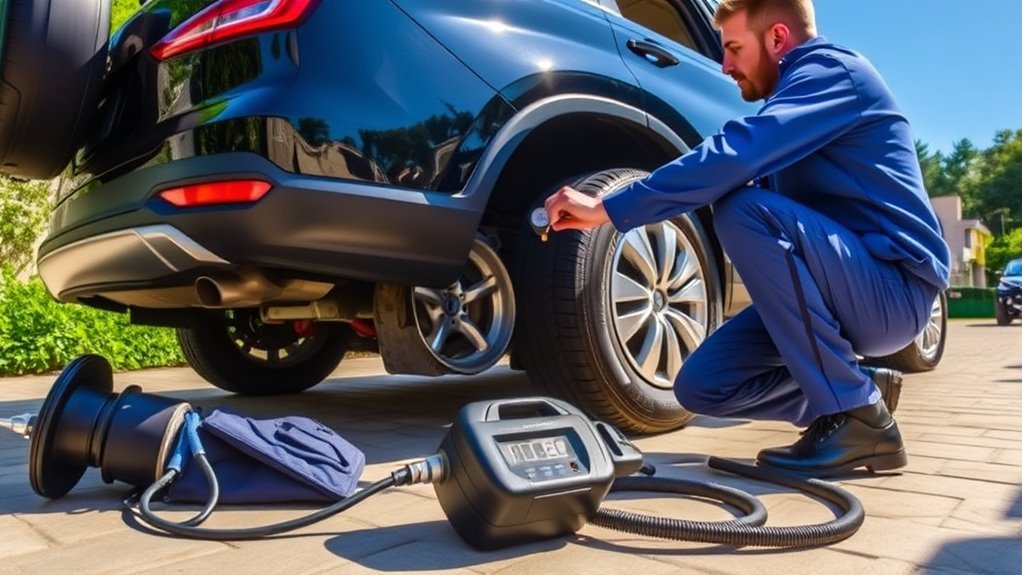
To find the correct tire pressure for your car, check the owner’s manual or the sticker on the driver’s door jamb; it usually ranges from 30 to 35 PSI. Always measure when the tires are cold to guarantee accuracy. Use a reliable gauge to get precise readings; TPMS systems also alert you to significant drops. Regular monthly checks and proper inflation enhance safety and extend tire life. Discover further details on maintaining ideal tire pressure.
Understanding Recommended Tire Pressure for Your Vehicle
Understanding the recommended tire pressure for your vehicle is vital for peak performance and safety. Vehicle manufacturers specify a normal tire pressure, typically ranging between 30 to 35 PSI (pounds per square inch). To find the correct tire pressure, check your tire pressure via the owner’s manual or the sticker in your driver’s door jamb. It’s important to check your tire pressure when the tires are cold, as heat from driving can inflate readings. Proper tire inflation enhances handling, braking, and extends tire lifespan while improving fuel efficiency. Additionally, a Tire Pressure Monitoring System (TPMS) alerts you when tire pressure drops by 25% or more, ensuring your tires remain properly inflated for ideal performance.
How to Check Your Tire Pressure Accurately
To check your tire pressure accurately, you’ll need a reliable tire pressure gauge. Begin by ensuring your tires are cold; this avoids inflated readings caused by heat. Here’s how to proceed:
Ensure accurate tire pressure readings by using a reliable gauge and checking when your tires are cold.
- Locate the valve stem on each tire and remove the cap.
- Firmly press the tire pressure gauge onto the valve stem to get an accurate reading. Make sure no air escapes during measurement.
- Compare the reading with the recommended PSI found in your vehicle’s owner manual or on the driver’s door sticker.
Regular checks are essential for effective tire maintenance. Aim to check tire pressure every other gas fill-up to prevent issues related to under-inflation. After inflating, double-check with a manual gauge for an accurate reading.
How TPMS Helps Monitor Tire Pressure
Maintaining proper tire pressure is critical for vehicle safety and performance, and modern technology has made this task easier with the introduction of the Tire Pressure Monitoring System (TPMS). This system continuously monitors tire pressure using direct sensors or existing vehicle sensors, providing real-time feedback to alert you when pressure falls below safe levels, indicating potential underinflation.
| Feature | Description |
|---|---|
| Alerts | Notifies drivers of low tire pressure |
| Recommended Pressure | Maintains ideal tire pressure for safety |
| Manual Check Frequency | Suggested at least once a month |
While TPMS enhances safety, it doesn’t replace the need for regular tire maintenance. Always perform a manual check to verify your tires are at the recommended pressure.
What Happens If Your Tires Are Under or Overinflated?
When tires are under or overinflated, they can greatly compromise your vehicle’s safety and performance. Underinflated tires increase contact with the road, leading to poor vehicle handling and higher risks of blowouts. Even a 5% deficiency in tire pressure can cause uneven tread wear and reduce fuel efficiency. On the other hand, overinflated tires create a harsher ride and also lead to rapid center tread wear.
Here are three critical impacts of incorrect tire pressure:
- Safety Risks: Increased likelihood of accidents due to compromised braking performance.
- Fuel Inefficiency: Both conditions lead to increased fuel consumption.
- Premature Tire Replacement: Uneven tread wear forces you to replace tires sooner than expected.
Regular checks guarantee you maintain correct pressure.
Year-Round Strategies for Keeping Your Tire Pressure in Check
Keeping your tire pressure in check year-round requires a proactive approach that integrates regular monitoring and timely adjustments. Check tire pressure at least once a month and before long trips, ensuring it aligns with the recommended PSI from your vehicle’s manual or the driver’s door sticker. Always monitor tire pressure when tires are cold, as driving can increase pressure, skewing readings. Use a reliable tire gauge—digital or dial—for precise measurements. While your tire pressure monitoring system (TPMS) alerts you to significant drops, regular manual checks are essential for maximum safety. Don’t forget to inflate your tires as necessary, and regularly inspect your spare tire, as it can lose pressure over time even if not in use.
Frequently Asked Questions
Should My Tires Be 32 or 35 PSI?
Your tires should match the manufacturer’s specifications—either 32 or 35 PSI. Correct tire pressure optimizes inflation, enhances handling characteristics, reduces tire wear, improves fuel efficiency, and addresses safety concerns under varying driving conditions and temperature effects.
What Is the 3% Tire Rule?
The 3% Tire Rule states tire pressure shouldn’t deviate more than 3% from recommended levels. This guarantees peak performance, safety, and fuel efficiency while minimizing tread wear, accommodating load capacity, and adjusting for temperature effects.
How Do I Know What PSI My Tires Should Be?
To determine your tires’ PSI, consult your vehicle’s manual or door jamb sticker. Regularly use a tire gauge for ideal inflation, considering seasonal adjustments to maintain handling performance, fuel efficiency, tread wear, and safety concerns.
Is 40 PSI Too Much Air Pressure in Tires?
Absolutely, 40 PSI’s excessive! Overinflation risks compromise safety, fuel efficiency, and tire lifespan. Regular visual inspections and using pressure gauges guarantee necessary adjustments, especially with seasonal changes and varying driving conditions affecting tire wear indicators.
Conclusion
Maintaining the correct tire pressure is essential for your vehicle’s performance and safety, much like ensuring a well-tuned engine. By regularly checking your tire pressure and utilizing the TPMS, you can prevent issues related to under or overinflation. Adopting year-round strategies to monitor and adjust tire pressure will not only enhance fuel efficiency but also extend the life of your tires. Stay vigilant, and your tires will roll smoothly on the road ahead.