To convert PSI to BAR, use the formula BAR = PSI ÷ 14.5038. For quick reference, remember that 1 PSI is about 0.06895 BAR. For instance, if you have 30 PSI, that’s roughly 2.07 BAR. Keep a conversion chart handy for common values like 35 PSI at 2.41 BAR. Regularly checking and adjusting tire pressure can boost performance and safety. Stay tuned, and you’ll discover more tips to make pressure management easier.
What Is PSI and Why Is It Important?
Pressure plays an important role in many aspects of daily life, and understanding PSI—pounds per square inch—is key to ensuring safety and efficiency in various applications. PSI measures the force exerted on one square inch of surface, making it essential in settings like tyre pressure and hydraulic systems. For instance, most passenger cars need 30 to 35 PSI, while trucks and SUVs typically require 35 to 40 PSI for peak performance. Maintaining proper tyre pressure is critical for vehicle safety, fuel efficiency, and road stability. As you explore pressure conversions, knowing PSI helps facilitate effective communication across industries, especially when moving to the metric system. This understanding empowers you to make informed decisions in automotive and engineering contexts.
Understanding PSI and BAR Pressures and Their Applications
Understanding the difference between PSI and BAR is essential for anyone dealing with equipment that relies on precise pressure measurements. PSI, or pounds per square inch, is a unit of pressure often used in the United States, while BAR is a metric unit equivalent to 100,000 Pascals. Proper tire pressure for passenger cars typically ranges from 30 to 35 PSI, translating to about 2.07 to 2.41 BAR. Knowing both units is vital for ensuring compatibility, especially in international settings. The PSI to BAR conversion formula, BAR = PSI ÷ 14.5038, makes quick adjustments simple. High-performance vehicles may require over 40 PSI, corresponding to approximately 2.76 BAR, highlighting the importance of accurate pressure exerted in your machinery and vehicles.
Easy Ways to Convert PSI to BAR
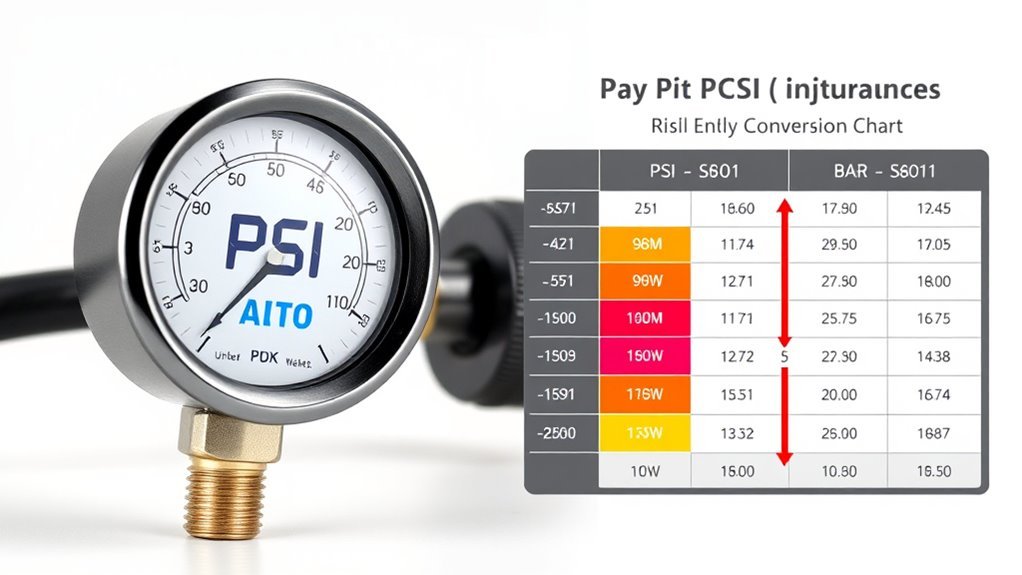
When you need to convert PSI to BAR quickly and accurately, several straightforward methods can help. You can use the formula BAR = PSI ÷ 14.5038 for precise measurements. For a quick reference, remember that 1 PSI is roughly 0.06895 BAR, which is especially handy for low-pressure applications. A conversion chart is another great resource, providing a full table of common PSI values and their BAR equivalents. For example, 30 PSI equals 2.07 BAR, while high-pressure scenarios like 1000 PSI convert to 68.95 BAR. Regularly applying these techniques guarantees you’re always compatible with international standards, making pressure often used in various industries easily manageable. Embrace these methods to confidently convert PSI to BAR!
Key Formulas and Examples for Converting PSI to BAR

Converting PSI to BAR becomes even easier with key formulas and practical examples at your fingertips. To convert pounds per square inch to BAR, simply use the formula: BAR = PSI ÷ 14.5038. For instance, when you apply this formula to 30 PSI, you’ll find it converts to approximately 2.07 BAR. A handy PSI to BAR conversion chart can streamline your pressure conversion process, showing you that 50 PSI equals 3.45 BAR. Remember, 1 PSI is about 0.06895 BAR, emphasizing the relationship between these units. Regularly converting PSI to BAR is essential, especially in international settings where the imperial measurement system may not apply. This guarantees your equipment remains compatible and efficient.
What Are Common PSI to BAR Values?
Many common PSI values have straightforward BAR equivalents that can help you quickly gauge pressure levels. For instance, 10 PSI is about 0.69 BAR, which is a common low-pressure measurement. When you reach 30 PSI, you’re looking at approximately 2.07 BAR, often used for standard tire pressure in vehicles. If you need higher pressure, 50 PSI converts to roughly 3.45 BAR, suitable for various applications. At 100 PSI, you’re at around 6.89 BAR, frequently found in industrial settings. For very high-pressure situations, 1000 PSI equals about 68.95 BAR, showcasing the significant conversion factor for extreme pressures. Knowing these values simplifies your understanding of pressure conversion and helps you choose the right specifications.
Tips for Accurate PSI and BAR Pressure Management
To manage PSI and BAR pressure effectively, it’s essential to monitor your pressure regularly. Always use reliable conversion tools to guarantee accuracy in your measurements. Keeping an eye on these details helps maintain safety and performance in various applications.
Regular Pressure Monitoring
While maintaining the right tire pressure may seem like a small detail, it plays an essential role in your vehicle’s overall performance and safety. Regularly check and adjust your tire pressure, aiming for 30 to 35 PSI for passenger cars and 35 to 40 PSI for larger vehicles. A reliable pressure gauge is vital for accurate readings; make certain it’s calibrated for both PSI and BAR to ease conversions. In high-performance situations, incorrect PSI can drastically impact traction and fuel efficiency. Keep a conversion chart handy for quick reference during routine checks. Finally, schedule periodic inspections of your pressure systems to catch leaks and guarantee your equipment runs efficiently, prolonging its lifespan.
Use Conversion Tools
Using conversion tools can greatly streamline your pressure management tasks, ensuring you maintain accurate PSI and BAR measurements. Online conversion calculators and apps offer a quick way to switch between these units, saving you time and effort. To enhance your efficiency, keep a pressure conversion chart handy that lists common PSI values alongside their BAR equivalents. If you ever find yourself without tools, remember the formula: BAR = PSI ÷ 14.5038 for manual calculations. Regularly check and calibrate your pressure gauges to avoid discrepancies that could affect safety and performance. Finally, familiarize yourself with the recommended PSI values for your equipment or vehicle, guaranteeing ideal pressure management and efficiency in your operations.
Frequently Asked Questions About PSI to BAR Conversions?
You might have questions about common pressure values and how to accurately convert PSI to BAR. Understanding the conversion formulas is key to achieving precise measurements in your applications. Let’s explore these topics to enhance your knowledge and guarantee efficiency in your work.
Common Pressure Values
When it comes to tyre pressure, understanding common values can greatly impact your vehicle’s performance and safety. Here’s a quick reference to help you convert PSI to BAR effectively:
| PSI Range | BAR Equivalent |
|---|---|
| 30 to 35 PSI | 2.07 to 2.41 BAR |
| 35 to 40 PSI | 2.41 to 2.76 BAR |
| Over 40 PSI | Over 2.76 BAR |
| Passenger Cars | Typically 30-35 PSI |
| Trucks/SUVs | Typically 35-40 PSI |
Regularly monitoring your tyre pressure within these ranges is crucial. By converting PSI to BAR, you guarantee maximum safety and fuel efficiency while enjoying your driving experience.
Conversion Formulas Explained
Understanding common pressure values is just the beginning; knowing how to convert PSI to BAR can enhance your accuracy in measuring tire pressure. The key conversion formula you’ll use is BAR = PSI ÷ 14.5038. This formula offers a precise way to translate PSI into BAR, ensuring you manage pressure effectively. For a quick estimate, remember that 1 PSI is roughly 0.06895 BAR, which simplifies your calculations. For instance, if you have a PSI value of 30, that’s about 2.07 BAR, while 60 PSI equals approximately 4.14 BAR. These conversion formulas are essential in fields like automotive and engineering, promoting compatibility and accurate pressure management across different systems. Regular conversions matter for ideal performance and safety.
Importance of Accurate Measurement
Accurate measurement of pressure is essential, especially in contexts like tire maintenance and equipment operation. Keeping your PSI and BAR in check can greatly enhance safety and performance. Here’s why accurate measurement matters:
- Optimal Performance: Correct PSI (30-35 for passenger cars) ensures fuel efficiency and stability.
- Preventive Maintenance: Regular checks help avoid premature tire wear and equipment failure.
- Effective Communication: Understanding PSI to BAR conversions (1 PSI = 0.0689476 BAR) aids in international compatibility.
Frequently Asked Questions
How Do You Convert PSI to BAR?
To convert PSI to BAR, divide the pressure units by 14.5038. For practical applications, use measurement tools like conversion charts to simplify the process and guarantee accuracy in your calculations. It’s that easy!
Is 1 BAR 14.5 or 14.7 PSI?
1 bar equals 14.5 PSI, not 14.7. Understanding this precise unit conversion is essential for accurate pressure measurement, especially in industries relying on historical PSI definitions for effective performance and safety.
What Is 32 PSI in BAR?
Picture a car’s smooth ride; 32 PSI translates to about 2.21 BAR. Understanding pressure units and conversion factors helps dispel common misconceptions, ensuring your vehicle’s performance stays ideal in practical applications like tyre maintenance.
What Is 2.5 Bars to PSI?
2.5 bars converts to approximately 36.26 psi. Understanding bar pressure and psi measurement allows you to use effective conversion methods, ensuring accurate pressure units for your applications and enhancing safety in operations.
Conclusion
In the world of pressure measurement, converting PSI to BAR can feel like maneuvering through a maze, but with the right tools, it’s a breeze. Whether you’re inflating tires or calibrating machinery, knowing these conversions keeps everything running smoothly. Think of it as switching gears in a car—you’ll move forward with confidence. So, next time you tackle pressure conversions, remember these tips and charts, and watch as the numbers transform effortlessly before your eyes.