Choosing between E10 and E15 for a Toyota RAV4 comes down to three things: your model year, the wording in your owner’s manual, and whether the small fuel-economy trade-off is worth the pump price. Most newer RAV4s can use gasoline with up to 15% ethanol, but E15 is not the same as E85, and it is not approved for every older vehicle or small engine.
Quick Answer
Most gasoline-powered Toyota RAV4s from model year 2001 and newer are federally approved for E15, but your owner’s manual is the final check. Recent Toyota RAV4 manuals allow gasoline containing up to 15% ethanol. For 2000-and-older RAV4s, use E10 or lower unless Toyota’s manual for your exact vehicle says otherwise.
Key Takeaways
- E15 means gasoline with 10.5% to 15% ethanol; it is often sold as Unleaded 88 or Regular 88.
- The EPA approves E15 for 2001-and-newer light-duty vehicles and flex-fuel vehicles, but prohibits it in older conventional vehicles, motorcycles, boats, and small engines.
- Recent Toyota RAV4 owner’s manuals say to use gasoline containing up to 15% ethanol and to avoid E30, E50, E85, and other fuels above 15% ethanol.
- Compared with E10, E15 usually reduces fuel economy slightly—often around 1% to 2%—because ethanol has less energy per gallon than gasoline.
- For long trips, towing, cold starts, or maximum driving range, E10 is still the safer default if the price difference is small.
Can My Toyota RAV4 Use E15? Quick Answer by Model Year
For most RAV4 owners, the easiest rule is this: if your RAV4 is a 2001-or-newer gasoline, hybrid, or plug-in hybrid model, E15 is generally allowed under federal fuel rules. Still, Toyota’s owner’s manual for your exact model year should be your final authority because it controls Toyota’s fuel recommendation for your vehicle.
The U.S. Department of Energy’s Alternative Fuels Data Center explains that E15 is approved for model year 2001 and newer light-duty conventional vehicles. It also says E15 is not approved for conventional vehicles older than model year 2001, motorcycles, boats, snowmobiles, lawn mowers, chain saws, and other off-road gasoline equipment.
| RAV4 Model Year | E15 Guidance | Best Practical Choice |
|---|---|---|
| 2000 and older | Do not use E15 unless the exact Toyota manual says it is allowed. | Use E10 or lower ethanol gasoline. |
| 2001–2011 | Federally approved for E15 as 2001+ light-duty vehicles, but check the manual before regular use. | Use E10 if the manual is unclear or you want the most conservative choice. |
| 2012 and newer gasoline RAV4 | Many recent Toyota manuals allow gasoline containing up to 15% ethanol. | E15 is acceptable when the manual says up to 15% ethanol is allowed. |
| RAV4 Hybrid and RAV4 Prime | Check the hybrid or plug-in hybrid manual. Recent RAV4 Hybrid guidance allows up to 15% ethanol. | Use E15 only if your manual allows it; never use E85 unless the vehicle is labeled flex-fuel. |
Warning: E15 is not E85. Standard Toyota RAV4 models are not flex-fuel vehicles, so do not use E30, E50, E85, or any fuel that may contain more than 15% ethanol unless Toyota specifically approves it for your exact vehicle.
E10 vs E15 for RAV4: Ethanol, Octane, and Energy Per Gallon
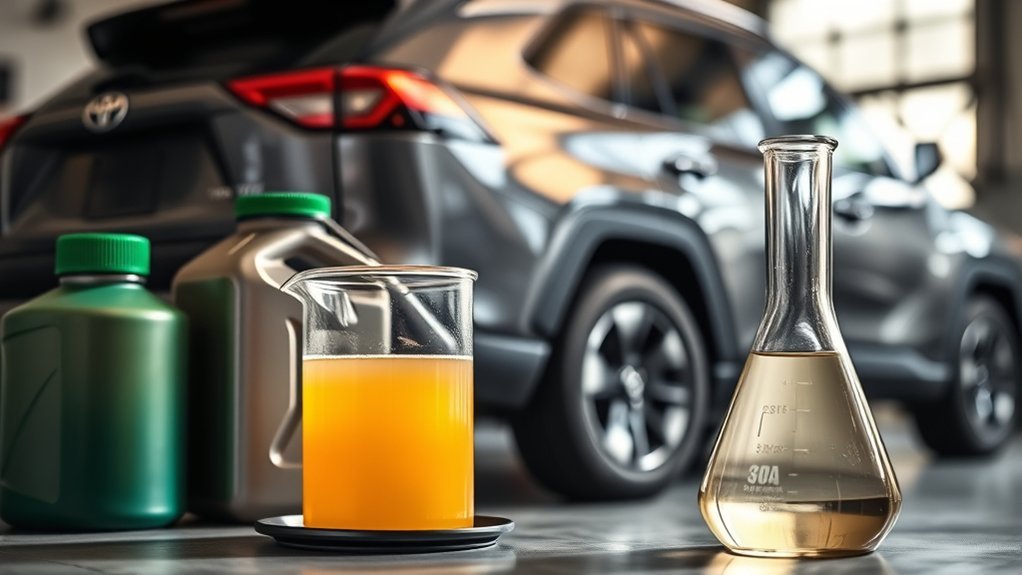
E10 and E15 are both gasoline-ethanol blends, but the number tells you the maximum ethanol content. E10 contains up to 10% ethanol, while E15 contains more than 10% and up to 15% ethanol. The U.S. Energy Information Administration notes that fuel pumps generally identify ethanol content on the dispenser.
Ethanol Percentage Differences
E10 is the everyday blend most U.S. drivers see at regular gas pumps. E15 is a slightly higher-ethanol blend and is commonly marketed as Unleaded 88, Regular 88, or Clean 88. If your RAV4’s fuel door, pump label, or owner’s manual says “up to 15% ethanol,” E15 fits that limit.
The difference sounds small, but it matters for fuel economy because ethanol contains less energy per gallon than gasoline. That does not usually hurt drivability in a compatible RAV4, but it can reduce miles per gallon slightly.
Octane and Energy Impact
E15 is often sold with an 88 octane rating, while regular E10 is commonly 87 octane. That one-point octane increase can help resist engine knock, but most RAV4 engines are designed to run normally on regular unleaded gasoline with an octane rating of 87 or higher. In other words, E15’s extra octane is usually not a major performance upgrade for a stock RAV4.
FuelEconomy.gov says ethanol has about one-third less energy than gasoline, and vehicles typically travel 3% to 4% fewer miles per gallon on E10 and 4% to 5% fewer on E15 than on ethanol-free gasoline.
That means the real E15-versus-E10 gap is usually modest. Since E10 is already 3% to 4% below ethanol-free gasoline and E15 is about 4% to 5% below ethanol-free gasoline, E15 is commonly about 1% to 2% lower in fuel economy than E10—not a huge drop, but enough to matter on long trips.
Real-World Effects on RAV4 Performance and Fuel Economy
In a compatible RAV4, E15 should not cause dramatic changes in normal driving. Most drivers are more likely to notice a small change in range than a big change in acceleration. Tire pressure, speed, weather, traffic, roof racks, and cargo load can easily create a larger MPG swing than the difference between E10 and E15.
Use this simple math at the pump: if E15 costs at least 2% less than E10, it may be cheaper per mile even with the small MPG loss. If E15 is only one or two cents cheaper, E10 may be the better value because it usually gives slightly better range.
Pro Tip: Track two or three tanks of E10 and two or three tanks of E15 using the same driving routine. Your RAV4’s trip computer is helpful, but hand-calculating miles driven divided by gallons pumped gives the clearest comparison.
Risks for Older RAV4s and Why E15 Isn’t for Small Engines
If your RAV4 was built before model year 2001, do not use E15 as a regular fuel. Federal E15 approval does not include conventional vehicles older than model year 2001, and older fuel-system materials were not always designed around higher ethanol blends.
Higher ethanol blends can be harder on some older rubber hoses, seals, gaskets, and fuel-system parts. Ethanol can also absorb water, which is one reason higher-ethanol fuels are a poor choice for equipment that sits unused for long periods.
- Older RAV4s: Use E10 or lower ethanol gasoline unless your exact Toyota manual approves a higher blend.
- Small engines: Do not use E15 in lawn mowers, generators, chainsaws, pressure washers, or similar equipment.
- Boats and motorcycles: E15 is not approved for these uses.
- Long storage: If your vehicle or equipment sits for months, use the fuel recommended in the manual and consider fresh fuel before returning it to service.
How to Check Your RAV4 Manual and Manufacturer Fuel Guidance
The safest way to answer the E15 question is to check your RAV4’s owner’s manual. Look for sections named “Fuel,” “Fuel Information,” “Fuel Recommendation,” or “Gasoline Quality.” You can also use Toyota Owners to find digital manuals and fuel guidance for many U.S.-market Toyota vehicles.
At a Glance
| Time Required | 2–5 minutes |
| Difficulty | Easy |
| Tools Needed | Owner’s manual, fuel door label, or Toyota Owners website |
| Cost | Free |
For example, Toyota’s online fuel information for the 2022 RAV4 says to use only gasoline containing up to 15% ethanol and not to use flex-fuel or gasoline that could contain more than 15% ethanol, including E30, E50, and E85. Toyota’s 2025 RAV4 Hybrid fuel information gives the same up-to-15% ethanol limit and says gasohol should have an octane rating no lower than 87.
Manual Checklist Before Using E15
- Find your exact model year and trim.
- Open the “Fuel” or “Fuel Information” section.
- Look for the maximum ethanol content Toyota allows.
- Confirm the fuel has an octane rating of 87 or higher unless your manual says otherwise.
- Avoid any pump labeled E30, E50, E85, flex fuel, or more than 15% ethanol.
- If the manual is missing or unclear, choose E10 and ask a Toyota dealer to confirm.
Note: EPA approval means the fuel is federally approved for a vehicle class. Toyota’s owner’s manual is still the best source for your specific RAV4, especially for warranty-sensitive decisions.
Practical Advice: When to Use E10 vs E15 for Daily Driving and Trips
Once you confirm compatibility, E10 and E15 can both make sense. The better choice depends on the trip, the price at the pump, and how much range matters to you.
When E15 Makes Sense
E15 can be a good choice for everyday driving if your RAV4 manual allows gasoline with up to 15% ethanol and the price discount is enough to offset the small MPG loss. It is especially reasonable for local commuting, short errands, and drivers who refill often enough that a slight range reduction does not matter.
When E10 Is the Better Choice
E10 is the better default for long highway trips, towing, heavy cargo, remote routes, and any situation where maximum range is more important than saving a few cents per gallon. It is also the safer choice if you own an older RAV4 or cannot confirm the ethanol limit in your manual.
Plan for Long Trips
For road trips, the small energy advantage of E10 can reduce fuel stops. That matters more when you are driving through areas with fewer stations, carrying passengers and luggage, using a roof box, or driving in cold weather.
- Confirm compatibility: Check the owner’s manual before switching fuel blends.
- Compare price per mile: E15 needs a meaningful discount to beat E10 on cost.
- Use E10 for range: Choose E10 for towing, road trips, and remote routes.
- Avoid higher blends: Do not use E30, E50, E85, or flex fuel in a standard RAV4.
What If You Accidentally Put E15 in an Older RAV4?
If you accidentally add a small amount of E15 to a 2000-or-older RAV4, do not panic, but do not make it a habit. Drive normally if the engine runs smoothly, then refill with the correct E10 or lower ethanol fuel as soon as the tank is partly used. If the vehicle runs rough, stalls, hesitates, leaks fuel, or shows a check engine light, stop driving and contact a qualified mechanic or Toyota dealer.
If you filled the tank completely with the wrong fuel and the vehicle is older, stored for long periods, or already has fuel-system issues, it is safer to ask a repair shop whether the tank should be diluted or drained.
Frequently Asked Questions
Can I use E15 in my Toyota RAV4?
You can use E15 in most 2001-and-newer Toyota RAV4s if your owner’s manual allows gasoline containing up to 15% ethanol. Recent Toyota RAV4 manuals do allow up to 15% ethanol, but older RAV4s should stay with E10 or lower unless the exact manual says otherwise.
Is E15 gas better than E10 for a RAV4?
E15 is not automatically better. It is often cheaper and has slightly higher octane, but E10 usually gives slightly better fuel economy and driving range. If E15 is much cheaper and your RAV4 allows it, E15 can be a good daily-driving fuel. For long trips or towing, E10 is usually the better pick.
What do E5, E10, and E15 mean?
The letter “E” stands for ethanol, and the number shows the ethanol percentage by volume. E5 contains up to 5% ethanol, E10 contains up to 10%, and E15 contains more than 10% and up to 15% ethanol.
Will E15 damage my RAV4 engine?
E15 should not damage a compatible RAV4 when the owner’s manual allows gasoline with up to 15% ethanol. The risk is higher for pre-2001 vehicles, vehicles with old fuel-system parts, and engines not approved for E15. Never use E15 in small engines, motorcycles, boats, or off-road equipment.
Can a Toyota RAV4 use E85?
No. Standard Toyota RAV4 models are not flex-fuel vehicles. Do not use E85, E50, E30, or any gasoline blend above 15% ethanol unless Toyota specifically approves it for your exact vehicle.
Does E15 lower MPG in a RAV4?
Usually, yes, but only slightly compared with E10. Because ethanol has less energy per gallon than gasoline, E15 typically delivers a little less fuel economy than E10. In real driving, expect the difference to be small and easily affected by speed, weather, tire pressure, and driving style.
Conclusion
For most newer Toyota RAV4 owners, E15 is a usable fuel when the owner’s manual allows gasoline with up to 15% ethanol. It may save money at the pump, but it usually gives slightly lower MPG than E10. For older RAV4s, long trips, towing, or any situation where you cannot confirm compatibility, E10 is the safer and more forgiving choice. Check the manual, avoid anything above E15, and your RAV4 should stay on the right side of both performance and fuel-system safety.
Sources
- U.S. Department of Energy Alternative Fuels Data Center — E15 — E15 definition, 2001-and-newer approval, and prohibited vehicle/equipment categories.
- FuelEconomy.gov — Ethanol — E10/E15 labels, EPA approval note, and fuel-economy impact from ethanol blends.
- U.S. Energy Information Administration — Ethanol in Gasoline FAQ — ethanol blend definitions, approval summary, and ethanol energy-content explanation.
- Toyota Owners — 2022 RAV4 Fuel Information — Toyota guidance allowing gasoline up to 15% ethanol and warning against E30, E50, and E85.
- Toyota Owners — 2025 RAV4 Hybrid Fuel Information — Toyota hybrid fuel guidance for ethanol limit and minimum octane.
- U.S. EPA — E15 Fuel Registration — E15 registration and misfueling mitigation requirements for companies selling E15.