How to Verify RAV4 Weight Limits Before Towing
What’s in This Article
- Quick Answer
- Before You Begin
- Locate Your RAV4’s GVWR and Curb Weight
- Calculate Payload and Proper Tongue Weight Step by Step
- RAV4 Towing Limits by Powertrain and Model Year
- Which Trailers Can a RAV4 Hybrid Safely Tow?
- Real-World Payload Examples: Passengers, Gear, Hitch Math
- Safe Towing Practices and Quick Pre-Trip Checklist
- Helpful Accessories and Upgrades to Stay Within Limits
- Frequently Asked Questions
- Conclusion
One wrong weight number can turn a simple RAV4 towing trip into a braking or steering problem. Your safest limit comes from the door sticker, owner’s manual, and real loaded weight of your vehicle and trailer. This guide shows you how to check GVWR, payload, tongue weight, and current RAV4 towing limits before you hook up.
Quick Answer
Quick Answer
Find your RAV4’s Gross Vehicle Weight Rating (GVWR) and tire loading label on the driver’s door jamb. Use the label’s payload number when available, or subtract curb weight from GVWR if you must calculate it. Then add passengers, cargo, hitch parts, and trailer tongue weight. Keep every number below Toyota’s vehicle, axle, tire, hitch, trailer, and combined weight limits.
Key Takeaways
- Check the driver’s door jamb label before you use any online RAV4 payload estimate.
- Count passengers, cargo, pets, hitch hardware, roof loads, and tongue weight against payload.
- Use 10% to 15% tongue weight as a planning target for most bumper-pull trailers.
- Match your loaded trailer to the towing limit for your exact model year, trim, and powertrain.
- Use about 80% of the tow rating as a planning buffer, not as a replacement for Toyota’s limits.
Before You Begin
Estimated total time: 15 to 30 minutes if you have the vehicle sticker, owner’s manual, and trailer details ready.
You need your owner’s manual, the driver’s door jamb labels, a calculator, trailer weight information, and a tongue weight scale or public vehicle scale. You also need realistic weights for passengers, cargo, pets, roof boxes, hitch parts, and any installed accessories.
- Use your exact RAV4 trim, model year, and market.
- Read the tire and loading label before you use generic online specs.
- Check the hitch label, ball mount rating, and trailer Gross Vehicle Weight Rating (GVWR).
- Weigh the loaded trailer before you trust dry trailer weight.
Warning: Never use a hitch, cargo carrier, or weight-distribution setup to raise Toyota’s published limits.
Locate Your RAV4’s GVWR and Curb Weight
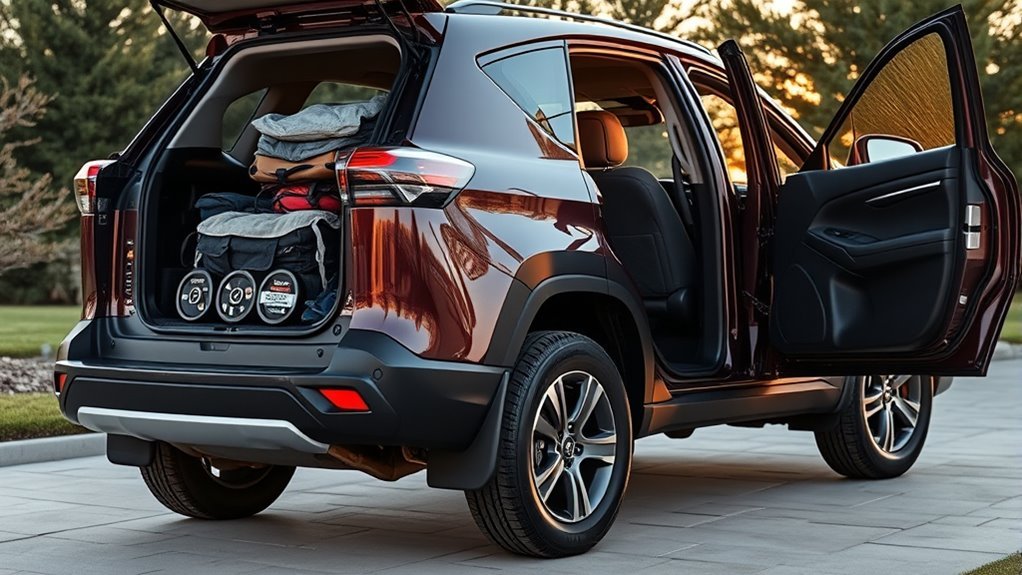
Start at the driver’s door jamb. Toyota places key weight labels near the door opening, and those labels give you the vehicle-specific limits you need. Look for GVWR, Gross Axle Weight Rating (GAWR), tire pressure, tire size, and the combined occupant and cargo limit.
GVWR means the most your RAV4 can weigh after you load people, cargo, fluids, accessories, and trailer tongue weight. Curb weight means the vehicle’s weight with standard fluids and fuel, but without passengers or cargo. Payload comes from the gap between those two numbers.
Use the payload number on the tire and loading label when it appears. If you only have GVWR and curb weight, subtract curb weight from GVWR to estimate payload. Your exact door label beats a general spec chart because options and installed accessories can change weight.
Note the Gross Combined Weight Rating (GCWR) if your manual lists it for towing. GCWR covers the loaded RAV4 plus the loaded trailer. You need both payload and GCWR because a setup can pass one limit and fail another.
Calculate Payload and Proper Tongue Weight Step by Step
Follow this order before you load the vehicle. It keeps the math simple and helps you catch overload problems early.
- Read the tire and loading label. Start with the stated occupant and cargo limit if your RAV4 label shows one.
- Confirm GVWR and curb weight. If you need to calculate payload, subtract curb weight from GVWR.
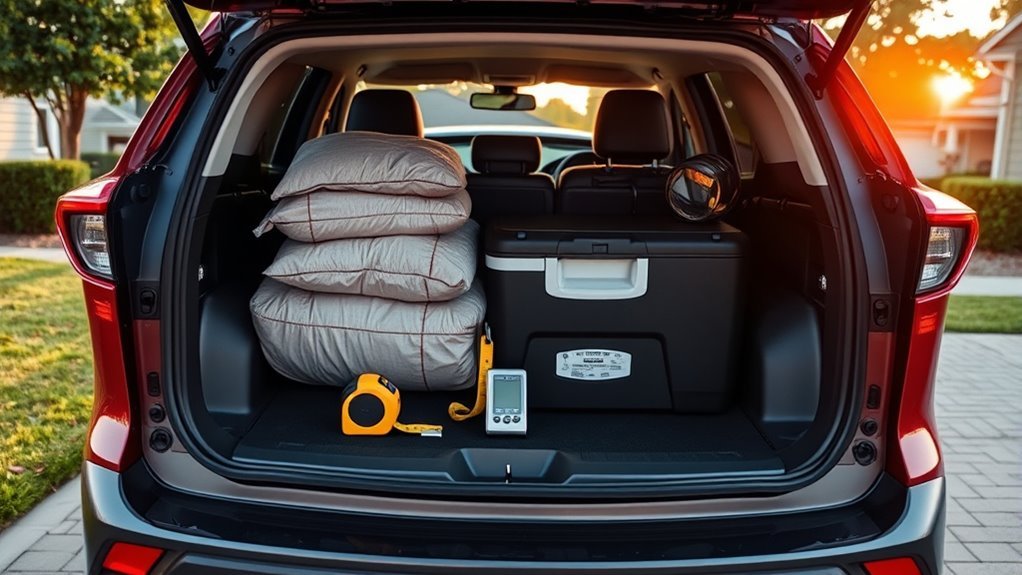
- Add people and cargo. Include passengers, luggage, tools, pets, coolers, roof cargo, and installed accessories.
- Add towing hardware. Include the receiver, ball mount, wiring parts, brake controller parts, and tongue weight.
- Compare every limit. Keep the final load under payload, GVWR, GAWR, GCWR, tire, hitch, ball mount, and trailer ratings.
Calculate payload this way: GVWR minus curb weight equals the load available for passengers, cargo, accessories, and hitch load.
For most bumper-pull trailers, plan tongue weight at 10% to 15% of loaded trailer weight. A 2,500 lb loaded trailer should place about 250 to 375 lb on the hitch. Too little tongue weight can increase sway, while too much can overload the rear axle and reduce steering control.
Use a tongue weight scale for the hitch load. Use a public vehicle scale to check the loaded RAV4, loaded trailer, and combined weight. These measured numbers matter more than brochure dry weight.
Pro tip: Weigh the trailer after you load water, food, tools, and camping gear because dry weight rarely reflects road-trip weight.
RAV4 Towing Limits by Powertrain and Model Year
RAV4 towing limits vary by model year, trim, drivetrain, market, and equipment. As of May 2026, Toyota’s U.S. RAV4 lineup uses hybrid power, and Toyota lists 1,750 lb towing capacity for some 2026 hybrid grades. Select 2026 all-wheel-drive grades and select 2026 RAV4 Plug-in Hybrid grades can tow up to 3,500 lb when properly equipped.
Older model years can use different limits. For 2025, gas-only RAV4 trims commonly list 1,500 lb, 2025 RAV4 Hybrid trims commonly list 1,750 lb, and the 2025 RAV4 Plug-in Hybrid commonly lists 2,500 lb. Check your owner’s manual because trim changes, towing packages, trailer brakes, and regional specs can change the safe number.
| Model or configuration | Typical tow rating | What you should verify |
|---|---|---|
| 2026 RAV4 Hybrid FWD and LE AWD | Up to 1,750 lb | Door label, owner’s manual, trim, hitch, and trailer brakes |
| 2026 RAV4 Hybrid select AWD grades | Up to 3,500 lb | Exact AWD grade, equipment, payload, and GCWR |
| 2026 RAV4 Plug-in Hybrid Woodland, SE, and XSE | Up to 3,500 lb | Trim, plug-in hybrid towing notes, hitch rating, and payload |
| 2025 RAV4 gas, Hybrid, and Plug-in Hybrid | About 1,500 to 2,500 lb by powertrain | Exact model year, trim, owner’s manual, and equipment |
| Earlier Adventure or TRD Off-Road trims | Some trims list up to 3,500 lb | Specific trim, tow package, manual, and condition |
[Products Worth Considering]

Protect your Toyota RAV4 interior with this custom‑fit windshield sun shade that blocks 99% of harmful UV rays and reduces cabin heat. The mirror cut‑out ensures a seamless fit without gaps, while durable 240T polyester and bendable wire keep it sturdy through repeated use. Foldable and stored in a convenient pouch, it offers easy installation and removal for everyday comfort.

The Autovir windscreen shade offers full windshield coverage for Toyota RAV4 models from 2019 to 2026, blocking up to 99.95% of UV rays and reducing interior heat. Its multi‑layer reflective material provides SPF 100 and UPF 80+ protection while keeping the dashboard, seats, and steering wheel cooler. The foldable design installs quickly and stores conveniently in the glove box, and reinforced stitching ensures long‑lasting durability for daily use.
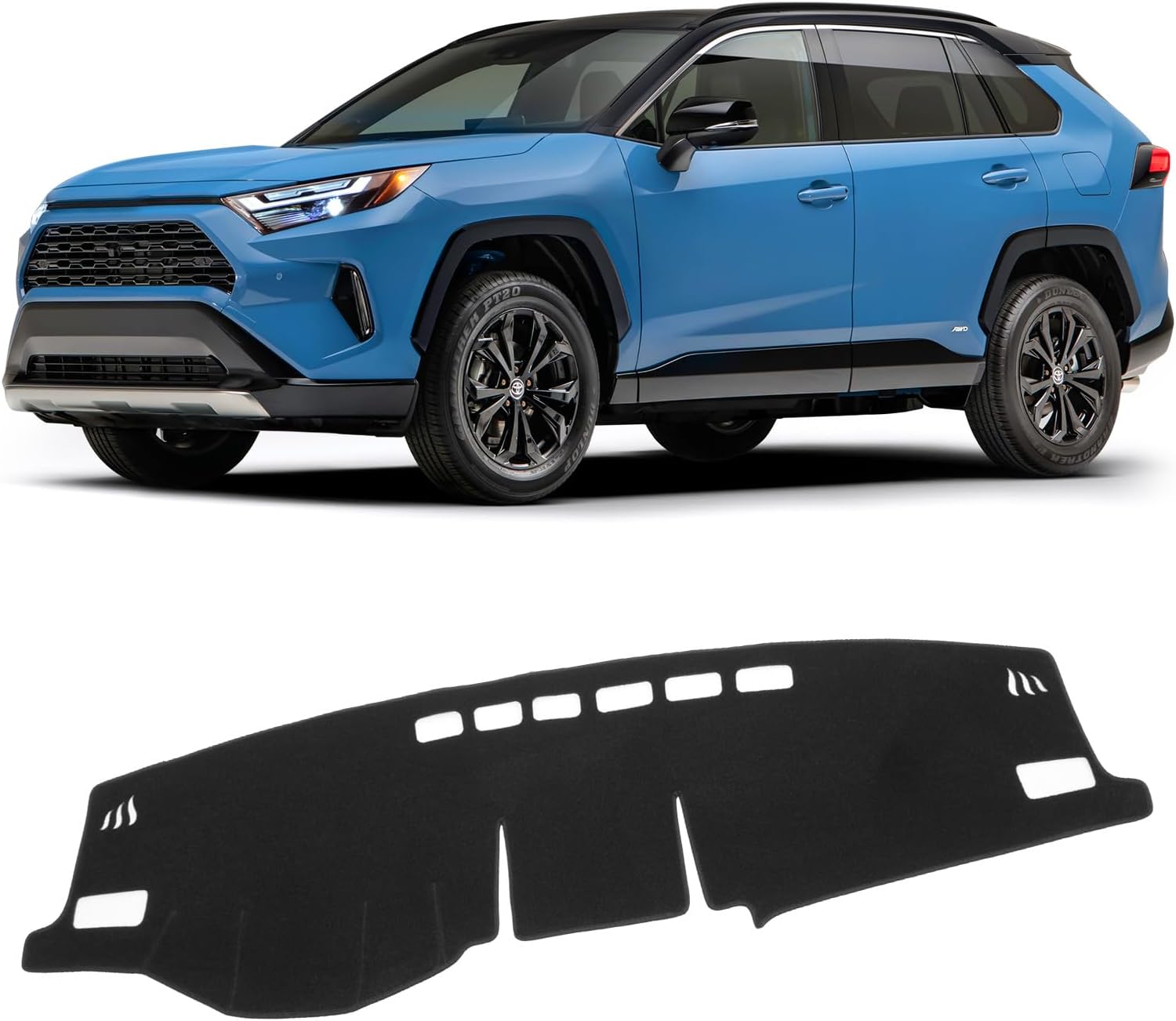
The KUST Black Dashboard Cover Mat offers a custom, eco‑friendly fit for Toyota RAV4 models from 2019 to 2025, protecting the dash from UV damage, scratches, and glare. Made from post‑consumer recycled polyester with a silicone anti‑slip underside, it stays soft, breathable, and odorless while securely adhering to the surface. Installation is quick and reversible, and the foldable design allows easy storage when not in use.
Gas vs Hybrid Towing
If you own a 2026 RAV4, you compare hybrid and plug-in hybrid setups instead of gas-only models. Toyota moved the U.S. RAV4 lineup to hybrid power for 2026, so older gas-only limits mainly matter for used RAV4 shoppers. A 2025 gas RAV4 often tows less than a 2025 Hybrid or Plug-in Hybrid.
Hybrid power can help low-speed pull and fuel use under light load, but payload still controls your real setup. You must count passengers, cargo, accessories, and tongue weight. A higher tow rating does not help if you run out of payload first.
Model Year Differences
Model year matters because Toyota changes trims, powertrains, cooling, brakes, and towing equipment. A 2024 Adventure or TRD Off-Road may show a higher tow rating than a basic 2025 gas trim. A 2026 AWD hybrid grade may also show a higher rating than some 2025 models.
Use the number for your exact vehicle, not a similar RAV4. Check the owner’s manual by year and read the door labels on the vehicle you drive. If the manual, hitch, or trailer rating gives a lower number, use the lower number.
Which Trailers Can a RAV4 Hybrid Safely Tow?
Start with your exact tow rating before you choose a trailer. A RAV4 with a 1,750 lb rating should stay with light utility trailers, compact sport trailers, single personal watercraft trailers, or very light teardrop trailers. A RAV4 with a 3,500 lb rating can handle a wider range, but payload, GCWR, trailer brakes, terrain, heat, and speed still matter.
Do not use empty trailer weight as your final number. Add water, batteries, propane, tools, bedding, coolers, bikes, and other gear. Your loaded trailer weight must stay below the tow rating, and the tongue weight must fit within payload.
[Products Worth Considering]

The Autorder dashboard cover mat provides a custom‑fit, velvet‑soft surface that shields your Toyota Tacoma or 4Runner dash from UV rays, heat, and glare while adding a premium look. Its nonslip silicone backing keeps the mat securely in place, and easy installation with double‑sided adhesive makes setup a breeze. The thick black fluff layer helps regulate temperature, keeping the dash cooler in summer and warmer in winter, ensuring long‑term durability and comfort.

The KUST windshield shade offers a precise, gap‑free fit for Toyota Prius models from 2023 to 2026, covering the entire glass to block UV rays and heat. Its double‑thick reflective polyester layers provide superior shading and thermal insulation, keeping the interior cooler and reducing AC load. Easy to install and store with an elastic steel wire, it folds in seconds without adhesives. Protect your dash and seats while enjoying a more comfortable ride.
Suitable Lightweight Trailers
For a 1,750 lb RAV4 rating, focus on small utility trailers, lightweight kayak trailers, single-axle sport trailers, and micro campers that leave room for cargo weight. Target a loaded trailer weight well under the rating when you carry passengers and gear. This approach gives you a safer margin for hills, wind, heat, and emergency braking.
For a 3,500 lb RAV4 rating, you may consider larger teardrop campers, small boats, or compact utility trailers. You still need to weigh the loaded trailer and check tongue weight. A trailer that looks small can exceed limits once you add water, batteries, tools, and camping gear.
Tongue Weight and Balance
Use 10% to 15% tongue weight as a starting range for most bumper-pull trailers. If you plan around 80% of a 1,750 lb rating, your loaded trailer target equals about 1,400 lb, and tongue weight should land near 140 to 210 lb. If you plan around 80% of a 3,500 lb rating, your loaded trailer target equals about 2,800 lb, and tongue weight should land near 280 to 420 lb.
Shift trailer cargo forward or rearward until the tongue weight falls in range. Keep heavy items low and close to the axle area. Avoid tail-heavy loading because it can increase sway and reduce control.
Real-World Payload Examples: Passengers, Gear, Hitch Math
Use real numbers before every trip. If your modified 2011 RAV4 Limited V6 has an adjusted payload of 815 lb, start with that lower number. Do not use a higher brochure number after modifications add weight.
Here is the math. Two passengers at 380 lb plus 85 lb of luggage use 465 lb. Subtract 465 lb from 815 lb, and about 350 lb remains for hitch hardware, tongue weight, and any more cargo.
That 350 lb does not create a new tow rating. It only shows the payload left before the RAV4 reaches its adjusted load limit. You still must keep the trailer below the vehicle tow rating, GCWR, hitch rating, axle ratings, tire ratings, and trailer ratings.
Use the same process for any RAV4. Start with the label, subtract real people and gear, add the hitch load, and keep a buffer. If the numbers land close to the limit, remove weight or choose a lighter trailer.
Safe Towing Practices and Quick Pre-Trip Checklist
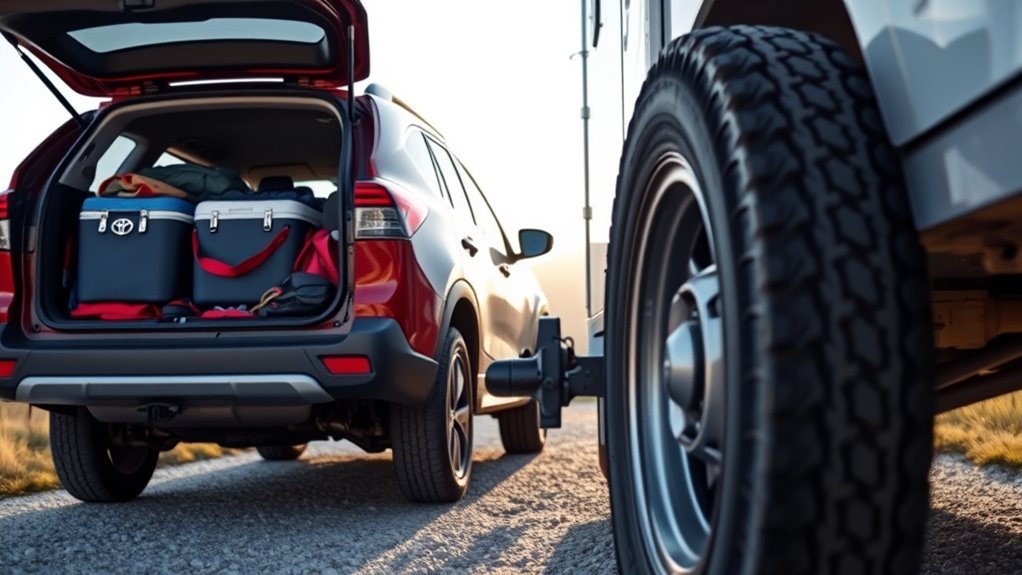
Check your tow setup before each trip, even if you used the same trailer last time. Load changes can alter tongue weight, rear axle load, and braking distance. A short scale check can prevent a long roadside problem.
Run this pre-trip checklist before you drive:
- Check weights: confirm loaded trailer weight, tongue weight, RAV4 payload, GVWR, GAWR, and GCWR.
- Inspect the hitch: secure the ball, coupler, safety chains, clips, wiring, and breakaway cable if equipped.
- Test systems: verify trailer lights, turn signals, brake lights, trailer brakes, and brake controller settings.
- Set the load: place heavy items low, balance side-to-side weight, and keep tongue weight in range.
- Plan the drive: reduce speed, increase following distance, avoid sudden lane changes, and allow more room for braking.
Repeat the checklist whenever you change cargo, passengers, or trailer setup. Small changes can push a compact SUV past a safe limit.
Helpful Accessories and Upgrades to Stay Within Limits
A few accessories can help you measure, secure, and control your tow setup, but none can raise Toyota’s limits. A tongue weight scale gives you better hitch-load data. A brake controller can help when your trailer has electric brakes and your setup supports one.
Use a weight-distribution hitch only if Toyota, the hitch maker, and the trailer maker allow it for your exact setup. Some cargo carriers, including enclosed hitch-mounted carriers such as GearSpace® 34 or GearDeck®, can add storage space, but they still consume payload and hitch capacity. A Silent Hitch Pin® can reduce hitch rattle, but it does not replace sway control or correct poor trailer balance.
| Accessory | Function | Important limit |
|---|---|---|
| Tongue weight scale | Measures hitch load | Does not replace a full vehicle scale check |
| Weight distribution hitch | Helps distribute load when compatible | Does not increase RAV4 ratings |
| Cargo carriers | Adds external storage space | Counts against payload and hitch limits |
| Silent Hitch Pin® | Reduces receiver rattle | Does not correct trailer sway |
| Proper load-rated tires | Supports safe load and pressure | Must match the label and manual |
Note: Hitch-mounted storage may reduce trailer tongue weight capacity because it adds load behind the rear axle.
Frequently Asked Questions
What does payload capacity mean on a RAV4?
Payload capacity means the weight your RAV4 can carry after you count people, cargo, accessories, and trailer tongue weight. Use the door jamb tire and loading label as your best starting point. If your added weight exceeds that number, remove cargo or reduce the trailer load.
Does trailer tongue weight count as payload?
Yes. Tongue weight pushes down on the hitch, so it counts against the RAV4’s payload and rear axle load. This is why a trailer can stay under the tow rating but still overload the vehicle.
What is the difference between towing capacity and payload?
Towing capacity tells you how much loaded trailer weight your RAV4 can pull. Payload tells you how much weight your RAV4 can carry on or inside the vehicle. You need to meet both limits before you tow.
Can a RAV4 tow 3,500 lb?
Some RAV4 models can tow up to 3,500 lb when properly equipped. This includes select 2026 AWD hybrid grades and select 2026 RAV4 Plug-in Hybrid grades. Many other RAV4 models have lower limits, so check your exact manual and door labels.
How do I figure out my RAV4 payload capacity?
Read the tire and loading label on the driver’s door jamb first. If you must calculate it, subtract curb weight from GVWR. Then subtract passengers, cargo, accessories, hitch hardware, and tongue weight to see what payload remains.
Conclusion
Your safest RAV4 towing setup starts with the sticker, not a guess. Check GVWR, payload, axle ratings, tow rating, GCWR, hitch rating, and trailer weight before you load up. Use 10% to 15% tongue weight, keep a smart buffer, and verify the setup with a scale when you can. Do the checklist before every trip so your RAV4 stays stable, legal, and ready for the road.
References
- 2026 Toyota RAV4 — Toyota, 2026
- 2026 Toyota RAV4 Plug-in Hybrid — Toyota, 2026
- The Next Adventure Begins: 2026 RAV4 Arrives this Winter — Toyota Pressroom, 2025
- Interpretation ID: GF004408 — National Highway Traffic Safety Administration
- Federal Motor Vehicle Safety Standards; Cargo Carrying Capacity — Federal Register, 2010
- Toyota RAV4 Towing Capacity & Performance Guide — DARCARS Toyota of Frederick