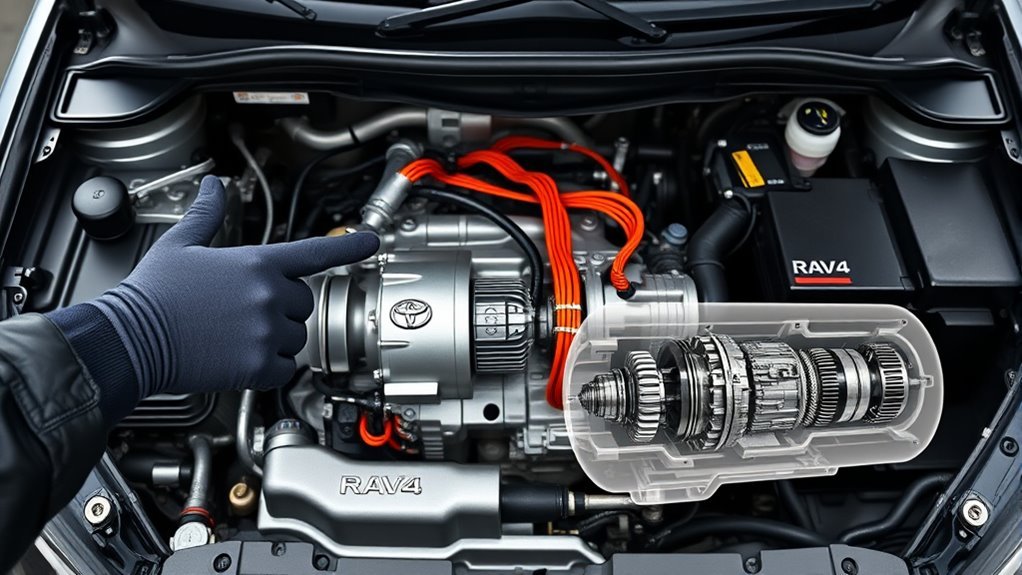
The RAV4’s eCVT blends your gasoline engine, two motor‑generators (MG1, MG2) and a planetary gearset to deliver seamless, efficient drive torque without gear shifts. MG2 provides traction and regenerative braking; MG1 manages generation, battery charge and engine start/stop. You’ll run quietly on electric power up to about 40 mph, get instant torque and smooth gas assist during heavy loads, and recover energy under deceleration—keep going and you’ll get detailed power‑flow and maintenance notes.
Quick Overview: What the RAV4 eCVT Does (TL;DR)
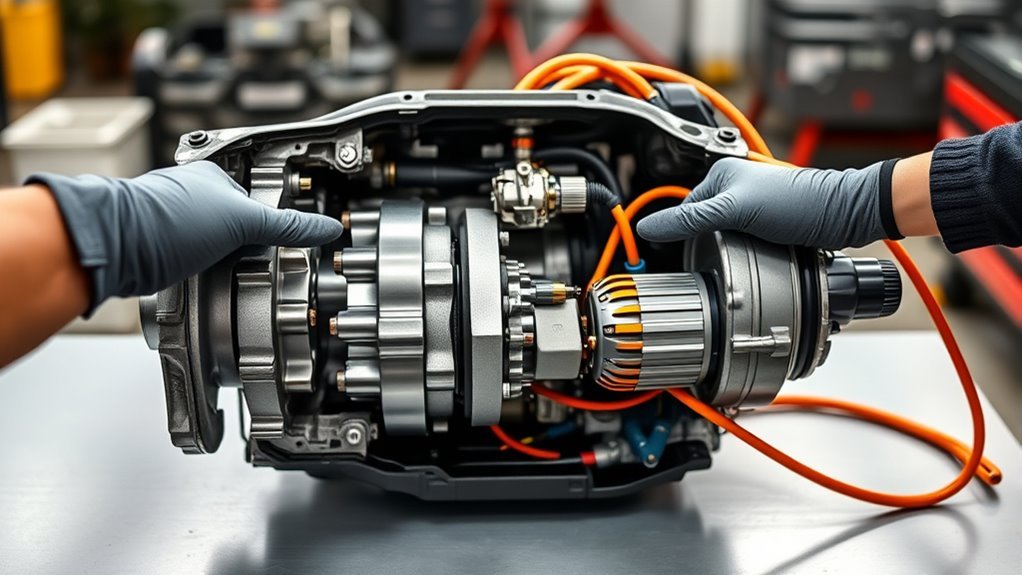
Although it looks like a conventional automatic, the RAV4’s eCVT uses electric motor-generators and a planetary gear set instead of a belt-driven pulley system, so it blends gasoline and electric torque seamlessly, enables quiet electric-only driving up to about 40 mph, and recovers energy through regenerative braking to recharge the hybrid battery. You’ll notice immediate eCVT benefits: smoother acceleration, reduced mechanical losses, and efficient power distribution across speed ranges. The system shifts the work between engine and motors without discrete gear steps, so you get consistent thrust and optimized fuel use. Regenerative braking captures slowdown energy, cutting reliance on external charging and extending your range. At low speeds the vehicle can run silently on electricity, improving urban fuel economy and giving you tactical control over noise and emissions. The driving experience feels liberated from conventional shift logic; you command seamless torque, minimal interruptions, and measurable efficiency gains that support independent mobility choices.
Key Parts Inside the RAV4 eCVT: Engine, MG1, MG2, and Planetary Gear
Think of the eCVT as a coordinated power-split assembly: a gasoline engine, two motor-generators (MG1 and MG2), and a planetary gear set work together to allocate torque and electrical power with minimal loss. You’ll see the engine act as the primary thermal power source tuned for engine efficiency; its shaft interfaces with the planetary carrier to vary mechanical input without a stepped gearbox. MG1, the smaller motor-generator tied to the sun gear, manages generator duties and can spin to charge the battery even when the engine is off, providing flexible power distribution and system control. MG2, connected to the ring gear, delivers the main traction torque and doubles as the regenerative generator during deceleration, recovering kinetic energy to the battery. The planetary gearset algebraically links rotational speeds and torques, so you can command combined mechanical and electrical outputs seamlessly. Together these parts grant you liberated control over propulsion, energy recovery, and optimized engine efficiency.
How Power Flows: Normal Driving, Electric-Only, and Hard Acceleration
When you accelerate gently or cruise, the eCVT directs most torque through MG2 for propulsion while MG1 manages generator duties and top-ups to the battery, with the planetary gearset continuously apportioning mechanical and electrical power to keep the engine at its most efficient operating point. In normal driving you’ll feel smooth, continuous power delivery: MG2 supplies traction at low loads while MG1 balances generator output to sustain battery state-of-charge and assist the engine when required. In electric-only mode the system lets you travel up to 40 mph with the combustion engine shut down, maximizing driving efficiency and showcasing core eCVT advantages over conventional gearboxes. Under hard acceleration the engine engages quickly; MG1 acts as a starter and immediate power source while MG2 supplements torque, the planetary gearset blending outputs to deliver prompt response. The result is liberated control—seamless shifts, minimized fuel use, and responsive performance without manual intervention.
Regenerative Braking and How Battery Charging Works
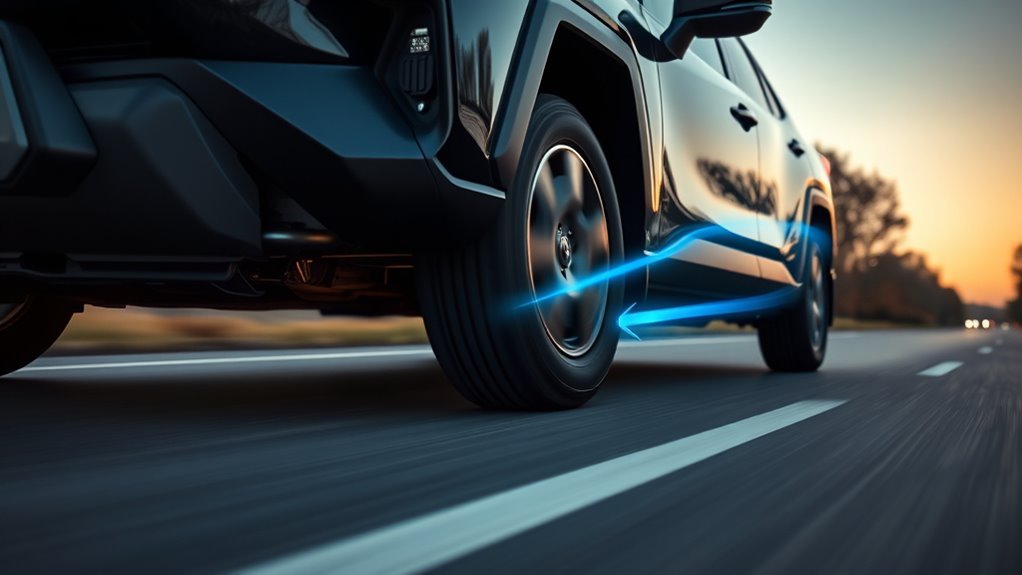
Because the RAV4’s eCVT links MG2 directly to the wheels through the planetary gearset, it can reverse MG2’s polarity during deceleration to convert kinetic energy into electrical energy and charge the hybrid battery. When you lift or apply the brakes, the control system commands MG2 to act as a generator: reversing its electrical phase shifts torque direction, producing electrical current while producing braking torque at the wheels. That electrical energy is routed through the power electronics to charge the hybrid battery, increasing available state-of-charge for electric-only operation. This regenerative action reduces reliance on friction brakes, improving brake efficiency and lowering component wear. The vehicle’s control logic balances energy recovery with driver feel, blending regenerative and mechanical braking smoothly so you retain predictable control. By capturing deceleration energy and storing it, you free yourself from wasteful fuel cycles, extend driving range, and boost overall efficiency — a direct, mechanical-to-electrical reclamation that supports liberation from traditional inefficiencies.
How the eCVT Starts and Stops the Gas Engine (MG1’s Role)
Although it sits out of sight, MG1 plays a critical role in starting and stopping the gas engine by acting as a controlled starter-generator tied into the planetary gearset; it spins the engine up precisely on command, lets the engine be shut down when not needed, and can top up the hybrid battery even with the engine off. You’ll see MG1 functionality every time the system shifts between electric-only and hybrid modes: MG1 generates electrical power to charge the battery or acts as a motor to crank the engine, coordinated through the planetary gears to avoid mechanical shock. You can rely on MG1 to modulate speed to influence acceleration and to manage a seamless engine shift, reducing drag and preserving momentum. When the car is cruising electrically, MG1 supplies just enough energy to restart the engine instantly when load demands rise. This controlled interplay liberates you from abrupt starts, lowers fuel use, and keeps the drivetrain responsive without driver intervention.
What’s New in the 3rd‑Gen RAV4 Hybrid vs Older Models
If you’re comparing generations, the 3rd‑gen RAV4 Hybrid’s eCVT brings several targeted improvements over older models: you get true electric-only operation, improved power flow, and simplified mechanical layout. The system uses electric motors to drive the vehicle without the combustion engine, extending electric-only range and delivering clear hybrid advantages in city traffic. A single counter gear in the power‑split device replaces a more complex arrangement, cutting parasitic losses and simplifying control logic for measurable efficiency enhancements. Electric‑only top speed rises to 40 mph from 5 mph previously, shifting more urban duty to the battery and lowering fuel use. Regenerative braking is upgraded, recovering more kinetic energy, reducing friction brake demand, and feeding stored energy back into propulsion. High‑voltage integration for MG1 and MG2 tightens coordination, improves transient response, and smooths torque blending. If you want freedom from fuel‑first driving, this generation gives you cleaner, more responsive electric‑forward operation without adding mechanical complexity.
[Products Worth Considering]

Protect your Toyota RAV4 interior with this custom‑fit windshield sun shade that blocks 99% of harmful UV rays and reduces cabin heat. The mirror cut‑out ensures a seamless fit without gaps, while durable 240T polyester and bendable wire keep it sturdy through repeated use. Foldable and stored in a convenient pouch, it offers easy installation and removal for everyday comfort.

The Autovir windscreen shade offers full windshield coverage for Toyota RAV4 models from 2019 to 2026, blocking up to 99.95% of UV rays and reducing interior heat. Its multi‑layer reflective material provides SPF 100 and UPF 80+ protection while keeping the dashboard, seats, and steering wheel cooler. The foldable design installs quickly and stores conveniently in the glove box, and reinforced stitching ensures long‑lasting durability for daily use.

The KUST Black Dashboard Cover Mat offers a custom, eco‑friendly fit for Toyota RAV4 models from 2019 to 2025, protecting the dash from UV damage, scratches, and glare. Made from post‑consumer recycled polyester with a silicone anti‑slip underside, it stays soft, breathable, and odorless while securely adhering to the surface. Installation is quick and reversible, and the foldable design allows easy storage when not in use.
Common Maintenance Checks and Technician Tasks for the eCVT
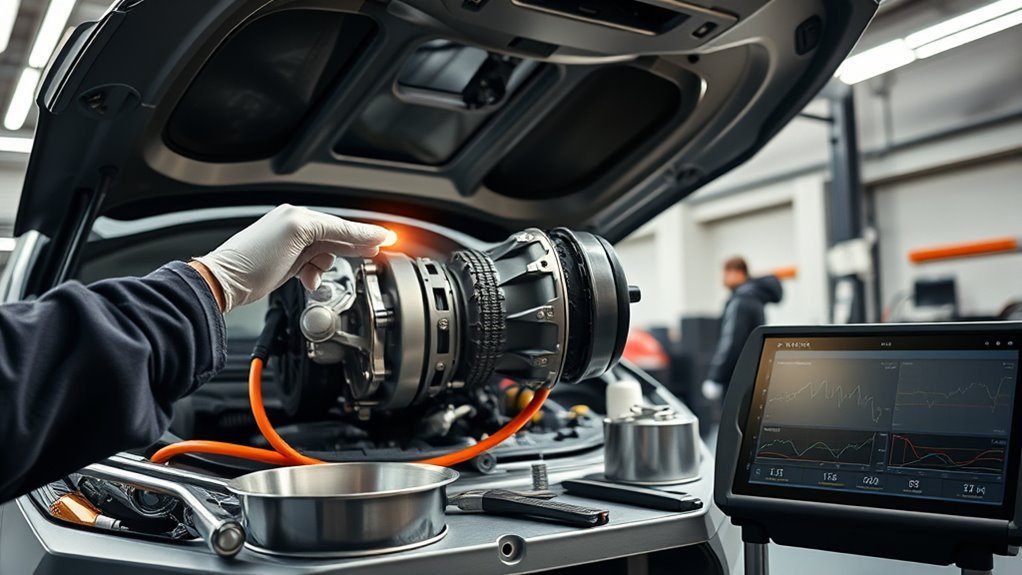
When you service a RAV4 eCVT, prioritize fluid level checks and component inspections to prevent overheating and premature wear. You’ll verify drain and fill plugs, confirm fluid maintenance intervals, and sample fluid for contamination. Conduct sensor inspection of integrated position and speed sensors to guarantee accurate control of MG1/MG2 torque commands. Verify electrical connectivity at high-voltage junctions and harnesses to avoid intermittent losses and thermal faults. Maintain the oil pump and regulator to preserve pressure and flow; test pump output under load where possible. Ascertain filter cleanliness by removing and inspecting the oil pickup filter, replacing when clogged to protect internal gears and bearings.
Prioritize fluid checks, sensor and high-voltage inspections, and oil-pump/filter service to prevent overheating and premature eCVT wear
- Check drain/fill plugs, sample fluid, record levels (fluid maintenance).
- Test position/speed sensors for correct signals and tolerances (sensor inspection).
- Inspect and torque high-voltage terminals, confirm insulation integrity (electrical connectivity).
- Service oil pump, regulator, and replace pickup filter to restore flow (oil pump, filter cleanliness).
[Products Worth Considering]

The TPXSIUE passenger storage organizer mat provides a custom‑fit, non‑slip silicone tray that keeps items secure and the console tidy. It slides into the grab‑handle slot without tools, protecting the interior from scratches and rattles while offering easy access to pens, gum, and other essentials. Designed for RAV4 models from 2019 to 2024, it delivers a perfect OEM‑like fit and enhances vehicle organization.

Protect your Toyota key fob with this soft TPU cover that offers a precise 1:1 fit for 3‑button models. The elastic material cushions against dust and scratches while maintaining full button functionality. Easy to install and portable, it clips onto bags or pockets for on‑the‑go convenience.
Practical Driving Tips: When You’ll Feel Electric vs Gas Power
In city driving and low-speed maneuvers you’ll feel the RAV4 move quietly on electric-only power up to about 40 mph. When you demand rapid acceleration the gasoline engine will engage to assist MG2, producing a noticeable surge and higher RPM behavior. Use regenerative braking when slowing to recover energy and extend the periods you experience pure electric drive.
Electric-Only Driving Feel
Curious how the RAV4 feels in electric-only mode? You’ll experience electric driving benefits and urban efficiency immediately: quiet starts, instant torque, and efficient city cruising up to 40 mph. Regenerative braking recovers energy and lowers brake wear. The gas engine joins smoothly under load, but you’ll notice a calibrated shift in delivery.
- Quiet launch — MG2 provides immediate torque without engine noise; ideal for liberated, stealthy urban moves.
- Speed cap — electric-only operation holds to ~40 mph; plan for engine assist beyond that.
- Regen — braking converts kinetic energy to battery charge, boosting range and control.
- Seamless shift — the eCVT balances motor and engine for consistent feel during acceleration and load changes.
Engine Assist Zones
Having felt the quiet, electric-only behavior, you’ll want to know exactly where the gas engine steps in—these are the engine assist zones. You’ll mostly drive on MG2 electric torque up to ~40 mph for city commutes, maximizing power efficiency and smooth low-speed acceleration in stop-and-go traffic. When you need surge—highway merge, full-throttle acceleration, or steep grades—the gasoline engine engages to assist MG1, supplying additional torque and elevating engine performance seamlessly. Regenerative braking returns kinetic energy via MG2 during decel, restoring charge and reducing brake wear. You’ll rarely notice shifts; the eCVT coordinates motors and engine to prioritize fuel economy without sacrificing responsiveness. Use light inputs to stay electric; demand invokes gas assist for liberated, confident progress.
Frequently Asked Questions
How Does the Toyota eCVT Work?
The eCVT blends engine and two electric motors via a planetary gearset so you’ll get smooth power, regenerative braking, electric-only driving, and hybrid efficiency; you’ll enjoy transmission benefits like seamless torque distribution and improved fuel liberation.
Does the Toyota eCVT Use a Belt?
No — unlike belt CVTs, the eCVT uses gears and electric motors, so you’ll get hybrid efficiency and transmission benefits through direct planetary gearing, regenerative control, and reduced maintenance, freeing you technically and practically.
Conclusion
You’ve just seen how the RAV4’s eCVT blends an internal combustion engine with two motor‑generators and a planetary gearset to optimize efficiency and performance. One striking stat: hybrids recover up to 70% more energy during city driving than conventional hybrids, so your braking directly improves fuel economy. Remember, MG1 controls starts/stops and charging while MG2 drives wheels; keep cooling, software, and high‑voltage inspections current to preserve smooth electric/gas shifts and long service life.