You’ll use 2H for normal pavement, 4H for slippery gravel or mud without stopping, and 4L for steep, rocky climbs needing max torque. Engage 4H by pulling the control and driving forward until the indicator settles; gently blip the throttle if it blinks. For 4L, stop, shift to Neutral, push down and pull back, then drive slowly. Expect lower MPG and more wear in 4WD—keep maintenance up to stay reliable, and more tips follow below.
Quick Steps: Engage 4H on a 2025 Tundra
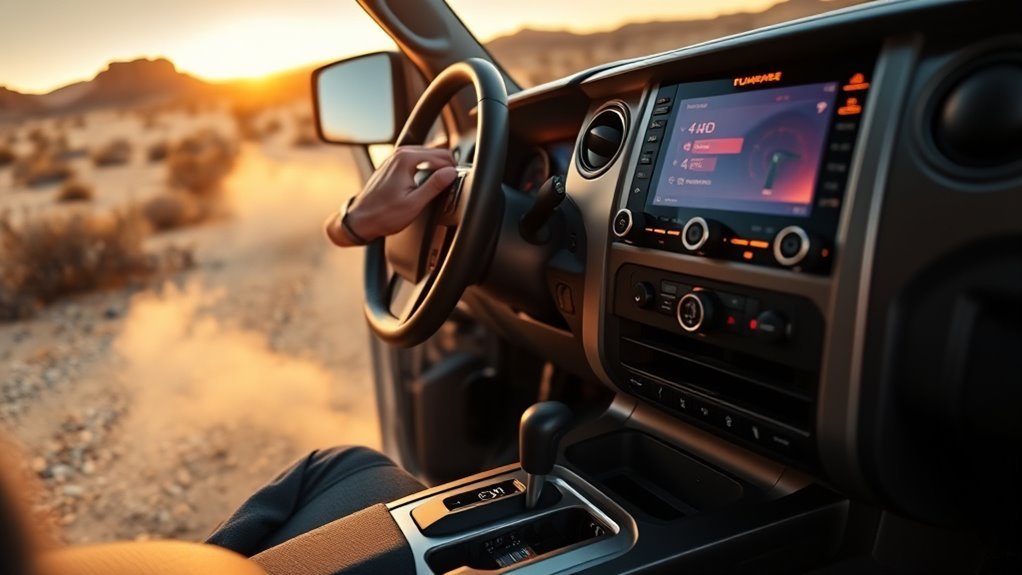
Start by pushing down and pulling back on the 4H control near the shift knob to engage Four High on your 2025 Tundra. You’ll see the 4H indicator blink on the dash until engagement completes; drive forward to finish the process. If the light keeps blinking, gently apply gas while moving to help the system synchronize. You don’t need to reverse — forward motion alone is sufficient.
Engaging 4H immediately improves traction control for slippery, uneven terrain, so you can move confidently and reclaim control of the trail. Use this as a basic off-road technique: maintain steady, moderate speed and avoid abrupt steering inputs while the transfer case meshes. Once the indicator stays solid, you’re locked into Four High and ready to press beyond paved limits. This method keeps changes clean, minimizes drivetrain stress, and lets you pursue freedom on rough ground without hesitation.
Quick Steps: Engage and Exit 4L Safely
1 clear sequence will keep your Tundra’s drivetrain safe when you need maximum torque: come to a complete stop, shift the transmission to Neutral, then push down and pull back on the 4L control until the yellow 4L indicator lights. After that, drive forward to engage the gearing fully and feel the 4L benefits—low speeds with high torque that let you conquer obstacles without strain.
To exit 4L safely, stop again, shift to Neutral, then push down and pull back on the control to return to 4H; watch the dashboard indicator to confirm disengagement. If you want full on‑road mode, push to 2H after confirming 4L is out. Follow this exact sequence every time to avoid binding or damage.
Disengagement tips: always stop before switching, use Neutral, and rely on the indicator lamp. These simple, disciplined steps free you to push limits confidently while protecting the drivetrain.
When to Use 2H, 4H, or 4L Off‑Road
Stick with 2H for normal pavement to maximize fuel economy and handling. Switch to 4H when roads get slippery or you’re off-road and need extra traction—you can engage it while driving and watch the indicator blink until it’s engaged. Use 4L only when you need maximum torque and low-speed control, and always stop and put the truck in neutral before engaging or disengaging it.
When To Use 2H
When you’re on dry, paved roads and don’t need extra traction, keep the Tundra in 2H to maximize fuel economy and reduce tire wear; save 4H for slippery surfaces and 4L for steep, technical terrain where low-range torque is required. Use 2H for everyday commuting and highway miles—those 2H driving conditions let you enjoy 2H fuel efficiency and reduced 2H tire wear. Understand 2H advantages: simpler drivetrain load, better 2H performance, and lower operating costs compared with 2H vs 4H use. Follow 2H safety tips and 2H driving techniques: maintain proper tire pressure, monitor dash indicators, and avoid engaging 4L unnecessarily. Regular 2H maintenance keeps the system reliable across various 2H road types.
When To Use 4H
Often you’ll flip into 4H whenever road grip becomes questionable—snow, mud, gravel, or wet pavement—because it gives you extra traction without stopping. Use 4H to reclaim freedom when conditions betray pavement: it boosts traction across slippery surfaces while you keep moving, letting you maintain momentum and confidence. Engage it at low speed; the indicator will blink until fully engaged. Don’t treat 4H like a permanent setting—return to 2H for normal driving to save fuel and preserve handling. Remember 4H advantages: improved stability, better control, and the ability to escape slick patches without halting. You won’t need 4L’s torque here; save that for true off‑road technical sections that demand a complete stop and low gears.
When To Use 4L
If you’re tackling steep hills, deep ruts, rocky climbs, or thick mud, shift into 4L to get maximum torque and control at low speeds. Use 4L when traction and power matter more than speed—climbing boulder-strewn slopes, crawling through deep mud, or powering out of sand traps. The 4L advantages are clear: multiplied torque, precise throttle response, and superior crawl capability so you can choose your line and escape on your terms. Always stop completely and shift to neutral before engaging 4L to protect the drivetrain, then drive forward to confirm engagement via dash lights. Reserve 4L for true off road scenarios; use 4H for slippery surfaces and 2H for normal roads to maintain efficiency and freedom.
Troubleshoot 4WD Engagement on Your Tundra
When the 4WD indicator blinks or won’t stay lit, keep the Tundra moving and give it a little gas until the light confirms engagement. For 4L, stop, shift to Neutral, then push down and pull back on the control and watch for the yellow indicator; repeat the same stop/Neutral/push-pull sequence to return to 4H. To fully disengage, shift from 4H to 2H after engagement, and always follow the proper sequence to avoid drivetrain damage.
4WD Indicator Troubleshooting
Because the 4WD indicator is your primary clue that the Tundra’s system is engaging, you should know what steady and blinking lights mean and how to respond. Use 4WD indicators as an initial step in quick system diagnostics: a steady yellow light signals successful 4L engagement, while blinking usually means the system’s trying to engage and may need you to drive forward to complete it. When shifting into 4L, verify you’re in neutral — it won’t engage in gear. If 4L won’t disengage, stop fully and shift to neutral before switching back to 4H or 2H. Consult your owner’s manual for model-specific cautions. These checks keep you moving and prevent damage, giving you control and freedom on rough terrain.
Shift Lever Engagement Steps
Shifting the Tundra’s transfer case is straightforward if you follow the correct lever‑movement and vehicle‑state sequence: push down and pull back on the shift lever while driving forward to engage Four High (4H) and watch the blinking dash indicator for confirmation. For Four Low (4L), come to a complete stop, shift to neutral, then push down and pull back; the indicator will turn yellow once engaged. After selecting 4L, drive forward to seat the gears and enjoy increased torque. To disengage 4L, stop, shift to neutral, repeat the push‑down/pull‑back to return to 4H, then push to 2H if you want full disengagement. Respect the shift lever mechanics and follow engagement troubleshooting steps to avoid damage and maintain liberation on rough trails.
How 4WD Affects Handling and MPG
If you engage 4WD on your Tundra, you’ll gain noticeably better traction and stability for rough trails and poor weather, but you should expect a drop in MPG and potentially higher wear if you leave it on paved roads. 4H helps control slippery conditions with modest efficiency loss, while 4L delivers much more torque for steep climbs or obstacles at the cost of considerably worse fuel economy.
When you switch from 2H to 4H, the improved traction stability lets you push through mud, snow, or loose rock with confidence, but added drivetrain resistance reduces drivetrain efficiency and lowers MPG slightly. 4L multiplies torque for technical moves and slow climbs, yet its low gearing and increased mechanical drag consume noticeably more fuel. Habitually running 4WD on pavement accelerates component wear and raises long‑term costs. Use 4H for bad weather, 4L for serious obstacles, and return to 2H for open roads to maximize fuel economy and preserve your Tundra’s freedom to roam.
Real Off‑Road Scenarios and Gear Choices
Now that you know how 4H and 4L affect handling and fuel use, let’s look at real off‑road situations and the gear choices you’ll make on the trail. You’ll use off road techniques and terrain assessment to decide when to shift: 4H for loose gravel or mud to keep speed and traction, 4L for steep, technical climbs where torque and control matter. Lower tire pressures increase grip but raise pinch‑flat risk, so balance traction with protection.
- Gravel/mud: engage 4H, maintain momentum, monitor steering feel.
- Steep/rocky: drop to 4L, use low revs and steady throttle.
- Sand/dunes: reduce pressure, avoid sudden turns, keep consistent speed.
- Changeover zones: reassess terrain, shift between 4H and 4L as needed.
You’re aiming for freedom on the trail, so make decisive gear choices, stay observant, and trust your Tundra’s capability while respecting the terrain.
Practical Maintenance for the Tundra 4WD System
Keep your Tundra’s 4WD ready by following a simple, regular maintenance routine: check transfer case fluid every 30,000–50,000 miles, inspect driveshafts and U‑joints for play or damage, and service front and rear differentials per Toyota’s schedule to preserve torque distribution. You’ll embrace freedom on rough trails when you prioritize fluid maintenance and differential servicing—don’t wait for a failure. Inspect for component wear during oil changes: look for looseness, leaks, torn boots, or metal flakes in fluids. Perform tire inspection monthly; unequal pressure or tread wear undermines traction and stresses the drivetrain. Run engagement testing on paved and soft surfaces so you catch binding or delay before it strands you off‑road. Keep records of services and parts replaced; they prove your truck’s readiness and help you push boundaries confidently. If you find damage or unusual noises, address them immediately—patching issues early protects performance, preserves torque balance, and keeps you liberated on any route.
Frequently Asked Questions
What Are the Basic 4×4 Off-Road Skills?
You master basic 4×4 off-road skills by managing tire pressure, engaging traction control appropriately, choosing proper lines, shifting between 4H/4L smoothly, controlling throttle and braking, winching when needed, and practicing recovery and situational awareness.
When to Use 4H and 4L Tundra?
Try testing the theory: you’ll gain control. Use 4H advantages on slippery roads and mild trails for better traction while moving; switch to 4L scenarios for steep, rocky, or slow technical climbs, engaging neutral first and proceeding steadily.
Conclusion
You’ll get the most from your Tundra off‑road by choosing the right mode: 2H for pavement, 4H for slippery trails, and 4L for steep, technical terrain. Remember that properly engaging 4WD reduces wheel slip—studies show using low range can cut rollover risk by up to 30% in extreme off‑camber situations—so use it when needed. Maintain your transfer case, check fluid and linkages, and practice shifts to stay safe and confident.