
You should use Toyota’s 0W‑20 full synthetic in most Tundras to preserve engineered clearances, meet emissions goals, and keep warranty coverage; it flows fast for cold starts and aids fuel economy. 5W‑20 is acceptable in warmer regions, while 5W‑30 gives thicker film and better protection under heavy towing or high loads but may increase consumption and risk warranty issues. Monitor oil use, pick viscosity by climate and duty, and follow intervals to protect the engine — more specifics follow.
Which Oil Should You Use for Your Tundra?

Which oil should you pick for your Tundra depends on climate, duty cycle, and Toyota’s recommendations. You’ll weigh 0W-20 for ideal fuel efficiency and emissions versus 5W-20 or 5W-30 for thicker protection. In colder regions 0W-20 gives quicker flow at startup, preserving engine performance and lowering emissions. In southern climates or high-mileage engines you may choose 5W-20 to reduce oil consumption and stress on bearings. For towing or sustained heavy loads, 5W-30 synthetic offers enhanced film strength and thermal stability. Regular synthetic oil changes every 5,000–10,000 miles maintains lubrication integrity and lets oil additives perform as designed. Talk to other Tundra owners to gauge real-world longevity and trade-offs; their data helps you resist one-size-fits-all prescriptions. Ultimately pick the viscosity that matches your operating demands and liberates you from avoidable wear while staying aligned with Toyota’s baseline guidance.
Toyota’s Recommended Oil for the Tundra : And Why
Because Toyota engineers calibrated the Tundra for 0W-20 full synthetic, you should use that grade unless local conditions or duties dictate otherwise: you’ll gain targeted oil benefits — improved fuel efficiency, emissions compliance, and superior cold-start protection that minimizes wear during initial rpm spikes. Using 0W-20 preserves engineered clearances and helps maintain warranty coverage; deviating risks voiding protections unless climate or heavy-duty use justify alternate viscosities like 5W-20/5W-30.
| Feature | 0W-20 Role | Note |
|---|---|---|
| Fuel economy | Low viscosity reduces friction | MPG gains |
| Cold starts | Rapid lubrication at low temp | Less wear |
| Emissions | Meets Toyota specs | Regulatory alignment |
| Warranty | Spec compliance required | Protects coverage |
| Service interval | 6 months / 10,000 km | Follow maintenance tips |
Adopt these recommendations to free yourself from avoidable failures: stick to specified oil, document changes, and follow scheduled oil changes for durable engine performance and autonomy.
0W‑20 vs 5W‑20 vs 5W‑30 : Protection, Cold Starts, MPG
Choosing between 0W‑20, 5W‑20, and 5W‑30 comes down to the tradeoffs among cold-start flow, high‑temperature film strength, and marginal fuel‑economy differences. You’ll prefer 0W‑20 where extreme cold start performance is critical: its lower “W” rating yields faster oil flow at startup, reducing initial hydrodynamic starvation. In milder or southern climates, 5W‑20 balances low-temperature behavior with slightly greater operating viscosity, offering modest fuel‑economy benefit versus thicker oils. Choose 5W‑30 when you need improved high-temperature film strength under sustained loads or towing; its higher hot viscosity increases protection where operating temperatures and stress rise. Be mindful of viscosity impact on efficiency and warranty: thinner grades can shave fuel use but may trade some protection under heavy duty. You should follow Toyota’s spec for the Tundra; deviating risks performance, longevity, and coverage. Decide based on your climate, load demands, and commitment to both efficiency and mechanical freedom.
How Viscosity Affects Wear, Bearings, and Oil Consumption
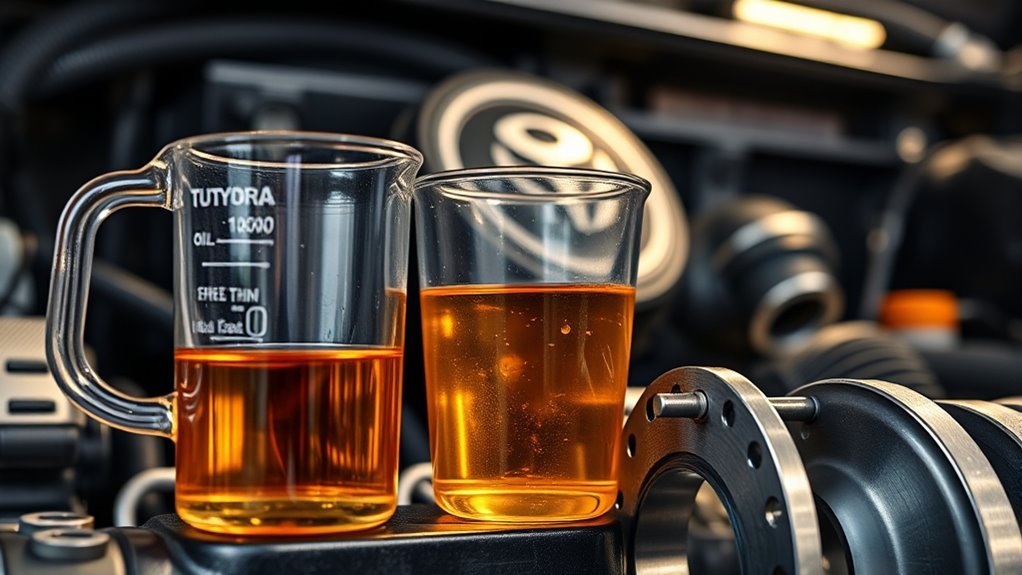
When you choose oil viscosity for a Tundra, thicker fluids generate a more robust hydrodynamic film that lowers metal-to-metal contact and reduces bearing load. Thicker oils like 5W‑20 maintain oil pressure better under high stress, whereas lower‑viscosity oils thin out and can increase consumption and evaporation. Picking the correct viscosity and following change intervals preserves bearing life and limits oil loss.
Viscosity And Bearing Load
If engine bearings don’t maintain a full hydrodynamic film, you’ll see higher metal-to-metal contact that increases wear and oil consumption; oil viscosity directly controls that film thickness and its stability across temperatures. You must prioritize bearing performance by selecting viscosity that sustains a stable film under expected loads and temps. Lower-viscosity oils reduce hydrodynamic separation, raising asperity contact and accelerating wear; they can also change oil consumption patterns. Conversely, higher-viscosity grades (e.g., thicker synthetics) preserve film thickness and reduce friction under heavy load, enhancing durability. Respect manufacturer viscosity ranges—engine clearances and pump dynamics are engineered for specific viscosities. Monitor consumption and wear trends; if you observe elevated metal contact or consumption, adjust viscosity within spec to restore viscosity stability and protect bearings.
Oil Thickness And Consumption
Having established how viscosity governs bearing film thickness and load-carrying, we’ll now examine how oil ‘thickness’ affects overall consumption and wear mechanisms. You’ll find thicker oils (5W-20, 5W-30) sustain stronger hydrodynamic films, lowering metal-to-metal contact and reducing bearing failure risk, especially in hot southern climates. Higher viscosity also curbs evaporation-driven consumption, slowing oil oxidation and limiting engine deposits that accelerate wear. Conversely, low-viscosity oils (0W-20) can raise consumption and risk thinner films under load, increasing friction and component wear. Match viscosity to driving patterns: frequent short trips and cold starts benefit from slightly thicker grades to preserve film strength until operating temperature. Choose viscosity to minimize consumption, control oil oxidation, and prevent deposits—liberating you from premature engine failure.
Real‑World MPG: Owner Reports When Switching Viscosities

When you compare 5W-20 and 0W-20 in real-world driving, reported MPG changes are often negligible, especially in warm climates and under light loads. Expect towing to magnify differences in oil temperature and shear, but owner data frequently shows towing economy driven more by weight and aerodynamics than by a one-grade viscosity change. Use empirical MPG logs from your own truck under comparable conditions to judge whether switching yields measurable benefit.
Real‑World Fuel Impact
Although manufacturers tout 0W‑20 for improved fuel economy, Tundra owner reports show only marginal real‑world gains and, in some cases, slight losses: most drivers switching from 0W‑20 to 5W‑20 saw negligible MPG change, a survey found 68% noticed no significant savings, and forum data indicates a 1–2% MPG drop for thinner oils under heavy towing. You’ll find oil performance varies with climate, duty cycle, and maintenance; warmer regions sometimes saw slight MPG gains with 5W‑20 due to better thermal stability. Longitudinal data on regular 5W‑20 service intervals show stable MPG, implying viscosity is secondary to driving habits and upkeep. If you value liberation from gimmicks, prioritize correct viscosity for your operating range and consistent maintenance to protect efficiency.
Towing And Economy
If you tow regularly, switching between 5W‑20 and 0W‑20 will usually produce negligible changes in real‑world MPG; owners report little to no fuel‑economy gain from thinner 0W‑20 under heavy loads. You’ll find community data shows 0W‑20’s light‑drive advantages vanish when towing; thermal and viscous shear under load erase marginal gains. Many owners report reduced towing performance and higher oil consumption with 0W‑20 on heavy hauls, while 5W‑20 delivers crisper throttle response and perceived durability. For liberation from roadside failures, prioritize oil longevity and stable film strength over marginal fuel savings. Practically, choose 5W‑20 for consistent power, lower consumption risk, and predictable maintenance intervals; reserve 0W‑20 only if you rarely tow and want slight light‑load efficiency.
Warranty Risk: When Thicker Oil Could Void Coverage for Your Tundra
Because Toyota engineers specify oil viscosities to match sealing, clearances, and cold-start flow, using a thicker oil than listed (for example replacing 0W‑20 with 5W‑30 or heavier) can create conditions that the warranty excludes, and you’ll likely face denial of engine-related claims. You need to weigh warranty implications against perceived benefits: OEM specs preserve designed oil performance, and deviating undermines the manufacturer’s ability to determine causality in failures.
If you install a heavier grade, service technicians can document nonconforming fluid during inspections; that documentation frequently triggers claim denial for wear, oil consumption, or timing-chain issues. Warranty windows (commonly up to ~60,000 miles) make compliance important for covered ownership. Beyond warranty, thicker oil’s reduced cold-start flow can increase initial wear rates, shortening component life.
Consult your owner’s manual, keep service records, and use specified viscosity to protect coverage. If you pursue nonstandard oils for liberation from constraints, accept the increased risk to warranty protection and future claims.
Choose Oil by Climate, Towing, and Driving Habits
Having covered how using thicker-than-specified oil can jeopardize warranty protection, you should now select viscosity based on climate, towing demands, and driving patterns. You’ll choose oil to match climate impact, towing considerations, and how you drive. In warm southern climates, 5W-20 maintains ideal flow and longevity; when you tow heavy loads or face sustained high engine stress, 5W-30 offers increased film strength. For frequent short trips that increase wear, prefer a formulation with robust shear stability and detergent capacity. Engage with other Tundra owners to validate real-world performance and refine your choice.
Choose oil viscosity by climate, towing, and driving: 5W‑20 for heat, 5W‑30 for heavy loads, synthetic for mixed use.
- Hot southern climate: 5W-20 for consistent lubricity and fuel efficiency.
- Regular heavy towing: consider 5W-30 for improved protection under load.
- Short-trip urban use: choose oil rated for wear control and rapid film recovery.
- Blend of conditions: prioritize synthetic oils with stable viscosity index.
- Peer feedback: corroborate manufacturer guidance with owner experience for liberation in choice.
Practical Maintenance Plan: Oil Choice, Intervals, and Checks
When you set up a practical maintenance plan for your Tundra, prioritize selecting the correct oil grade, establishing realistic change intervals, and scheduling routine checks to prevent premature wear and preserve warranty coverage. You’ll choose 5W-20 or 5W-30 based on climate and load: warmer southern conditions and frequent towing favor 5W-30 for thermal stability and film strength. Set change intervals between 5,000–10,000 miles tailored to stop-and-go, towing, or highway duty; shorter intervals for severe use. Monitor oil condition visually and with viscosity checks; thicker oils can reduce wear but must meet Toyota specs to avoid voiding warranty. Use community-reported data to refine your plan, but validate against manufacturer guidance. Limit oil additives to approved products that address specific deficiencies; indiscriminate additives can destabilize formulations. Include periodic engine cleaning during service when deposits appear. Record intervals, inspections, and fluid properties to keep your Tundra resilient, efficient, and aligned with liberty-minded ownership.
Frequently Asked Questions
Can I Use 5w20 Instead of 0W20 Toyota Tundra?
You can use 5W-20, but it may affect oil compatibility and engine performance; you shouldn’t if warranty adherence matters. You’ll want stricter maintenance, monitor consumption, and choose based on climate, habits, and risk tolerance.
Is 5W-30 or 5W-40 More Viscous?
Whoa, thicker by far: 5W-40 is more viscous. In this oil viscosity comparison, you’ll see temperature effects make 5W-40 retain higher high-temp viscosity, giving stronger protection though slightly reducing fuel economy and flow.
Which Oil, 0W20 or 5W30, Has a Lower Viscosity?
0W-20 has the lower viscosity. You’ll gain improved cold-start oil performance and better fuel efficiency due to its viscosity ratings, though you’ll weigh that against potential reduced wear protection under high-stress, heavy-load conditions.
Conclusion
You’ll follow Toyota’s oil spec because you want warranty peace of mind, yet you’ll still wonder if a thicker oil won’t somehow make your Tundra bulletproof — ironic, since thicker oil can raise consumption and stress seals. Pick viscosity for your climate, load, and driving style, stick to recommended intervals, and monitor consumption and pressure. Do that, and your engine won’t need heroics — just proper, precise care you almost certainly already knew you should give.