
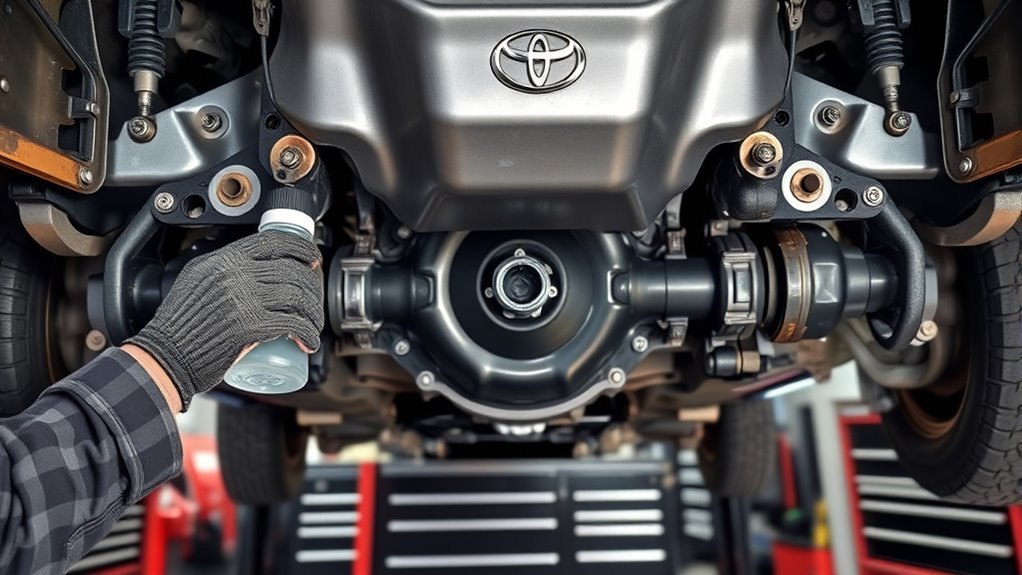
By: Ryker Calloway · Last updated: July 31, 2026
Affiliate disclosure: We may earn a commission from qualifying purchases made through links on this page, at no extra cost to you. A product link or retailer fitment tool does not replace the fluid specification in your exact Toyota owner’s manual.
Most 2007-2026 U.S.-market Toyota Tundras use Toyota Genuine Differential Gear Oil LT SAE 75W-85 API GL-5 or an equivalent that meets Toyota’s specification. Many 2000-2006 Tundras use different grades for the front differential, standard rear differential, and mechanical limited-slip rear, so early trucks must be checked by exact model year and axle type.
For example, Toyota’s 2003 manual lists SAE 75W-90 for the front differential, synthetic SAE 75W-140 for the standard rear differential, and temperature-dependent grades for the mechanical limited-slip rear. Toyota’s redesigned 2007 Tundra documentation lists SAE 75W-85 API GL-5 differential oil or an equivalent.
Quick Answer
Use the viscosity and API classification in the owner’s manual for your exact Tundra, axle, market, and production date. Do not apply one oil to every model year. Also, Toyota’s electronic Auto LSD function does not prove that the axle contains a mechanical limited-slip unit or requires friction modifier.
What’s in This Article
- Toyota Tundra Differential Oil Quick Answer by Year
- Tundra Model-Year Guide: Why One Viscosity Does Not Fit Every Truck
- How to Tell Which Differential You Have
- What Labels and Specifications to Require
- Does Driving Condition Change the Required Oil?
- How to Change Tundra Differential Fluid
- Maintenance Intervals and Warning Signs
- Frequently Asked Questions
Key Takeaways
- Most U.S.-market 2007-2026 Tundras specify SAE 75W-85 API GL-5 differential oil or an equivalent that meets Toyota’s requirements.
- Many 2000-2006 Tundras use different front, standard-rear, and mechanical-LSD grades.
- Check the exact model year, production date, axle position, market, and differential type before buying oil.
- An AUTO LSD button identifies a brake-based traction feature, not necessarily a mechanical limited-slip axle.
- Driving conditions usually change the inspection or replacement interval before they change the required viscosity.
- Remove the fill plug before the drain plug so you know the axle can be refilled.
How this guide was checked: We compared Toyota’s 2003 owner’s manual, Toyota’s 2007 Tundra manual repository, representative later second-generation documentation, Toyota instructions for 2022-and-newer Tundras, and model-year maintenance guides. This article uses U.S.-market documentation. The manual supplied with the exact truck remains the final authority.
Toyota Tundra Differential Oil Quick Answer by Year
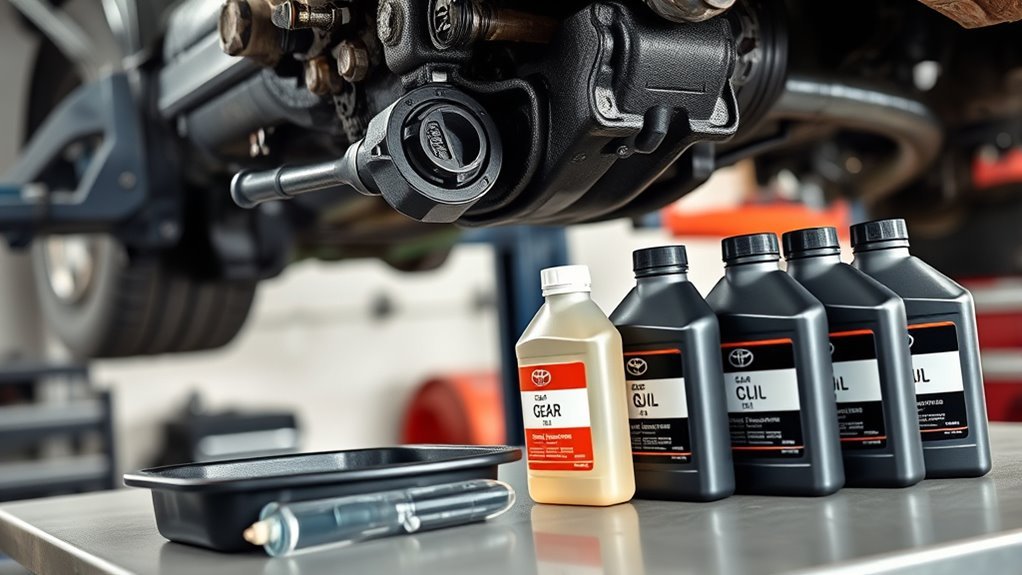
Use the following table to narrow your search, not as permission to skip the owner’s manual. Toyota changed axle designs and fluid specifications during the Tundra’s production history. Trucks built for markets outside the United States may also use different recommendations.
| Tundra years | What checked Toyota documentation shows | What to confirm before buying |
|---|---|---|
| 2000-2006 | No generation-wide viscosity should be assumed. A representative 2003 manual lists front SAE 75W-90, standard rear synthetic SAE 75W-140, and temperature-dependent oil for the mechanical limited-slip rear. | Exact year, production date, front or rear axle, 2WD or 4WD, mechanical limited-slip equipment, and ambient-temperature instructions |
| 2007-2021 | Representative Toyota manuals throughout this range list Toyota Differential Gear Oil LT SAE 75W-85 API GL-5 or an equivalent for the differentials. | Exact model-year manual, front and rear capacities, drivetrain and axle equipment, and the separate Toyota Tundra transfer-case fluid specification |
| 2022 and newer | Toyota documentation commonly specifies SAE 75W-85 API GL-5 differential oil or an equivalent. Fill quantity varies by powertrain, axle position, and locker configuration. | Gas or hybrid powertrain, front or rear axle, electronic-locker equipment, exact capacity, and fill-level procedure |
[Products Worth Considering]
These custom-fit all-weather floor mats are designed for compatible Hyundai Sonata and Kia K5 models to help protect your vehicle's interior from mud, slush, dirt, and spills. Made from odorless, durable rubber with a deep hexagon pattern, they offer reliable anti-slip coverage and are easy to remove and clean with water or a damp towel. The set is built for long-lasting use in every season and helps keep your car looking clean while supporting resale value.

This portable roadside emergency car kit helps drivers stay prepared with essential tools for common breakdowns and unexpected roadside situations. It includes jumper cables, a tow strap, a flashlight, a rain poncho, gloves, and a first aid kit, all stored in a durable zippered case for easy access and organization. With included roadside assistance coverage, it adds extra peace of mind for commuters, new drivers, and road trips.

This dual dash cam captures detailed road footage with front and rear recording for added driving security. Built-in WiFi and app control make it easy to review, download, and manage videos from your phone, while the IPS screen provides clear on-device viewing. With loop recording, G-sensor protection, parking mode, and WDR support, it is designed to help document incidents day or night.
Verified Manual Checkpoints
The following checkpoints show why the article separates early trucks from 2007-and-newer models:
| Toyota source checked | Specification established | Practical meaning |
|---|---|---|
| 2003 Tundra Owner’s Manual | Front 75W-90; standard rear synthetic 75W-140; mechanical-LSD rear uses temperature-dependent grades | Do not assign one viscosity to every first-generation axle. |
| 2007 Tundra Manuals and Warranties | The redesigned 2007 Tundra documentation lists Toyota Differential Gear Oil LT SAE 75W-85 API GL-5 or equivalent. | The 2007 model belongs with the later 75W-85 group, not the first-generation viscosity split. |
| 2021 Tundra Manuals and Warranties | Later second-generation documentation continues to specify 75W-85 API GL-5 or equivalent. | Match the viscosity and API category, then confirm configuration-specific capacity. |
| Toyota 2022+ Tundra Service Instructions | Toyota Differential Gear Oil LT 75W-85 GL-5 or equivalent; later-model front fill level 0-5 mm below the lower lip of the filler opening | Use the listed capacity to buy fluid and the model-specific level procedure to finish the fill. |
Follow this four-check sequence before selecting a bottle:
- Identify the model year, market, and production date.
- Confirm whether you are servicing the front or rear differential.
- Determine whether the axle is open, mechanical limited-slip, electronically locked, or supported by brake-based traction control.
- Match the Toyota-listed viscosity, API classification, and any limited-slip requirement.
Do not treat 75W-90 API GL-5 as a universal substitute for 75W-85, 75W-140, SAE 90, or another Toyota-listed grade. Matching the API category does not make different viscosities interchangeable.
Tundra Model-Year Guide: Why One Viscosity Does Not Fit Every Truck
Tundra specifications can change by year, axle location, differential type, market, and production date. An early truck may also require one oil in the front differential and another in the rear.
[Products Worth Considering]

Designed for Toyota Avalon models from 1995 to 1997, this front ceramic brake pads kit delivers dependable stopping power with a quiet, smooth braking feel. The ceramic construction helps reduce brake dust for cleaner wheels while supporting consistent performance and easier maintenance. Built to fit properly with compatible rotors, it offers a practical replacement solution for everyday driving.

This brake caliper hanger set helps hold calipers securely during brake pad changes and other suspension or axle work, making brake service safer and more convenient. Built from durable steel with rust-resistant coating, it features rubber tips to help prevent scratches and protect brake hoses and surrounding components. Brightly colored and easy to spot, it is a practical mechanic tool for keeping calipers supported while you work.
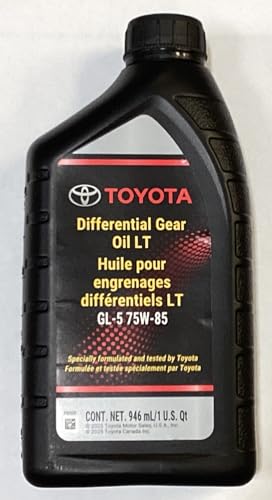
GENUINE OEM: Toyota factory-approved differential gear oil designed specifically for Toyota vehicles, ensuring optimal performance and protection
Why First-Generation Tundra Oils Vary
Do not summarize every 2000-2006 Tundra as an 80W-90 application. In Toyota’s 2003 manual, the front differential uses SAE 75W-90, while the standard rear calls for synthetic SAE 75W-140.
The same manual gives the mechanical limited-slip rear a temperature-dependent recommendation: SAE 90 above 0°F (-18°C) and SAE 80W or 80W-90 below 0°F (-18°C). The example shows why axle type and temperature instructions matter as much as model year.
Another first-generation year, market, or axle may have a different specification. Open the correct manual rather than extending the 2003 example to every early truck.
Why 2007 and Newer Tundras Commonly Use 75W-85 GL-5
The redesigned 2007 Tundra and representative later second-generation Toyota manuals specify Toyota Differential Gear Oil LT SAE 75W-85 API GL-5 or an equivalent for the differentials.
Third-generation Tundras also commonly use 75W-85 API GL-5 differential oil. However, front and rear quantities differ by powertrain, axle position, and electronic-locker equipment. Confirm both viscosity and capacity in the exact manual or Toyota repair information.
- Use the model-year manual rather than a generation-only compatibility list.
- Check the front differential and rear differential separately.
- Do not assume the transfer case uses differential oil.
- Keep the bottle label and receipt with your maintenance record.
Can You Use 75W-90 Instead of 75W-85?
Use 75W-90 instead of 75W-85 only when Toyota documentation or the lubricant manufacturer’s application data explicitly approves the product for your exact year and axle. A generic API GL-5 claim or anecdotal success in another truck is not application approval.
Some owners choose 75W-90 because it is widely available, but owner experience does not override Toyota’s listed grade. Stay with 75W-85 when that is the only approved viscosity you can document.
Does Toyota Auto LSD Need Friction Modifier?
Usually, no. Toyota’s Auto LSD function is a traction-control feature that uses engine control and braking to reduce drive-wheel spin. An AUTO LSD button does not prove that the rear axle contains mechanical limited-slip clutch packs.
A true clutch-type limited-slip differential may require oil with the correct limited-slip friction properties or a specified additive. Use the axle identification and owner’s manual to make that decision.
Do not add friction modifier to an open differential, electronic locker, or brake-based Auto LSD system unless Toyota or the installed differential manufacturer specifically requires it. Excess additive can change the behavior of a mechanical limited-slip unit.
Note: A dashboard label, trim name, or off-road package does not replace axle identification. Check the manual, build information, axle markings, or a Toyota VIN-based parts lookup.
How to Tell Which Differential You Have
Start with documentation rather than driving behavior. Check the owner’s manual, door-jamb build label, differential housing, factory build information, and any locker controls inside the cab.
If those sources do not identify the axle clearly, ask a Toyota parts department to check the VIN. Remember that a previous owner may have installed an aftermarket differential or locker that will not appear in the original build record.
Visual Inspection of the Axle
Look for stamped codes, tags, lubricant warnings, wiring, and actuator housings on or near the differential. A factory electronic locker commonly has an actuator and wiring, while an open differential may have fewer external clues.
- Check the driver’s door jamb for build and axle information.
- Inspect the differential housing for tags or lubricant labels.
- Look for a factory locker switch and axle-mounted actuator.
- Check service records for a previous differential or locker replacement.
- Ask Toyota to decode unclear factory information by VIN.
VIN and Build Codes
The VIN can help Toyota identify the truck’s original drivetrain equipment. Build-code formats vary by year and market, so do not rely on an unsourced generic chart.
A VIN lookup cannot identify every aftermarket change. If the housing, actuator, or service history conflicts with the original build information, have a qualified drivetrain shop inspect the axle before selecting a limited-slip additive.
Why a Road Test Cannot Confirm the Oil Specification
Wheelspin, tight-turn behavior, and traction on loose ground are not reliable fluid-identification tests. Brake-based traction control, tire grip, electronic lockers, worn clutch packs, and aftermarket parts can produce similar symptoms.
Use road behavior to identify a possible fault, not to select the oil. Chatter after a fluid change may point to an incorrect mechanical-LSD lubricant, but it can also indicate wear, contamination, or another drivetrain problem.
Warning: Do not perform wheelspin tests on public roads or run the drivetrain while the truck is lifted without professional equipment and procedures.
What Labels and Specifications to Require
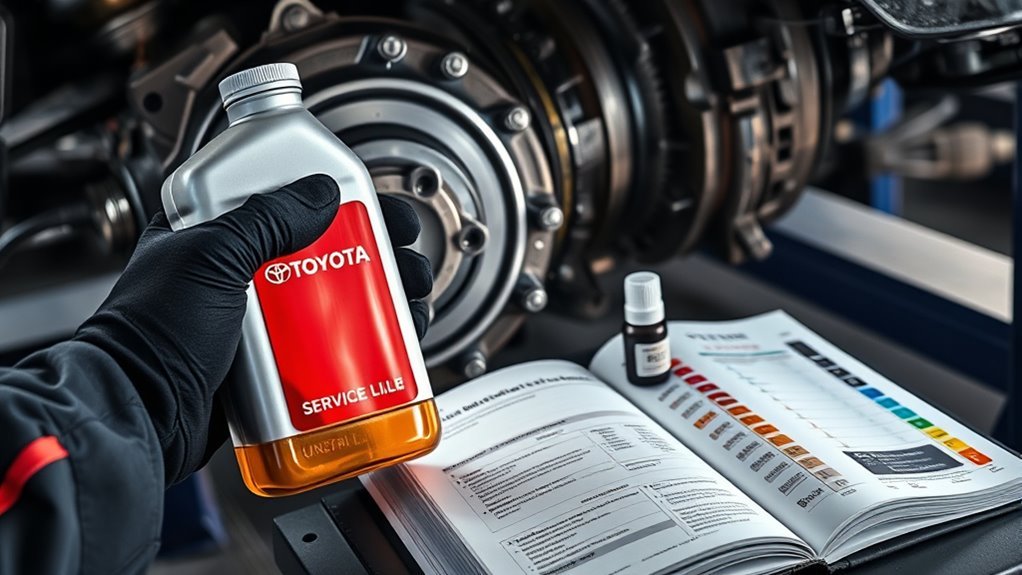
Tundra differentials use hypoid gearing, which places high sliding and contact loads on the gear teeth. When Toyota specifies API GL-5, buy an axle lubricant that clearly carries that classification.
Match all applicable label items before buying:
- API classification: Use API GL-5 when the Toyota manual lists GL-5.
- SAE viscosity: Match the exact 75W-85, 75W-90, 75W-140, SAE 90, 80W-90, or other grade listed for that axle.
- Limited-slip compatibility: Require this only when the axle has a mechanical limited-slip unit that needs it.
- Application approval: Check whether the oil maker lists the exact Tundra year and axle when considering a substitute.
A bottle marked “limited-slip ready” does not override the required viscosity. Likewise, the correct viscosity without the required API classification is not a complete match.
Do not use engine oil, motorcycle engine oil, automatic transmission fluid, or transfer-case fluid in a differential unless the exact Toyota documentation specifically identifies that fluid for the axle.
[Products Worth Considering]

FlexFill squeezable pouch releases 2X more fluid with less effort for 3X faster filling vs. traditional bottle packaging

High-performance additives deliver 1.5X better gear wear protection

Extreme pressure additives deliver outstanding high pressure performance, load carrying capacity and durability for towing and hauling
How Much Differential Oil Does a Tundra Take?
There is no universal Tundra differential-fluid capacity. The amount can change with generation, engine, cab, bed or wheelbase, front or rear axle, 2WD or 4WD, gas or hybrid powertrain, and locker configuration.
Find the amount in the owner’s manual or Toyota repair information using the exact vehicle and axle configuration. Purchase enough fluid to cover the listed capacity, but use Toyota’s fill-level procedure as the final control rather than forcing the entire purchased amount into the housing.
Does Driving Condition Change the Required Differential Oil?
Driving conditions normally change how often you inspect or replace the oil. They do not automatically authorize a different viscosity.
| Driving condition | What may change | What normally stays fixed |
|---|---|---|
| Daily road driving | Inspection and replacement follow the normal model-year schedule. | The Toyota-listed viscosity and API classification |
| Towing or heavy hauling | The maintenance guide may require earlier inspection or replacement under special operating conditions. | The specified oil grade unless Toyota or the installed differential manufacturer approves another one |
| Cold weather | A temperature-dependent manual recommendation may apply on some older mechanical-LSD axles. | The exact model-year manual remains the authority. |
| Off-road or water exposure | Inspect sooner and replace contaminated or milky fluid promptly. | The required viscosity and performance category |
| Aftermarket locker or differential | The component manufacturer may specify its own lubricant, additive, or break-in procedure. | Do not assume the original Toyota axle instructions still apply unchanged. |
When an aftermarket carrier or complete axle has been installed, follow the component maker’s current lubricant and break-in instructions unless the installer documents another approved requirement.
Does Towing Require Thicker Differential Oil?
No, towing does not automatically require thicker differential oil. It may place the truck under Toyota’s special operating conditions and shorten the service interval, but it does not by itself authorize 75W-140 or another grade.
Use a different viscosity only when the exact Toyota manual, installed differential manufacturer, or qualified drivetrain documentation approves it.
Pro tip: Photograph the manual specification, axle identification, and bottle label before service. The record shows which viscosity and API classification went into each axle.
How to Change Tundra Differential Fluid
Work on a level surface and let the drivetrain cool enough for safe handling. Wear eye protection and gloves. Use properly rated lifting equipment if the truck must be raised, and keep the vehicle level during filling.
Before You Begin
Confirm the fluid, capacity, washer type, plug tool, fill procedure, and torque specifications before loosening anything. Do not begin the service with only a retailer fitment result.
- The exact Toyota-listed gear oil and enough fluid for the axle
- Limited-slip additive only when the mechanical axle specifically requires it
- The exact socket or hex tool required by the fill and drain plugs
- A fluid pump or suitable squeeze bottle
- A drain pan, rags, gloves, and eye protection
- New sealing washers or gaskets where Toyota requires them
- A torque wrench and the correct model-specific torque values
- Wheel chocks and properly rated support equipment if lifting is required
Warning: Never work beneath a truck supported only by a jack. Keep the truck level so the fill opening can provide an accurate level check.
Step-by-Step Drain and Fill
- Park on level ground, set the parking brake, and chock the wheels.
- Confirm that you have the correct oil, quantity, washers, plug tool, fill procedure, and torque specifications.
- Clean the areas around both plugs so dirt cannot enter the housing.
- Loosen the fill plug first. Do not drain the axle until you know the fill plug can be removed.
- Position the drain pan and remove the drain plug carefully.
- Drain the old oil and inspect its color, odor, and contamination.
- Inspect the magnetic plug for fine paste, sharp flakes, or larger pieces.
- Clean the plug, install the required new washer, and torque the drain plug to Toyota’s specification.
- Fill with the specified oil using Toyota’s model-specific level procedure. As one later-model Toyota example, the specified level is 0-5 mm below the lower edge of the filler opening while the truck is level. Other axles may have different instructions.
- Install the fill plug with the required washer and torque it to the correct specification.
- Clean the housing so a new leak will be easy to identify.
- Recheck the plugs and surrounding seals after a short drive and again after the axle cools when Toyota’s procedure calls for a recheck.
Do not force extra fluid into an axle that has reached the specified level. Overfilling can contribute to foaming, heat, or leakage through the vent and seals.
Maintenance Intervals, Signs of Wear, and Troubleshooting Tips
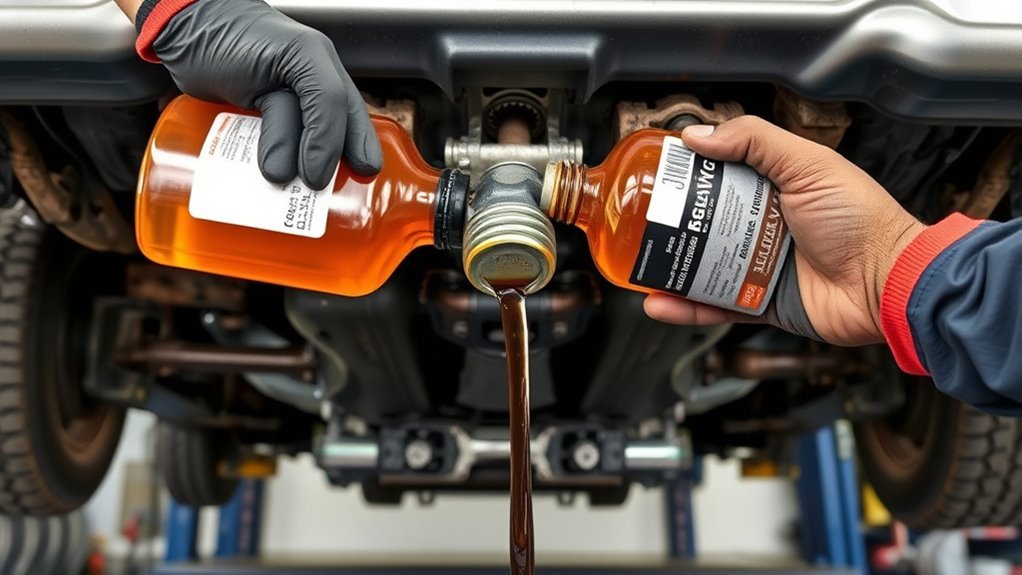
Toyota does not publish one differential-fluid replacement interval for every Tundra. Use the warranty and maintenance guide for the exact model year, drivetrain, and operating conditions.
Normal schedules may list differential oil as an inspection item. Specified towing, heavy loading, dirt-road, dusty-road, or off-road use can trigger earlier replacement under special operating conditions. See the dedicated Toyota Tundra differential-fluid interval guide for the year-specific schedule discussion.
- Inspect the fill level and plug areas at the intervals listed in the Toyota maintenance guide.
- Replace the oil promptly if water contamination makes it milky or foamy.
- Investigate a burnt odor, heavy grit, recurring metal debris, or rapidly darkening oil.
- Check axle seals, pinion seals, plug washers, and the axle vent when leaks appear.
- Diagnose chatter instead of repeatedly adding friction modifier without confirming the axle type.
What Does Metal on the Drain-Plug Magnet Mean?
A thin gray paste can develop as the magnet captures fine wear material. Sharp flakes, chips, chunks, or heavy recurring buildup are more concerning.
Stop treating the service as routine if you find larger metal pieces or hear grinding. A drivetrain shop should inspect the ring gear, pinion, carrier, and bearings before additional driving causes more damage.
When Should a Mechanic Inspect the Differential?
Arrange an inspection if the differential grinds, howls, binds, overheats, leaks actively, or produces large metal fragments. Seek help when a plug is seized or damaged, the axle type remains unclear, or safe lifting exceeds your equipment and experience.
Noise that changes between acceleration, steady throttle, and deceleration can help a technician narrow the cause. Do not assume new oil will repair worn gears or bearings.
Frequently Asked Questions
Can I Use 75W-90 Instead of 75W-85 in a Tundra?
Use 75W-90 instead of 75W-85 only when Toyota documentation or the lubricant manufacturer’s application data explicitly approves the product for your exact year and axle. Matching API GL-5 alone does not make different viscosities interchangeable.
Does Toyota Auto LSD Need Friction Modifier?
Usually, no. Toyota describes Auto LSD as a traction-control function that uses engine control and braking, not as proof of a clutch-type limited-slip differential. Add friction modifier only when the exact axle specification calls for it.
How Much Differential Fluid Does a Tundra Take?
Capacity varies by model year, engine, cab or wheelbase, front or rear axle, drivetrain, powertrain, and locker equipment. Check the exact Toyota manual or repair information, purchase enough oil for that specification, and use the required fill-level procedure as the final check.
How Often Should Tundra Differential Fluid Be Changed?
Follow the warranty and maintenance guide for the exact model year. Normal use may call for inspections, while specified towing, heavy-load, dirt-road, dusty-road, or off-road conditions can require earlier replacement.
Can I Mix Synthetic and Conventional Differential Oils Safely?
Do not mix products as a planned service. For an emergency top-off, follow the lubricant manufacturer’s compatibility guidance and ensure the added oil meets every Toyota-listed viscosity, API, and limited-slip requirement. Drain and refill with one confirmed product when practical.
Are There Warranty Implications for Using Third-Party Gear Oil?
In the United States, federal warranty law generally prevents a warrantor from requiring a named-brand product unless it supplies that product free or has an applicable legal waiver. Coverage can still be denied for damage caused by the wrong oil or improper service, so keep the manual specification, receipt, and bottle-label record.
How Should I Dispose of Used Differential Fluid Responsibly?
Collect used gear oil in a clean, sealed container and take it to a recycling site, auto-parts store, repair shop, or local waste facility that accepts used oil. Do not pour it onto the ground, into a drain, or into household trash.
Safety Disclaimer: This article is for informational purposes only and does not replace Toyota service information or professional mechanical advice. Use properly rated lifting equipment and consult a qualified mechanic when the axle specification, fill procedure, or repair condition is unclear.
Conclusion
Select Toyota Tundra differential oil by the exact axle, not by a one-size-fits-all rule. Many 2000-2006 trucks can have different front, standard-rear, and mechanical-LSD requirements. Most U.S.-market 2007-and-newer Tundras commonly specify 75W-85 API GL-5, but the exact manual still controls.
Before buying, open the exact manual, identify the front or rear axle, confirm whether the rear is mechanical limited-slip or electronically controlled, record the required viscosity and API classification, and buy enough fluid for the listed capacity. Use friction modifier only when the identified mechanical differential requires it.
References
- 2003 Toyota Tundra Owner’s Manual – Toyota
- 2007 Toyota Tundra Manuals and Warranties – Toyota
- 2021 Toyota Tundra Manuals and Warranties – Toyota
- 2014 Toyota Tundra Warranty & Maintenance Guide – Toyota
- 2025 Toyota Tundra Warranty & Maintenance Guide – Toyota
- Toyota Tundra and Tundra HV Service Instructions for 2022 and Newer Models – Toyota
- Lubricant Service Designations for Automotive Manual Transmissions, Manual Transaxles, and Axles – American Petroleum Institute
- Managing, Reusing, and Recycling Used Oil – U.S. Environmental Protection Agency
- Businessperson’s Guide to Federal Warranty Law – Federal Trade Commission


[…] Toyota’s maintenance and fluid information is model-year specific. Before buying fluid, open the correct owner’s manual and warranty and maintenance guide for your truck. The Tundra name covers multiple generations, engines, axles, transfer cases, and fluid requirements. This page focuses on service timing; for model-year viscosity and oil-selection details, see the Tundra differential oil guide. […]