Auto Review Nest Editorial Team · Last updated: July 31, 2026 · Reviewed against Toyota, NHTSA, Auto Rust, and Fluid Film source material.
Tacoma frame rust repair should match the amount and location of metal loss. Treat light surface rust only when cleaning exposes firm, full-thickness metal. A localized patch or shaped section repair may work when the complete damaged area can be exposed and solid frame remains around the repair. Full frame replacement, vehicle retirement, or a donor-parts decision is usually more appropriate when corrosion affects several mounts, crossmembers, or long sections of both frame rails.
This guide synthesizes Toyota program documents, NHTSA-hosted bulletins, repair-section limitations, corrosion-product instructions, and documented repair considerations. It does not replace an in-person frame assessment.
Quick Answer
Choose cleaning and rust treatment for surface corrosion with solid metal underneath. Choose a patch or shaped section repair only when corrosion is confined, the full damaged area can be exposed, and sound metal remains around the repair. Choose full frame replacement or retire the truck when corrosion affects multiple structural points, long rail sections, or several suspension and body mounts. Do not drive or tow with the truck if a frame rail is cracked or sagging, a structural bracket is separating, or perforation affects a suspension or steering attachment point.
What’s in This Article
- Should You Patch, Section-Repair, or Replace a Tacoma Frame?
- How to Assess Tacoma Frame Rust Severity
- Before You Decide: Safety Checks You Should Not Skip
- When Is Cleaning and Rust Treatment Enough?
- Safe-T-Cap and Patch Repairs: Pros and Cons
- Section Repair vs. Full Frame Replacement: Which Should You Choose?
- Undercoating Options for Tacoma Frames: Fluid Film and Alternatives
- Tacoma Frame Rust Repair Costs, Lifespan, and Value
- How to Choose a Frame Repair Shop and Maintenance Plan
- Frequently Asked Questions
Key Takeaways
- Surface treatment protects remaining metal but cannot restore thickness already lost to corrosion.
- Visible holes, cracks, separated mounts, sagging, or crumbling metal need a professional full-frame assessment.
- A patch or repair section needs sound attachment metal, correct frame geometry, proper welding, sealed seams, and internal corrosion protection.
- SafeTCap fitment depends on the exact frame, cab, bed, drivetrain, repair location, and whether the frame has been modified.
- The published special-coverage windows for older Toyota Tacoma frame programs have expired, but owners should still check VIN-specific campaign and repair history.
Should You Patch, Section-Repair, or Replace a Tacoma Frame?
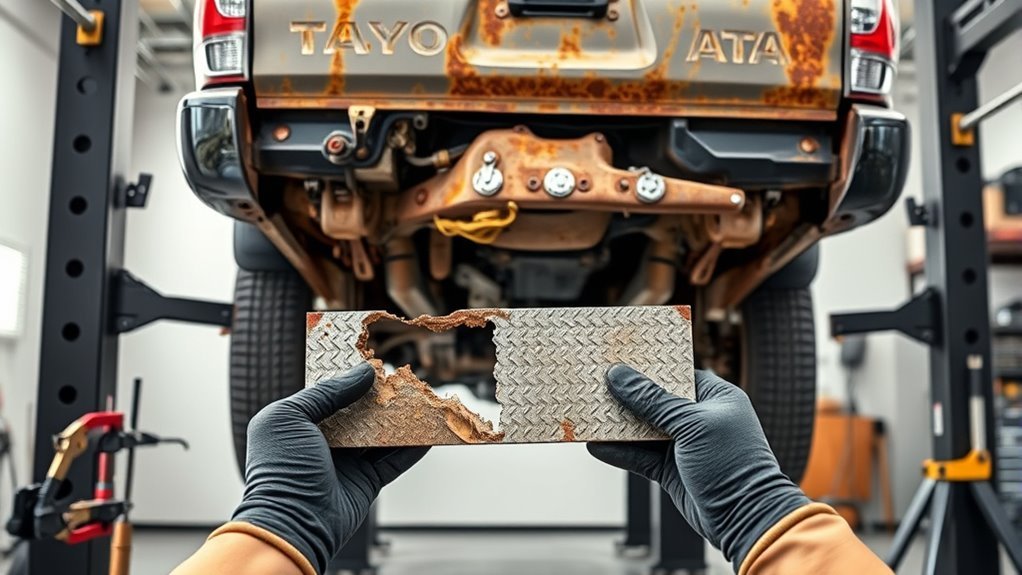
The correct Tacoma frame rust repair depends on whether corrosion is superficial, localized, section-wide, or widespread. It also depends on where the damage sits. A small hole beside a low-load bracket is not the same repair decision as perforation around a control-arm mount, leaf-spring hanger, steering attachment, or major crossmember.
| Frame condition | Typical signs | Usual path | Important limit |
|---|---|---|---|
| Surface corrosion | Discoloration or light scale; cleaned metal remains firm and intact | Clean, dry, treat, coat, and monitor | A rust converter or coating does not replace lost steel |
| Localized perforation | One defined damaged area with sound metal beyond the corrosion boundary | Custom patch or shaped repair section by a frame specialist | The complete repair perimeter must attach to structurally suitable metal |
| Section-level corrosion | A longer known rust zone, possibly including a hanger, mount, or rail transition | Model-specific repair section or fabricated section replacement | Fitment, frame geometry, adjacent rust, and installation instructions must be verified |
| Widespread structural corrosion | Several mounts, crossmembers, or long rail areas are thin, cracked, or perforated | Full frame replacement, vehicle retirement, or donor-parts evaluation | Repeated patches may leave unaddressed weak metal between repairs |
| Unsafe or unknown | Cracked or sagging rail, separating bracket, altered wheel alignment, or damaged brake or fuel lines | Stop heavy use and arrange professional inspection or transport | Do not rely on paint, undercoating, or a thin cover plate |
[Products Worth Considering]

Vehicle Fitment: Mid Rear Frame Section at Bump Stop fit for 1996-2004 Toyota Tacoma Regular Cab, XtraCab, Tacoma 2000-2004 Double Cab, 2WD and 4WD models

Fitment: Rear frame rust repair with spring mount fit for 1996-2004 Toyota Tacoma Reg cab(2 doors), 1996-2004 Xtra cab(2.5 doors), 2000-2004 Double cab(4 doors) 2WD 4WD

Vehicle Fitment: Mid frame repair with spring mount fit for 2000-2004 Toyota Tacoma Double Cab, 2WD and 4WD models, including passenger side and driver side.
What Makes a Tacoma Frame Repairable?
A Tacoma frame is a reasonable candidate for a localized repair only when the shop can expose the full corrosion boundary and establish a sound structural attachment area. Repairability is not determined by hole size alone.
- Defined damage boundary: The shop can clean and expose all thin, scaled, or perforated metal around the proposed repair.
- Suitable attachment metal: The complete weld or attachment perimeter reaches metal that the shop considers structurally suitable.
- Restorable geometry: Frame, suspension, body-mount, and drivetrain reference points can be measured and returned to their intended positions.
- No unaddressed structural corrosion: Other mounts, crossmembers, and rail sections do not contain separate damage that undermines the repair.
- Complete corrosion-control plan: The quote includes preparation, welding, seam protection, accessible internal-cavity treatment, and open drainage paths.
If any of these conditions cannot be met, a full frame replacement or vehicle-retirement decision may be more responsible than another localized patch.
For broader inspection signs, recall history, and documentation steps, see the Tacoma frame rust safety and recall guide.
How to Assess Tacoma Frame Rust Severity
Start with a careful visual inspection of the complete frame, not only the first rust hole you noticed. Focus on skid-plate mounts, drain openings, leaf-spring hangers, crossmembers, control-arm areas, body mounts, transmission crossmember attachments, welded joints, brake-line routes, and fuel-line brackets.
Inspection safety: Never crawl under a Tacoma supported only by a jack. Use correctly rated stands on solid, approved support points, block the wheels, and do not place a stand on rust-weakened metal. Review the Tacoma jack-stand placement guide before lifting the truck.
Visual Rust Inspection
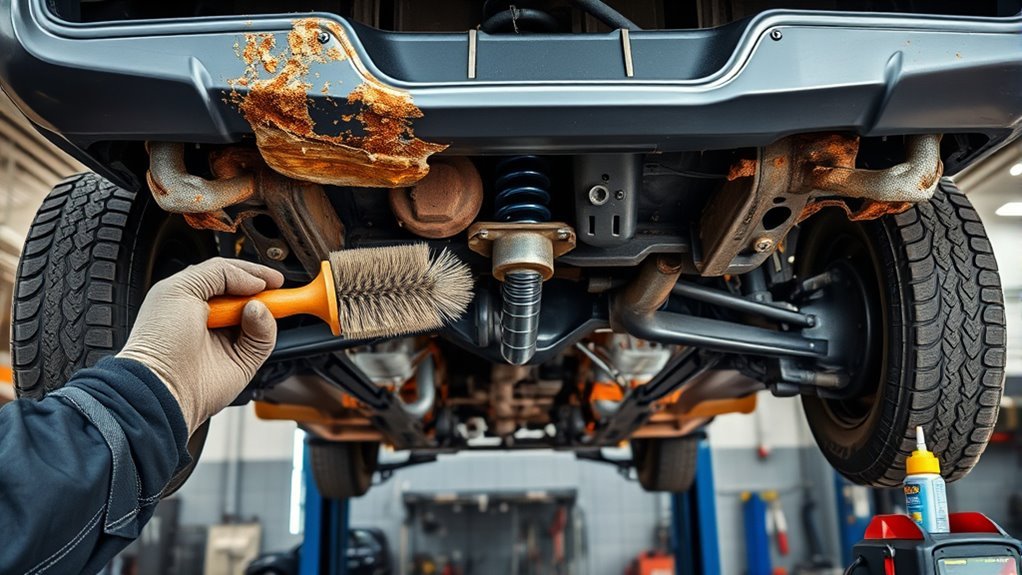
Use bright light, a mirror, gloves, and eye protection. Remove loose dirt with a hand brush where it is safe to do so. Look for bubbling coating, swelling seams, layered scale, wet debris, cracked undercoating, rust trails around fasteners, split welds, uneven brackets, and metal loss around factory openings.
Pay close attention to boxed sections, overlapping plates, crossmember ends, skid-plate contact points, and clogged drains. Corrosion can progress inside a boxed frame before the outer face clearly shows the full damage.
Mark and photograph each suspect area. Include one wide photo showing its location and one close photo showing the corrosion. Dated photos help the shop map the damage and help you monitor treated areas later.
Structural Integrity Check
Visible perforation, a cracked rail, a separating bracket, sagging, or metal that crumbles with light hand pressure is enough to stop a DIY assessment. Do not hammer or aggressively stab a heavily corroded frame while positioned underneath the truck.
A frame specialist may need to remove coating and scale, inspect concealed surfaces, check metal condition around the proposed repair, and measure frame or suspension reference points. A painted surface or solid-looking outer edge does not prove the metal behind it is suitable for welding.
Warning: Do not rely on paint, undercoating, body filler, or a thin cover plate to hide frame perforation near suspension, steering, body, drivetrain, or towing attachment points.
| Item | Action |
|---|---|
| Skid bolts | Inspect and replace if seized or badly rusted |
| Drain openings | Clear debris and confirm water can escape |
| Moisture | Dry accessible cavities and remove trapped debris |
| Coating | Check for cracks, swelling, separation, and hidden scale |
| Structural damage | Ask a frame specialist to inspect the complete frame |
Before You Decide: Safety Checks You Should Not Skip
Frame rust is a safety issue rather than a cosmetic defect. Before approving a repair, ask the shop to inspect both rails, all major crossmembers, suspension and body mounts, steering attachments, brake and fuel lines, hitch attachments, and areas hidden by skid plates or the fuel tank.
Arrange transport instead of driving for inspection if a frame rail is cracked or sagging, a structural bracket is separating, perforation affects a suspension or steering attachment point, or corrosion has damaged a brake or fuel line. Avoid towing, hauling, off-road driving, and hard braking until the condition is assessed.
Check Toyota Frame Program History by VIN
Toyota’s Tacoma frame-corrosion history involves several separate, time-limited programs rather than one open recall covering every rusty truck:
| Model years | Published action | What owners should know now |
|---|---|---|
| Certain 1995–2000 Tacoma | A separate Toyota customer-support program described extended frame-perforation coverage for qualifying trucks. | The published time window has expired. Ask about prior inspection or repurchase history. |
| Certain 2001–2004 Tacoma | Toyota bulletin POL08-04, program ZTH, described 15 years/unlimited mileage from first use for the specified condition, subject to program requirements. | The published time window has expired. A dealer may still be able to confirm prior program status and frame work. |
| Certain 2005–2010 Tacoma | The 2017 ZH6 warranty-enhancement material followed a class-action settlement and provided qualifying inspection, frame replacement, and corrosion-resistant-compound actions. | The bulletin’s published coverage period has elapsed. Check the VIN rather than assuming current coverage. |
Enter the 17-digit VIN in Toyota’s official Safety Recalls and Service Campaigns lookup. Then ask a Toyota dealer to check open actions, past frame inspections, completed corrosion treatment, frame-replacement history, and any VIN-specific notes.
Do not describe an old customer-support program, warranty enhancement, limited service campaign, or class-action remedy as an open recall unless the current VIN lookup or Toyota confirms that status.
When Is Cleaning and Rust Treatment Enough?
Cleaning and treatment may be enough when corrosion is limited to the surface and cleaning exposes intact, firm metal. It is not enough when the frame has perforation, deep section loss, cracked welds, distorted brackets, separated layers, or weakened structural attachments.
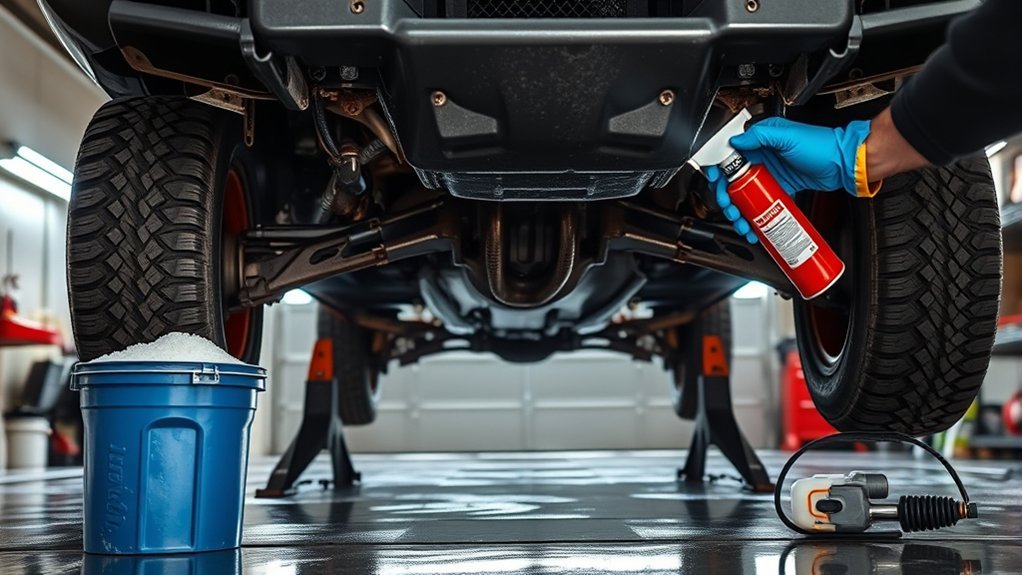
Remove only loose scale and contamination that can be handled safely. Clean the area, dry it completely, and apply a rust inhibitor, converter, encapsulator, primer, or coating only as its manufacturer directs. A chemical treatment may slow corrosion, but it cannot restore steel thickness or structural strength already lost.
Fluid Film states that its lanolin-based automotive product remains soft, migrates into inaccessible areas, and can provide up to a full year of protection. The manufacturer also warns that it may soften some existing undercoatings and may affect non-oil-resistant rubber, so verify compatibility before application.
Recheck treated areas after winter, off-road mud, beach use, or prolonged wet driving. If scale quickly returns, coating lifts, or rust appears along a seam beyond the treated area, have the frame reassessed.
Safe-T-Cap and Patch Repairs: Pros and Cons
Compare a custom patch with a shaped repair section by examining corrosion boundaries, fit, attachment metal, frame geometry, weld access, and long-term corrosion control. The cheapest steel part is not necessarily the lowest total-cost repair.
Structural Integrity Tradeoffs
SafeTCap repair kits are model- and location-specific shaped frame sections. Installation requirements differ by kit. The installer must verify the exact model year, cab, bed, drivetrain, side, repair location, and frame dimensions before ordering or altering a section.
Auto Rust states that its parts are functional repair kits or sections but do not guarantee that a vehicle will be roadworthy. Its standard fit assurance applies to factory-stock frame dimensions, and the company does not guarantee normal fit on modified or altered frames. A lifted, shortened, collision-repaired, off-road-modified, or previously patched frame therefore needs additional fitment assessment.
A custom patch may work for a small, clearly bounded area when the shop removes unsuitable metal and attaches the repair to structurally suitable steel. It may fail early if the repair covers active scale, attaches to thin metal, distorts the frame, blocks drainage, or traps moisture along an unsealed edge.
Cost and Longevity
Do not choose a repair by part price alone. A shaped section can reduce fabrication time in a known rust zone, but access work, fuel-tank removal, seized hardware, damaged lines, geometry correction, and coating may cost more than the section itself.
- Patch repair: Appropriate only for a small, clearly bounded defect with suitable surrounding metal.
- SafeTCap-style repair: Appropriate when an exact kit matches the truck and the full affected section can be prepared and installed as instructed.
- Fabricated section replacement: Appropriate when a larger custom area must be removed and reconstructed by a qualified frame specialist.
- Full frame replacement: Appropriate when corrosion affects multiple structural zones or leaves too little dependable original metal between repairs.
Ask for photos after cleaning and before the new steel hides the attachment area. The documentation should show the exposed corrosion boundary, prepared attachment metal, section fit, weld access, seam treatment, drainage, and accessible cavity protection.
Section Repair vs. Full Frame Replacement: Which Should You Choose?
Choose section repair when corrosion is confined to one or two clearly defined areas, the shop can reach structurally suitable metal around each repair, and the rest of the frame passes a complete inspection. The shop must also be able to preserve or restore the positions of suspension, body, drivetrain, and towing attachment points.
Choose full frame replacement when corrosion affects several mounts or crossmembers, appears along long rail sections, exists on both sides in multiple zones, or leaves questionable metal between proposed repairs. Replacement may also be more sensible when prior patches hide the original frame condition or when another localized repair would only move the next failure point.
Full frame replacement requires extensive disassembly and can expose additional needs such as brake lines, fuel lines, tank straps, body mounts, suspension hardware, steering components, wiring clips, exhaust fasteners, and alignment work. Parts availability and the condition of the rest of the truck may determine whether the project is economically reasonable.
[Products Worth Considering]

EXACT VEHICLE COMPATIBILITY:Compatible with For Toyota Tacoma 2005 2006 2007 2008 2009 2010 2011 2012 2013 2014 2015.

Fitment: Front frame repair fit for toyota tacoma 2005-2015 2nd Gen Double Cab and Access Cab

Perfect Fit: Mid frame rust repair with spring mount fit for 1996-2004 Toyota Tacoma XtraCab, 2WD and 4WD models, including passenger side and driver side and spring mount
Questions the Shop Should Answer
- Where does every rusted zone begin and end?
- What metal will the repair attach to, and how was that area assessed?
- Will any suspension, body, steering, drivetrain, hitch, or crossmember reference point be removed or repositioned?
- How will the shop verify frame dimensions and alignment after the repair?
- How will welds, seams, internal cavities, and drainage openings be protected?
- What additional work may be required after teardown?
Undercoating Options for Tacoma Frames: Fluid Film and Alternatives
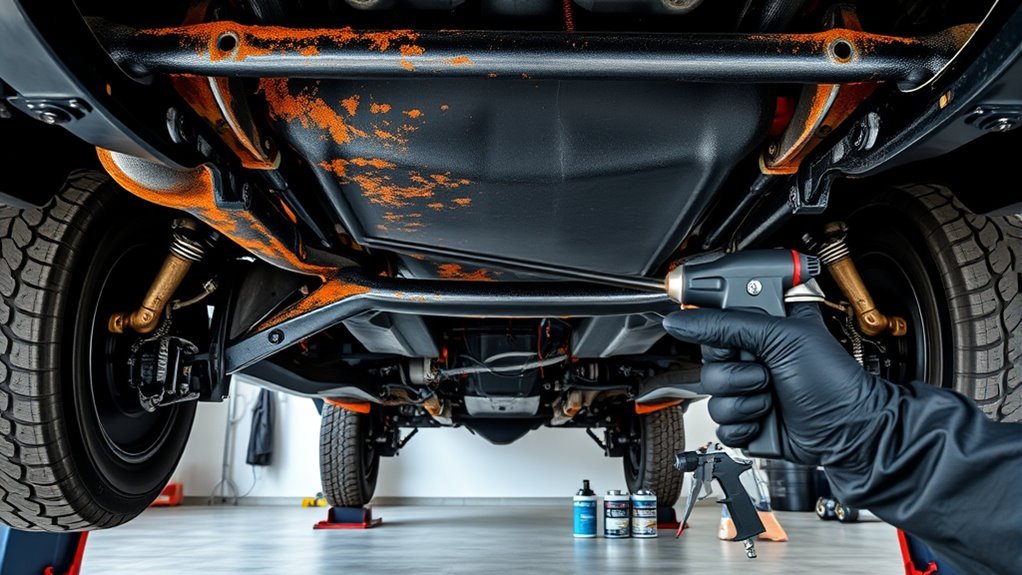
After a frame repair, corrosion protection should cover prepared exterior surfaces, repaired seams, accessible overlap areas, and reachable internal cavities. It should not block factory drainage openings or hide untreated scale.
Oil-, wax-, and lanolin-based products can creep into seams and are easier to inspect and renew. Hard or paint-like coatings can protect well-prepared exposed surfaces, but they need clean, dry, compatible material underneath. A hard film placed over wet debris or active scale can conceal continuing corrosion.
Undercoating protects prepared metal. It does not make perforated, cracked, or structurally thin steel sound again.
- Use a compatible creeping coating where seam and cavity penetration are needed.
- Use a hard coating only after suitable preparation and drying.
- Keep frame drains and weep openings clear.
- Do not coat brake friction surfaces, tire tread, hot exhaust parts, belts, or components excluded by the product instructions.
- Wash salt and mud from the Tacoma underbody before residue remains in frame pockets.
Pro tip: Ask the shop which internal frame areas it can access, which product it will use there, and how often the coating should be inspected or renewed.
[Products Worth Considering]

FLUID FILM BLACK offer powerful corrosion protection for all metals and superior lubrication for moving parts. The long lasting thixotropic liquids and gels is aptly used in the highly corrosive marine environment and vehicle undercoating in the automotive and snow handling industries

Rust and Corrosion Prevention

Fluid Film Kit - Includes Fluid Film 11.75 ounce Spray Bottles-6-pack with Spray Can Extension Wand
Tacoma Frame Rust Repair Costs, Lifespan, and Value
Tacoma frame rust repair costs vary with location, labor rate, access, frame condition, parts availability, prior modifications, and the amount of related hardware that survives disassembly. A useful estimate separates every major cost instead of quoting one unexplained total.
What a Complete Frame-Repair Estimate Should Include
- Diagnosis and cleaning: Removal of enough coating, scale, skid plates, or debris to map the damage.
- Access and teardown: Bed, fuel tank, exhaust, suspension, crossmember, body-mount, or drivetrain access where required.
- Repair material: Model-specific section, fabricated steel, brackets, crossmembers, mounts, and hardware.
- Structural work: Cutting, fitting, welding, geometry control, and any approved reinforcement.
- Related systems: Brake lines, fuel lines, wiring clips, tank straps, suspension hardware, seized fasteners, and damaged mounts.
- Corrosion protection: Surface preparation, primer or coating, seam protection, accessible cavity treatment, and drain clearing.
- Completion checks: Frame measurements, wheel alignment where applicable, road test, fastener checks, and follow-up inspection.
- Transport and downtime: Towing, storage, parts delays, and alternate transportation.
Compare the complete repair cost with the truck’s mechanical condition, body condition, service history, intended use, and realistic remaining life. A documented section repair may make sense on an otherwise sound truck. A frame replacement may not make sense when the engine, transmission, body, brake system, and suspension also need major work.
- Lowest-cost path: Cleaning, treatment, and coating for verified surface corrosion.
- Middle path: Properly assessed patch or section repair for confined damage.
- Highest-cost path: Full frame replacement with extensive teardown and related-component work.
- Best value: The option that addresses every structural weakness rather than hiding the first visible hole.
Keep the written inspection, rust map, repair estimate, photographs, alignment information, invoices, part records, and coating history. Documentation helps future technicians and buyers understand exactly what was done.
How to Choose a Frame Repair Shop and Maintenance Plan
Choose a shop that regularly assesses and repairs truck frames. General welding ability alone does not establish that the shop can evaluate load paths, frame geometry, suspension attachment points, hidden corrosion, or model-specific repair-section fitment.
Ask for a written estimate that separates diagnosis, teardown, steel or repair sections, structural labor, related parts, corrosion protection, alignment or geometry checks, and possible added work after hidden areas are opened.
Frame-Repair Shop Checklist
- Has the shop repaired the same Tacoma generation and frame area before?
- Will it inspect and document both rails and all major mounts before quoting the final method?
- Will it confirm exact repair-section fitment before cutting or modifying a kit?
- Will it photograph prepared attachment metal before installing the repair?
- How will it control and verify frame, suspension, and mount positions?
- What coating will it use on exterior steel, welds, seams, and accessible cavities?
- Will it inspect nearby brake lines, fuel lines, wiring, tank straps, and hardware?
- Does the written workmanship warranty explain what is and is not covered?
Post-Repair Acceptance Checklist
Before collecting the truck, ask for the following records:
- A rust map or written description of every inspected frame area.
- Photos before cleaning, after weak metal was exposed, during fitment, and after completion.
- The repair-section name or part information, where applicable.
- A description of geometry or alignment checks performed.
- Confirmation that brake lines, fuel lines, wiring, mounts, and adjacent hardware were checked.
- The exterior, seam, and cavity-protection products used.
- The recommended date or mileage for the first follow-up inspection.
After repair, wash the underbody after salt and mud exposure, keep drains clear, inspect the frame at least yearly, and inspect more often in salt-heavy, coastal, wet, beach, or off-road use. Renew protective coatings according to product condition and manufacturer directions rather than relying only on the calendar.
Frequently Asked Questions
What is the Toyota frame rust lawsuit?
The Toyota Tacoma frame-rust lawsuit usually refers to the class-action settlement approved in 2017 for certain 2005–2010 Tacoma vehicles. Separate Toyota customer-support and warranty-enhancement programs addressed certain 1995–2000 and 2001–2004 Tacomas. Each program had its own eligibility requirements and time limits.
Does Toyota still replace Tacoma frames under the old programs?
The published special-coverage windows for the older Tacoma frame-corrosion programs have expired. Do not assume that an old settlement or bulletin provides current replacement coverage. Enter the VIN in Toyota’s recall and service-campaign lookup and ask a dealer to check open actions, prior inspections, corrosion treatment, and completed frame-replacement history.
Can a rusted-through truck frame be repaired?
Some rusted-through areas can be repaired when the full corrosion boundary can be exposed, structurally suitable metal remains around the repair, frame geometry can be preserved or restored, and no other unaddressed structural corrosion undermines the work. Widespread damage may require full frame replacement or vehicle retirement.
How do I know whether a Tacoma frame can be patched?
A frame specialist must determine whether corrosion is truly localized and whether the complete repair perimeter can attach to suitable metal. Hole size alone is not enough. The shop should also inspect the rest of the frame, measure affected reference points, and document how it will protect the finished repair.
Is it safe to drive a Tacoma with frame rust?
Light surface corrosion does not automatically make a Tacoma unsafe. Do not continue normal driving, towing, hauling, or off-road use when a rail is cracked or sagging, a structural bracket is separating, metal is perforated around a suspension or steering attachment, or corrosion has damaged brake or fuel lines. Arrange professional inspection or transport.
Does undercoating stop existing frame rust?
Undercoating can protect properly prepared metal and slow future corrosion, but it cannot restore metal thickness or structural strength. Do not use it to cover active scale, holes, wet debris, cracked welds, or weak mounts.
How often should you inspect a Tacoma frame?
Inspect the frame at least once a year in mild, dry use. Inspect it more often when the truck is exposed to road salt, coastal air, beaches, frequent rain, mud, or off-road debris. Recheck repaired areas and coatings after harsh use and at the interval recommended by the repair shop or coating manufacturer.
Safety Disclaimer
Safety Disclaimer: This article is for informational purposes only and does not replace a professional frame inspection. Always consult a qualified automotive frame or collision-repair technician before driving, towing, lifting, welding, modifying, or repairing a vehicle with suspected structural corrosion.
Conclusion
The best Tacoma frame rust repair is the method that addresses all structurally weak metal, not merely the first visible hole. Treat verified surface corrosion early. Consider a patch or shaped section only when the damage is fully bounded, suitable attachment metal remains, geometry can be controlled, and the rest of the frame passes inspection. Choose full replacement or retire the truck when corrosion is widespread or leaves too little dependable original structure.
Before spending money, stop heavy use when structural damage is suspected, obtain a complete written frame assessment, check Toyota history by VIN, and compare itemized repair estimates. Afterward, preserve the documentation and inspect the repaired frame and protective coating regularly.
References
- SafeTCap® Kits and Product Liability Disclaimer — Auto Rust Technicians, accessed 2026
- Auto Rust Technicians and SafeTCap® Frame Repair Information — Auto Rust Technicians, accessed 2026
- Automotive Applications and Compatibility Warnings — Fluid Film, accessed 2026
- Warranty Enhancement Program ZH6: Certain 2005–2010 Model Year Tacoma Frame Corrosion — Toyota document via NHTSA, 2017
- Warranty Enhancement ZTH: Certain 2001–2004 Model Year Tacoma Frame Rust Corrosion Perforation — Toyota document via NHTSA, revised 2016
- Customer Support Program for Certain 1995–2000 Model Year Tacoma Trucks — Toyota Customer Services document, 2008
- Safety Recalls and Service Campaigns Lookup — Toyota