
If you own a Toyota Supra, especially a JDM model, managing US registration and emissions compliance can be tricky. You’ll need to convert your ECU to US specs and install a mass airflow sensor to meet emissions standards. States vary in their requirements, so it’s vital to know the specific rules where you live. Additionally, many owners turn to collector classifications for potential exemptions. Stick around to uncover more essential tips and resources for successfully changing your Supra.
Understanding Emissions Regulations for Your Toyota Supra

When you’re managing the emissions regulations for your Toyota Supra, understanding the specifics can save you a lot of headaches. The 1996 JDM Supra uses the J-OBD protocol, which complicates compliance with US emissions standards. To pass emissions testing, you’ll need a US spec ECU conversion that includes a mass airflow sensor, replacing the JDM’s manifold absolute pressure sensor. Additionally, the lack of an EGR system can elevate NOX levels, risking failures in states like Arizona. However, some states offer collector or historic vehicle registration that can exempt qualifying cars from emissions tests; collector insurance alone does not grant an exemption. Staying informed about local regulations is essential, as compliance benefits can greatly ease your registration process and keep your Supra on the road.
Challenges for JDM Supras in Emissions Compliance
Steering through emissions compliance for your JDM Supra can be a real challenge. You’ll need to contemplate converting to a U.S. spec ECU and integrating a mass airflow sensor, as the original setup just won’t cut it here. Plus, exploring alternative registration strategies might offer some relief from stringent emissions tests, but you must verify local regulations first.
Emissions Testing Difficulties
Although owning a JDM Supra can be a thrilling experience, emissions testing often presents significant hurdles for enthusiasts looking to register their vehicles in the U.S. The 1996 model’s lack of OBD-II complicates compliance, requiring a conversion to a U.S. spec ECU. This means integrating a MAFS instead of the JDM’s MAP, which can be intimidating for many. Without an EGR system, NOX levels spike, increasing the likelihood of failing tests, especially in states like Arizona. While performance upgrades and aftermarket parts may enhance your car, they can also introduce legal implications. Exploring DIY solutions, engine swaps, and exhaust modifications can improve fuel efficiency, but it’s crucial to navigate these challenges carefully to guarantee a successful registration process.
ECU Conversion Requirements
Converting the ECU of a JDM Toyota Supra can feel overwhelming, especially when tackling emissions compliance. You’ll face several challenges that can complicate the process:
- ECU Compatibility Issues: The JDM Supra relies on J-OBD, while U.S. models use OBD-II, requiring a significant switch.
- Sensor Integration Challenges: U.S. ECUs require a Mass Airflow Sensor (MAFS), but JDM models use a Manifold Absolute Pressure (MAP) sensor.
- EGR System Absence: JDM Supras lack an Exhaust Gas Recirculation system, impacting NOx emissions and increasing test failure risks.
- Configuration Precision: Properly configuring converted components is essential to prevent triggering error codes during testing.
Staying informed and prepared can make this conversion a liberating experience.
Alternative Registration Strategies
When considering alternative registration strategies for JDM Supras facing emissions compliance challenges, you’ll find that options like collector or historic vehicle registration can offer a practical solution. In some states, that registration class exempts qualifying older vehicles from routine emissions testing, usually with mileage or use limits. Since JDM Supras often lack the OBD-II protocol and EGR systems, achieving compliance can be a formidable task. A collector registration, where available, can provide a legal pathway around some of these hurdles. Additionally, community forums are valuable resources. They share DIY modifications and successful strategies, helping you navigate the complexities of emissions compliance. Embracing these alternative methods can liberate you from stringent regulations, allowing you to keep your Supra on the road.
How to Convert Your JDM Supra for OBD-II Compliance
To convert your JDM Supra for OBD-II compliance, you’ll need to make essential modifications, starting with swapping in a US-spec ECU. This involves integrating a mass airflow sensor and addressing emissions system requirements to pass state testing, especially if you’re in areas with strict NOX regulations. Be prepared for common challenges, as improper configurations can trigger error codes and complicate the conversion process.
Required ECU Modifications
If you own a 1996 JDM Supra and want to bring it up to OBD-II compliance, understanding the necessary ECU modifications is essential. Follow these steps for successful ECU tuning and sensor calibration:
- Install a US-spec ECU: This is vital, as the JDM ECU uses the J-OBD protocol and lacks the OBD-II plug.
- Add a Mass Air Flow Sensor (MAFS): Replace the JDM MAP sensor to meet US standards.
- Integrate an Exhaust Gas Recirculation (EGR) system: This addresses NOx emissions, which your JDM model may lack.
- Ensure proper configurations: Misconfigurations can trigger error codes during emissions testing.
These modifications will help you navigate the compliance process more smoothly and legally.
Emissions System Integration
Converting your JDM Supra for OBD-II compliance involves several critical steps that guarantee your vehicle meets emissions standards. Start by integrating a US-spec ECU, which requires sensor compatibility, as your JDM model uses a MAP sensor instead of the needed MAFS. You’ll also need to install an EGR system to lower NOx levels, often a roadblock in testing procedures. Proper wiring harness configuration and ECU tuning is essential to prevent error codes that can undermine emissions performance. Consider aftermarket solutions to enhance compatibility. Engaging with communities like Supra Forums can provide insights into successful emissions software and diagnostic tools for a smooth conversion.
| Step | Component Needed | Considerations |
|---|---|---|
| ECU Integration | US-spec ECU | Sensor compatibility |
| Sensor Replacement | Mass Air Flow Sensor | Wiring harness modifications |
| EGR System Installation | Aftermarket EGR options | Testing procedures compliance |
Common Conversion Challenges
While transforming your JDM Supra for OBD-II compliance can be rewarding, it also presents a slew of challenges. To successfully navigate this process, you’ll need to address several key issues:
- Sensor Compatibility: Your JDM engine management uses a MAP sensor; switching to a MAF sensor is essential for the US ECU.
- Wiring Modifications: Integrating a US-spec ECU requires significant electrical rewiring.
- EGR System: The absence of an EGR system in JDM models complicates emissions and may lead to NOx failures.
- Calibration: Properly configuring and calibrating new components is vital to avoid error codes during emissions testing.
State Emissions Testing Requirements
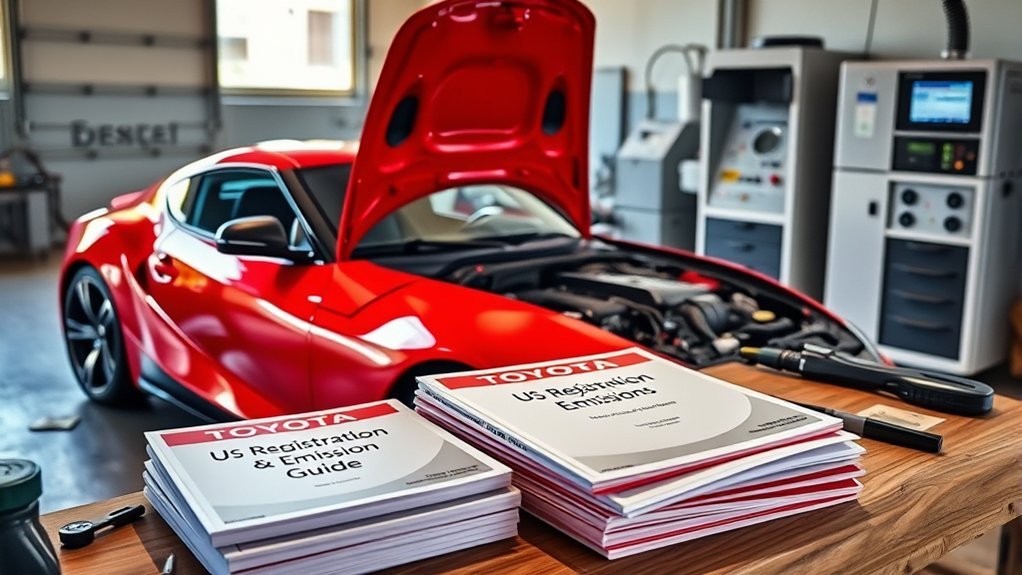
Managing state emissions testing requirements can be a challenging task, especially for JDM Supra owners. Each state has different emissions standards that can complicate registration. For instance, Arizona’s tests are tough due to high NOx levels, while California and New York often check based on vehicle age and engine type. If your JDM Supra lacks OBD-II compliance, you’ll likely need a US spec ECU conversion, which can be costly. However, collector vehicle classifications in some states might exempt you from emissions tests altogether.
Here’s a quick overview of emissions testing by state:
| State | Emissions Testing Requirement |
|---|---|
| Arizona | High NOx standards |
| California | Strict checks by vehicle age |
| Colorado | Engine type assessments |
| New York | Age and engine requirements |
| Texas | Varies; check local laws |
Tips for Successful Registration Across States
When it comes to successfully registering your JDM Toyota Supra across different states, understanding the nuances of local regulations can make all the difference. To streamline your registration process, keep these compliance tips in mind:
- Ensure your ECU is compliant: Convert to a US spec ECU for emissions testing.
- Know your state’s regulations: Familiarize yourself with specific emissions rules, especially in states like Arizona, where high NOx can cause failures.
- Consider collector classification: This may exempt you from emissions in some states.
- Use a physical address: Avoid PO Boxes to reduce scrutiny from ADOT.
Common Emission Issues for JDM Supras and Solutions
Successfully maneuvering the registration process isn’t just about meeting paperwork requirements; it also involves addressing common emission challenges that JDM Toyota Supras face. These vehicles often struggle with OBD-II compliance due to J-OBD systems, requiring a US-spec ECU conversion. Additionally, the MAP sensor instead of a MAFS complicates emissions troubleshooting.
Here’s a quick overview of common issues and solutions:
| Issue | Solution |
|---|---|
| No OBD-II compliance | US-spec ECU conversion |
| High NOX emissions | Install an EGR system |
| MAP sensor incompatibility | Modify ECU settings |
| Emission test failures | Check collector/historic registration rules |
| Error codes during testing | Significant ECU modifications |
Implementing these compliance strategies can help you navigate emissions regulations smoothly.
Community Resources for Supra Owners and Emissions Support
A wealth of community resources is available for Supra owners looking to tackle emissions compliance challenges. Engaging with fellow enthusiasts can greatly ease the process. Here are some key resources you should consider:
- Supra Forums: Join discussions to share successful registration strategies and compliance tips.
- DIY Modification Guides: Access tips on ECU adjustments and emissions equipment alterations.
- State-Specific Regulations: Learn about local laws that affect registration outcomes, ensuring you’re well-informed.
- Troubleshooting Support: Benefit from shared experiences on common issues like NOx levels.
This collective knowledge fosters community support and resource sharing, creating an invaluable network for managing emissions complexities while maintaining your Supra’s performance. Embrace the community; you’re not alone in this journey!
Frequently Asked Questions
What Is the 50K Service on a Supra?
The 50K service on your Supra guarantees peak engine performance through oil and filter changes, spark plug inspections, and brake system checks. Follow these maintenance tips to enhance longevity and maintain that exhilarating driving experience.
What Are the Common Problems With Supras?
Common problems with Supras include engine issues like turbocharger failures and transmission problems, particularly with the stock clutch. Regular maintenance is essential to avoid these pitfalls and keep your Supra performing at its best.
Do Toyota Dealerships Do Emissions Testing?
It depends on the state. In some states, dealerships and repair shops can be licensed inspection stations; in others, testing happens only at state-run or contracted centers. Check your state’s emissions program website.
Conclusion
Steering through emissions regulations for your Toyota Supra can feel like driving through a maze, but with the right tools and knowledge, you can find your way. By understanding state requirements and addressing common issues, you’ll keep your Supra on the road and in compliance. Remember, connecting with fellow Supra enthusiasts can provide invaluable insights. So, gear up, stay informed, and enjoy the ride—your dream car is worth the effort!