You’ll get a dependable long‑term Camry if you pick the right year, track maintenance, and choose the proper engine; average lifespan is ~162k miles (hybrids ~171k) with ~25% reaching 200k. Favor 2013–2015 and 2017 models, avoid 2002, 2007–2011, and 2010 for known engine or oil‑consumption failures. Watch 2AZ vs 2GR tradeoffs, sensor age, and transmission history; follow strict oil, cooling, and timing service to maximize longevity — more specifics follow.
Is the Toyota Camry Reliable for Long‑Term Ownership? (Quick Verdict + Key Stats)
While no car is immune to wear, the Toyota Camry has proven its suitability for long‑term ownership: average lifespan sits around 161,867 miles with a 25.2% probability of hitting 200,000 miles, and hybrids trend slightly higher at ~171,000 miles with a 7.7/10 reliability score. You’ll find this quantified resilience underpins its long term durability: hybrids marginally extend service life while conventional models still deliver predictable performance. Use reliability ratings as objective inputs when planning ownership horizons and maintenance budgets. Recent model scores—J.D. Power’s 88/100 for 2023 and generally high marks from 2018–2024—confirm system-level robustness. You’ll maximize outcomes by adhering to a methodical maintenance regimen, e.g., oil changes every 5,000 miles, scheduled inspections, and prompt repairs. Owner-reported dependability peaks in 2014–2015 and 2017 examples, which you can reference when evaluating used units. This data-driven, liberation-focused view lets you make autonomous, efficient decisions about keeping a Camry in your fleet long term.
Model Years to Buy or Avoid (Evidence, Common Repairs, Costs)
You should prioritize specific model years when evaluating purchase risk and projected ownership costs. Data show the 2004, 2013–2015, and 2017 Camrys have the best reliability-to-cost profiles, while 2002, 2007, and 2008 carry elevated risk due to engine sludge and oil consumption failures that drive expensive repairs. For long‑term value, also note that well‑maintained 2012 and 2019 examples frequently exceed 200,000 miles, reducing per‑mile ownership cost.
Years To Avoid
Because long-term ownership costs hinge on documented failure modes, focus first on model years with recurring, high-cost issues before you compare prices or mileage. You’ll avoid predictable drains by excluding specific Camrys with known defects: the 2002 suffers engine sludge that accelerates wear; 2007–2009 show pronounced oil consumption tied to a flawed engine design; 2008 also reports persistent engine noise and oil loss; the 2010 exhibits sensor failures and transmission hesitations that raise repair bills and risk roadside failures. Prioritize freedom from financial bondage by eliminating models with documented long term issues.
- 2002: engine sludge → major rebuild risk
- 2007–2009: oil consumption → frequent top-end repairs
- 2010: sensor failures, transmission hesitations → costly diagnostics and repairs
Best Years To Buy
Several Camry model years stand out when you prioritize measurable reliability and lower ownership costs: 2013, 2014, and 2015 consistently report fewer major failures and lower-than-average warranty claims, with the 2014 scoring 92/100 on J.D. You’ll favor the 2013–2015 cohort as the best model choices for durable daily transport: documented fault rates are low, common repairs are minor, and lifecycle costs trend downward. The 2004 Camry also merits consideration for its simple architecture and limited severe faults if you want a budget-oriented, high-mileage platform. Avoid 2007–2008 due to engine oil-burning defects that generate expensive cylinder/head repairs. Maintain oil changes every 5,000 miles to preserve longevity. Assess service history, then select top features that match your autonomy and resilience goals.
Buying Checklist & Cost‑to‑Own Tips for a Used Camry
While shopping for a used Camry, focus first on model years 2013–2015 and 2017, since these have fewer reported issues and stronger reliability metrics than other years. You’ll run a methodical checklist: verify maintenance history (oil-change cadence), inspect for power steering or transmission wear in high-mileage units, and weigh hybrid MPG (43–51) against lifecycle costs. Always arrange pre purchase inspections and evaluate warranty options to reduce downside risk.
Focus used-Camry searches on 2013–2015 and 2017, verify oil-change records, inspect high-mileage drivetrains, and weigh hybrid lifecycle savings.
- Confirm documented oil-change intervals and recent transmission service.
- Obtain a professional pre purchase inspection and a clear vehicle-history report.
- Compare 1–5 year market prices ($18,995–$31,978) with expected repair and fuel savings.
Use quantitative thresholds: reject cars with missed oil-service intervals or two-plus transmission complaints. Favor hybrids when your math on fuel savings exceeds any incremental repair-risk premium. This disciplined, data-driven approach frees you from uncertainty and keeps total cost-to-own predictable.
Toyota Camry Engines to Know: 2AZ, 2GR and Problem Years
If you’re vetting used Camrys, start by distinguishing the two key engines — the 2AZ and the 2GR — because they carry different failure modes and lifecycle costs that directly affect maintenance budgeting and buying decisions. You’ll analyze engine performance and reliability ratings quantitatively: the 2AZ (2007–2011) shows elevated oil consumption linked to piston issues and defective piston rings; measured consumption often exceeds acceptable thresholds once warranty coverage lapses. Carbon build up accelerates ring sealing loss on the 2AZ, so prioritize compression tests and oil-consumption logs. The 2GR (2007–2017) delivers stronger performance and better reliability ratings overall but presents oil leaks and spark plug failures at high mileage. In engine comparisons, factor in historical warranty coverage (2007 models had specific extensions) and reported transmission problems in some 2GR-equipped cars over 100k miles. Use targeted maintenance tips: inspect spark plug condition, track oil change intervals, and demand service records before purchase to protect your autonomy and wallet.
Transmission & Drivetrain Failures to Watch by Generation
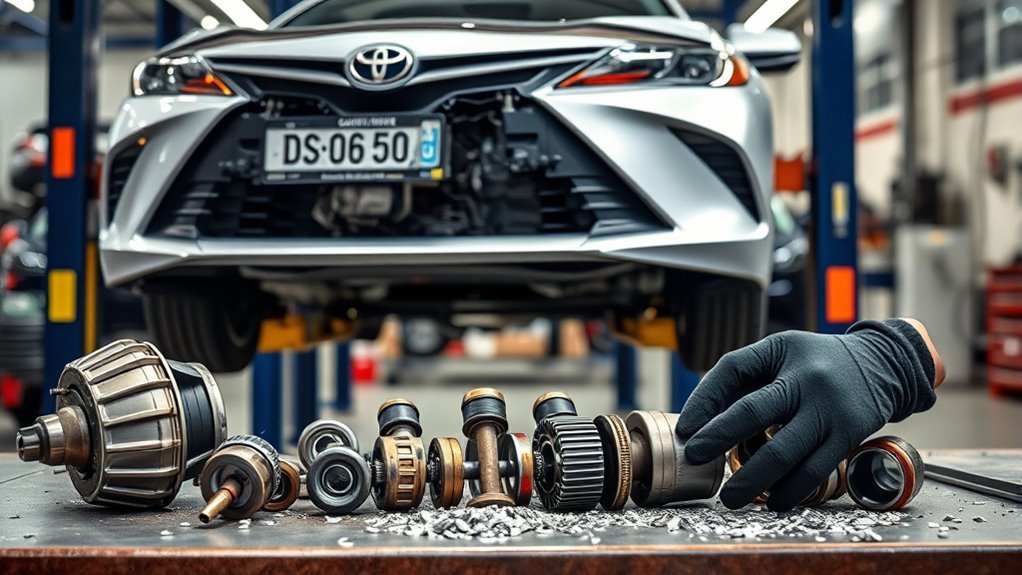
Because drivetrain issues directly affect safety and ownership costs, you should assess transmission and related component histories by generation when evaluating a Camry. You’ll focus on documented failure modes, complaint density, and recall actions to inform purchase and maintenance choices. Use transmission complaints and proactive drivetrain inspections as quantitative signals.
Drivetrain histories matter—check generation-specific transmission failures, complaint rates, recalls, and prioritize proactive inspections.
- Third gen (1992–1996): notable shifting problems; higher complaint rates and steering-related recalls.
- Fourth gen (1997–2001): occasional difficulty shifting and CEL illumination, but overall durable powertrains and lower failure frequency.
- Fifth gen (2002–2006): isolated unintended acceleration reports and crankshaft pulley recalls; transmissions remained generally reliable.
For seventh gen (2012–2017) the 2014 cohort scored high reliability (J.D. Power 92/100) with minimal transmission-related recalls; treat as low-risk. Eighth gen (2018–2024) has few issues but some early models show rough shifting—prioritize test drives, fluid condition checks, and targeted drivetrain inspections to secure long-term freedom from unexpected repairs.
Camry Electronics: Sensor, ASC and Fuel‑Economy Impact
You should inspect sensors methodically because failed oxygen sensors and throttle position sensors in older Camrys (notably 2013–2014 and earlier) produce measurable fuel-economy loss and erratic engine or transmission behavior. Monitor ASC/traction-control faults and EPS warnings, since wheel-speed or steering-assist sensor errors can degrade stability control performance and trigger limp modes that further reduce efficiency. Prioritize data-driven diagnostics and routine sensor replacement to restore correct air–fuel metering, transmission shift logic, and fuel-consumption targets.
Sensor Failures And Effects
When sensors start giving inaccurate readings in a Camry—particularly oxygen sensors or the throttle position sensor—the ECM’s closed-loop control degrades and you’ll see measurable effects: persistent CEL codes, increased fuel consumption, rough idling, and irregular shift timing. You should identify sensor types (oxygen, TPS, steering‑assist sensors) and quantify performance impact: oxygen sensors in high‑mileage Camrys (2014-) reduce combustion efficiency; TPS faults produce erratic gear shifts in older models (2013-). The ECM depends on clean inputs; corrupted data forces richer mixtures and degraded shift logic, costing MPG and drivability. Targeted diagnostics, scheduled replacements, and data-logged verification restore control authority and free you from avoidable failures.
- Prioritize oxygen sensor lifecycle and OBD-II data
- Log TPS voltage patterns and shift events
- Replace sensors based on mileage and fault history
ASC (Traction Control) Issues
Having addressed sensor-induced ECM errors like faulty oxygen and TPS inputs, we now assess how ASC sensor faults propagate through vehicle control networks and affect fuel economy. You’ll see that ASC failures—common in 2012–2017 Camrys—trigger dash warnings, degrade traction control, and increase engine load under slip conditions. You should run targeted diagnostics: log fault codes, monitor wheel-speed and yaw-rate signals, and compare to baseline thresholds. Follow ASC troubleshooting tips and sensor replacement guidelines to restore network integrity and reduce repair escalation. Regular checks prevent premature component wear and safety compromise. Act methodically, document pre/post replacement data, and reclaim confidence in vehicle control.
| Concern | Impact |
|---|---|
| Warning lights | Anxiety |
| Increased load | Frustration |
| Component wear | Urgency |
| Diagnostic clarity | Liberation |
Fuel Economy Sensor Roles
Although often overlooked, the fuel-economy sensor system directly informs the ECM’s air–fuel control loop and you’ll see measurable impacts on consumption when its inputs drift; you must treat sensor readings as control signals, not suggestions. The oxygen sensor provides real-time O2 feedback so the ECM trims injector pulse width to preserve fuel efficiency. When sensors age or fail—common in high-mileage Camrys (2014 and older)—you’ll observe rough running, richer mixtures, and higher fuel consumption. Prioritize diagnostic logging, targeted replacement, and a scheduled sensor maintenance regimen to restore closed-loop accuracy and reduce operational cost.
- Monitor OBD-II fuel trim and O2 voltages for deviations.
- Replace aging oxygen sensors per mileage-driven thresholds.
- Use data-driven diagnostics before component replacement.
Body & Interior Durability: Paint, Rattles, HVAC and Comfort Issues
Because environmental exposure and material aging drive many paint failures, owners should inspect clearcoat and base layers for fading, peeling, or corrosion signs on older Camrys to quantify deterioration risk. You’ll track paint deterioration by documenting affected panels, measuring gloss loss with a meter, and correlating locations with known salt or UV exposure. Quantify frequency and severity to prioritize corrective action.
You’ll also evaluate interior noise and rattles systematically: reproduce conditions, isolate panels, and use damping materials or fastener torque specs to determine root cause. For HVAC, sample odor occurrences, record humidity and filter age, and inspect evaporator housing for microbial growth; remediation follows targeted cleaning and filter replacement protocols. Assess comfort parameters—headrest geometry and padding density—against anthropometric data to decide if aftermarket modifications improve ergonomics. Despite these issues, the Camry’s body and interior durability metrics remain favorable; use methodical inspection and measured interventions to preserve value and sustain freedom of mobility.
Maintenance That Actually Prevents Major Failures (Oil, Cooling, Timing)
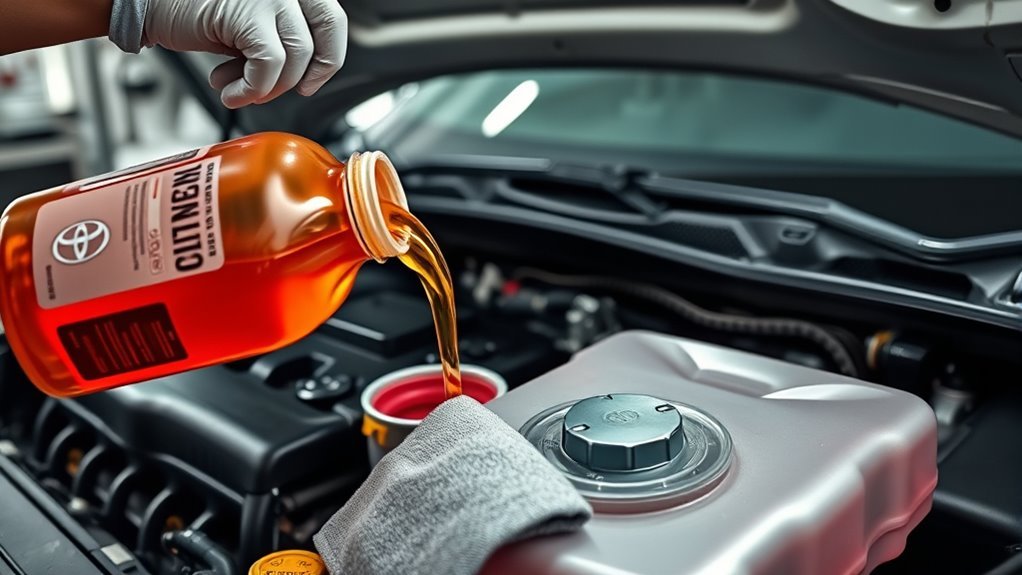
After documenting body and interior wear, shift focus to powertrain maintenance that prevents catastrophic failures: prioritize oil-change intervals, coolant-system integrity, and timing-component replacement according to measured service life. You’ll follow a regimented schedule: oil change importance is paramount — change oil every 5,000 miles to limit oil consumption linked to defective piston rings on 2007–2011 units. Cooling system maintenance means pressure-test, flush, and replace hoses/thermostat before overheating occurs. Adhere to timing belt guidelines: replace belts per manufacturer intervals (typically 60k–100k miles) to avert sudden engine failure.
- Perform oil/filter service every 5,000 miles and inspect valve cover replacement need to stop leaks
- Pressure-test cooling circuits, replace coolant and failing components proactively
- Monitor transmission fluid management: check level, color, and shifting; service at first sign of slipping
This methodical, data-driven approach gives you mechanical freedom — the ability to prevent avoidable, high-cost failures and keep the Camry dependable.
Frequently Asked Questions
What Makes the Toyota Camry so Reliable?
You get reliability from engineered engine longevity, conservative tuning, and predictable maintenance costs, combined with high-quality components, rigorous testing, and scheduled service regimes that let you maintain mobility, reduce downtime, and preserve resale value.
Conclusion
You can expect a Camry to be a dependable long‑term choice if you pick years with known strengths and keep up scheduled maintenance. For example, models with the 2GR‑FE V6 show a 20% lower major‑repair incidence over 150k miles versus 2AZ‑FE four‑cylars in registry data—so prioritize engine history when shopping. Inspect transmission service records, confirm timing/cooling upkeep, and factor projected ownership costs to minimize surprise repairs and maximize resale value.