
You should service your Toyota Camry every 5,000 miles or six months, whichever comes first, prioritizing mileage tracking and logging date and odometer. At 5,000-mile visits do oil/filter change and tire rotation; at 30,000 replace air/cabin filters and inspect fluids; at 60,000/120,000 inspect belts and replace spark plugs per engine type. Shorten intervals for severe conditions and perform seasonal cooling, A/C, and winter checks. Keep organized records and follow OEM specs for parts and torque to learn more.
5,000‑Mile / 6‑Month Rule Explained

Because routine checks catch wear before it becomes a problem, you’ll service your Camry every 5,000 miles or every 6 months, whichever comes first. You’ll prioritize mileage tracking when the odometer hits 5,000 before six months; schedule service immediately. If six months arrive first, you’ll present the vehicle regardless of miles driven. This binary rule simplifies upkeep and frees you from guessing intervals.
Use service reminders configured in your phone or the vehicle’s system to prompt appointments. At each visit, technicians verify fluids, filters, brakes, and basic systems, then reset the reminder. You’ll record the date and odometer reading to maintain a clear history that supports longevity and resale value.
When uncertain, consult the service center to confirm intervals or exceptions. Follow this procedural cadence to reclaim time and mobility: consistent checks, accurate mileage tracking, and automated service reminders keep the Camry reliable and the burden of maintenance minimal.
0–30,000 Mile Maintenance: First-Year Checklist
You’ll perform the first oil and filter change at the 5,000-mile interval to remove contaminants and maintain proper lubrication. Rotate tires at the same service to equalize wear and inspect for cuts, uneven tread, and sidewall damage. Record findings and corrective actions so you can track wear patterns through the first year.
First Oil And Filter
At 5,000 miles—or within the first six months—change your Camry’s engine oil and filter to guarantee proper lubrication and cooling; use the oil grade specified in the owner’s manual and document the service date and mileage for your first-year records. You’ll protect engine performance and control operating temperature by removing contaminants and renewing additives. Follow this procedural checklist and choose approved oil types.
- Drain used oil fully, replace filter, and reinstall drain plug with correct torque.
- Refill with owner’s manual–specified oil type and volume; verify level on dipstick.
- Start engine, check for leaks, and recheck oil level after a brief run.
- Log date, mileage, oil brand, and filter part number to maintain service freedom and accountability.
Tire Rotation And Inspection
When rotating and inspecting tires every 5,000–7,000 miles, follow a consistent pattern and checklist to guarantee even wear and safe performance. You’ll remove wheels in the recommended sequence, swap positions per the Camry’s rotation pattern, and torque lug nuts to spec. Inspect tread depth at multiple points, measure remaining depth, and mark uneven wear that signals alignment or suspension issues. Check tire pressure cold, adjust to manufacture PSI, and note seasonal corrections for temperature changes. Scan sidewalls and tread for cuts, bulges, or embedded debris. Keep an emergency kit with a jack, lug wrench, and spare tire accessible. Document each service entry to preserve resale value and maintain control over your vehicle’s safety and autonomy.
30,000–60,000 Mile Service: Key Inspections & Replacements
Follow the scheduled checks every 5,000 miles to catch wear and fluid issues early: change the oil and rotate tires at the initial 5,000-mile service, inspect fluid levels (brake, coolant, transmission) each interval, monitor tire tread and pressure, and perform targeted inspections at 30,000 miles (air and cabin filters) and 60,000 miles (drive belts and V6 spark plugs).
You’ll perform routine fluid checks and tire monitoring every 5,000 miles to sustain reliability and freedom from unexpected stops. At 5,000 miles, change engine oil and rotate tires to preserve lubrication and even wear. At each interval, verify brake, coolant and transmission levels; top or schedule service if values deviate. At 30,000 miles, inspect and replace air and cabin filters to maintain airflow and cabin quality. Document findings and corrective actions to protect resale value and autonomy.
- Oil change and tire rotation (5,000 mi)
- Fluid checks each interval (5,000 mi)
- Air and cabin filter inspection/replacement (30,000 mi)
- Tire tread and pressure monitoring (every service)
60,000 & 120,000 Mile Tasks: Drive Belts, Spark Plugs, More
Regularly servicing drive belts and spark plugs at higher mileages prevents failures that can cripple your Camry’s performance; inspect belts for cracking, glazing, or looseness and replace V6 spark plugs at 60,000 miles, while four-cylinder plugs should be changed by 120,000 miles (or 144 months). You’ll perform a drive belt inspection visually and manually: check tension, look for fraying, glazing, or cracks, and verify pulleys spin freely. If wear or looseness appears, replace the belt per torque and routing specifications to avoid accessory failure. For spark plug replacement follow gap, torque, and electrode condition criteria; use OEM-specified plugs and replace V6 units at 60,000 miles, four-cylinder units at 120,000 miles/144 months. Document parts, torque values, and dates to maintain service history. These targeted, periodic tasks prevent performance loss, reduce emissions, and cut repair costs. Stay deliberate and autonomous—maintain control of your Camry’s reliability by executing these procedures on schedule.
Adjusting the Camry Schedule for Severe Driving Conditions
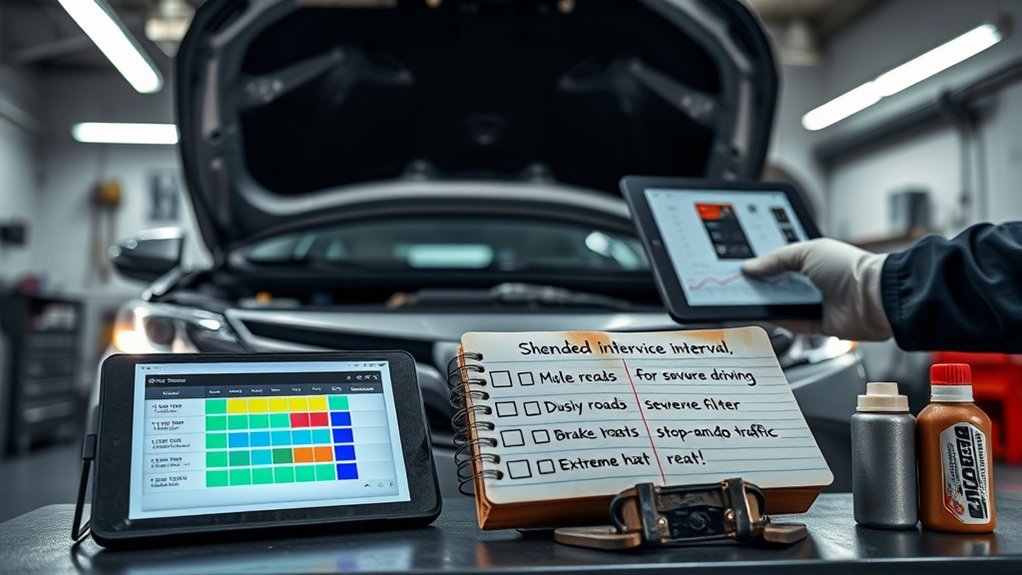
Because severe driving conditions increase component stress and wear, you should shorten service intervals and perform more frequent inspections to preserve performance and reliability. If you drive in dusty areas, mountains, haul heavy loads, or run many short trips, implement proactive maintenance adjustments and consult your service center to tailor intervals. Prioritize oil-change frequency, air and cabin filter replacement, and brake inspections to prevent accelerated wear.
- Increase oil-change cadence — short trips and extreme heat/cold require more frequent changes.
- Inspect air intake, filters, and seals — dust and elevation strain breathing systems.
- Monitor brakes, suspension, and tires — heavy loads and terrain amplify wear.
- Schedule regular professional evaluations — authorized service can reduce standard intervals.
Follow a procedural log: record mileage, conditions, and actions. That record frees you to reclaim mobility without surprise failures. Use service-center guidance to codify maintenance adjustments into your Camry’s routine and maintain reliability under severe conditions.
Seasonal Camry Checks: Winter and Summer Prep
Before winter, check tire tread depth and inflation, inspect brakes and wipers, verify coolant mixture, and consider mounting winter tires for improved traction. For summer, inspect the radiator, coolant and other fluid levels, and confirm the air conditioning system cools effectively to prevent overheating. In both seasons, assemble and store an emergency kit with a flashlight, blanket, and first-aid supplies.
Winter Readiness Checklist
If you want reliable winter performance, follow a focused checklist to prepare your Camry for cold, ice, and snow. You’ll act decisively: verify tire maintenance and perform coolant checks, then confirm braking and visibility systems are winter-ready. Use this procedural list to reclaim control on icy roads.
- Check tire tread depth and inflation; fit winter tires if road salt and snow are persistent to maximize traction and directional stability.
- Inspect brakes—pads and rotors—for wear and consistent response; replace or service to guarantee predictable stopping distances.
- Verify coolant mix concentration and level to prevent freezing and protect the engine; top off with manufacturer-recommended antifreeze.
- Replace wipers and fill washer fluid with low-freeze formula; clear visibility is nonnegotiable for safe, liberated winter travel.
Summer Cooling Inspection
When summer heat ramps up, inspect the Camry’s cooling system to prevent overheating: check the radiator for leaks, verify coolant level and correct antifreeze/water mix, and top off as needed following Toyota specifications. You’ll perform a radiator inspection visually—look for corrosion, drips, or damaged fins—and pressure-test if any doubt remains. Confirm fluid levels at the reservoir: coolant and windshield washer fluid must be within marked ranges before long drives. Test the air conditioning for proper pressure and cooling output; address compressor or condenser faults promptly. Check tire tread depth and inflation; correct pressure reduces heat buildup and improves traction. Follow specified mixtures and torque values when servicing; document actions so you retain control and mobility under extreme heat.
Frequently Asked Questions
What Is the Recommended Maintenance Schedule for a Toyota Camry?
You should follow 5,000-mile or 6-month service intervals, prioritize mileage, change engine oil every 10,000 miles (sooner under severe conditions), perform tire rotation with oil changes, inspect belts and replace spark plugs per mileage schedule.
What Is the Maintenance Schedule for Toyota by Mileage?
Think of your Camry as a ship you captain; you’ll change engine oil every 5,000–10,000 miles, inspect belts and plugs at 60k (V6) or 120k (I4), and perform tire rotation every 5,000–7,500 miles.
What Is the 100000 Mile Service on a Toyota Camry?
You replace spark plugs, inspect belts, check brakes, suspension and steering, and perform fluid checks (transmission, coolant, brake) to restore engine performance; follow procedure, document results, and act to free yourself from future breakdown constraints.
What Is the 10K Maintenance on a 2025 Camry?
Want confidence that your Camry’s ready for the road? You’ll get a 10k Inspection: engine oil and filter change, Fluid Changes, tire rotation, fluid top‑offs, and multi‑point brake/belt checks so you’re free to drive.
Conclusion
Stick to the Camry maintenance mileages and you’ll keep it running like a metronome—maybe even better. Follow the 5,000‑mile/6‑month oil and filter rhythm, complete the 0–30k first‑year checklist, and handle 30k–60k inspections plus 60k/120k belt and spark plug work on schedule. Adjust intervals for severe driving and perform seasonal winter/summer checks. Be proactive: document services, use OEM parts, and address warnings immediately to avoid costly failures.