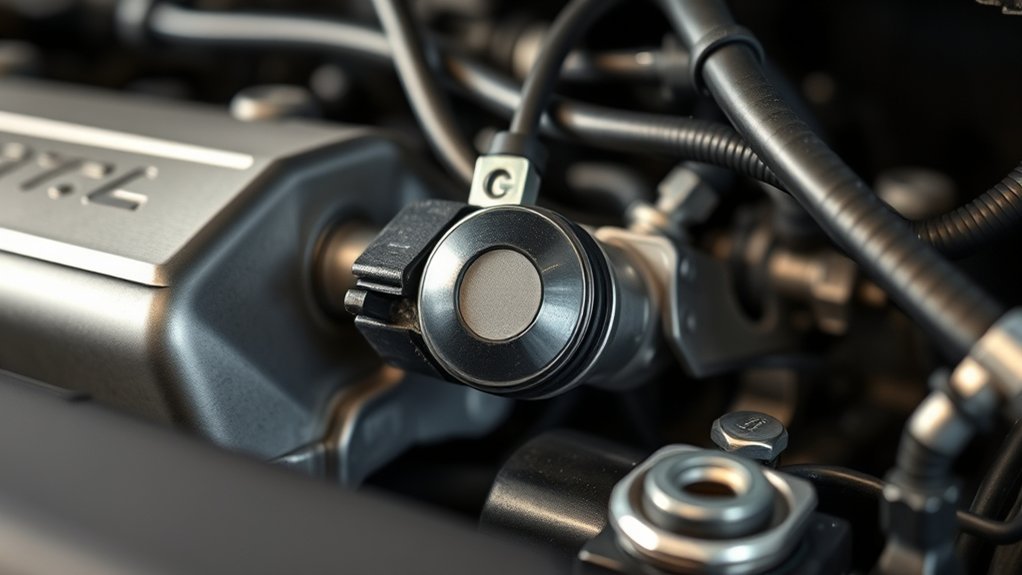
Your Camry’s knock sensor detects engine knock by converting block vibrations into electrical signals your ECU uses to instantly retard ignition timing, preventing damaging detonation and optimizing power and fuel efficiency. It’s mounted on the engine block or head where vibration coupling is strongest, so secure contact and correct placement are critical. A failing sensor triggers DTCs, reduced performance, and higher emissions; simple tests and proper OEM replacement restore precise ignition control — keep going to learn specifics.
Quick Triage: Can You Drive if Your Camry Knock Sensor Fails?
Wondering whether you can drive your Camry with a failed knock sensor? You can, but you shouldn’t treat it as freedom to ignore the issue. Using knock sensor basics, understand that the sensor’s failure lets the engine control unit lose reliable knock data, so it retards or defaults ignition timing to protect the engine. That safeguard limits engine performance and fuel economy, and the check engine light will usually alert you to the fault. If you keep driving, persistent knocking from improper timing can escalate into severe internal damage—think cylinder head or engine block repairs. For liberation from costly downtime, act promptly: diagnose codes, confirm sensor failure, and replace the sensor to restore normal combustion control. Short-term, you can limp home or to a shop; long-term, continued operation sacrifices fuel efficiency, increases emissions, and risks expensive repairs. Prioritize repair to reclaim peak engine performance and avoid captivity to preventable breakdown.
How a Knock Sensor Protects Your Camry Engine
You rely on the knock sensor to detect engine knocking by converting abnormal combustion vibrations into electrical signals for the ECM. The ECM then retards or adjusts ignition timing to prevent damaging pressure spikes and protect pistons, rods, and bearings. Keeping the sensor functional optimizes timing for performance and fuel efficiency while preventing premature internal component wear.
Detects Engine Knocking
Detecting engine knock, the Camry’s knock sensor converts abnormal vibration from uneven combustion into electrical signals the Engine Control Module (ECM) analyzes. You rely on knock frequency analysis to distinguish normal engine noise from destructive detonation; the sensor’s piezoelectric element is tuned to the narrowband frequencies produced by combustion irregularities. Mounted on the block or head, it provides real-time feedback so the ECM retards ignition timing the instant knock is detected, preventing progressive damage and reclaiming efficient combustion. If the sensor fails, you’ll notice degraded performance, higher emissions, and loss of adaptive timing control. For liberation from avoidable repairs, verify sensor operation during diagnostics and replace a faulty unit promptly to restore precise timing authority and fuel efficiency.
Protects Internal Components
Shielding the Camry’s internal components, the knock sensor converts specific combustion vibration frequencies into electrical signals so the ECM can immediately retard timing and prevent damaging pressure spikes. You rely on this rapid feedback to preserve the cylinder head, block, and bearings by minimizing shockwaves from uneven combustion. The piezoelectric element delivers precise vibration analysis, enabling targeted responses that reduce stress cycles and fatigue. That protection translates to measurable engine longevity and fewer catastrophic failures.
- Detects knock-specific frequencies via piezoelectric crystal
- Sends real-time data for immediate ECM countermeasures
- Limits pressure spikes and mechanical shock to internal parts
- Preserves engine longevity by preventing progressive damage
This system empowers you to keep your Camry strong and free.
Optimizes Ignition Timing
When the knock sensor senses abnormal combustion vibrations, it converts those signals into electrical data that the ECM uses to instantly retard or advance ignition timing, preventing persistent knock and protecting engine components. You rely on that rapid feedback for ignition optimization: the sensor’s placement on the block or head guarantees accurate detection, so the ECM fine-tunes timing in real time. That fine-tuning yields performance enhancement by improving fuel efficiency and cutting emissions while avoiding detonation-driven damage. If the sensor fails, you’ll get improper timing, reduced power, higher consumption, and elevated knock risk. Maintain the sensor and wiring to keep the system responsive; doing so preserves engine health and lets you drive free from the constraints of avoidable mechanical failure.
Where the Camry Knock Sensor Is Located (And Why Placement Matters)
You’ll find the Camry’s knock sensor mounted on the engine block or cylinder head, often beneath the intake manifold, so it sits directly on the structure that transmits combustion vibration. That mounting location is chosen to maximize vibration detection accuracy for the specific knock frequencies the ECM monitors. If the sensor is mislocated or damaged during installation—especially when the intake manifold is removed—you’ll get inaccurate signals and the ECM may make harmful timing corrections.
Sensor Mounting Location
On the Camry, the knock sensor sits on the left side of the engine block just below the intake manifold, positioned to pick up cylinder vibration with maximum sensitivity and minimal interference from adjacent components. You rely on precise sensor alignment and vibration sensitivity to free the engine from misfire compromises. Mounting location balances signal fidelity, mechanical isolation, and service access.
- Secure mounting torque: avoid over-tightening that distorts the sensor housing.
- Solid electrical and mechanical connection: prevent intermittent transmission to the ECM.
- Acoustic path isolation: placement reduces masking by other components’ frequencies.
- Maintenance access: intake plenum removal is required but placement limits invasive disassembly.
You’ll appreciate that correct placement enforces strict detection integrity, enabling timely ECM ignition corrections.
Vibration Detection Accuracy
Because the Camry’s knock sensor sits on the left side of the engine block below the intake manifold, it can pick up cylinder vibration with high fidelity and minimal masking from other components. You’ll rely on that placement to detect the specific vibration frequency signatures of detonation; the piezoelectric element converts mechanical pulses into voltage pulses the ECU interprets. With correct sensor calibration you’ll guarantee thresholds align to true knock events, not normal combustion noise. Misplaced or poorly calibrated sensors introduce false positives or missed knocks, degrading timing control, increasing emissions, and risking damage. Maintain mounting torque, clean contact surfaces, and follow OEM calibration procedures so you preserve detection accuracy and keep the engine free to perform without compromise.
Common Signs a Camry Knock Sensor Is Failing
When the knock sensor starts to fail, your Camry will often set the check engine light and log DTCs like P0325 while the PCM reports a circuit fault. You’ll recognize knock sensor symptoms through objective signs: the PCM alerts, audible detonation, and degraded engine control. These indicators undermine your control over the vehicle and demand corrective action to restore efficient operation.
- Distinct pinging noise under acceleration or heavy load indicating detonation.
- Stored DTCs such as P0325 showing knock sensor/circuit malfunction.
- Noticeable drop in engine performance: sluggish acceleration, stalling, or misfires from retarded ignition timing.
- Increased emissions and reduced fuel economy due to inefficient combustion.
You should treat these signals as failure evidence, not inconvenience. They quantify how the sensor’s loss of input forces the ECU to alter timing, harming power and economy. Act decisively to reclaim reliable, liberated driving.
Quick Tests for the Camry Knock Sensor and Wiring
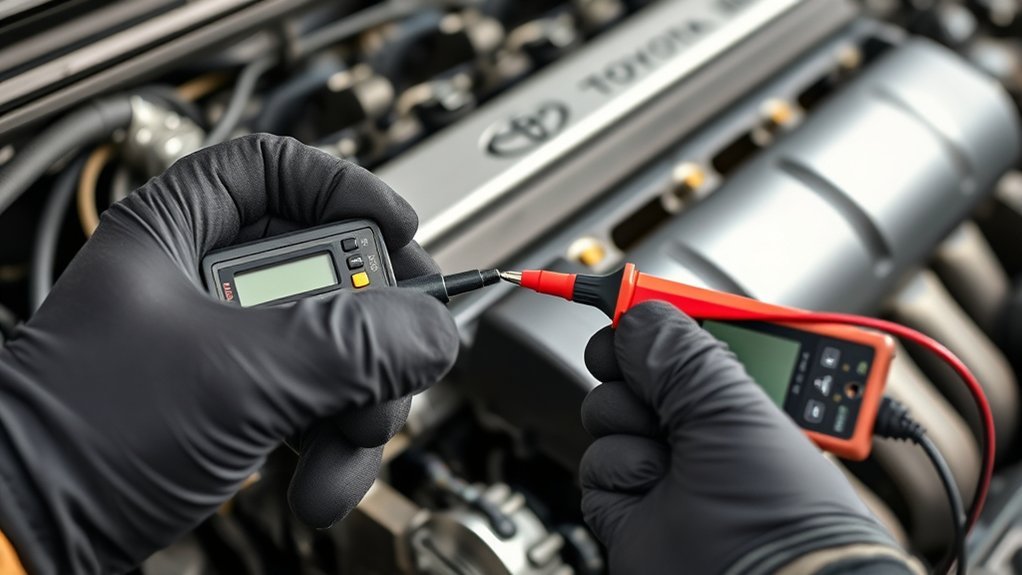
Having identified the common signs of a failing knock sensor, you should next verify sensor and wiring integrity with a few quick tests that pinpoint faults and guide repairs. Begin with a wiring inspection: visually check connectors, loom, and ground points for corrosion, chafing, or broken pins. Repair or replace damaged sections to prevent intermittent faults that undermine control and freedom from costly misdiagnosis. Next, perform a resistance measurement of the sensor with a multimeter; compare the reading to Toyota’s specification. A value outside the range indicates internal failure. Tap the sensor gently while monitoring voltage output— a functioning unit will produce brief voltage spikes, proving mechanical-to-electrical transduction. For deeper analysis, use an oscilloscope to view real-time waveform characteristics under simulated vibration or running conditions. If measurements and waveforms show degradation, replace the sensor and suspect wiring, ensuring the new assembly restores reliable signal fidelity and returns you to confident, liberated driving.
How Your Camry’s ECU Responds to Knock Signals
While monitoring the knock sensor’s voltage pulses, the ECU analyzes their frequency and magnitude in real time and then retards ignition timing in precise increments to suppress detonation and protect the engine. You’ll see ECU adjustments occur as the control unit interprets converted vibration signals delivered by the sensor; signal processing isolates knock-related frequencies from normal mechanical noise and triggers corrective action. If the ECU loses reliable input, it can’t apply ideal timing, which reduces efficiency and raises emissions. You benefit by understanding that consistent, accurate signals let the ECU maintain power and prevent internal damage.
- Knock-to-voltage conversion: sensor converts vibration to electrical pulse for the ECU
- Signal processing: ECU filters and measures pulse frequency/magnitude to detect detonation
- ECU adjustments: timing is retarded in controlled steps to quell knock
- Failure mode: missing or erratic signals prevent proper timing control, harming economy and durability
Act deliberately—know the system so you can demand freedom from preventable engine failure.
Choosing and Installing the Right Camry Knock Sensor
Now that you know how the ECU uses knock signals to protect timing and performance, pick a knock sensor that matches your Camry’s engine variant—V6 and 4‑cylinder models use different sensors and mounting locations—prefer OEM parts for guaranteed electrical and mechanical compatibility with the ECM, and inspect wiring/connectors for corrosion or damage before installation. Choose from reputable sensor brands that specify fitment by engine code; avoid generic cross‑references without pinout confirmation. Prepare workspace: disconnect battery, access sensor (intake manifold removal may be required), and note torque specs in the service manual. Use installation tips: clean mounting surface, apply specified torque to avoid casing fracture or false readings, and secure connectors with dielectric grease where recommended. After fitment, clear DTCs and perform a controlled test drive to verify knock thresholds and ECU timing adjustments. If abnormal behavior persists, recheck wiring, grounding, and sensor orientation before assuming ECU failure.
Frequently Asked Questions
Can a Faulty Knock Sensor Trigger the Check Engine Light Codes Beyond Knock-Related Ones?
Yes — a faulty knock sensor can trigger unrelated codes; you’ll see knock sensor symptoms like misfires and reduced engine performance, plus cascade faults in ignition, fuel systems, or emissions that set additional diagnostic trouble codes.
Do Aftermarket Tuners Disable or Alter Knock Sensor Behavior?
Like a surgeon’s scalpel, you’ll find aftermarket tuning can modify or disable knock sensor behavior by altering sensor calibration and ignition maps; you’ll need to verify tunes, because some prioritize power over protection, risking engine damage and faults.
How Often Should the Knock Sensor Be Inspected or Replaced Proactively?
You should inspect the knock sensor every 30,000 miles and consider replacement around 80,000–100,000 miles; this preventive maintenance balances sensor lifespan and performance, ensuring reliability and empowering you to avoid unexpected engine damage.
Can Water or Oil Contamination Permanently Damage the Knock Sensor?
Yes—you can permanently damage a knock sensor: water damage or oil interference can corrode the element, short circuits or dampen vibrations, causing irreparable sensor failure; you’ll need diagnostic testing and likely sensor replacement.
Do Hybrid Camry Models Use a Different Knock Sensor Setup?
Yes — you’ll see different knock sensor types and hybrid engine considerations: hybrids often use more sensors, varied mounting and signal processing to accommodate electric-assist noise and reduced combustion events, so diagnostics and calibration differ accordingly.
Conclusion
You can keep driving briefly if the Camry’s knock sensor fails, but don’t: Toyota data shows uncontrolled knock cuts engine life by up to 30%. The sensor detects vibration from detonation and tells the ECU to retard timing, protecting pistons and bearings. Its tight mounting on the block guarantees accurate readings. If you see persistent misfire codes or timing retard, test the sensor and wiring and replace with the correct OEM-spec unit promptly.