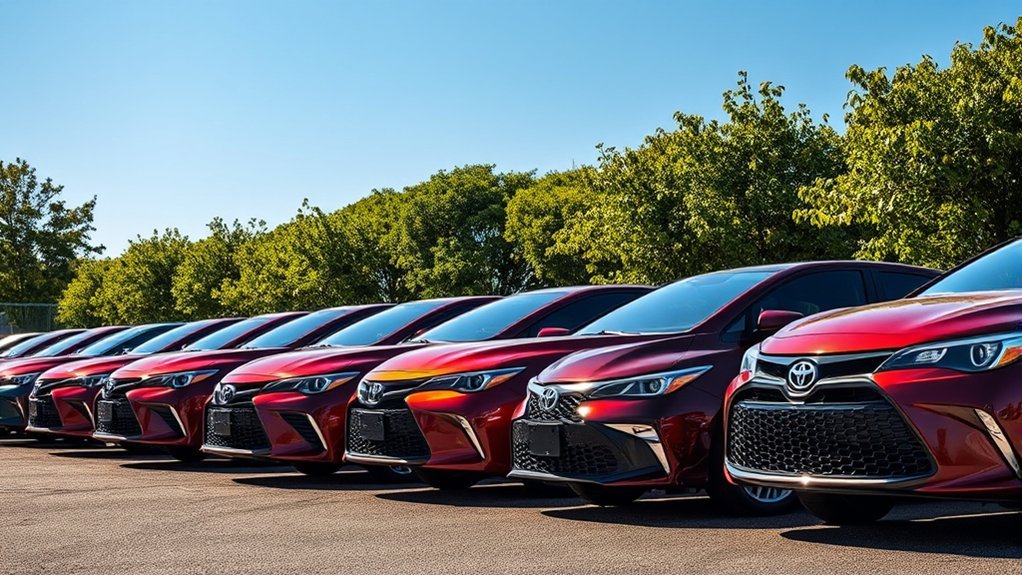
The Toyota Camry has transformed since its 1983 debut, shifting from a compact sedan to a top midsize vehicle. You’ll see its journey through generations marked by technology, safety, and performance advancements. Each generation brings unique features, like the powerhouse hybrid in the sixth or the sportier, tech-savvy eighth. Curious about upcoming innovations? Discover how the anticipated ninth generation might reshape the Camry, along with the lasting impact it’s had on the automotive market.
Overview of the Toyota Camry’s Evolution
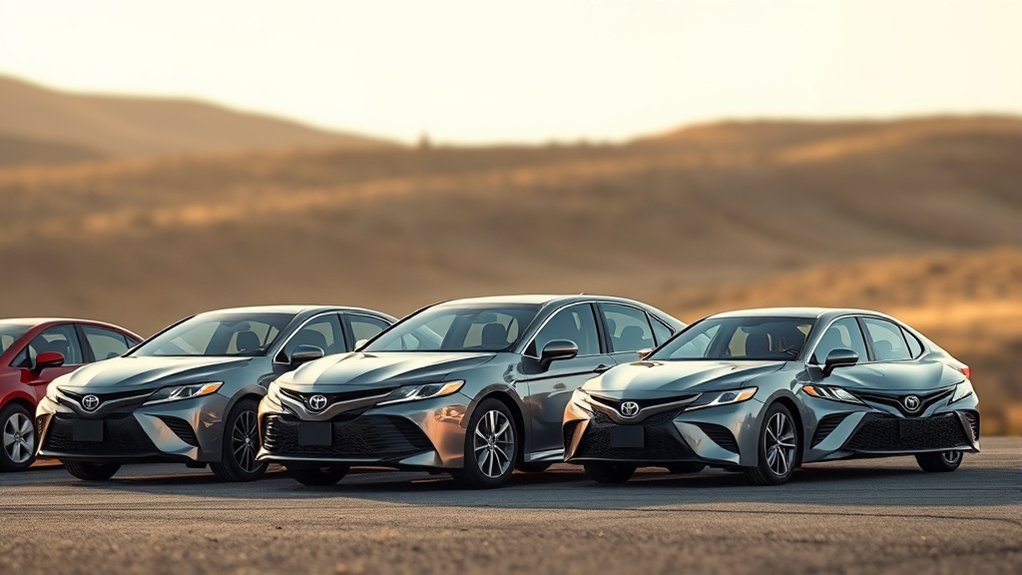
Since its debut in 1983, the Toyota Camry has undergone a remarkable transformation from a compact car to a leading midsize sedan. This evolution mirrors market trends and consumer preferences, with each generation showcasing significant design evolution and technological advancements. By the mid-1990s, the third generation marked a pivotal shift to a wider body and improved performance benchmarks. The introduction of hybrid technology in the sixth generation (2007-2011) highlighted Toyota’s commitment to sustainability, achieving up to 40 mpg city. The eighth generation (2018-Present) further refined driving dynamics with the TNGA platform and sport-oriented TRD trim. Remarkably, the Camry has achieved impressive sales milestones, including 473,108 units sold in 2007, solidifying brand loyalty and its status as a best-seller for over 18 years. Competitive analysis reveals that the Camry continues to adapt, ensuring its relevance in an ever-evolving automotive landscape.
Defining Features of the First Generation Camry (1983 – 1987)
The first generation of the Toyota Camry, launched in 1983, laid a solid foundation for what would become a beloved midsize sedan. Its design philosophy emphasized reliability and comfort, appealing to a broad audience. With a 2.0-liter inline-four engine producing 130 horsepower, it offered commendable performance comparisons, especially with its 30.5 mpg fuel efficiency. Market reception was overwhelmingly positive, with user reviews praising its front-wheel-drive configuration for enhanced handling and spacious interiors.
Available in various trim levels and color options, the Camry catered to diverse preferences. Maintenance tips from early owners highlighted its longevity, contributing to impressive resale value over the years. This first generation set a high standard, ensuring that the Toyota Camry would remain a top choice for drivers seeking both practicality and style.
What Changed in the Second Generation? (1988 – 1991)
As the Toyota Camry shifted into its second generation from 1988 to 1991, it retained the familiar body style but introduced significant enhancements that elevated its appeal. You’d notice improved performance, thanks to the new optional 2.5-liter V6 engine, boosting power to 160 horsepower. This generation also marked a pivotal shift, offering an all-wheel-drive system, enhancing traction and handling in various conditions.
- Increased interior space for added passenger comfort
- Retained base engine with a robust 130 horsepower
- Sales surpassed 200,000 units in the U.S. for the first time
These changes not only refined the driving experience but also reflected Toyota’s commitment to meeting consumer needs. With enhanced engine options and a focus on comfort, the second-generation Camry solidified its place in the market, paving the way for future success.
Advancements in Technology for the Third Generation (1992 – 1996)
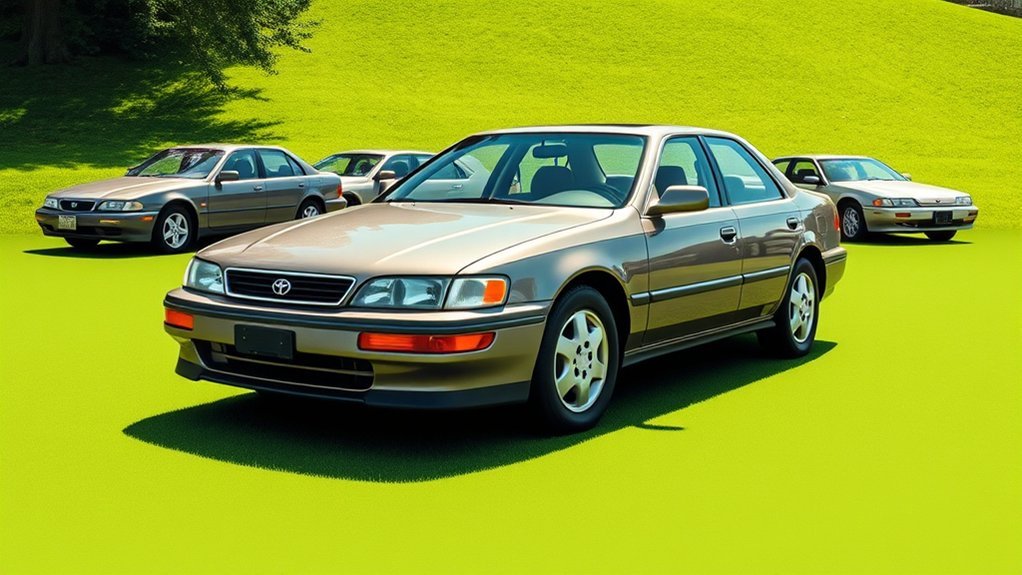
In the third generation of the Toyota Camry, from 1992 to 1996, you’ll notice significant advancements in technology that transformed your driving experience. Enhanced safety features, improved engine performance, and advanced audio systems not only elevated comfort but also boosted reliability. These upgrades set a new standard for what a mid-sized sedan could offer, making the Camry a standout choice during its time.
Enhanced Safety Features
While driving a third-generation Toyota Camry from 1992 to 1996, you’d quickly notice its commitment to safety. This model markedly enhanced collision protection, ensuring you and your passengers feel secure on the road. Key features include:
- Dual airbag systems for both driver and front passenger, improving front-impact safety.
- Standard anti-lock braking system (ABS) on higher trims, enhancing braking stability in emergencies.
- Side-impact door beams introduced in 1994, fortifying your vehicle against side collisions.
These advancements reflect Toyota’s dedication to creating a safer driving experience. With options like traction control, the Camry not only protects you but also empowers you to navigate diverse road conditions with confidence.
Improved Engine Performance
The third generation of the Toyota Camry, produced from 1992 to 1996, marked a notable leap in engine performance that transformed the driving experience. This era introduced a more powerful 3.0-liter V6 engine option, delivering remarkable performance enhancements over earlier models. You’ll appreciate the standard 2.2-liter four-cylinder engine, which switched from carbureted to multi-point fuel injection, boosting fuel efficiency and responsiveness. Coupled with a new 4-speed automatic transmission, shifts became smoother, allowing for better acceleration. Additionally, the four-wheel steering system sharpened handling and maneuverability, making your drives feel more agile. These engine upgrades not only improved driving dynamics but also solidified the Camry’s reputation for quality, notably elevating consumer satisfaction and market competitiveness.
Advanced Audio Systems
With the enhancements in engine performance setting the stage, the third generation of the Toyota Camry also revolutionized in-car entertainment. This era introduced significant audio innovations that elevated sound quality and transformed the driving experience.
- Standard models featured a basic cassette player, while higher trims offered CD players, embracing the CD craze of the early ’90s.
- Some models boasted a six-speaker setup, providing an immersive sound experience previously unseen.
- The shift to multi-point fuel injection contributed to quieter engine operation, enhancing cabin acoustics and allowing music to shine.
These advancements reflected a growing demand for sophisticated entertainment options, making each drive not just a journey, but a rich auditory experience. You could finally enjoy your favorite tunes like never before.
Performance Upgrades From 1997 to 2017
As you explore the evolution of the Toyota Camry from 1997 to 2017, you’ll notice a remarkable shift in performance that reflects both technological advancements and consumer demand. The fourth generation introduced a standard V6 engine, boosting performance metrics to 210 horsepower, blending power and comfort seamlessly. By the sixth generation, the base engine evolved to a 158-hp 2.4-liter four-cylinder, while the new 3.5-liter V6 ramped up to an impressive 268 horsepower, achieving 0-60 mph in just 5.8 seconds. The introduction of the Camry Hybrid highlighted a commitment to engine refinement, merging gasoline with electric power for excellent fuel efficiency. The seventh generation maintained this momentum, offering a standard 178-hp engine alongside the potent V6. Throughout these years, advancements in transmission technology, particularly the shift to six-speed automatics, enhanced driving dynamics, making the Camry a compelling choice for performance enthusiasts.
Toyota Camry Highlights of the Eighth Generation (2018 – 2024)
Toyota’s eighth generation of the Camry, spanning from 2018 to 2024, marks a significant evolution in design and performance. This generation caters to diverse customer preferences with five distinct trim levels: L, LE, SE, XLE, and XSE. Performance options are robust, featuring a 2.5L four-cylinder engine with 203 horsepower or an optional 3.5L V6 with a powerful 301 horsepower.
- A hybrid variant combines fuel efficiency with a total output of 208 horsepower.
- The introduction of an eight-speed automatic transmission enhances driving dynamics.
- The sporty TRD trim offers performance enhancements and all-wheel-drive options.
This eighth generation showcases a sporty design while focusing on performance and efficiency, ensuring you enjoy every drive. Whether you prioritize power or fuel economy, the Camry’s versatility empowers your choices on the road.
Anticipated Features in the Upcoming Ninth Generation? (2025 – Present)
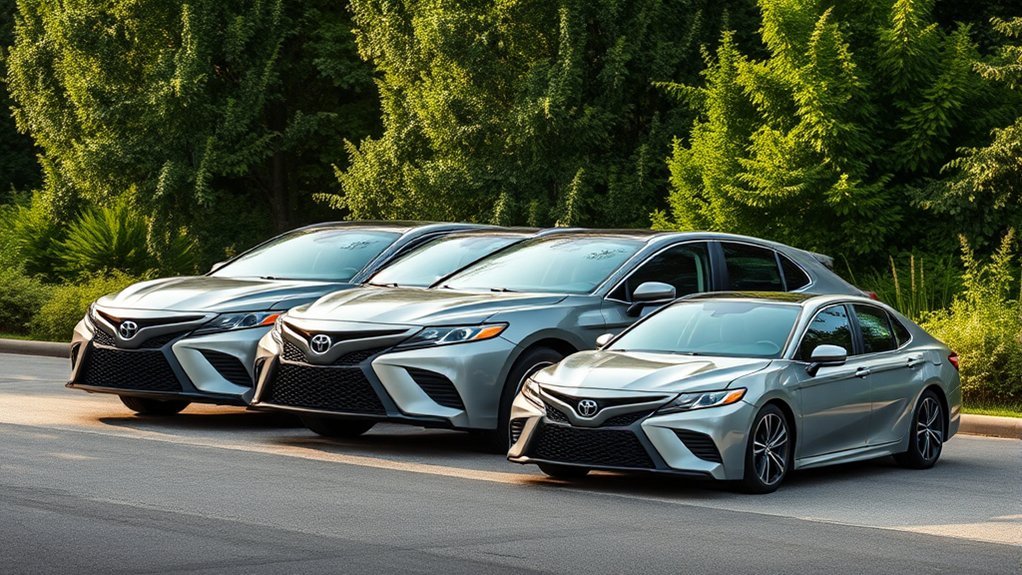
As the ninth-generation Toyota Camry approaches its 2025 debut, you’re likely enthusiastic to explore the anticipated upgrades. Expect powerful new hybrid options and an eye-catching exterior with bold design elements that may echo the Prius. Plus, with enhanced interior technology across four distinct trims, this Camry aims to stand out in an increasingly competitive midsize sedan market.
Anticipated Powertrain Options
While many drivers enthusiastically await the ninth generation of the Toyota Camry, the anticipated powertrain options promise to enhance both performance and efficiency. Expect two hybrid options, including a 2.5L four-cylinder engine with 225 hp and an AWD variant boasting 232 hp. This generation aims to improve fuel efficiency while maintaining the reliability you love.
- A potential plug-in hybrid model could broaden your choices.
- Four trim levels—LE, XLE, SE, and XSE—will cater to diverse preferences.
- Enhanced performance features promise a thrilling driving experience.
These updates not only reflect Toyota’s commitment to innovation but also guarantee that the Camry remains a top contender in the competitive sedan market.
Exterior Design Updates
Exciting changes are on the horizon for the ninth generation of the Toyota Camry, set to debut in 2025. This new model showcases a notable Camry styling evolution, featuring Prius-like headlights and a revised grille design that embraces modern design trends. With four distinct trim levels—LE, XLE, SE, and XSE—you’ll find options that cater to your unique taste while maintaining a sporty yet spacious cabin. Enhanced LED lighting is expected to elevate the vehicle’s sleek appearance and improve visibility. Plus, a plug-in hybrid model aligns with the growing shift towards electrification, ensuring you enjoy both style and efficiency. The ninth-generation Camry is poised to redefine your driving experience with its enchanting exterior updates.
Interior Technology Enhancements
With the ninth generation of the Toyota Camry on the horizon, you can expect a significant leap in interior technology enhancements. These features aim to elevate both interior comfort and technology usability, making your driving experience more enjoyable and efficient.
- Larger touchscreen displays for seamless navigation and control
- Over-the-air updates for easy software enhancements
- Enhanced driver-assistance technologies for safer driving
The anticipated digital instrument cluster will be more intuitive, presenting critical information in a user-friendly format. Plus, with expanded smartphone connectivity options like wireless Apple CarPlay and Android Auto, staying connected has never been easier. Get ready for a more connected, comfortable, and technologically advanced driving experience in the upcoming Camry!
The Toyota Camry’s Impact on the Automotive Market
Since its debut in 1983, the Toyota Camry has profoundly shaped the automotive market, becoming synonymous with reliability and consumer satisfaction. With over 10 million units sold globally, the Camry represents a significant market transformation, reflecting widespread consumer loyalty. Its consistent evolution—from a compact to a midsize sedan—keeps it relevant in a landscape dominated by SUVs and crossovers.
| Feature | Impact | Significance |
|---|---|---|
| Best-Seller Streak | 18 consecutive years | Reflects consumer acceptance |
| Hybrid Introduction | Eco-conscious appeal | Influenced competitors’ fuel efficiency |
| Quality Benchmarking | Multiple placements on 10Best Cars | Set industry standards |
| Adaptation to Trends | Evolved with consumer preferences | Maintained relevance |
Safety Features Across Generations
When you look at the Toyota Camry through its generations, you’ll see a remarkable evolution in safety features. From the early inclusion of multiple airbags to the cutting-edge driver assistance systems in recent models, safety has always been a priority. Understanding these innovations can help you appreciate how the Camry has maintained its reputation as a top choice in midsize sedans.
Safety Innovations Over Time
As the Toyota Camry has evolved over the years, its commitment to safety has remained a top priority. You can see this dedication reflected in its innovative safety technology and robust crash testing results. From the introduction of the Toyota Safety Sense package in 2015 to advanced driver-assistance systems in 2018, each generation has built on the last.
- Thorough airbag systems and stability control (2007-2011)
- Pre-collision systems and lane departure alerts (2015)
- Blind-spot monitoring and rearview cameras (2021)
With consistently high ratings from the NHTSA, the Camry guarantees you’re not just driving, but driving safely. These innovations empower your journey, making certain you and your loved ones are protected on the road.
Standard Safety Features
Throughout its many generations, the Toyota Camry has prioritized safety by incorporating a range of standard features that evolve with technology. Early models introduced standard airbags, but by 2015, the Camry embraced the Toyota Safety Sense suite, enhancing collision prevention with pre-collision systems and lane departure alerts. Stability control became standard from 2007 to 2011, greatly improving handling and boosting safety ratings. By 2018, features like automatic high beams and backup cameras were standard across all trims, reflecting a commitment to driver feedback and real-world needs. As the 2025 model year approaches, expect even more impressive feature comparisons and upgraded driver-assistance systems, further solidifying the Camry’s reputation for safety in an ever-changing landscape.
Advanced Driver Assistance Systems
The evolution of the Toyota Camry’s safety features has seamlessly integrated advanced driver assistance systems (ADAS) that enhance your driving experience. From anti-lock brakes in earlier models to the thorough Toyota Safety Sense in newer generations, each iteration reflects the ADAS evolution in safety technology.
- The 2012-2017 models improved safety with the updated Star Safety System.
- The 2018 model made dynamic radar cruise control and lane departure alert standard.
- The upcoming 2025 model promises further advancements in driver-assistance features.
This consistent integration of cutting-edge safety technology not only guarantees your well-being but also liberates you to enjoy the drive, knowing that your Camry is equipped with the latest innovations designed to keep you safe on the road.
Future Trends and Expectations for the Toyota Camry
Anticipating the future of the Toyota Camry reveals a blend of innovation and tradition, as the 2025 model is set to introduce two hybrid powertrains that enhance both performance and fuel efficiency. With a 2.5L four-cylinder engine offering 225 hp and an AWD variant with 232 hp, it’s clear Toyota’s responding to market trends and consumer demands for eco-friendly innovations.
Design updates, including Prius-like headlights and a revamped grille, align the Camry with modern aesthetic preferences. Looking ahead, the 2028 model is expected to refresh its tech and design elements, keeping it competitive in a shifting landscape where SUVs dominate.
To maintain its market presence, the Camry will integrate sportier trims and advanced driver-assistance features. Speculation about a future plug-in hybrid model underscores Toyota’s commitment to expanding its eco-friendly options, ensuring the Camry remains a relevant choice for environmentally conscious drivers.
Frequently Asked Questions
What Are the Different Generations of Toyota Camry?
The Toyota Camry’s different generations showcase significant design evolution and engine advancements. From compact beginnings to spacious mid-size options, each generation enhances performance and features, ensuring you enjoy a reliable and stylish driving experience.
Which Camry Generation Is Considered the Best?
The 2012-2017 Camry is considered the best, thanks to its outstanding reliability ratings and best features like impressive fuel efficiency, spacious interiors, and advanced safety tech. You’ll find comfort and value in this generation.
Conclusion
As you’ve journeyed through the rich history of the Toyota Camry, it’s clear that this model isn’t just a car—it’s a legacy on wheels. Each generation has built upon the last, weaving a tapestry of innovation, safety, and performance that resonates with drivers. With the next generation on the horizon, the Camry is poised to continue its reign, adapting to new trends while staying true to its roots. Buckle up; the future looks bright for this automotive icon!