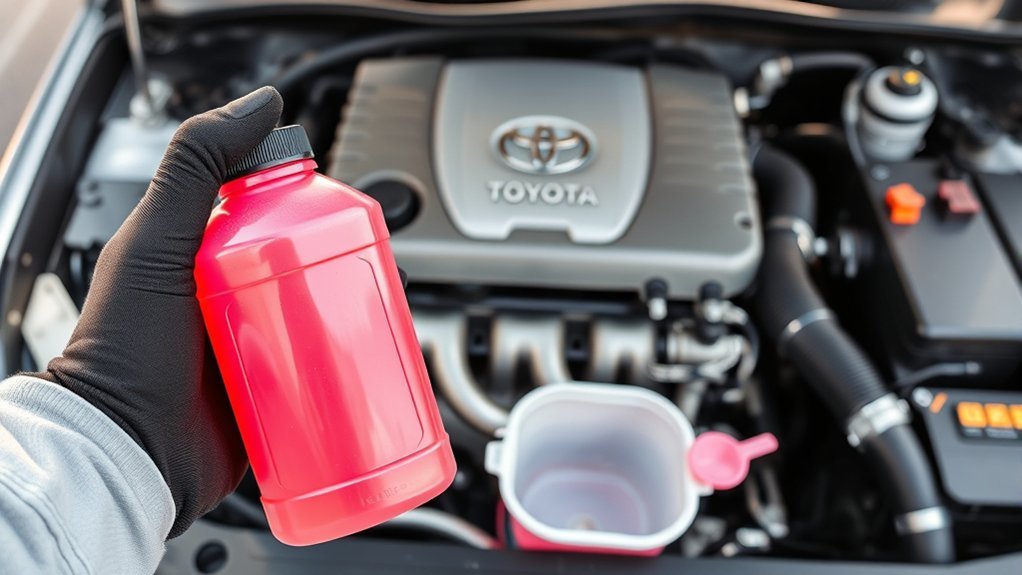
You’ll identify your Camry’s coolant by color, reservoir label, and service history—2007 models use pink Super Long Life (HOAT) while newer Toyotas often use red OAT Long Life. Match the formulation and interval to the model year and mileage to avoid corrosion or heater issues; don’t mix IAT/HOAT with OAT. For aged or contaminated fluid choose a flush; for routine service do a full replacement per Toyota specs. Keep going to see specific year-by-year guidance.
Identify the Coolant in Your Camry (Color, Age, Labels)
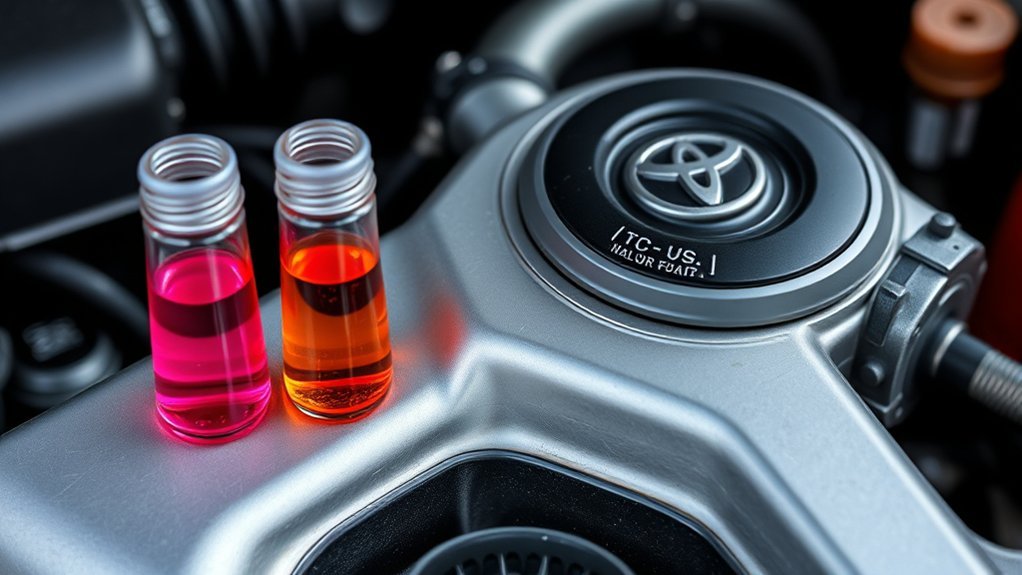
Start by checking the coolant color and the label on the reservoir or overflow tank: a 2007 Camry most often left the factory with pink Super Long Life Coolant (a HOAT formulation), but you may also encounter Toyota red, green, blue, or yellow aftermarket types. You’ll perform color identification visually, but don’t assume chemistry from hue alone—cross-reference the reservoir label and owner’s manual. Next, perform an age assessment: locate any service tags or records indicating fill date and mileage, and inspect fluid for sediment, rust, or a faded dye that signals degradation. If records are absent, use the coolant’s appearance and odor plus a test strip or refractometer to estimate remaining inhibitor life. Remember Toyota red and pink HOAT formulas are compatible, but mixing with unknown aftermarket types can shorten protection—so document what you find and plan a controlled flush if chemistry’s unclear. You’re reclaiming control over maintenance through precise, evidence-based checks.
Camry Coolant by Year & Mileage : Which to Use
Because coolant formulation and service interval change with model year and mileage, you should match the coolant type and change frequency to your Camry’s specific year and service history. For 2007 models, use Pink Super Long Life Coolant (HOAT) and plan service every ~30,000 miles or 2 years; for many newer Camrys, Toyota Red Long Life Coolant (HOAT/OAT variants) can extend intervals to ~100,000 miles or 5 years. Check the owner’s manual for exact capacity and specification.
Prioritize coolant longevity considerations: age, mileage, and prior coolant chemistry determine replacement timing. Respect coolant performance differences between older IAT/HOAT and newer OAT formulas; avoid mixing technologies because compatibility issues degrade corrosion protection and heat transfer. If you shift (e.g., Red to Pink), maintain the same technology family where possible and perform a thorough flush. By matching formulation and interval to year and service history, you control corrosion, preserve cooling efficiency, and keep your Camry liberating you from avoidable failures.
Compatibility Pitfalls and Choosing an OEM-Equivalent
When selecting a replacement coolant, pay strict attention to formulation compatibility—mixing older IAT coolants with newer OAT/HOAT chemistries can neutralize inhibitors and accelerate corrosion or scale formation. You’ll prevent costly failures by avoiding incompatible blends: IAT + OAT/HOAT mixing consequences include reduced corrosion protection, precipitate formation, and loss of reserve alkalinity. For 2007 Camry models, Toyota’s pink Super Long Life and red Long Life are both HOAT-compatible; they’re generally mixable because their coolant formulation bases align. Still, confirm the owner’s manual and avoid aftermarket IATs or unrelated OAT types.
When choosing an OEM-equivalent, pick products explicitly specified for Asian imports—examples include Peak Global Lifetime and Zerex Asian Vehicle—since their inhibitor packages match Toyota’s service profile. You should also source pre-diluted or concentrated mixes per spec, check freeze/boil protection, and document service dates. Act decisively: select the right coolant formulation to preserve freedom from breakdowns and maximize engine longevity.
Coolant Flush vs. Full Replacement: When to Do Each
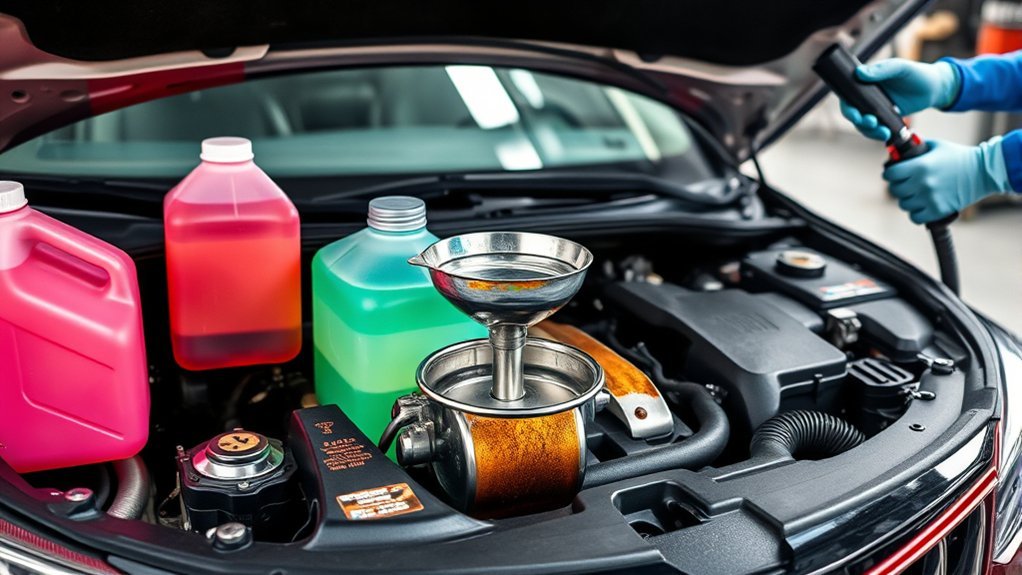
Although both procedures renew coolant, you should choose a coolant flush when the system shows contamination—visible rust, sediment, or erratic temperature readings—because a flush removes deposits and restores flow paths, while a full replacement (drain and refill) is sufficient for routine servicing or when coolant age has reached the recommended interval without contamination. You’ll follow manufacturer intervals: flushing every 100,000–150,000 miles for deposit control; full replacement around 30,000 miles or every 2 years for routine freshness. Check the coolant for sediment and monitor temperature behavior; if you see contamination or persistent overheating, opt for a flush to recover system flow and heat transfer.
- Inspect coolant color and clarity regularly
- Monitor engine temperature for anomalies
- Flush when rust, sludge, or particles appear
- Replace routinely per owner’s manual intervals
- Prioritize system cleanliness to prevent failure
These coolant maintenance tips focus on liberation from avoidable breakdowns; understand flushing benefits versus simple refresh to make decisive, empowering service choices.
How to Top Off or Change Camry Coolant : Step-by-Step
Now that you’ve decided whether a flush or full replacement fits your Camry, here’s how to top off or change the coolant step by step. First, verify the engine is cold; this prevents burns and gives accurate reservoir readings. Gather proper tools: funnel, drain pan, gloves, and the specified coolant (Toyota Super Long Life or HOAT equivalent). For topping off, mix concentrate with distilled water per label, then slowly add to the reservoir until it reaches the “full” line—don’t overfill. For a change, position a drain pan, open the drain, and fully evacuate old fluid. If needed, flush the system with clean water. Close drains, refill with the new mixture, then run the engine to operating temperature and monitor for air pockets as you top to the correct level. Follow coolant maintenance tips: use the right formula, keep the system sealed, and plan lawful disposal of used coolant at approved facilities.
Common Mistakes to Avoid (Mixing, Disposal, and Testing)
Because mixing coolant chemistries can neutralize inhibitors and accelerate corrosion, always confirm the type in your Camry before adding or topping off—check the owner’s manual or the coolant label. You’ll avoid common coolant myths and preserve system integrity by verifying compatibility, using distilled water, and rejecting ad-hoc mixes. When testing, inspect color, sediment, and rust; any change signals contamination or degradation requiring a flush.
Always confirm your Camry’s coolant type before topping off—verify compatibility, use distilled water, and flush if contamination appears.
- Never mix IAT with OAT/HOAT.
- Dispose of used coolant as hazardous waste per local rules.
- Use distilled water for mixing; avoid tap water minerals.
- Test visually and with appropriate reagent strips or testers.
- Replace rather than dilute contaminated coolant.
Follow these maintenance tips to protect seals, radiators, and aluminum components. You’re freeing your vehicle from preventable failure modes by applying precise checks and responsible disposal. Don’t trust hearsay—verify, test, and act with documented procedures to sustain reliability and environmental responsibility.
Frequently Asked Questions
Can I Mix Toyota Coolant With Universal “Long-Life” Brands?
You shouldn’t mix them; you’ll risk coolant compatibility issues and reduced corrosion protection. Stick to specified formulations to preserve long life benefits, maintain warranty coverage, and guarantee ideal thermal performance and system longevity.
Is Distilled Water Necessary When Diluting Concentrate?
Yes — you should use distilled water for coolant dilution because water quality affects corrosion and freeze/boil protection; using tap water risks mineral deposits and electrochemical damage, so choose high-purity water to preserve system longevity and freedom.
How Often Should Coolant Pressure Be Tested?
You should test coolant pressure every 1–2 years or whenever overheating, leaks, or cooling-system work occurs; regular coolant testing and pressure measurement prevent failure, and you’ll reclaim control over your vehicle’s reliability and safety.
Can Coolant Type Affect Cabin Heater Performance?
Yes — you’ll notice coolant color and composition influence temperature regulation and heater core flow; incompatible or degraded coolant can reduce heat transfer, clog passages, or corrode components, so you’ll maintain ideal cabin heating by using correct fluid.
Are There Warranty Implications for Using Aftermarket Coolant?
Yes — if aftermarket coolant risks cause damage, manufacturers may deny warranty coverage details; picture seals corroding, and you’ll lose claims. You’ll want documented OEM compatibility and service records to preserve your rights.
Conclusion
Now that you know how to identify, match, and safely service your Camry’s coolant, you’re ready to keep its cooling system in prime order. Don’t get sloppy about color, labels, or mileage-based specs — a small oversight can quietly invite corrosion or overheating. When in doubt, stick with OEM-equivalent formulas and perform flushes or fills on a planned schedule. Treat disposal and testing with care; your engine will thank you in quieter, longer-lived service.