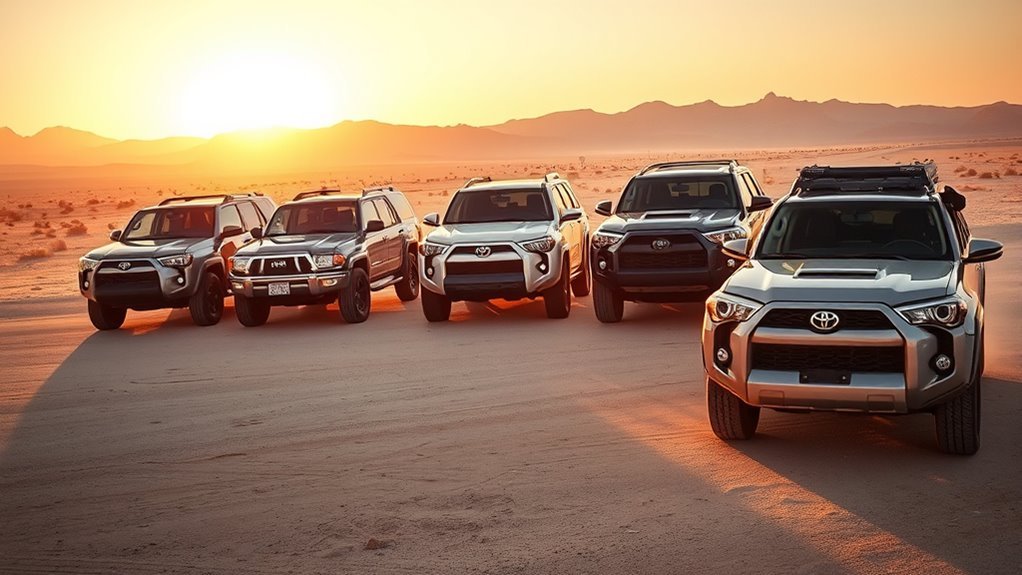
You’ll find Toyota 4Runner generations mapped by years and key traits: 1st/2nd Gen (1984–1995) with removable tops and early carbureted/EFI engines; 3rd Gen (1996–2002) with the durable 3.4L V6 and Tacoma parts sharing; 4th Gen (2003–2009) introducing V8 options and a comfort focus; 5th Gen (2010–2024) modernized for durability; 6th Gen (2025–present) on the TNG‑F chassis with a turbo four and advanced safety — keep going to see practical buying and maintenance implications.
Quick Guide : Toyota 4Runner Generations (Year Ranges)
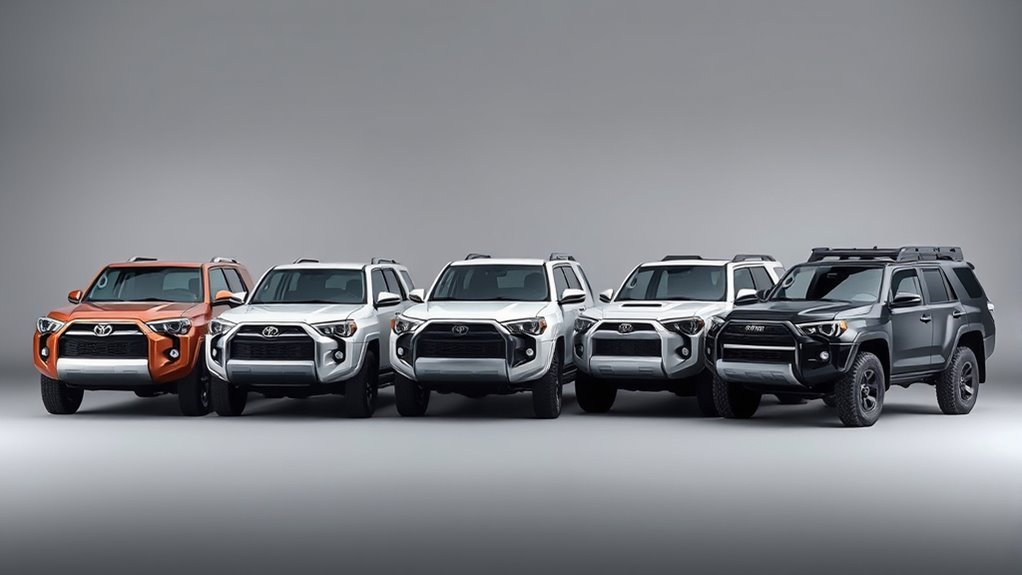
For a clear overview, here’s a concise guide to Toyota 4Runner generations and their year ranges so you can quickly identify which model fits your needs. You’ll see a design evolution from compact pickup-derived shells (1984–1989) to a distinct SUV body (1990–1995), a popular third-gen run with a durable 3.4L V6 and improved off road features (1996–2002), a platform and power upgrade adding a V8 option with comfort emphasis (2003–2009), and a rugged, modern fifth generation that prioritizes durability and updated styling (2010–2024). Evaluate engine options across generations—early four-cylinders, the reliable 3.4L V6, later V6 and V8 choices—to match power needs and fuel tradeoffs. Note market trends: buyers shifted from utility to lifestyle off-road capability, then toward refined daily drivers that still go off pavement. Use this guide to liberate your choice: pick the generation that balances mechanical simplicity, off road features, and modern amenities you value.
1st & 2nd Gen (1984–1995): Removable Top, Early Engines, and Buying Tips
One standout feature of the 1st‑ and 2nd‑generation 4Runners (1984–1995) is their tangible simplicity: you get a straightforward platform with removable hardtop features that let you convert an enclosed SUV into an open, utilitarian rig. Early powertrains were basic—the carbureted 2.4L 22R I4 made about 96–100 hp, later EFI versions reached roughly 116 hp—while the 2nd gen added a 3.0L V6 option for more torque and towing capacity. You’ll evaluate these trucks by examining body integrity, rust around joints and steel panels, and condition of fiberglass top sections. Check the swing‑out rear bumper option on 2nd gens for access and frame condition. If you seek liberation from modern complexity, focus on simple fixes: tune carburetors, verify EFI sensors, and prioritize durable suspension components. Consider modest engine performance upgrades only after confirming a solid block and drivetrain; bolt‑on intake and exhaust changes yield reliable gains without compromising the 4Runner’s original, serviceable character.
3rd Gen (1996–2002): 3.4L V6, Reliability, and Why Collectors Want It
Although it looks conservative next to flashier SUVs, the 3rd‑gen 4Runner (1996–2002) earns its reputation on measurable strengths: a torquey, long‑lived 3.4L V6, truck‑derived underpinnings shared with the Tacoma, and chassis components engineered for serious off‑road use. You’ll appreciate engine performance that routinely exceeds 300,000 miles with basic maintenance, delivering predictable torque for trails and towing. Shared parts mean robust aftermarket modifications and straightforward repairs, so you can free yourself from factory limits and customize suspension, armor, and driveline without chasing rare components. Collector trends push values up for clean, unmodified examples and capable restores alike; demand favors originality plus tasteful upgrades that preserve reliability. The interior balance of comfort and utility reinforces its appeal for liberated adventure. Evaluate candidates by frame integrity, head‑gasket history, and suspension wear to judge remaining service life and off road capabilities before investing.
| Strength | Impact |
|---|---|
| 3.4L V6 | Longevity |
| Tacoma parts | Serviceability |
| Chassis | Off road capabilities |
| Aftermarket | Customization |
| Market | Collector trends |
4th & 5th Gen (2003–2024): V8 Debut, Facelifts, and Reliability Notes
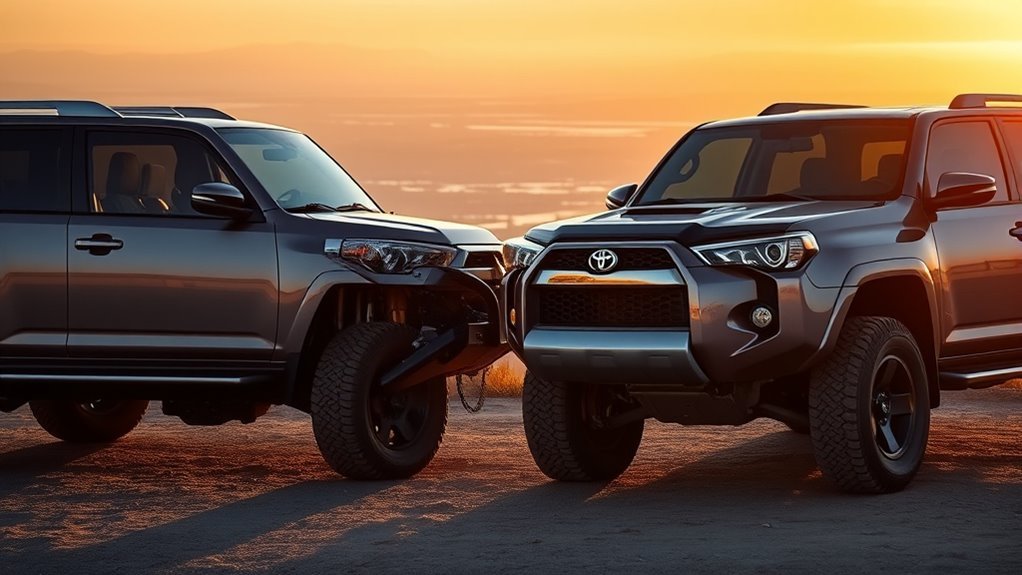
The 4th and 5th‑generation 4Runners (2003–2024) introduced a V8 option, mid‑cycle facelifts, and incremental tech upgrades while preserving the platform’s core durability and off‑road geometry. You’ll find the 2003–2009 4th Gen added a V8 for genuine V8 performance and towing muscle while keeping the proven V6. The 2006 facelift tightened aesthetics and updated fitment without compromising frame or suspension geometry critical to Off road capabilities.
From 2010 onward, the 5th Gen stretched over 14 years, refining reliability and durability; many examples surpass 300,000 miles. Toyota layered in advanced safety and infotainment tech to satisfy liberated, tech‑minded drivers, yet kept skid plates, locking diffs, and high‑clearance suspension intact. Evaluatively, these generations balance modernization with conservative engineering: you get increased power options, incremental tech, and retained mechanical simplicity. For buyers seeking long‑term ownership and genuine off‑road performance, these 4Runners remain a pragmatic, resilient choice.
6th Gen (2025–Present): TNG‑F Platform, Turbo 4‑Cylinder, and What Buyers Should Know
After a long run of conservative mechanical evolution, Toyota reworks the 4Runner for 2025 on the TNG-F platform shared with Tacoma, Tundra, and Sequoia, bringing a modernized structure and chassis stiffness improvements that support both on-road refinement and off-road loads. You’ll notice the shift to a turbocharged 4‑cylinder powerplant designed for turbo benefits: improved torque delivery, lower mass, and measurable fuel efficiency gains versus the old V6. Off road enhancements retain crawl capability while the stiffer platform reduces body twist under load. Tech integration arrives via advanced safety and driver‑assist systems, matching contemporary expectations without diluting ruggedness. For buyers seeking liberation from compromise, the 6th Gen balances daily refinement and trail readiness. Evaluate payload, towing, and optional equipment closely; drivetrain tuning and cooling options will determine real-world trail performance and long‑term economy. The 4Runner’s new equation is efficiency plus capability — decide which tradeoffs suit your autonomy goals.
| Feature | Impact | Consideration |
|---|---|---|
| Turbo benefits | Higher torque | Cooling needs |
| Off road enhancements | Better chassis rigidity | Added weight |
| Tech integration | Safety gains | Complexity tradeoff |
Frequently Asked Questions
What Aftermarket Lift Kits Fit Each 4runner Generation?
You’ll find lift kit compatibility varies by generation: choose generation-specific kits; consider installation considerations, suspension upgrades, and off road performance trade-offs. You’ll evaluate clearances, steering, brakes, and drivetrain to liberate your 4Runner confidently.
Which Model Years Have Factory Rear Lockers?
You’ll find factory rear lockers on 1984–2002 (solid-axle Hilux/Runx era) and selectively 2010–present models with optional TRD off-road packages; rear locker advantages include traction, stability; factory options guarantee integration, reliability, maintainability.
What Are Common Rust-Prone Areas by Generation?
Frame rails, rockers, wheel arches, rear quarter panels, door bottoms, and tailgate commonly rust; you’ll inspect, apply rust prevention, and use repair techniques like rust conversion, welded patch panels, and seam sealing to regain structural freedom and longevity.
How Do Parts Costs Compare Across Generations?
Like a roadmap, you’ll find newer generations costlier for OEM parts but easier for parts availability; older ones cut maintenance expenses with cheaper used parts yet demand more labor and time, so your budget and freedom guide choices.
Which Generations Offer Best Towing Capacity Stock?
You’ll find fifth- and fourth-generation 4Runners offer the best towing capacity stock; they combine towing features, robust engine options, and reinforced frames, so you can confidently haul heavier loads and reclaim freedom on rugged routes.
Conclusion
You’ve seen how the 4Runner evolved from removable tops and carbureted engines to the modern TNG‑F platform and turbo four-cylinders. Consider this: over 40% of 4Runners on the road are older than 15 years, underscoring their longevity but also the higher maintenance needs of vintage models. Use that durability statistic to weigh restoration versus replacement parts when buying—prioritize proven mechanical simplicity and documented service history for best long-term value.