You need both: towing capacity tells you the maximum trailer weight your vehicle can pull, while GCWR limits the combined weight of truck, passengers, cargo, and trailer so you don’t overload the driveline, brakes, or axles. Calculate tow rating as GCWR minus GVWR, watch tongue weight (10–20% of trailer), and keep axle loads under GAWR. Don’t assume limits—weigh and leave a safety buffer, and if you keep going you’ll get step‑by‑step sizing and checklist tips.
Quick Answer: Towing Capacity vs GCWR
Think of towing capacity as the maximum weight your vehicle can pull, and GCWR (Gross Combined Weight Rating) as the absolute limit for the combined weight of your vehicle, trailer, passengers, and cargo. You’ll use towing capacity to set the trailer’s loaded weight; you’ll use GCWR to guarantee the combined system doesn’t exceed safe limits. Calculate towing capacity by subtracting your vehicle’s GVWR from its GCWR—e.g., a 7,200 lb GVWR with 16,400 lb GCWR yields a 9,200 lb tow limit. Don’t let towing myths lull you into overloading: factory ratings aren’t conservative suggestions, they’re legal and mechanical boundaries. You’ll also manage weight distribution to preserve handling and avoid exceeding tongue weight or axle loads. Exceeding towing capacity compromises brakes and drivetrain; exceeding GCWR degrades control and may incur penalties. You’re liberated when you tow within ratings—predictable performance, lawful operation, and the freedom to move without risking yourself or others.
Key Definitions: GVWR, GCWR, Tow Rating, Tongue Weight
When you’re preparing to tow, four ratings govern what’s safe and legal: GVWR importance, GCWR implications, Tow rating overview, Tongue weight significance. You’ll treat GVWR as the manufacturer-set ceiling for your vehicle’s curb weight plus passengers and cargo; exceeding it risks structural damage and regulatory penalties. GCWR tells you the combined allowable mass of truck plus trailer and cargo; its implications reach drivetrain limits, cooling capacity, and braking performance. Tow rating gives a practical cap on trailer mass—the calculable margin between GCWR and GVWR—so you’ll know the legal tow limit for your setup. Tongue weight significance lies in stability: the downward hitch force, typically 10–15% of trailer weight, prevents sag, sway, and overloaded rear axles. You’ll monitor each rating together; surpassing any one creates cascading hazards. Use these definitions as operational constraints, not suggestions, to maintain control and preserve your freedom to tow safely.
How the Math Links GVWR, GCWR, and Tow Rating
Although the labels can seem abstract, the math tying GVWR, GCWR, and your tow rating is straightforward: tow rating = GCWR − GVWR, so you always subtract the vehicle’s maximum loaded weight from the combined-vehicle limit to find the maximum trailer mass. You use the GVWR implications to track payload consumed by passengers, cargo, and tongue weight; that consumption reduces allowable trailer mass directly. GCWR limitations define the absolute combined ceiling for vehicle plus trailer; you can’t exceed that without risking drivetrain, brake, and handling failure.
Practically, calculate GVWR used: curb weight + occupants + cargo + tongue weight. Subtract that from GCWR to get your tow rating. If tongue weight rises, your tow rating falls. This math frees you to make intentional choices: load selectively, manage tongue weight, or downsize trailer load. It’s precise, unambiguous, and protects vehicle integrity while maximizing liberated mobility within safe limits.
Sizing a Trailer With GCWR and Your Tow Rating
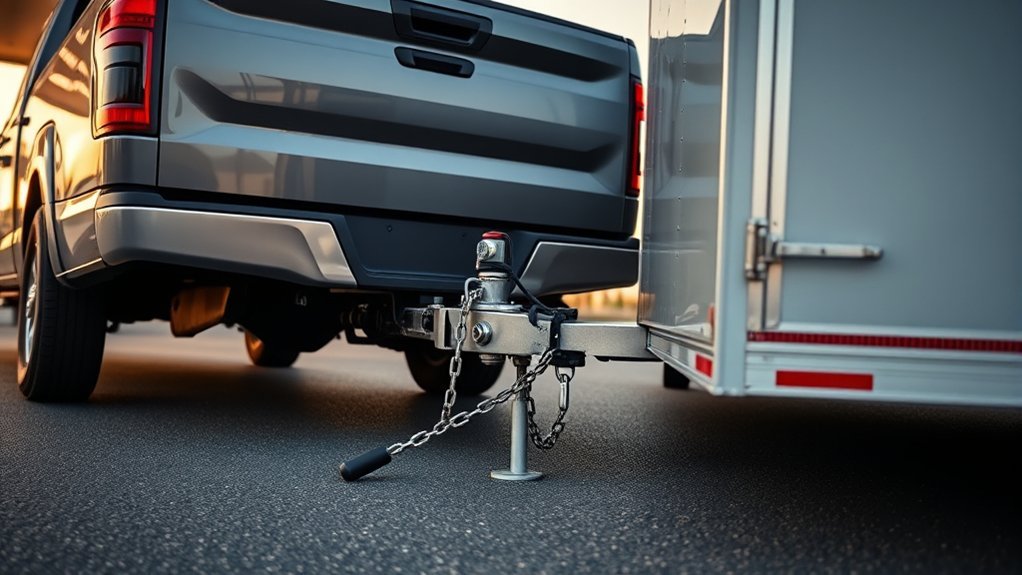
Match the combined trailer and payload to your vehicle’s GCWR so the total never exceeds that limit. Then size the trailer so its loaded weight stays below your tow rating, leaving a safety buffer for tongue weight (15–20%) and unexpected cargo. That buffer guarantees you don’t overload the hitch, drivetrain, or brakes and preserves safe performance.
Match GCWR To Load
If you want to size a trailer to your vehicle, start by subtracting your GVWR from the GCWR to determine the absolute maximum trailer weight you can tow, then guarantee the combined weight of the trailer, its cargo, and any passengers in the tow vehicle stays below that figure. Use that result as a hard cap; it preserves towing safety and prevents drivetrain or brake overload. Factor in realistic cargo weights and check them on a scale—manufacturer specs can mislead. Pay attention to tongue load and overall weight distribution to maintain control and legal compliance. Don’t ignore passenger load when calculating. Aim for measured freedom: match GCWR to your actual load precisely, not theoretically, so you tow confidently and without compromise.
Allow Tow Rating Buffer
When sizing a trailer, leave a meaningful buffer below your vehicle’s tow rating—aim for at least 1,000 lb less than the maximum—to account for cargo, gear, and real-world variances. You’ll calculate maximum tow rating by subtracting GVWR from GCWR, then target a trailer weight roughly 60–70% of that rating to preserve handling and control. Factor tongue weight as 15–20% of trailer weight; it consumes vehicle capacity and affects payload distribution. Monitor actual curb, cargo, and trailer weights with scales before every trip so you don’t unknowingly exceed limits. By keeping conservative margins and verifying figures, you free yourself from risky compromises and maintain confidence that your rig stays within safe, legal vehicle capacity and towing parameters.
Step-by-Step Example: Truck + Camper Calculation
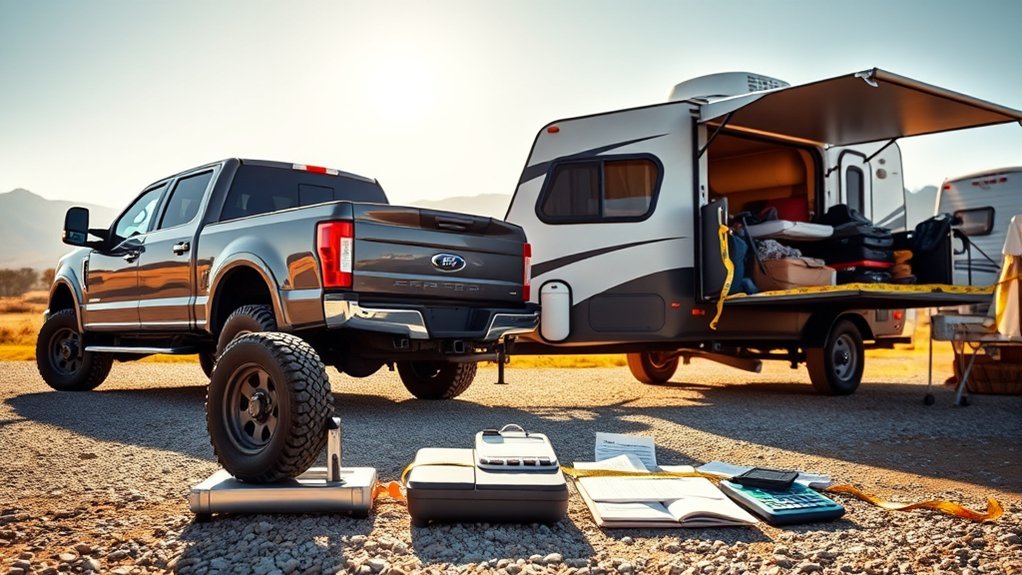
Because you need clear numbers before hitching up, we’ll walk through a concrete truck-plus-camper calculation using GVWR and GCWR to find towing capacity, then factor in curb weight, payload (including tongue weight), and a safety buffer so you don’t exceed ratings. Start with GCWR 16,400 lbs and GVWR 7,200 lbs: towing capacity = 9,200 lbs. Subtract the truck’s curb weight and occupants to see remaining tow allowance. For liberation, take control with precise payload management: include passengers, cargo, and tongue load.
| Item | Value |
|---|---|
| GCWR − GVWR (towing cap) | 9,200 lbs |
| Recommended camper UVW limit | ≤ 8,200 lbs |
| Tongue weight (15–20%) | counts against payload |
Keep camper weight at least 1,000 lbs below max tow rating to allow gear. Regularly weigh truck and camper on a scale to verify totals and stay within manufacturer ratings.
Safety Constraints: Tongue Weight, Payload, and GAWR
You’ve already worked out your towing ceiling from GCWR and GVWR; now focus on how tongue weight, payload, and GAWR limit what you can safely carry and tow.
You must allocate tongue weight equal to roughly 10–15% of trailer mass for stability; exceeding that range destabilizes steering and braking. Calculate payload as all onboard mass—passengers, cargo, aftermarket gear—and add the trailer tongue weight. That combined figure must stay within GVWR and each axle’s GAWR. GAWR is non-negotiable: distribute load to keep individual axle loads under their ratings to prevent axle failure, degraded handling, and accelerated component wear. Use conscious weight distribution to shift mass fore or aft and maintain proper tongue weight without overloading axles. Preserve safety margins by derating capacities—avoid planning to the absolute maximum. By respecting TW percentages, payload limits, GAWR, and conservative safety margins, you retain control, reduce mechanical risk, and liberate yourself to tow with confidence.
Common Mistakes and a Pre-Tow Checklist
Don’t confuse GCWR with towing capacity—you’ll risk overloading if you ignore the combined weight of vehicle, passengers, cargo, and trailer. Before you hitch up, verify GVWR, GCWR, payload, and tongue weight against the actual measured weights. Perform a pre-tow inspection: weigh the loaded vehicle and trailer, check tire pressures, brakes, lights, and hitch security to guarantee compliance and safe towing.
Common Weight Calculation Errors
When calculating whether your vehicle can safely tow a load, many people make predictable errors that turn sound math into risky assumptions: they rely only on GVWR, forget to add passengers and cargo, ignore tongue weight, and trust manufacturer trailer specs instead of weighing the rig. You must reject towing myths that simplify limits to a single number. Calculate GCWR by adding vehicle curb weight, passengers, cargo, and actual trailer weight measured on a scale. Include tongue weight (15–20% of trailer mass) when evaluating payload and hitch load. Verify weight distribution front-to-rear and side-to-side to maintain steering and braking control. Use this disciplined approach to free yourself from false confidence and tow within engineered limits.
Pre-Tow Vehicle Inspection
Before you hitch up, run a disciplined pre-tow inspection that confirms the vehicle and trailer match legally and mechanically: check GVWR and GCWR to verify they exceed trailer plus cargo weight, preventing overload. Verify hitch and accessories match vehicle specs and are torqued to spec to avoid failures. Inspect lights, brakes, and safety chains; confirm operation before moving. Check tire pressure and condition on both tow vehicle and trailer — underinflation compromises control and capacity. Determine tongue weight, targeting 15–20% of trailer weight to stabilize towing and reduce sway. These steps tie towing safety to rigorous vehicle maintenance. Avoid assumptions; document measurements and correct deficiencies so you remain free to travel with confidence.
Frequently Asked Questions
Does a 4000 Pound Trailer Need a Weight Distribution Hitch?
Yes—you should consider a weight distribution hitch for a 4,000-pound trailer if tongue weight exceeds about 400–600 pounds; it improves trailer stability, offers hitch advantages like reduced sag, better handling, braking, and sway control.
Is GCWR the Same as Towing Capacity?
No — GCWR and towing capacity differ: if you probe towing terminology, you’ll find GCWR covers combined weight while towing capacity equals GCWR minus vehicle GVWR; respect weight limits, and you’ll stay safely liberated.
Conclusion
You now know GCWR limits the combined weight of truck and trailer, while towing capacity tells you how much the vehicle can pull. Remember tongue weight should be 10–15% of trailer weight and payload must cover hitch load plus passengers and cargo. Notably, nearly 30% of light-truck accidents involving trailers cite improper weight distribution as a factor — so always run the numbers, confirm GVWR/GAWR, and stay within both tow rating and GCWR before you hitch up.