Choosing between 2H, 4H, and 4L in a Toyota 4Runner is mainly about matching the transfer-case setting to available traction and the amount of low-speed torque you need. One important detail comes first: Toyota has used several 4WD systems across different 4Runner years and trims. This guide focuses on part-time 4WD 4Runners equipped with 2H, 4H, and 4L. Full-time 4WD models use different controls and should be operated according to their specific owner’s manual.
Quick Answer
Use 2H for normal paved-road driving, 4H when driving on loose or slippery surfaces that allow some tire slip, and 4L for slow, difficult terrain where extra wheel torque and control are needed. Avoid part-time 4H or 4L on dry, high-grip pavement.
Key Takeaways
- 2H: Best for normal dry pavement and most everyday driving in a part-time 4WD 4Runner.
- 4H: Best for snow, ice, gravel, dirt, sand, mud, and other surfaces where the tires can slip enough to relieve driveline stress.
- 4L: Use for low-speed rock crawling, steep climbs or descents, deep mud or sand, recovery situations, and other conditions requiring greater wheel torque.
- Do not confuse a shift-speed limit with a 4H driving-speed limit. Toyota’s allowable 2H-to-4H engagement speed varies by model year and selector design.
- Model year matters: Fifth-generation and 2025+ 4Runners differ in how Multi-Terrain Select and other off-road systems operate.
At a Glance
| Time Required | A few seconds for 2H/4H selection; roughly 1–2 minutes when stopping and shifting into or out of 4L |
| Difficulty | Easy, provided you follow the correct model-specific shift procedure |
| Tools Needed | No tools; use the 4WD selector and your model-year owner’s manual for exact operating limits |
| Cost | $0 |
Warning: Do not use a part-time 4Runner’s 4H or 4L on dry, high-traction pavement unless Toyota specifically permits it for your drivetrain. Part-time 4WD couples the front and rear driveline closely enough that normal differences in axle speed while turning can create driveline wind-up when the tires cannot slip.
Pick the Right Mode Now: Quick 2H / 4H / 4L Decision Guide

Which drive mode should you pick right now? On a part-time 4WD 4Runner, start with the road surface rather than the weather forecast.
| Mode | Best Use | Avoid |
| 2H | Normal dry pavement, ordinary commuting, and paved-road driving when traction is adequate | Deep snow, loose sand, difficult mud, or terrain where two driven wheels cannot maintain traction |
| 4H | Snow, ice, gravel, dirt, loose sand, muddy tracks, and other low-traction surfaces that permit tire slip | Dry, high-grip pavement on part-time 4WD models |
| 4L | Rocks, steep grades, deep mud or sand, difficult recoveries, controlled descents, and other slow-speed obstacles | Normal road speeds and high-grip pavement |
2H drives the rear axle on part-time 4WD models and is the normal setting for paved roads. It reduces unnecessary front-driveline operation and is Toyota’s recommended setting for normal hard-surfaced-road driving.
4H engages four-wheel drive without selecting the transfer case’s low range. It is useful when additional traction is needed but you still need normal road or trail speeds. Think snow-covered roads, loose gravel, dirt, sand, or mud rather than ordinary dry asphalt.
4L selects low-range gearing. It is not simply “more 4WD.” Low range changes the gear reduction so more torque reaches the wheels at lower vehicle speeds, giving the driver finer throttle control over rocks, steep slopes, deep mud, and difficult recovery situations.
Note: A wet paved road does not automatically mean you should select part-time 4H. If the tires still have strong grip, stay in 2H. Consider 4H when the surface is genuinely slippery enough to permit tire slip, such as snow, ice, slush, loose gravel, mud, or similar conditions.
What Happens in 2H, 4H, and 4L: Power, Torque, and Limits
When you switch among 2H, 4H, and 4L, you are changing how the transfer case sends engine output to the axles and, in low range, how much gear reduction occurs before that power reaches the wheels.
- 2H: The rear wheels provide propulsion on a typical part-time 4WD 4Runner. This is the normal mode for paved-road use.
- 4H: The transfer case engages the front drivetrain so both axles can contribute traction. Because a part-time system does not behave like an unlocked full-time center differential, tire slip is needed to release differences in front-to-rear driveline speed during turns.
- 4L: Four-wheel drive remains engaged while low-range gearing multiplies torque delivered at the wheels. Engine horsepower does not suddenly increase; the transfer-case reduction trades vehicle speed for greater wheel torque and more precise control.
That is why 4L can feel dramatically stronger at crawling speed even though the engine itself is producing the same basic output. The vehicle travels less distance for each engine revolution, making throttle inputs easier to control during technical off-road driving.
4Runner Model-Year Differences You Need to Know
One reason 4Runner 4WD advice becomes confusing is that Toyota changed the system substantially with the redesigned 2025 model. Even within earlier model years, selector types and trim equipment differ.
2010–2024 Fifth-Generation Part-Time 4WD
On equipped fifth-generation part-time 4WD models, Toyota uses 2H/H2, 4H/H4, and 4L/L4. Toyota documentation describes H4 as a setting for roads or tracks that permit tire slip, including off-road, icy, and snow-covered surfaces.
Multi-Terrain Select on equipped fifth-generation models operates with the transfer case in 4L and Crawl Control off. Depending on model year and selector design, Toyota’s quick-reference information has also listed different maximum engagement speeds for shifting from 2H to 4H. For example, some lever-type systems specify below 50 mph, while some rotary-selector systems specify below 62 mph.
2025 and Newer Sixth-Generation 4Runner
The redesigned 4Runner is available in 2WD, part-time 4WD, and full-time 4WD configurations. Toyota’s 2025 technical material specifically notes that Multi-Terrain Select on equipped sixth-generation models can now function in both 4WD HI and 4WD LO. A-TRAC is associated with 4WD LO on applicable part-time 4WD models.
That means advice such as “MTS only works in 4L” can be correct for an older 4Runner and incorrect for a newer one. Always identify your model year and drivetrain before applying transfer-case or traction-control instructions.
Pro Tip: Before an off-road trip, learn which 4WD selector your exact 4Runner uses and practice engaging 4H and 4L in a safe, low-traction area. It is much easier to learn the indicator-light sequence before you are stuck on a trail.
How to Shift Between 2H, 4H, and 4L: Safe Step-by-Step
Exact limits differ by generation and selector, but the following procedure captures the important safety steps used by Toyota’s part-time 4WD systems.
[Products Worth Considering]

Upgrade your Toyota 4Runner with these heavy duty roof rack cross bars designed for raised side rails and secure cargo transport. The aluminum construction, anti-theft locking system, and tie-down loops help keep gear stable on the road while the low-profile design helps reduce wind noise. Easy to install with no drilling required, they provide a durable and convenient solution for road trips, hauling, and outdoor adventures.
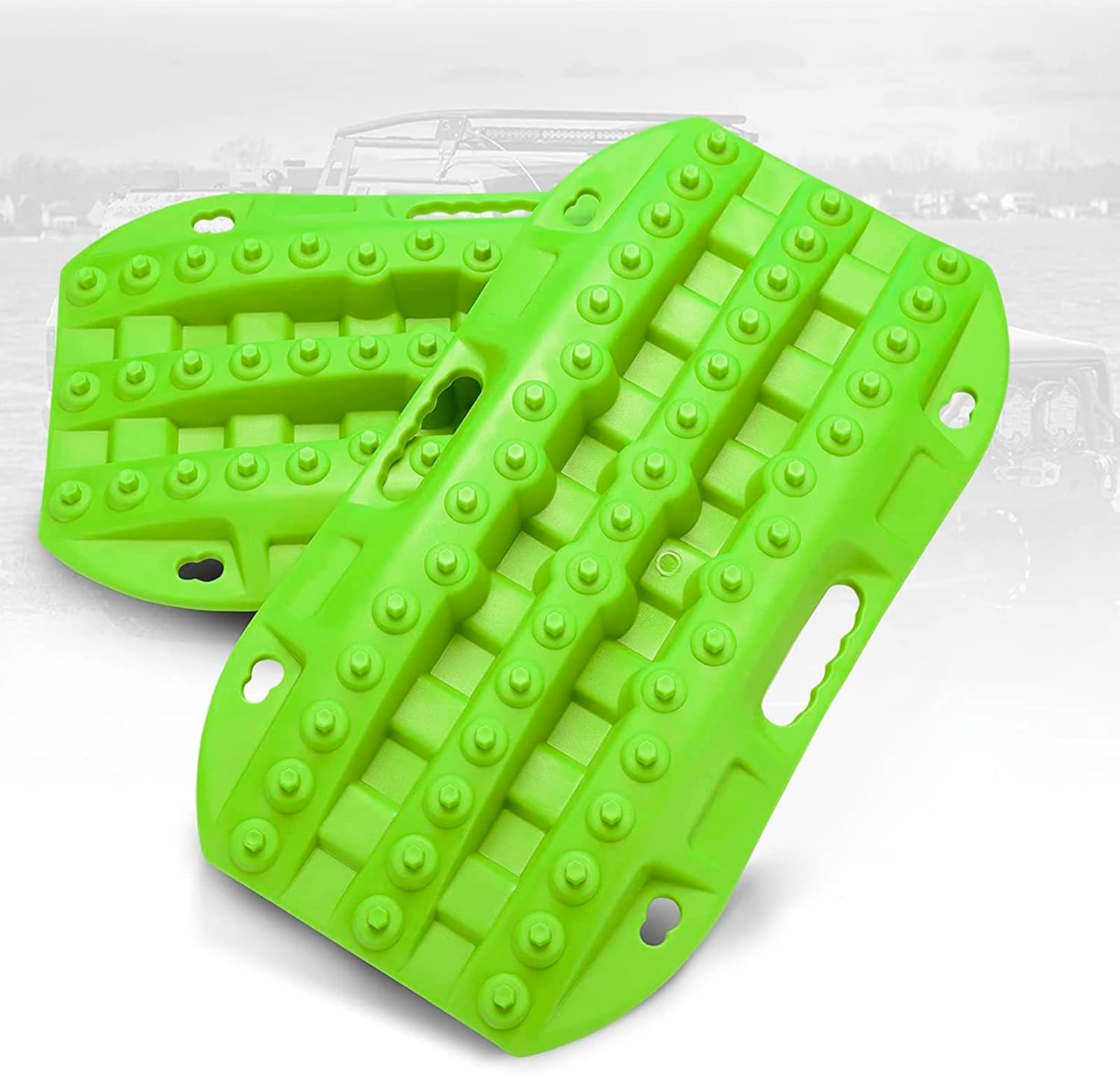
These short recovery traction boards are designed to help ATVs, UTVs, and other off-road vehicles regain grip in mud, sand, and snow. Built with strengthened teeth and a durable polypropylene construction, they provide reliable traction, easy handling, and year-round performance in tough conditions. Their nested, space-saving design and integrated shovels make them practical for carrying and using on remote adventures.

These off-road traction boards are designed to help vehicles recover from mud, sand, and snow with reliable grip and easier ramp-up. Their double-sided diamond construction, cross-shaped teeth, and contoured ramps improve traction while the durable polypropylene build stays flexible in harsh conditions. Convenient mounting points, ergonomic handles, and a visible leash make them practical to carry, store, and retrieve when recovery is needed.
How to Shift From 2H to 4H
- Make sure the wheels are not spinning or slipping excessively.
- Drive as straight as practical.
- Reduce speed below the engagement limit specified for your model and selector.
- Select 4H using the lever or rotary 4WD control.
- Watch the 4WD/4HI indicator and make sure the shift completes before relying on four-wheel drive.
Some fifth-generation selector types permit a 2H-to-4H shift only below 50 mph, while another Toyota selector design permits the shift below 62 mph. The number is an engagement-speed limit, not permission to ignore road conditions or a universal maximum speed for operating in 4H.
How to Shift From 4H to 2H
- Reduce speed if required by your particular system.
- Keep the vehicle traveling smoothly with the wheels under control.
- Select 2H.
- Confirm that the 4WD indicator goes out or changes to the expected 2H indication.
How to Shift From 4H to 4L
- Bring the 4Runner to a complete stop.
- Keep the brake pedal depressed.
- Shift the automatic transmission into N (Neutral).
- Select 4L.
- Wait until the 4LO indicator confirms that low range has fully engaged.
- Only then select the appropriate transmission gear and continue at low speed.
How to Shift From 4L Back to 4H
- Stop completely.
- Keep your foot on the brake.
- Shift the transmission into N.
- Select 4H.
- Wait for the 4LO indicator to go out and the proper 4H indication to appear before moving normally.
Warning: Never command a 2H/4H change while the tires are spinning freely. Toyota specifically warns against operating the 4WD selector while the wheels are slipping or spinning. Stop the wheelspin first.
Real Scenarios: Which Mode to Use on Slippery Roads, Sand, Rocks, and Steep Climbs
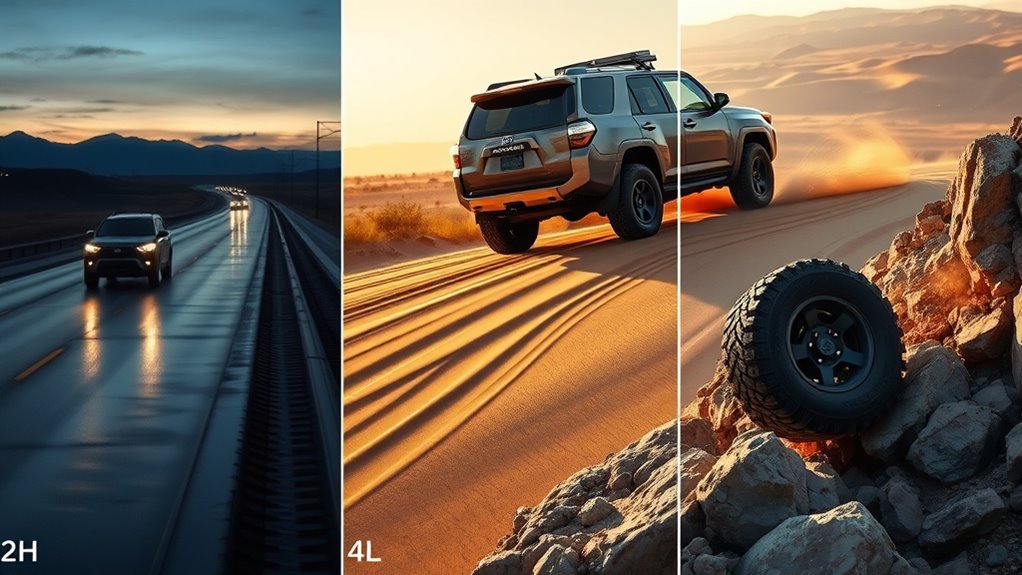
Pick the drive mode according to how much traction the surface provides and whether you need normal-speed four-wheel drive or low-range torque.
| Situation | Typical Choice | Why |
| Dry pavement | 2H | Normal traction; avoids unnecessary part-time 4WD driveline stress |
| Ordinary wet pavement | Usually 2H | Rain alone does not mean the tires can safely relieve part-time driveline wind-up |
| Snow, ice, or slush | 4H | Four driven wheels can improve propulsion where the surface permits tire slip |
| Gravel or dirt road | 2H or 4H | Use 4H when additional traction or stability is needed on the loose surface |
| Soft sand | 4H initially | Maintains momentum without immediately using low range; select 4L when low-speed torque becomes more important |
| Deep mud | 4H or 4L | 4H helps preserve momentum; 4L helps when the vehicle must crawl or pull through heavy resistance |
| Large rocks / rock crawling | 4L | Low range provides precise throttle control and greater wheel torque |
| Steep off-road climb | 4L | Greater gear reduction helps climb slowly without excessive throttle |
| Steep technical descent | 4L | Low gearing improves low-speed control and engine-braking effect |
Wet highway: Stay in 2H when the pavement still provides normal traction. If conditions change to snow, ice, slush, or another genuinely low-grip surface and your particular 4WD system permits it, 4H becomes useful.
Sand or beach driving: 4H is often appropriate when momentum is important. If the vehicle begins bogging down and you need slower movement with more wheel torque, stop and select 4L correctly. On equipped 2025+ models, MTS Sand may be available in 4H; older fifth-generation 4Runners generally require 4L for Multi-Terrain Select.
Rocks and steep terrain: 4L is the appropriate starting point when precision matters more than speed. Low range allows smaller throttle inputs while keeping useful torque at the wheels.
[Products Worth Considering]
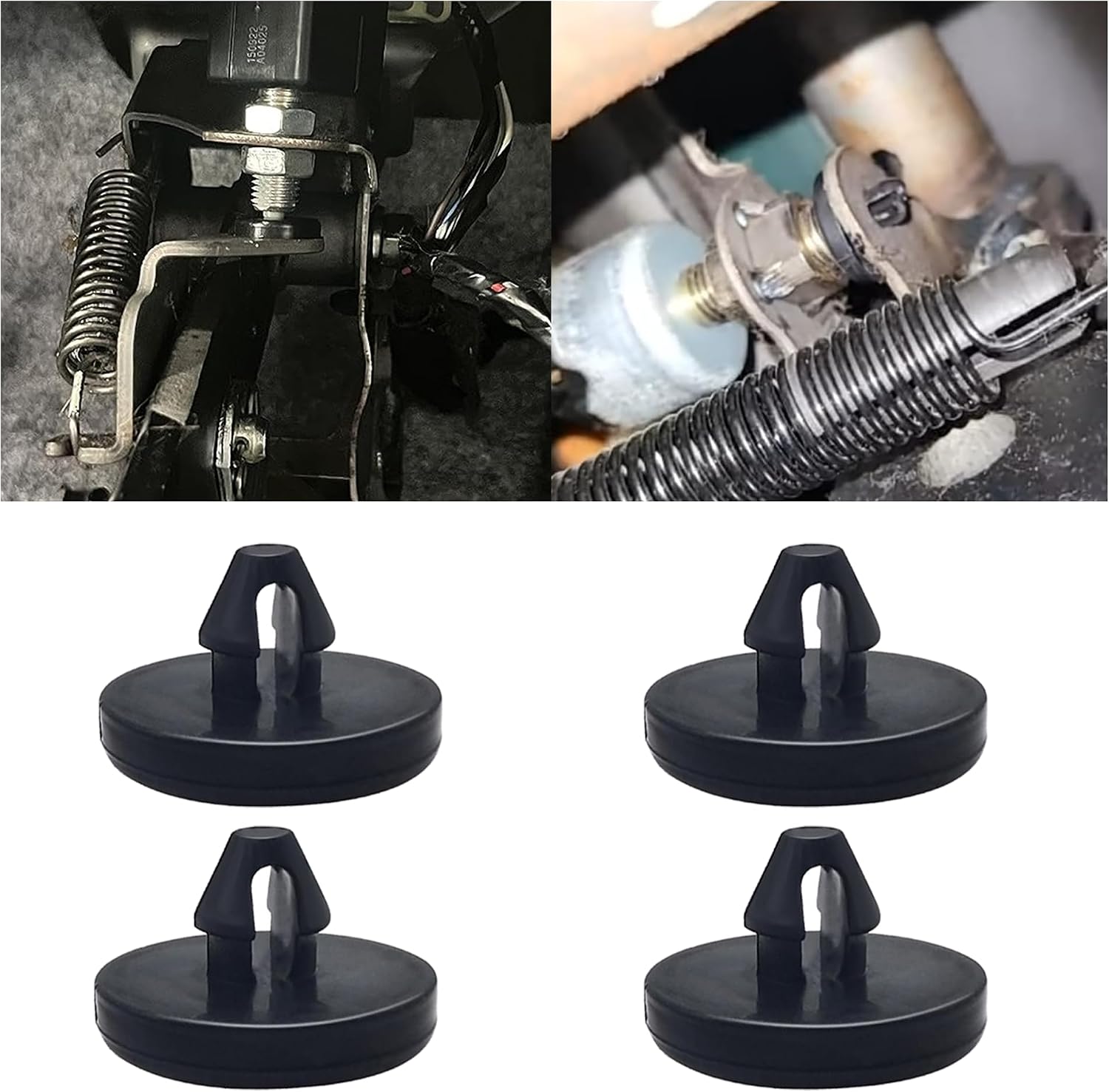
This brake pedal stop pad set is designed as an OEM replacement for compatible Toyota, Lexus, and Scion models, helping restore proper brake light switch function when the brake light stays on. Made from durable nylon, these compact stoppers are built for reliable long-term use and quick, tool-free installation. The set includes multiple pieces for convenient replacement and sharing.

The VIOFO A229 Pro delivers sharp front and rear recording with dual STARVIS 2 sensors, capturing vivid 4K and 2K footage for clearer license plates and road details day or night. HDR, voice control, 5GHz Wi‑Fi, and GPS logging make it easy to use and highly dependable for daily driving and parking protection. A built-in supercapacitor, loop recording, and included CPL filter further enhance reliability and video clarity in demanding conditions.
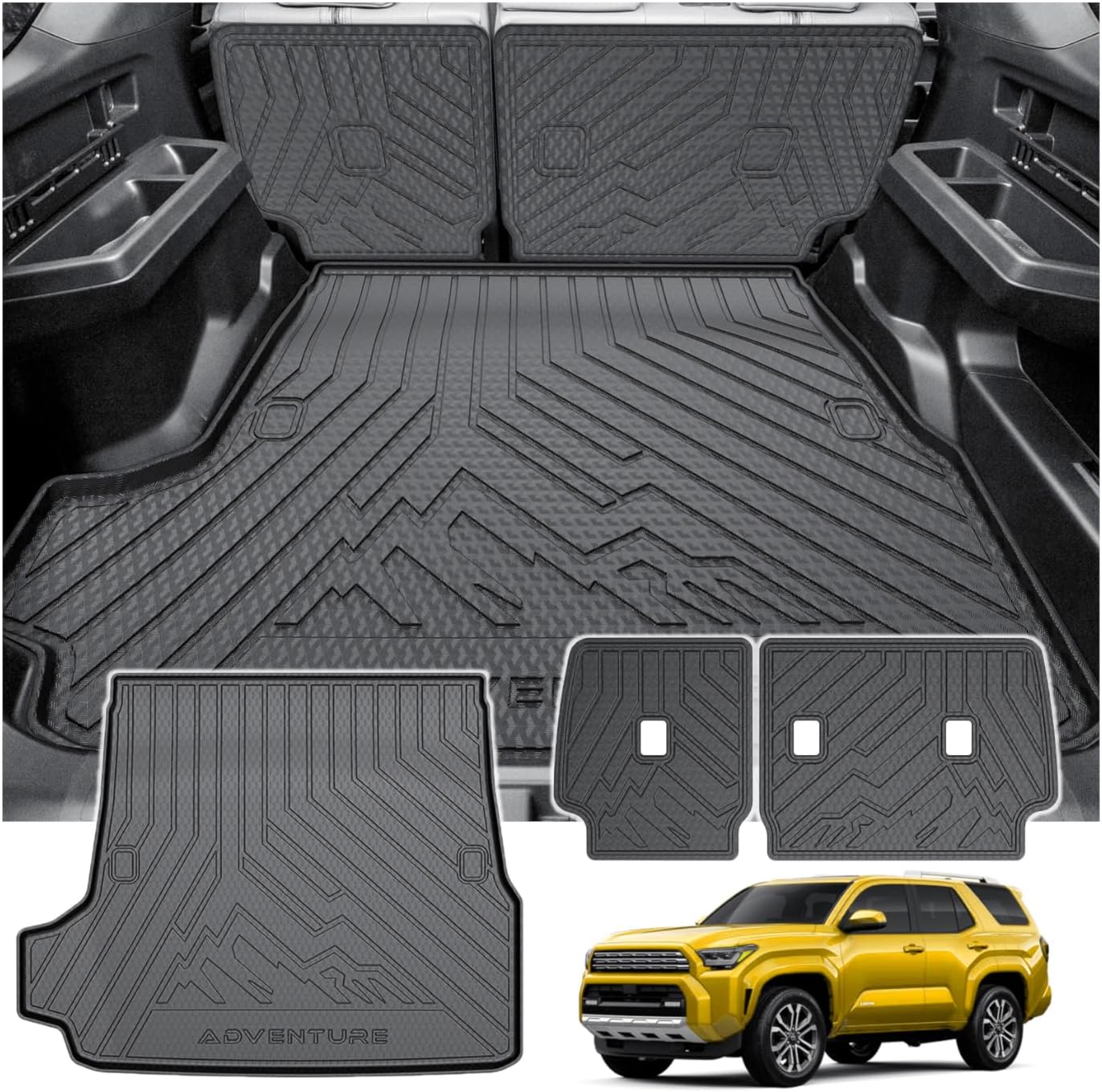
This custom-fit cargo mat is designed for 2025-2026 Toyota 4Runner gas models with 5 seats, offering full coverage for the trunk and back seat area. Made from durable TPE material with raised edges, it helps protect against mud, spills, dust, and everyday wear while staying easy to remove and clean.
Troubleshooting & Advanced Tips: Failed Shifts, MTS, A-TRAC, Crawl, and Rear Locker
The 4Runner’s off-road systems do different jobs. Understanding the difference helps you avoid using one feature as though it were another.
[Products Worth Considering]

The VIOFO A229 Plus delivers sharp 2K front and rear recording with dual Sony STARVIS 2 sensors for improved night clarity, reduced noise, and better motion handling. HDR support helps preserve license plate detail and balanced exposure in challenging light, while voice control, quad-mode GPS, and fast 5GHz Wi-Fi make daily use simple. With multiple parking modes and a user-friendly interface, it is built to protect your vehicle on the road and while parked.

The REDTIGER F9 dash cam captures road trips and daily driving in sharp front 4K and rear 1080P video, helping provide clear evidence in the event of an incident. Built with 5.8GHz WiFi, GPS tracking, wide-angle coverage, loop recording, G-sensor protection, and parking mode, it offers reliable all-around monitoring and easy smartphone access through the app.

These X-BULL recovery traction tracks help drivers get unstuck from sand, snow, mud, or ice with a stable U-shaped elastic design and a wavy ramp that makes tire entry easier. Built from reinforced nylon, they are flexible, impact-resistant, and designed to perform in extreme temperatures while providing reliable emergency traction for a wide range of vehicles.
Flashing 4HI or 4LO Indicator
A flashing indicator usually means the commanded transfer-case change has not finished. Do not assume four-wheel drive or low range is engaged until the indicator reaches its normal steady state.
Depending on the system, Toyota may instruct you to drive straight ahead while gently accelerating or decelerating, or to move slowly forward or backward before stopping and retrying the shift. For a failed 4L engagement, stop completely, hold the brake, place the transmission securely in Neutral, and retry the selection.
If the 4WD indicators continue flashing rapidly, a buzzer persists, or the transfer case will not complete the shift after the prescribed procedure, have the system inspected rather than continuing as though the requested mode is active.
Multi-Terrain Select (MTS)
Multi-Terrain Select changes brake and traction-management strategies for specific surfaces. The available modes and transfer-case requirements depend heavily on model year.
- 2010–2024 equipped 4Runners: MTS operates in 4L, with modes intended for conditions such as mud and sand, loose rock, moguls, rock and dirt, and rock depending on model year.
- 2025+ equipped 4Runners: Toyota expanded MTS so it can operate in both 4WD HI and 4WD LO, with available terrain selections changing according to transfer-case position.
A-TRAC
Active Traction Control (A-TRAC) is brake-based traction management. When a wheel spins, the system can apply braking to that wheel so usable drive force can be directed to wheels with better grip.
A-TRAC should not be described as a mechanical locker. It can produce a similar practical benefit in some cross-axle situations, but it does so electronically through brake intervention rather than physically locking two axle shafts together.
Crawl Control
Crawl Control is designed for difficult terrain at very low speed. It automatically manages acceleration and braking so the driver can concentrate primarily on steering. On relevant fifth-generation 4Runner configurations, Toyota requires the transfer case to be in L4 for Crawl Control operation. Newer configurations should be operated according to their specific display and owner’s-manual instructions.
Rear Differential Locker
An electronic locking rear differential, when equipped, is different from A-TRAC. A true rear locker mechanically forces the rear axle shafts to rotate together, which can provide strong traction when one rear wheel becomes unloaded.
Use the rear locker only under the operating conditions Toyota specifies and disengage it after clearing the obstacle. A locked differential can seriously affect turning behavior and should not be treated as an everyday traction mode on high-grip pavement.
Vehicle Stability Control in 4L
On applicable Toyota part-time 4WD systems, selecting low range automatically changes or disables parts of Vehicle Stability Control because off-road driving often requires more controlled wheel slip than normal paved-road stability programming allows. Indicator lights should tell you when these systems change state.
Four-wheel drive can improve the vehicle’s ability to move, but it cannot create tire grip. Braking, cornering, and stopping distance still depend heavily on the tires, surface, speed, and driver input.
Sources
- Toyota 4Runner Manuals and Warranties — official Toyota owner’s-manual access and fifth-generation operating information.
- Toyota 2023 4Runner Owner’s Manual — part-time/full-time 4WD, A-TRAC, rear differential lock, Crawl Control, and Multi-Terrain Select operation.
- Toyota 2020 4Runner Quick Reference Guide — selector-specific 2H/4H engagement speeds and low-range shifting procedure.
- Toyota 2025 4Runner Sales Consultant Guide — redesigned 4WD system, A-TRAC, and MTS operation in 4WD HI and 4WD LO.
- Toyota 4Runner — current drivetrain configurations, including 2WD, part-time 4WD, and full-time 4WD.
- Toyota USA Newsroom: 4Hi vs. 4Lo — Toyota’s overview of high- and low-range four-wheel drive.
Frequently Asked Questions
When should I use 4H and 4L in a Toyota 4Runner?
Use 4H on loose or slippery surfaces such as snow, ice, gravel, dirt, sand, and mud when normal-speed four-wheel drive is useful. Use 4L for difficult low-speed terrain such as large rocks, steep climbs or descents, deep mud or sand, and recovery situations where greater wheel torque and precise control matter.
Should I daily drive my 4Runner in 2H, 4H, or 4L?
For a part-time 4WD 4Runner, use 2H for ordinary paved-road driving. Do not daily-drive in 4L, and avoid part-time 4H on dry, high-traction pavement. Full-time 4WD 4Runners use a different drivetrain and are not governed by the same 2H advice.
Can I use 4H in the rain?
Rain by itself does not automatically require part-time 4H. If paved-road traction remains good, 2H is normally appropriate. Use 4H when the surface becomes sufficiently slippery to permit tire slip, such as snow, ice, slush, loose gravel, mud, or similarly low-grip conditions.
Can I shift a 4Runner from 2H to 4H while moving?
Many part-time 4Runner systems allow a 2H-to-4H shift while moving, but the permitted engagement speed depends on model year and selector type. Some fifth-generation systems specify below 50 mph, while another Toyota selector design permits the shift below 62 mph. Never shift while the wheels are spinning.
Can I drive in 4H on the highway?
4H can be appropriate at normal road speeds when the road surface is genuinely low traction, such as a snow-covered highway, and your owner’s manual permits it. Do not interpret a 50- or 62-mph engagement limit as a universal 4H cruising-speed limit, and do not use part-time 4H on dry high-grip pavement.
Why is my 4HI or 4LO light flashing?
A flashing light commonly means the transfer-case shift has not completed. Follow the model-specific procedure, which may involve driving straight briefly, moving slowly forward or backward, or stopping, selecting Neutral, and retrying low range. Persistent or rapid flashing may indicate a 4WD-system fault that needs inspection.
Does 4L give the 4Runner more horsepower?
No. Selecting 4L does not increase the engine’s rated horsepower. Low-range gearing provides additional gear reduction, which increases torque delivered at the wheels while reducing vehicle speed for a given engine speed.
Can I use Multi-Terrain Select in 4H on a 4Runner?
It depends on the generation. On equipped fifth-generation 2010–2024 4Runners, MTS operates in 4L. On the redesigned 2025-and-newer 4Runner, Toyota expanded MTS so equipped models can use it in both 4WD HI and 4WD LO, with different terrain modes available according to transfer-case position.
Conclusion
Think of your 4Runner’s transfer case as three tools for three different jobs. 2H handles normal paved-road driving, 4H adds four-wheel-drive traction on loose or genuinely slippery surfaces, and 4L trades speed for greater wheel torque and precise control when terrain becomes difficult. The most important rule is to match the mode to both the surface and your specific 4Runner’s drivetrain. Avoid part-time 4H and 4L on dry, high-grip pavement, complete every transfer-case shift before relying on it, and remember that fifth-generation and 2025+ 4Runners do not use every MTS, A-TRAC, Crawl Control, or 4WD feature in exactly the same way.