The Sonata Smartstream engine gives you a compact, efficiency‑first powertrain that uses CVVD, HTCS and dual injection to sharpen combustion, boost torque delivery and cut emissions. Thermal management and friction optimization reduce parasitic losses and improve longevity. Choose IVT for maximum mpg or the wet 8DCT for brisk shifts; the 1.6T balances peppy response with real‑world 33–36 mpg combined. Keep going to see how each system affects performance, economy and ownership trade‑offs.
What the Sonata Smartstream Engine Means for Drivers
For drivers, the Sonata’s Smartstream engine delivers measurable gains in efficiency and responsiveness you can feel in daily use. You’ll notice 36 MPG combined (CVT) and a 5% fuel-efficiency improvement from CVVD-driven timing, so commuting costs drop and range extends without compromise. The turbocharged 1.6L produces usable 120 hp and 113 lb-ft torque, sharpening throttle response and freeing you from sluggish starts. Dual injection and integrated thermal management cut emissions and stabilize operating temperatures, which reduces wear cycles and supports engine longevity—critical if you value independence from frequent repairs. Overall, the driver experience becomes more liberated: predictable acceleration, lower operating expense, and a design that prioritizes durable, efficient performance for routine mobility.
CVVD & HTCS: How the 1.6T Improves Combustion
You’ll see how Continuously Variable Valve Duration adjusts valve timing across loads to optimize combustion phasing and yield about 5% better fuel economy versus conventional timing. Paired with the High Tumble Combustion System’s controlled vortex generation, air‑fuel mixing and flame propagation become more stable and efficient. Together CVVD and HTCS raise power roughly 4% while cutting gas emissions by over 12%, improving throttle response and smoothness.
Variable Valve Duration
Although it varies valve duration continuously to match load, the Smartstream 1.6T pairs CVVD with a High Tumble Combustion System (HTCS) to directly improve mixing, burn stability, and thermodynamic efficiency. You’ll see CVVD perform valve optimization across the map: shortening duration under high load to boost torque and lengthening it at part-load to favor efficiency. That adaptive control raises engine performance and yields a roughly 4% power gain while enabling a 5% fuel-economy improvement and over 12% emissions reduction versus conventional timing systems. CVVD works with dual-port injection and HTCS so your air–fuel ratio stays stable and wall film is minimized, preserving combustion stability. For drivers seeking liberation, this precision control frees you from trade-offs between power and efficiency.
High Tumble Mixing
CVVD’s variable duration sets the stage, but HTCS is what actively sculpts in-cylinder airflow to make those timing changes effective. You’ll feel the difference as HTCS generates controlled high tumble vortices that accelerate mixing, reducing pockets of rich or lean charge and improving ignition stability. Combined with CVVD’s optimized valve duration, those vortices guarantee the air fuel distribution matches combustion timing, boosting thermal efficiency. Dual GDi/MPI injection feeds precise quantities to exploit the high tumble patterns while minimizing wall film. The result: a more responsive 1.6T that extracts 4% more power, achieves about 5% better fuel economy, and cuts emissions by over 12% versus conventional designs. This is engineering that frees you from compromise.
Dual Injection (GDi + MPI): Why It Boosts Power and Economy
You’ll see the Sonata’s dual injection pairs GDi and MPI to control where and how fuel is introduced, optimizing atomization and air–fuel homogeneity for different operating conditions. That precision raises peak power and throttle response while improving part-load efficiency—typically about a 5% fuel-economy gain versus single-injection setups. It also reduces particulate and port-deposit formation, cutting emissions and supporting longer-term combustion stability.
Dual Injection Basics
When you combine Gasoline Direct Injection (GDi) with Multi‑Port Injection (MPI), the Smartstream dual‑injection system tailors fuel delivery to operating conditions to sharpen power delivery and cut consumption. You get precise fuel atomization from GDi for high-load demands and MPI’s port injection for stable mixtures at low load, enabling Fuel Efficiency and Performance Optimization without compromise. The ECU switches or blends injections based on knock, load, and temperature, improving combustion stability and throttle response while minimizing carbon buildup on intake valves. That translated control yields up to ~4% performance gain versus single injection and over 12% lower emissions in tests, so you gain liberated control over economy and power through an integrated, condition‑adaptive fuel strategy.
Power And Efficiency
Having seen how GDi and MPI work together to match injection to load and temperature, let’s focus on how that pairing raises both output and efficiency. You gain measurable engine optimization because GDi delivers precise charge at high load while MPI supplies a homogenizing spray at low load, cutting wall film and stabilizing flame propagation. That duality suppresses knock, sharpens throttle response, and lets you exploit more aggressive ignition timing and higher effective compression without compromise. The result is a tangible power uplift alongside up to ~5% better fuel efficiency, and overall system gains translate into higher horsepower and sustained performance. You control a liberated powertrain: optimized fueling maps deliver consistent torque and efficient consumption under varied driving conditions.
Reduced Deposits And Emissions
Because Hyundai pairs GDi with MPI, the Sonata cuts intake-valve carbon buildup while also lowering tailpipe emissions. You gain a pragmatic system: GDi provides precise, high-pressure fueling for power, MPI delivers port fuel to wash valves and prevent deposit formation. This dual strategy sharpens air-fuel mixing, stabilizes combustion, and yields a measured ~4% power increase with ~5% better fuel economy versus single injection. You’ll see over a 12% reduction in regulated gas emissions, helping the engine meet stringent emission standards without sacrificing responsiveness. For a liberated driver focused on control and durability, the combined injectors reduce maintenance risk from carbon buildup and guarantee consistent performance across operating conditions, aligning efficiency with regulatory compliance.
ITMS & FOMS: Thermal Control and Friction Reduction Explained
Although it’s easy to overlook them, ITMS and FOMS are core to the Smartstream engine’s gains in efficiency and durability: you get targeted coolant efficiency and measurable friction reduction that free the engine to perform with less waste. ITMS uses a 3-way valve to route coolant where and when it’s needed, trimming warm-up time, improving HVAC responsiveness, and claiming up to a 1% fuel economy gain by minimizing thermal losses across driving conditions. FOMS cuts the friction coefficient by 34% via lightweight components and advanced coatings, lowering parasitic losses and wear. Together they reduce energy loss, extend component life, and tighten emissions margins. You benefit through reduced consumption, improved longevity, and more control over your vehicle’s mechanical destiny.
Which Sonata Transmissions Work Best With Smartstream (IVT vs Wet 8DCT)
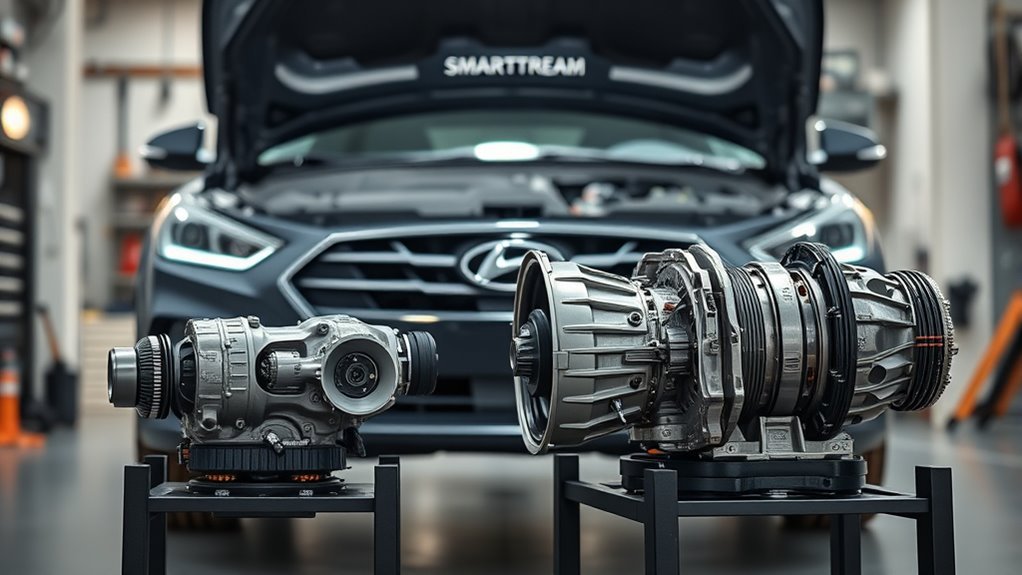
Which transmission suits your Smartstream Sonata comes down to whether you prioritize economy or sport: the IVT maximizes fuel efficiency (improving mpg by roughly 20–30%) and delivers seamless, automatic-like operation via virtual gear patterns, while the Wet 8DCT trades a small efficiency edge for rapid, crisp shifts and 93.8% power transmission efficiency using dual clutches. You’ll choose based on transmission preferences and desired driving dynamics: IVT yields smoother torque delivery, ideal RPM control, and low parasitic loss for liberated, efficient commuting. Wet 8DCT gives direct, immediate responses, faster acceleration bursts, and mechanical engagement that appeals if you value control and spirited inputs. Both boost acceleration over older units; pick IVT for economy and refinement, Wet 8DCT for sport and tactile feedback.
Sonata Smartstream: Real‑World MPG, Driving Feel, and Ownership Costs
When you push the 1.6L Smartstream hard in mixed driving, expect noticeably better real-world economy than older Sonatas—manual models average about 33 mpg combined and CVT-equipped cars about 36 mpg—while retaining brisk, peppy acceleration. You’ll find real world performance characterized by a sharp torque response from the turbo and efficiency gains from CVVD, so daily commuting and highway runs feel liberated from frequent fuel stops. Ownership experiences show competitive maintenance costs, though some owners flag reliability concerns versus older, simpler engines. Evaluate total cost of ownership by balancing improved fuel savings and reduced emissions against potential long-term repair risk. Technically, the package favors drivers who want efficiency without sacrificing dynamic engagement.
Frequently Asked Questions
Is the Smartstream Engine Reliable?
Yes — you’ll find the Smartstream reliable overall: engine performance is improved while maintenance costs stay moderate, but you’ll weigh turbocharged long‑term durability against advanced tech like CVVD, HIE‑EGR and integrated thermal management.
Which Engine Is Better, Kappa or Smartstream?
Smartstream is better: you’ll prioritize Smartstream efficiency for fuel savings, emissions reduction, and thermal control, while Kappa performance gives spirited power. You’ll choose based on goals—efficiency and longevity versus raw, responsive driving dynamics.
Conclusion
You’ll notice the Sonata’s Smartstream 1.6T blends efficiency and performance: CVVD and HTCS optimize valve timing and combustion to cut fuel use, while dual injection and friction-reduction systems raise output and durability. Real-world EPA-adjacent economy sits near 36 mpg highway—about a 10% gain over the previous turbo—so you’ll see tangible savings. Paired with the wet 8‑DCT for quicker, firmer shifts, the package delivers measurable efficiency without sacrificing responsiveness.