The Toyota Camry Hybrid’s eCVT is not a belt-and-pulley CVT. It is an electro-mechanical hybrid transaxle that blends gasoline-engine power with electric-motor power through a power-split gearset. That design is why the Camry Hybrid can pull away smoothly, run quietly at low speeds, recover energy while braking, and deliver strong fuel economy without the stepped shifts of a conventional automatic.
Quick Answer
The Toyota Camry eCVT uses a gasoline engine, electric motor-generators, hybrid battery, inverter, and planetary gearset to split and blend power automatically. Instead of shifting through fixed gears, it varies engine speed and electric-motor output to improve smoothness, efficiency, and regenerative braking.
Key Takeaways
- Toyota’s Camry Hybrid eCVT is a power-split hybrid transaxle, not a traditional belt CVT.
- The system uses electric motor-generators and a planetary gearset to manage engine speed, battery charging, and wheel torque.
- Regenerative braking turns some deceleration energy into electricity that can help recharge the hybrid battery.
- For 2025 Camry Hybrid models, the EPA lists up to 51 mpg combined for the front-wheel-drive LE trim.
- Maintenance is mostly about using the correct factory fluid and following the owner’s manual, not treating the eCVT like a belt-style CVT.
What Is an eCVT and How Does It Work?
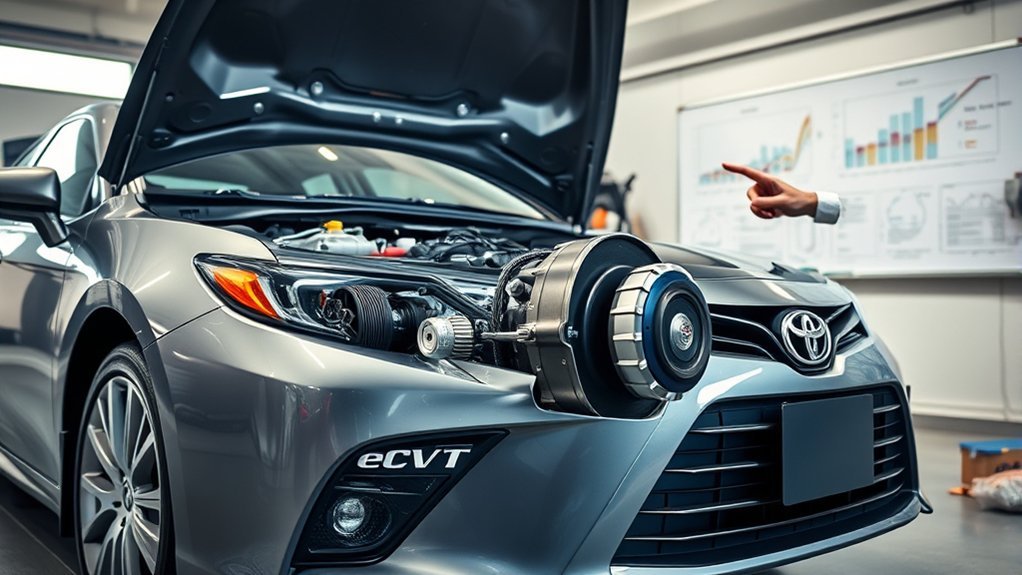
An eCVT, short for electronic continuously variable transmission, is Toyota’s way of making a hybrid feel smooth without using the belt-and-pulley layout found in many conventional CVTs. In the Camry Hybrid, the eCVT is part of the hybrid transaxle. It coordinates the gasoline engine, electric motor-generators, hybrid battery, and inverter so the car can choose the most efficient power source for the moment.
Toyota describes the Camry Hybrid system as a setup that combines a gasoline engine with an electric traction motor according to driving conditions to improve fuel efficiency and reduce exhaust emissions. In everyday driving, that means the system can use electric power at low loads, add gasoline-engine power when more acceleration is needed, and recover energy during deceleration through regenerative braking. Toyota Owners
The key difference is how the ratio changes. A belt CVT changes pulley diameter. A conventional automatic changes between fixed gearsets. Toyota’s eCVT varies the relationship between engine speed, motor-generator speed, and wheel speed electronically through a power-split design.
Note: “eCVT” can sound like a regular CVT with electronics added, but Toyota’s hybrid eCVT is mechanically different from a belt-driven CVT. It does not rely on a drive belt that changes pulley position to vary the ratio.
Key Components of the Toyota Camry’s eCVT
The Camry Hybrid eCVT works because several systems are constantly communicating. The driver only feels smooth acceleration, but the hybrid control system is balancing power flow many times per second.
- Gasoline engine: Provides efficient cruising power and extra output when the car needs more acceleration.
- Electric motor-generators: Help launch the car, assist the engine, start the engine, generate electricity, and support regenerative braking.
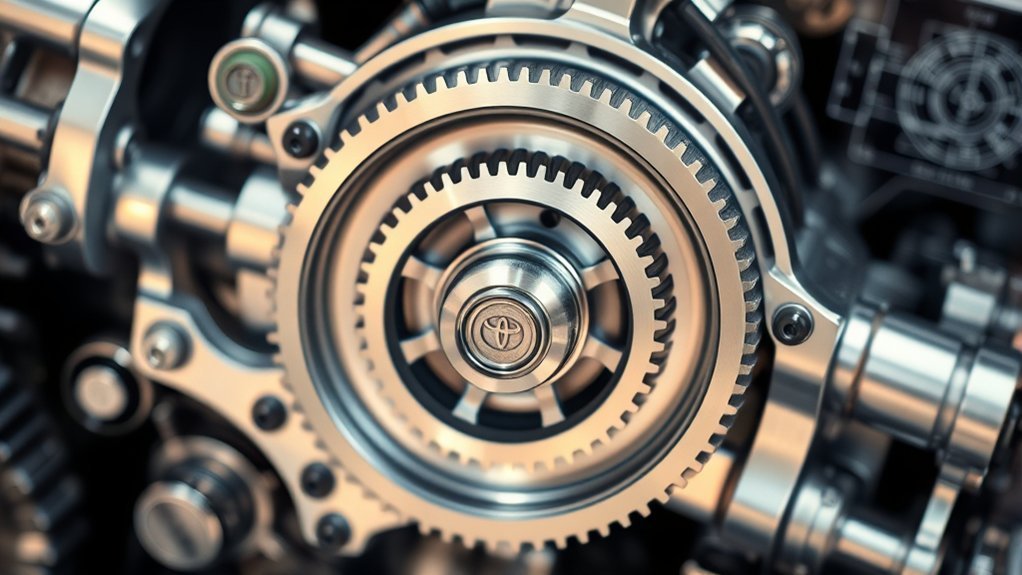
- Planetary gearset: Acts as the power-split device that connects engine power, electric-motor power, and wheel output without stepped gear changes.
- Hybrid battery: Stores electrical energy for low-speed driving, acceleration assist, and recovered braking energy.
- Inverter and power-control electronics: Convert and manage electrical power between the battery and motor-generators.
- Rear electric motor on AWD models: Camry Hybrid models with Electronic On-Demand All-Wheel Drive can use a rear electric motor to help drive the rear wheels when traction or acceleration demands it.
In the 2025 Camry, Toyota says the fifth-generation Toyota Hybrid System uses lighter, more compact electric motors and can produce up to 232 net combined horsepower when paired with Electronic On-Demand AWD. Toyota USA Newsroom
How eCVT Power Distribution Maximizes Efficiency
The Camry eCVT improves efficiency by letting the engine run closer to its efficient operating range while the electric system fills in the gaps. Instead of forcing the engine through fixed gears, the hybrid system can adjust engine speed and motor output to match the load.
Here is what happens in common driving situations:
| Driving Situation | What the eCVT Does | Why It Helps |
|---|---|---|
| Starting from a stop | Uses electric torque first when conditions allow. | Smooth launch and less fuel use in stop-and-go traffic. |
| Moderate acceleration | Blends engine power with electric-motor assist. | Responsive acceleration without a gear-change jolt. |
| Steady cruising | Keeps the engine in an efficient range and balances battery charging. | Better highway efficiency and lower engine strain. |
| Slowing down | Uses regenerative braking before relying fully on friction brakes. | Recovers energy that would otherwise become heat. |
For the 2025 Camry Hybrid, EPA ratings range from 44 mpg combined for the AWD XSE to 51 mpg combined for the front-wheel-drive LE, depending on trim and drivetrain.
Those ratings come from the U.S. Department of Energy and EPA fuel-economy database, which lists the 2025 Camry Hybrid LE FWD at 53 mpg city, 50 mpg highway, and 51 mpg combined. FuelEconomy.gov
The Role of Regenerative Braking in Energy Management
Regenerative braking is one of the biggest reasons a hybrid does well in city driving. When you lift off the accelerator or press the brake pedal, the Camry Hybrid can use an electric motor-generator to slow the vehicle. During that process, the motor-generator acts like a generator and sends recovered energy back toward the hybrid battery.
This does not mean the friction brakes disappear. The car still has conventional brake pads, rotors, hydraulic components, and stability-control systems. The benefit is that light and moderate braking can be blended with regeneration, which may reduce wasted energy and can reduce brake wear under normal driving.
- Energy recovery: Some kinetic energy is converted into electricity instead of being lost as heat.
- Smoother deceleration: The car blends regenerative and friction braking automatically.
- Battery support: Recovered energy helps keep the hybrid battery charged for future electric assist.
Pro Tip: Smooth, early braking gives the hybrid system more opportunity to recover energy. Hard last-second braking relies more heavily on the friction brakes.
Driving the Camry eCVT: What to Expect
Driving a Camry Hybrid with an eCVT feels different from driving a car with a traditional automatic transmission. There are no normal upshifts or downshifts because the system is not stepping through fixed gears. Instead, engine speed may rise and settle according to the amount of power requested.
| Feature | What You Feel | Why It Happens |
|---|---|---|
| Smooth takeoff | No shift bump from a stop | Electric torque helps launch the vehicle |
| Quiet low-speed driving | The engine may shut off when conditions allow | The hybrid battery and motor can handle light loads |
| Steady engine sound during hard acceleration | Engine rpm may hold while road speed increases | The eCVT keeps the engine in a useful power range |
| Smooth deceleration | Braking can feel controlled and progressive | Regenerative and friction braking are blended |
Some drivers love the smoothness right away. Others need time to get used to the way engine sound does not always match road speed in the same way a stepped automatic does. That behavior is normal for Toyota’s hybrid system and is not, by itself, a sign of transmission trouble.
Advantages of the eCVT Over Traditional Transmissions
The Toyota Camry eCVT has several advantages over a conventional automatic or belt-style CVT, especially in a hybrid sedan built for daily commuting.
Smoother Power Delivery
Because there are no traditional shift points, the eCVT can deliver power without the brief interruptions you feel in many geared transmissions. The transition between electric drive, gasoline drive, and blended power is managed automatically.
- No stepped shift shock: Acceleration is more continuous.
- Better low-speed response: Electric torque helps the car move away from stops quickly and quietly.
- Less mechanical complexity than some automatics: The power-split design avoids many clutches and gear changes used in stepped transmissions.
Enhanced Fuel Efficiency
The eCVT supports fuel economy by reducing the need to run the engine inefficiently at low speeds and by recovering some energy during braking. It also lets the engine operate in a more efficient range during cruising and moderate acceleration.
On the 2026 Camry product page, Toyota lists up to an estimated 51 combined mpg and up to 232 net combined horsepower, depending on configuration. Toyota Camry official page
Strong Fit for Hybrid Driving
A hybrid needs to coordinate two types of power: mechanical power from the engine and electrical power from the battery and motors. Toyota’s eCVT is designed around that job. It is not simply a transmission bolted behind a hybrid engine; it is the center of the hybrid power-management system.
eCVT Trade-Offs and What Drivers Misunderstand
The eCVT is efficient and reliable when maintained correctly, but it is not magic. It has a few traits drivers should understand before judging the system.
- Engine drone under hard acceleration: During heavy throttle, the engine may hold a higher rpm. This is normal for many eCVT hybrids.
- Different feel than a sporty automatic: Drivers who prefer crisp gear changes may find the eCVT less engaging.
- Hybrid-system dependence: The eCVT works with high-voltage components, so diagnosis should be handled by qualified technicians.
- Not designed for neglect: Correct fluid, cooling, software updates, and inspection still matter.
Warning: Do not service the Camry Hybrid transaxle with generic CVT fluid. Toyota warns that using the wrong hybrid transmission fluid can cause abnormal noise, vibration, or transmission damage.
Understanding eCVT Maintenance Needs
The Camry Hybrid eCVT generally has fewer wear items than a traditional automatic transmission, but it still depends on the correct fluid and proper inspection. Maintenance advice should be based on the exact model year, market, and owner’s manual, because Toyota fluid requirements can change by generation.
[Products Worth Considering]

Bosch QuietCast premium ceramic rear brake pads are engineered for quiet, reliable stopping power with low dust performance. Featuring pre-attached multilayer shims, corrosion-resistant backing plates, and OE-style slots and chamfers, this set is designed for smooth fitment and long-lasting durability. It includes pads for one axle, plus hardware and lubricant where available, making installation easier for compatible Lexus, Pontiac, and Toyota vehicles.

This coolant electric water pump is designed as a replacement for select Toyota vehicles, helping maintain proper engine cooling performance and reliable temperature control. Built to OE specifications, it offers fitment support for compatible Avalon, Camry, and RAV4 models with 2.5L L4 engines. It also includes cross-reference part numbers for easier matching and comes with after-sales support for covered defects.

This replacement filter set is designed for a range of Toyota hybrid vehicles, including popular models like RAV4 Hybrid, Camry Hybrid, Highlander Hybrid, Sienna, Venza, and more. It combines cabin and engine filtration to help support cleaner airflow, reduce dust and odors, and protect your HVAC and engine systems. Built for easy installation and extended service life, it offers a convenient maintenance upgrade for compatible hybrid and gas-only Corolla models.
Fluid Type Matters
For the 2025 Camry Hybrid, Toyota’s owner information lists Toyota Genuine e-Transaxle Fluid TE for the hybrid transmission and warns against using other fluid types. It also notes that if replacement is necessary, owners should contact a Toyota dealer. Toyota Owners maintenance data
Older Camry Hybrid models may specify a different Toyota fluid, such as Toyota Genuine ATF WS. That is why the safest rule is simple: check the maintenance guide for your VIN and model year before buying fluid or approving service.
Maintenance Frequency Recommendations
Toyota maintenance schedules can vary by year, driving conditions, and region. Rather than using a one-size-fits-all mileage interval, follow the maintenance schedule for your specific Camry Hybrid. Ask for a hybrid transaxle inspection if you notice unusual noise, vibration, leaks, warning lights, or a sudden change in drivability.
- Check for leaks: Fluid seepage around the transaxle should be inspected promptly.
- Use the correct fluid: The wrong fluid can cause expensive problems.
- Keep cooling paths clear: Hybrid components need proper cooling to stay reliable.
- Address warning lights early: Hybrid-system faults can affect power delivery and charging behavior.
Component Longevity Insights
Long-term reliability depends on more than the eCVT alone. The hybrid battery, inverter, cooling system, wiring, engine, and software all work together. Toyota hybrids have a strong reputation for durability, but the best results come from regular maintenance, correct parts, and early diagnosis when symptoms appear.
Symptoms That Need a Professional Inspection
Most Camry Hybrid eCVT behavior is normal: smooth takeoff, engine stop-start operation, regenerative braking feel, and steady rpm during acceleration. However, the following symptoms deserve attention:
- Grinding, whining, or new humming noises from the transaxle area
- Hybrid system warning messages or warning lights on the dashboard
- Sudden loss of power or reduced acceleration
- Fluid leaks under the front of the vehicle
- Harsh vibration that was not present before
- Burning smell after normal driving
Because the Camry Hybrid uses high-voltage components, diagnosis is not the same as checking a conventional transmission. A qualified hybrid technician can scan hybrid control modules, inspect fluid condition, verify software updates, and check related cooling and electrical systems.
[Products Worth Considering]
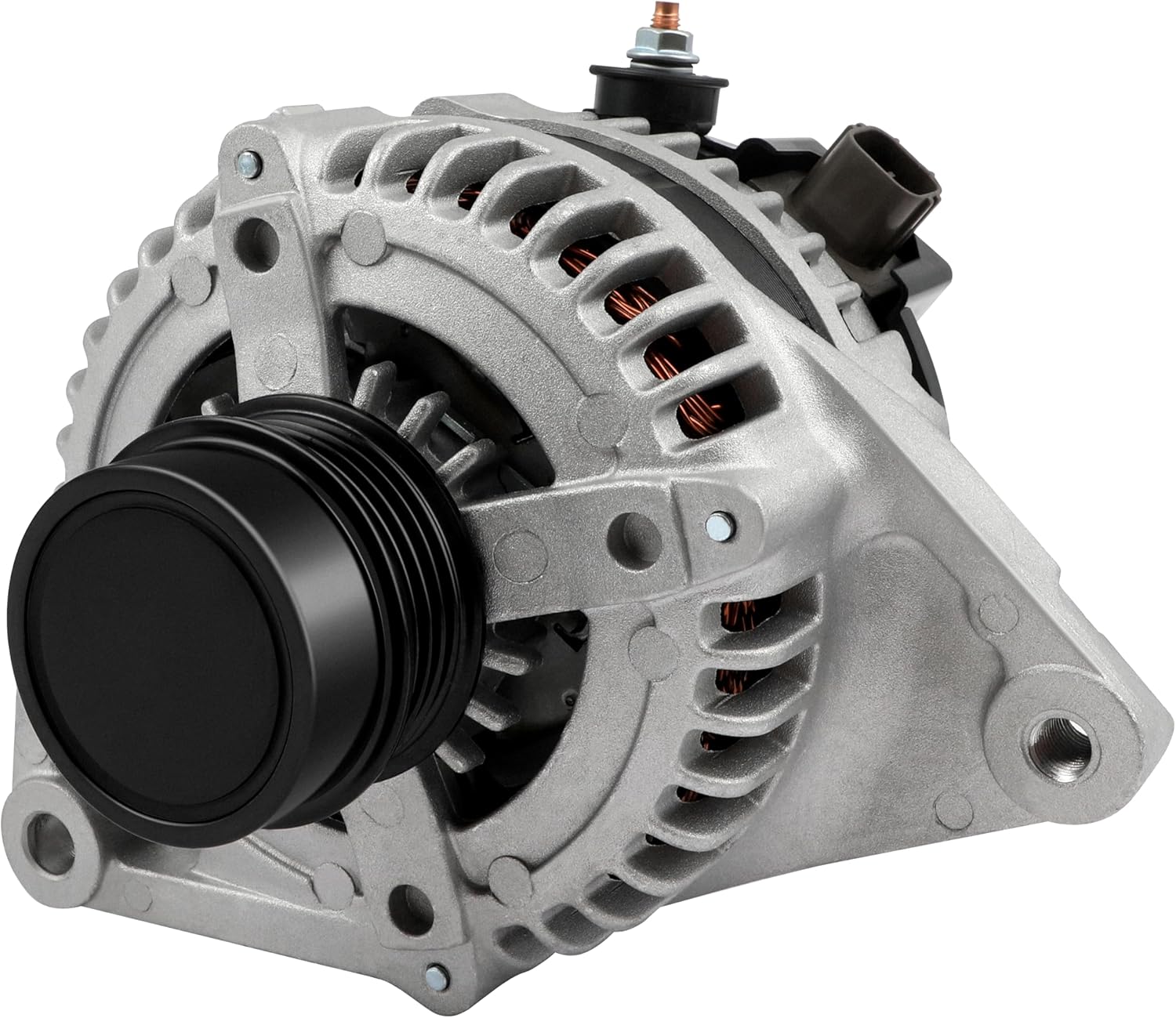
This high output alternator is designed to fit select Toyota, Scion, and RAV4 2.5L applications, delivering reliable charging performance for everyday driving. Built with a 12-volt, 100-amp design and precision-engineered components, it helps support battery recharge, stable electrical output, and consistent operation when your vehicle shows signs of charging issues.

This engine air filter is designed to fit select Lexus and Toyota hybrid models, helping maintain clean airflow to the engine for reliable performance. Built with high-fiber filter paper and a fine filtration layer, it offers strong dust capture while minimizing airflow resistance. It is a direct replacement for multiple OEM part numbers and is backed by warranty support.

This front bumper license plate bracket is designed for Toyota Camry and Camry Hybrid models from 2018 to 2026, offering a secure and street-legal way to mount your plate. Built from durable, rust-proof plastic with included screw bolts and a wrench, it helps protect your bumper paint while making installation straightforward. The bracket fits US and Canada plates and is made to keep your license plate and registration sticker visible.
Toyota’s eCVT Compared to Other Hybrid Technologies

Toyota’s eCVT is part of a power-split hybrid layout. That makes it different from several other hybrid approaches on the market.
| System Type | Basic Idea | How It Feels |
|---|---|---|
| Toyota power-split eCVT | Engine and electric motors are blended through a hybrid transaxle. | Very smooth, efficient, and seamless. |
| Belt-style CVT | A belt and pulleys vary the ratio. | Smooth, but not designed around hybrid power splitting. |
| Traditional automatic | Fixed gears and clutches shift through ratios. | Familiar gear changes and stronger shift feel. |
| Series-style hybrid | Engine often works mainly as a generator while electric motors drive the wheels. | EV-like response, depending on vehicle design. |
There is no single “best” hybrid layout for every driver. Toyota’s eCVT excels when the goal is high efficiency, low-speed smoothness, and long-term daily-driver refinement.
[Products Worth Considering]

Bendix Premium Ceramic Front Brake Pads are engineered to match original equipment fit, form, and function for a straightforward replacement. Built with durable materials to help resist wear and corrosion, they support consistent braking performance and reduced brake fade for everyday driving. These pads are a dependable choice for compatible Pontiac, Scion, Toyota, and related vehicles.

This A-Premium serpentine belt drive kit is designed for compatible Toyota Camry, RAV4, and Scion tC models with a DOHC 2.5L L4 engine. It includes a serpentine belt and belt tensioner to help maintain smooth engine operation, reduce noise, and support reliable power transfer. Built for dependable replacement performance, it also comes with a one-year unlimited-mileage guarantee for added peace of mind.

This ALLWELL engine air filter is designed to help maintain clean airflow for compatible Toyota, Lexus, and Subaru vehicles, supporting engine performance and efficient operation. It serves as a direct replacement for multiple OE part numbers and fits a wide range of hybrid and standard models across several years. Built for broad compatibility, it is a practical maintenance part for keeping your vehicle’s intake system protected.
Real Owner Feedback on the Camry’s eCVT Performance
Camry Hybrid owners commonly praise the eCVT for smoothness, quiet low-speed operation, and strong fuel economy. The most common adjustment is getting used to the engine sound during hard acceleration. Because there are no fixed upshifts, the engine can sound like it is holding a steady rpm while the vehicle continues to gain speed.
- Best-liked trait: Smooth power delivery in traffic.
- Most noticeable difference: Engine sound does not mimic a normal automatic transmission.
- Biggest daily benefit: Lower fuel use in mixed city and suburban driving.
- Best use case: Commuting, errands, highway cruising, and stop-and-go traffic.
If you are test-driving a Camry Hybrid, try it in city traffic, on a highway ramp, and during gentle braking. Those three moments reveal most of what makes the eCVT different.
Future Innovations in eCVT Technology and Toyota Hybrids
Toyota continues to improve its hybrid systems with lighter electric motors, improved power electronics, better battery control, and available electronic all-wheel-drive systems. The newer Camry Hybrid generation uses Toyota’s fifth-generation hybrid system, which Toyota says is designed for more power, improved performance, and a more engaging feel.
Future eCVT development will likely focus on the same goals: better efficiency, stronger acceleration, smaller components, improved software control, and smoother transitions between electric and gasoline operation. For drivers, the result should be hybrids that feel more natural while still saving fuel.
Frequently Asked Questions
How does the Toyota eCVT work?
Toyota’s eCVT works by using a hybrid transaxle to blend gasoline-engine power with electric-motor power. A power-split gearset and electronic controls vary the relationship between engine speed, motor-generator speed, battery charging, and wheel torque without traditional gear shifts.
Is Toyota’s eCVT the same as a regular CVT?
No. A regular CVT usually uses a belt or chain with variable pulleys. Toyota’s hybrid eCVT uses motor-generators and a power-split gearset inside the hybrid transaxle. The driving feel may be similar because both are smooth, but the mechanical design is different.
Which is more reliable, CVT or eCVT?
Toyota’s hybrid eCVT is generally considered a durable design because it avoids the belt-and-pulley wear points found in many conventional CVTs. Reliability still depends on correct fluid, proper cooling, software updates, and following the maintenance schedule for the specific vehicle.
Is the eCVT transmission good?
Yes, the eCVT is a strong fit for the Camry Hybrid because it supports smooth acceleration, efficient engine operation, and regenerative braking. Its main drawback is feel: drivers who like firm gear changes may need time to adjust to the smoother, gearless acceleration.
Does the Camry Hybrid eCVT need transmission fluid changes?
The Camry Hybrid transaxle uses specific Toyota fluid, but service requirements vary by model year and market. For example, Toyota lists Toyota Genuine e-Transaxle Fluid TE for the 2025 Camry Hybrid. Always follow the owner’s manual and use the exact fluid specified for your vehicle.
Why does the engine sound steady when accelerating?
That is normal for many Toyota hybrids. Because the eCVT does not shift through fixed gears, the engine can hold an efficient or powerful rpm while the vehicle speed keeps increasing. It may sound different from a traditional automatic, but it is usually normal behavior.
Conclusion
The Toyota Camry’s eCVT is one of the main reasons the hybrid model feels smooth and efficient. By coordinating the gasoline engine, electric motor-generators, hybrid battery, inverter, regenerative braking, and power-split gearset, it delivers a driving experience that is quiet at low speeds, efficient in traffic, and seamless on the highway.
The most important thing to remember is that Toyota’s eCVT is not a belt-style CVT. It is a hybrid power-management system built into the transaxle. Treat it correctly, use the right fluid, follow the owner’s manual, and the Camry Hybrid’s eCVT can be one of the most satisfying parts of the car.
Sources
- Toyota Owners: 2025 Camry Hybrid system features — backs up how the Camry Hybrid combines gasoline and electric power according to driving conditions.
- Toyota Owners: 2025 Camry Hybrid maintenance data — backs up the factory hybrid transmission fluid warning and fluid type.
- Toyota USA Newsroom: next-generation Camry Hybrid announcement — backs up fifth-generation Toyota Hybrid System details and available AWD power output.
- Toyota Camry official product page — backs up current Camry estimated mpg, power, and drivetrain information.
- FuelEconomy.gov: 2025 Toyota Camry fuel economy ratings — backs up EPA city, highway, and combined mpg ratings by trim and drivetrain.