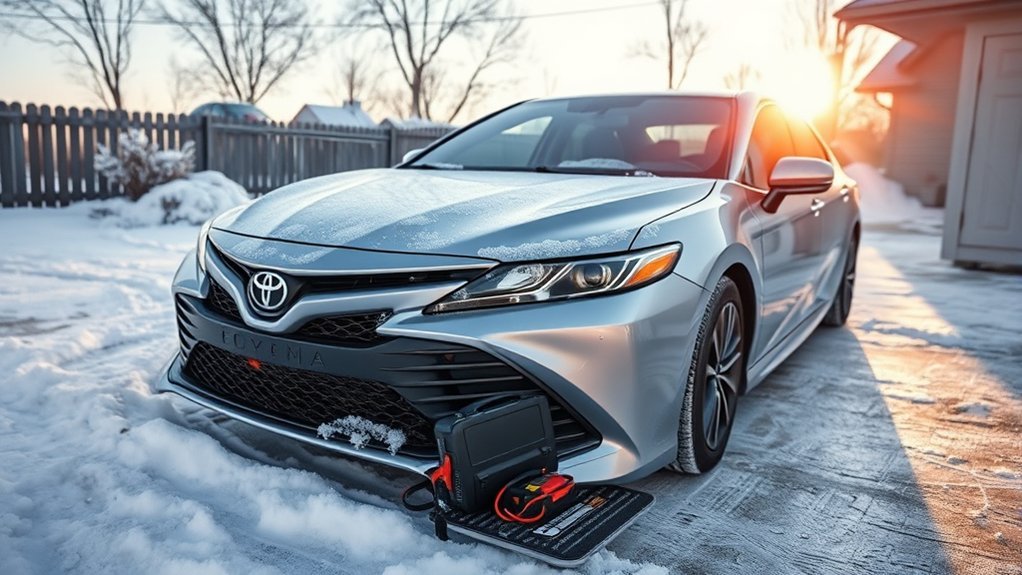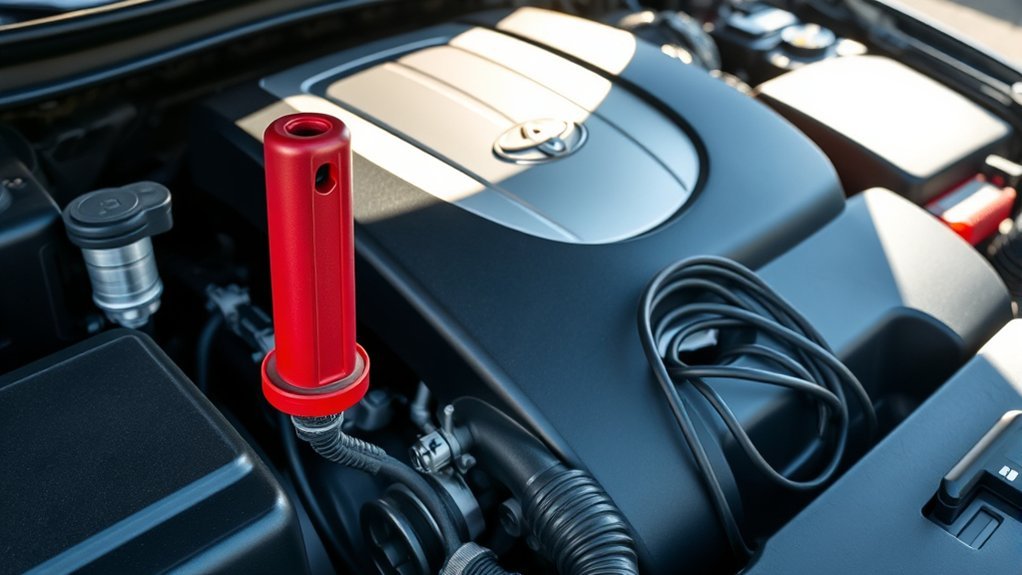
A dead 12-volt battery can stop a Toyota Camry from powering on, even when the hybrid battery is not the problem. The safest way to use the Toyota Camry jump-start terminal is to follow the model-year instructions in your owner’s manual, connect the cables in the correct order, and keep the final negative clamp on a solid ground point away from the positive terminal and moving parts.
Quick Answer
To use the Toyota Camry jump-start terminal, open the hood, remove the fuse box cover, open the positive jump-terminal cover, connect red to the Camry terminal and booster positive, then connect black to booster negative and a solid Camry ground point. Power the Camry on and confirm the READY indicator.
Key Takeaways
- This guide focuses on Camry Hybrid and newer Camry models that use an under-hood positive jump-start terminal; older gas-only Camrys may use the 12-volt battery posts instead.
- Use only a 12-volt booster source, and never connect jumper cables to orange hybrid cables, the inverter, the ECM, or a painted/dirty bracket.
- Connect the positive cable first, make the final negative connection to a solid unpainted ground point, then remove the cables in the exact reverse order.
- For a hybrid Camry, the goal is the READY indicator. If READY does not appear after a careful retry, stop and get help.
- Do not use the Camry Hybrid under-hood jump-start terminal to jump-start another vehicle.
At a Glance
| Time Required | 10–15 minutes |
| Difficulty | Beginner, if you follow the order carefully |
| Tools Needed | 12-volt portable jump starter or jumper cables and a second 12-volt vehicle, safety glasses, gloves, flashlight, and owner’s manual |
| Cost | $0 if you already have cables or a jump pack; about $40–$150 if buying a portable jump starter |
Before You Start: Confirm Your Camry and Stay Safe
Before you connect anything, confirm which Camry you have. The 2025-and-newer U.S. Camry lineup is hybrid-only, and Camry Hybrid models commonly use an under-hood positive jump-start terminal for the 12-volt system. Many older gas-only Camrys have the 12-volt battery in the engine bay and may be jumped at the battery posts instead. When in doubt, check the exact procedure in the Toyota owner’s manual for your model year.
Warning: Do not jump-start a battery that is cracked, leaking, swollen, frozen, smoking, or giving off a strong rotten-egg smell. Keep sparks, flames, cigarettes, jewelry, and loose metal tools away from the battery area. If anything looks damaged or unsafe, call roadside assistance or a qualified repair shop.
Set the parking brake, shift to Park, turn off lights, audio, climate controls, chargers, and accessories. If you are using a second vehicle, park it close enough for the cables to reach, but do not let the vehicles touch. Use only a 12-volt booster source. Never use a 24-volt truck system, household current, or any connection point that is not listed in your manual.
How to Access Your Toyota Camry’s Jump Start Terminal
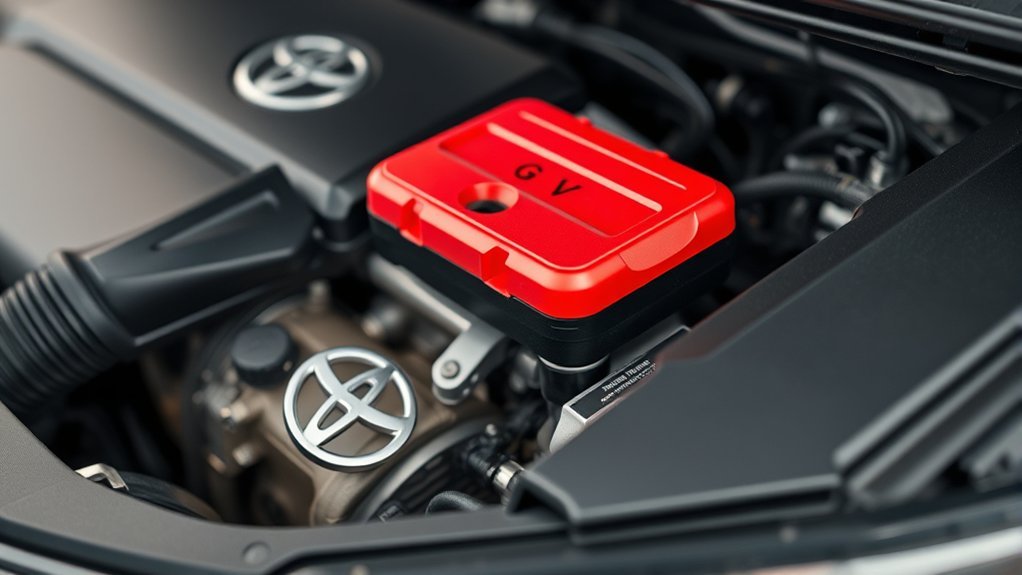
If the doors unlock normally, open the car as usual. If the 12-volt battery is too weak for the Smart Key system, use the mechanical key hidden inside the key fob to unlock the driver’s door. Then pull the hood release and open the hood fully.
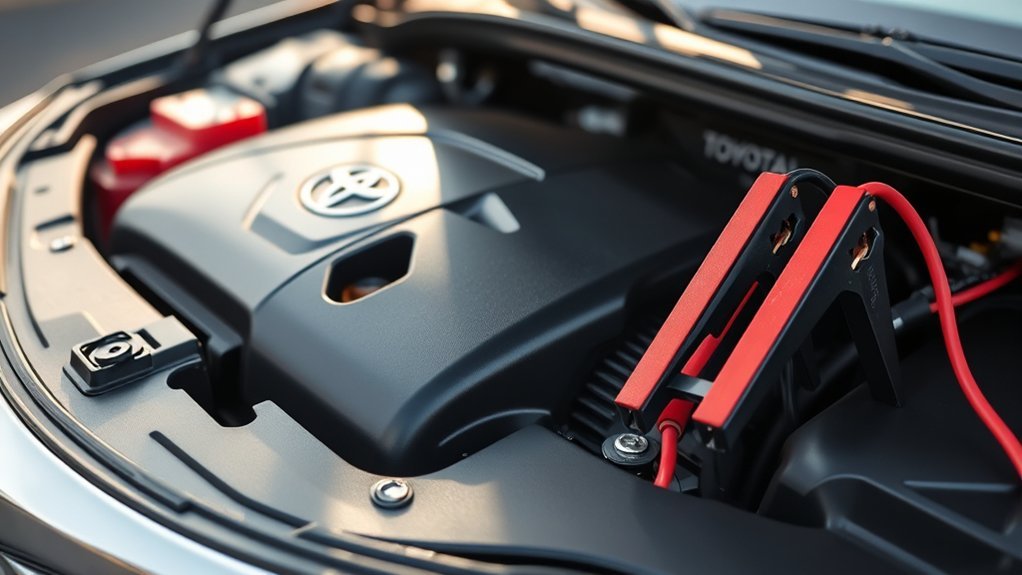
On Camry Hybrid-style layouts, the jump-start terminal is under the hood in the engine-compartment fuse box. Look for the fuse/relay box on the driver-side area of the engine bay. Release the tabs, lift off the fuse box cover, and open the small positive terminal cover inside. This covered positive point is the terminal used to receive a jump for the Camry’s 12-volt system.
Next, identify a safe ground point. Use a solid, stationary, unpainted metal point in the engine bay that is away from the positive jump terminal and away from moving parts such as fans and belts. Do not connect to orange high-voltage cables, the inverter, the ECM, plastic covers, painted brackets, or the fuse box lid.
Note: The 12-volt battery location can vary by Camry generation and trim. Some hybrid models place the 12-volt battery away from the under-hood jump point, but Toyota provides the under-hood terminal so you do not need to access the battery directly for an emergency jump.
Tools and Safety Checklist for a Safe Jump Start
Gather everything before you start. You need either a fully charged 12-volt portable jump starter or a second vehicle with a healthy 12-volt battery and jumper cables. Safety glasses and gloves are strongly recommended because lead-acid battery work can involve sparks, acid, and gas.
- Use jumper cables with clean, tight clamps and no exposed wire.
- Keep the electronic key with you, not inside the vehicle, in case the locks cycle during the process.
- Make sure the donor vehicle and Camry are both in Park with the parking brakes set.
- Turn off accessories in both vehicles before connecting cables.
- Route cables so they cannot touch fans, belts, pulleys, or hot engine parts.
- Do not let the positive and negative clamps touch each other.
- Stop immediately if you see smoke, sparking beyond a tiny clamp-contact spark, melting insulation, or a hot cable.
Pro Tip: Take a quick photo of the fuse box cover and terminal cover before you remove them. It makes it easier to put everything back correctly after the Camry starts.
[Products Worth Considering]

The S ZEVZO ET03 is a powerful 12V jump starter designed to revive gas and diesel vehicles quickly, including cars, trucks, motorcycles, lawnmowers, and boats. It also doubles as a portable power bank with USB charging ports, a bright LED flashlight, and an LCD display for added convenience during roadside emergencies. Built with multiple safety protections and included carrying case, it offers dependable backup power whenever you need it.
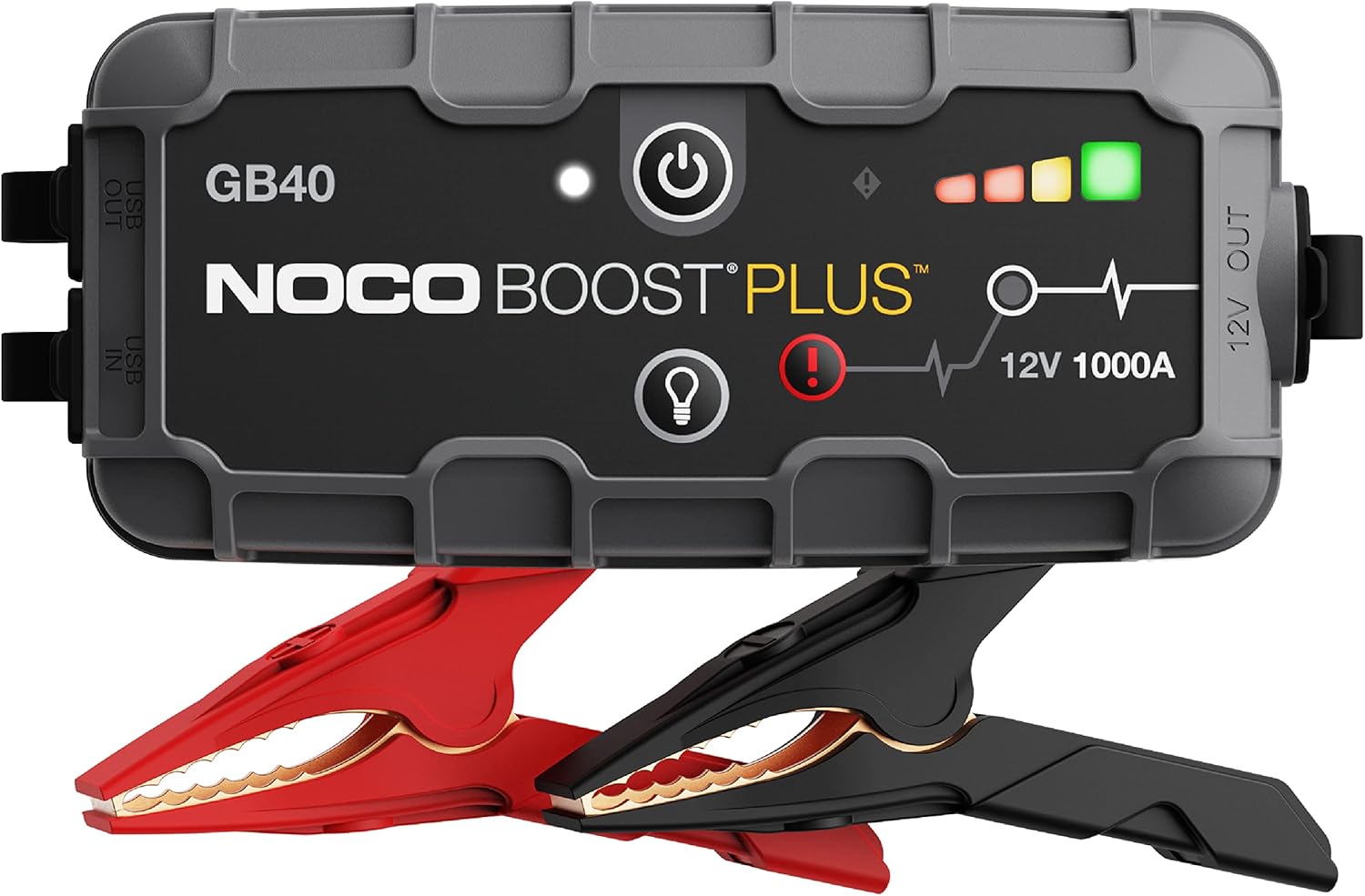
The NOCO Boost GB40 is a compact lithium jump starter designed to safely revive dead 12V batteries in seconds, with enough power for cars, trucks, motorcycles, boats, and more. It also functions as a portable power bank and includes a built-in LED flashlight with multiple modes, making it a versatile emergency tool for roadside use and everyday preparedness.

The OXILAM jump starter delivers powerful emergency starting performance for gas engines and up to 12L diesel engines, helping revive dead batteries in seconds. It also doubles as a portable power bank and LED flashlight, with USB and Type-C ports for convenient device charging. Built with multiple safety protections, a clear LED display, and a rugged portable design, it is a reliable roadside companion for cars, trucks, motorcycles, and more.
Step-by-Step Guide to Connecting Jumper Cables
Follow this order if you are using jumper cables and a second 12-volt vehicle. The order matters because it reduces spark risk and protects sensitive electronics.
- Open the Camry jump terminal. Remove the fuse box cover and open the positive jump-start terminal cover.
- Connect red to the Camry positive terminal. Clamp one red positive cable end to the Camry’s covered positive jump-start terminal.
- Connect red to the donor positive post. Clamp the other red cable end to the positive (+) battery post on the second vehicle.
- Connect black to the donor negative post. Clamp one black negative cable end to the negative (-) battery post on the second vehicle.
- Connect black to the Camry ground point. Clamp the final black cable end to a solid, stationary, unpainted metal ground point on the Camry, away from the jump terminal and moving parts.
- Start the donor vehicle. Let it idle. If the Camry’s 12-volt battery is very weak, wait a few minutes before trying the Camry.
- Start the Camry. Press the brake pedal and press the power button. On a hybrid Camry, look for the READY indicator.
If the READY indicator appears, the hybrid system is on. The gasoline engine may or may not start right away because the hybrid system controls that automatically. Do not keep pressing the power button repeatedly if READY does not appear.
[Products Worth Considering]

The NOCO Boost GB70 is a compact yet powerful jump starter designed to safely revive dead 12V batteries in seconds. It combines UltraSafe spark-proof protection, a built-in power bank, and a bright LED flashlight in a rugged, portable design that fits easily in a glove box or emergency kit. Built for cars, trucks, SUVs, boats, motorcycles, and more, it delivers dependable emergency starting power whenever you need it.

This roadside emergency kit helps drivers handle common breakdowns and winter travel issues with confidence. It includes jumper cables, a shovel, tow rope, warning triangle, first aid kit, gloves, and repair tools in a compact bag that fits easily in a trunk or storage compartment. Designed for cars, trucks, SUVs, motorcycles, and RVs, it is a practical safety companion for commuting, road trips, and everyday preparedness.

NOONE jumper cables are designed to help get 12V and 24V vehicles back on the road with reliable boosting power. The 10-foot length, insulated rubber covering, and copper-clad aluminum conductors support dependable performance in extreme temperatures, while the strong clips help ensure a secure connection. Ideal for family cars and vehicles up to 3.0L gas engines, this kit offers a practical emergency starting solution backed by a two-year service promise.
Using a Portable Jump Starter on a Toyota Camry
A portable jump starter can be easier than using another vehicle, but you still need the same safe connection points. Make sure the jump starter is charged, rated for 12-volt vehicles, and approved by its manufacturer for your vehicle size.
- Turn the jump starter off before connecting it, unless the jump starter instructions say otherwise.
- Connect the red clamp to the Camry’s positive jump-start terminal.
- Connect the black clamp to a solid, unpainted metal ground point on the Camry.
- Turn on the jump starter or activate its boost mode according to its instructions.
- Press the brake pedal and press the Camry power button.
- Confirm the READY indicator appears.
- Turn the jump starter off before removing clamps, unless its instructions give a different removal sequence.
If the jump pack has reverse-polarity, low-voltage, or error lights, stop and read the jump starter manual before trying again. Do not bypass safety warnings on the jump pack.
[Products Worth Considering]

The NOCO Boost X GBX155 is a powerful portable jump starter designed to deliver reliable starts for large gas and diesel engines with advanced UltraSafe 2.0 protection. It also doubles as a USB-C power bank and includes a bright LED flashlight with multiple modes, making it a versatile emergency tool for roadside use, travel, and everyday charging needs.

The NOCO Boost GB150 is a powerful 12V lithium jump starter designed to safely revive dead batteries in seconds, with enough peak power for large gas and diesel engines. Its UltraSafe technology helps prevent sparks and reverse polarity mistakes, while the built-in USB-C power bank and LED flashlight add dependable emergency utility for roadside repairs and everyday use.

The AstroAI S8 is a compact 12V lithium jump starter designed to get gas and diesel vehicles back on the road quickly, even from low or fully drained batteries. It combines powerful starting performance with smart boost mode, built-in safety protections, and a versatile 5-in-1 design that also works as a power bank and flashlight for everyday emergencies and travel.
How to Jump Start Your Vehicle
Once the cables are connected, the next step depends on whether your Camry is a hybrid model or an older gas-only model.
For Camry Hybrid and 2025+ Camry Models
Keep the electronic key inside the vehicle or with the driver. Press the brake pedal firmly and press the power button once. Watch the instrument cluster for the READY indicator. READY means the hybrid system has started, even if the gasoline engine is quiet.
If READY does not appear, turn the power off, wait a moment, and check every clamp. Make sure the positive clamp is on the correct jump terminal and the negative clamp is on a clean, solid ground point. If it still does not work after one careful retry, stop and call a Toyota dealer, roadside assistance, or a qualified repair shop.
For Older Gas-Only Camry Models
Older non-hybrid Camry models usually start like a conventional vehicle. After connecting cables according to that model’s manual, start the donor vehicle, wait briefly if the battery is very weak, then start the Camry. If it cranks slowly but does not start, stop after a short attempt and recheck the connections. Long repeated cranking can overheat cables, strain the starter, or point to a problem that is not just a low battery.
Warning: Do not push-start a Camry Hybrid. Toyota hybrid systems need the 12-volt system to power up the computers and relays before the vehicle can enter READY mode.
Safely Disconnecting Jumper Cables and Securing the Hood
After the Camry reaches READY mode or the engine starts, remove the cables in the exact reverse order from how you connected them. Keep the clamps separated while you work.
- Remove the black negative clamp from the Camry ground point.
- Remove the black negative clamp from the donor vehicle or jump starter.
- Remove the red positive clamp from the donor vehicle or jump starter.
- Remove the red positive clamp from the Camry jump-start terminal.
- Close the Camry’s positive jump-start terminal cover.
- Reinstall the fuse box cover securely.
- Check that no tools, cables, or loose covers remain in the engine bay.
- Close the hood firmly.
Let the Camry remain in READY mode or drive it safely for at least 20–30 minutes if conditions allow. A jump start does not fix a weak or failing 12-volt battery; it only gets the vehicle powered up. If the battery dies again, the 12-volt battery, charging system, fuse, key fob battery, or another electrical issue may need diagnosis.
What to Do If Your Vehicle Doesn’t Start?
If your Toyota Camry still does not start, do not keep trying blindly. Use the symptoms to narrow down the problem.
| Symptom | Likely Cause | What to Do |
|---|---|---|
| No lights or display | Poor clamp contact, dead jump pack, wrong terminal, or very weak 12V battery | Turn everything off, recheck positive terminal and ground point, and confirm the booster source is charged. |
| Dash lights appear, but no READY indicator | Low 12V voltage, key not detected, brake pedal not pressed, or hybrid-system fault | Keep the key inside the vehicle, press the brake firmly, retry once, then call for service if READY still does not appear. |
| Clicking sound or flickering lights | Weak 12V battery or poor ground connection | Use a cleaner ground point and give the booster source a few minutes. Replace or test the 12V battery if it happens again. |
| Strong corrosion at terminal or clamp area | Battery acid residue or long-term terminal neglect | Do not force a bad connection. Clean only if you can do so safely, or have the battery and terminals serviced. |
| Starts once, then dies again later | Failing 12V battery, parasitic drain, or charging issue | Have the 12V battery tested and inspected as soon as possible. |
After any deep 12-volt battery discharge, some vehicle systems may need to relearn or initialize. Warning lights may clear after a short drive, but persistent warnings should be checked by a Toyota dealer or qualified technician.
Common Mistakes to Avoid
- Using the under-hood hybrid jump terminal to boost another car: This terminal is for receiving emergency 12-volt power, not for jump-starting another vehicle.
- Connecting the final negative clamp to the wrong place: Use a solid, unpainted metal ground point away from the positive jump terminal and moving parts.
- Touching high-voltage hybrid components: Stay away from orange cables and hybrid power electronics.
- Letting clamps touch: Positive and negative clamps touching can create sparks, heat, and electrical damage.
- Skipping the fuse box cover: Always reinstall the positive terminal cover and fuse box cover before closing the hood.
- Repeated start attempts: If the Camry does not reach READY or start after a careful retry, the problem may not be a simple low battery.
- Jumping a damaged battery: Do not jump-start a battery that is leaking, swollen, frozen, cracked, or giving off a strong odor.
Frequently Asked Questions
Can I jump-start other vehicles with my Camry?
Do not use the under-hood exclusive jump-start terminal on a Camry Hybrid to jump-start another vehicle. That terminal is meant to receive emergency 12-volt power for your Camry. If you have an older gas-only Camry with a conventional battery under the hood, follow that model’s owner’s manual before using it as a donor vehicle.
What if my jump-start terminal is corroded?
Do not force a clamp onto heavy corrosion. Light corrosion can often be cleaned with the vehicle off, proper eye protection, and a battery-safe cleaning method, but heavy corrosion, acid residue, loose terminals, or damaged wiring should be handled by a qualified technician.
How long should I leave the jump box connected?
Leave a portable jump starter connected only as long as its instructions allow. Many jump packs are designed for a short boost attempt, not long charging. If you are using a second vehicle, a very weak 12-volt battery may need a few minutes before the Camry reaches READY or starts.
Is it safe to jump-start in the rain?
It can be done with extra care, but only if the cables, jump starter, and connection points are in good condition and you can keep the clamps out of standing water. Do not jump-start during lightning, flooding, heavy rain, or when you cannot keep your hands and equipment controlled. Call roadside assistance if conditions are unsafe.
Can I use a portable jump starter instead of another vehicle?
Yes, a 12-volt portable jump starter is a good option if it is charged and rated for your Camry. Connect red to the Camry positive jump-start terminal, connect black to a solid ground point, activate the pack as directed, then press the brake and power button to look for READY.
Where is the 12-volt battery on a Toyota Camry Hybrid?
The 12-volt battery location varies by Camry generation and trim. Some Camry Hybrid models place it away from the under-hood jump terminal. For emergency starting, use the under-hood positive jump-start terminal and approved ground point shown in your owner’s manual instead of guessing at the battery location.
Why does my hybrid Camry show READY instead of cranking like a normal car?
READY means the hybrid system is on and the vehicle can drive. The gasoline engine may stay off at first because the hybrid system decides when it needs to run. For a hybrid Camry, READY is the sign that the jump-start worked.
Can I push-start a Toyota Camry Hybrid?
No. A Camry Hybrid cannot be push-started when the 12-volt battery is discharged. The 12-volt system must power up the vehicle computers and hybrid controls before the car can enter READY mode.
Conclusion
Jump-starting your Toyota Camry is safe when you treat it as a 12-volt electrical procedure and follow the correct order. Open the under-hood terminal cover, connect positive first, place the final negative clamp on a clean ground point, start the Camry, confirm READY on hybrid models, and remove the cables in reverse order. If the Camry will not start after a careful retry, stop and have the 12-volt battery and charging system checked.
Sources
- Toyota Owners: 2025 Camry Hybrid — If the 12-volt battery is discharged — Toyota-specific jump-start procedure, READY indicator, reverse removal, and hybrid notes.
- Toyota Owners: Manuals and Warranties — official source for checking the correct owner’s manual by model year.
- Toyota USA Newsroom: 2025 Toyota Camry — confirms the 2025 Camry generation went exclusively hybrid.
- AAA Club Alliance: How to Use Jumper Cables to Start a Car — general jumper-cable safety, connection order, and ground-point guidance.
- OSHA: Batteries and Battery Charging — battery ventilation and explosive gas safety background.