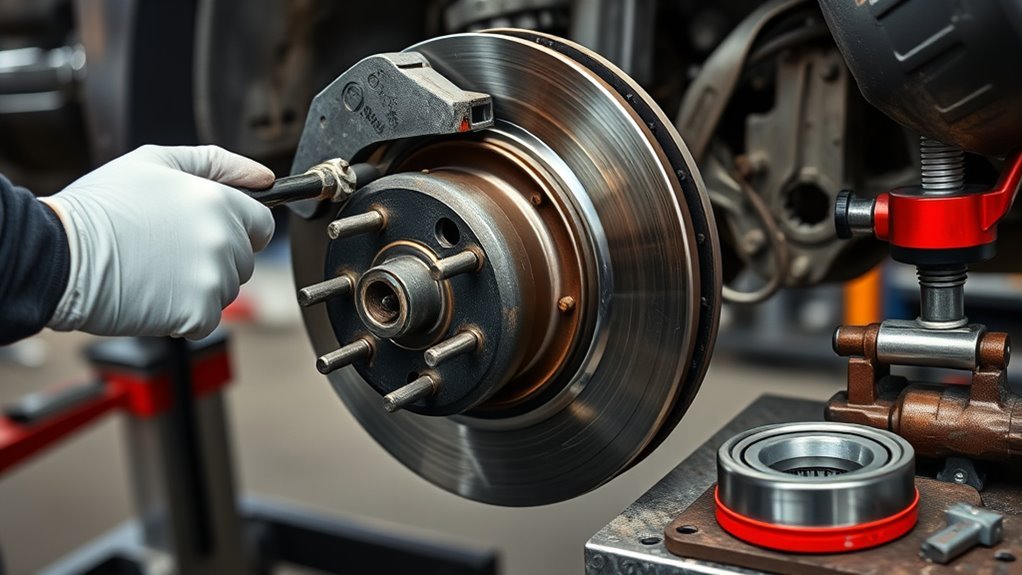
You’ll safely lift and support the Tacoma, remove the wheel, caliper and rotor, then extract the axle nut and separate the hub to access the bearing; confirm noise and play first. Press or tap the new bearing and backing plate into the knuckle, align bolt holes, apply copper anti-seize, hand-start bolts, then torque the axle nut to 173 ft⋅lb with the staged method and install the locking mechanism. Reassemble brakes, torque fasteners, road-test for smoothness—keep going for full procedure details.
Quick Step-by-Step: Tacoma Wheel Bearing Replacement
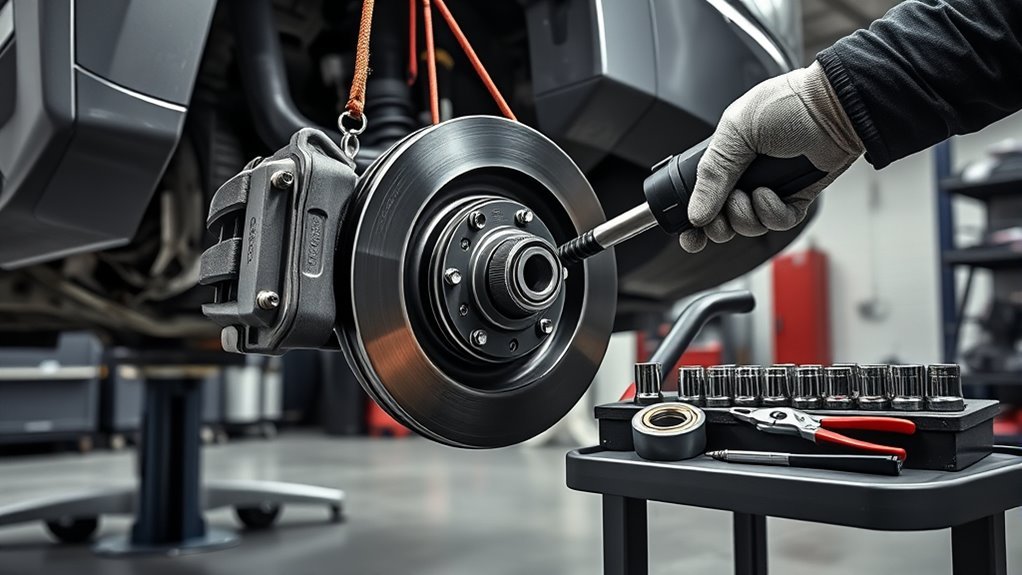
Start by safely lifting and supporting the Tacoma, then remove the wheel by taking off all six lug nuts with a 12 mm socket so you have clear access to the brake and hub assembly. You’ll detach the caliper by removing the two 17-mm mounting bolts and hang it to prevent strain on the brake line. Remove the rotor, then take off the cap and carefully extract the cotter pin and axle nut; use a center punch for stubborn fasteners. Separate the bearing from the knuckle with a 17-mm wrench and a rubber mallet, applying penetrant if bolts resist. Install the new bearing by sliding it over the axle splines, verify alignment, and torque the axle nut to 173 ft-lb; tighten other fasteners in a criss-cross pattern. Follow these bearing maintenance steps and basic troubleshooting techniques to confirm rotation is smooth and free of play, restoring control and motorist liberation through disciplined, methodical work.
Prep: Tools and Safety for Tacoma Wheel Bearing
You’ll need personal protective equipment—gloves and goggles—and a stable, raised Tacoma on jack stands before you touch the hub. Assemble required hand tools: a 12 mm socket, two 17 mm wrenches, rubber mallet, center punch, penetrant, and a torque wrench set to 173 ft·lb for the axle nut. Confirm tool condition and clear working space so each step proceeds safely and without interruption.
Essential Safety Gear
Before you lift the Tacoma, gather the essential safety gear and verify each item’s condition so you can work efficiently and reduce risk. Assemble safety equipment and protective gear: safety goggles to shield eyes from debris and dust, heavy-duty gloves to protect hands from sharp edges and heavy components, and a first aid kit within reach for immediate response to minor injuries. Confirm your jack and jack stands are rated for the Tacoma’s weight, inspect feet and locking mechanisms, and position stands on solid ground before loading. Keep a calibrated torque wrench ready to meet manufacturer torque specifications during reassembly. You’ll work with control and autonomy when each item functions correctly, reducing hazards and ensuring a disciplined, liberated repair process.
Required Hand Tools
A concise set of hand tools will let you remove and install a Tacoma wheel bearing safely and to spec: bring a 12 mm socket for the bracket bolt, a 17 mm socket for the caliper mount, a reliable torque wrench for final tightening, a rubber mallet to free seized parts without damage, and a center punch to help work out cotter pins and the axle nut. Add copper never-seize for mating surfaces and a breaker bar for stubborn fasteners. Use a criss-cross pattern when reassembling to distribute clamping loads evenly. Inspect sockets and wrench heads for wear as part of routine tool maintenance; replace damaged items to protect fastener heads and guarantee accurate readings. Follow Toyota torque specifications precisely during final tightening to secure parts and preserve your autonomy over the repair.
Diagnose Tacoma Wheel Bearing Noise and Confirm It
Start by identifying the noise characteristics: note whether it’s a grinding or humming that rises with speed and shifts when you turn. Perform a controlled road test at varying speeds and then coast to see if the sound persists with the brakes off. If you hear the persistent noise, follow with a hands‑on check—rock the tire for play and use a stethoscope to confirm the bearing as the source.
Identify Noise Characteristics
Someone experiencing wheel-bearing issues on a Tacoma will usually hear speed-dependent noises—grinding or a humming that grows louder as you accelerate—which point to worn or damaged rolling elements or raceways. You’ll catalog noise patterns against bearing types: low-pitched whirring often means early-stage wear, while harsher grinding indicates advanced damage. Note directional cues: a growling that intensifies when turning left or right suggests the bearing on the side of the turn is compromised. To confirm, listen for changes when you steer or sway the vehicle; differential volume or tone isolates the faulty unit. Supplement auditory diagnosis with a tactile check: elevate the wheel and firmly shake it. Any excessive radial or axial play corroborates the audio findings and signals bearing replacement.
Perform Road Test Check
Drive the Tacoma at varying speeds on a quiet stretch to confirm a wheel-bearing issue. You’ll listen for low-frequency humming or grinding that rises with speed — classic road noise indicating bearing wear. Perform straight-line runs and gentle left/right turns; if noise changes when you turn, it often points to the opposite-side bearing. Record observations and handling changes for diagnosis.
- Note humming frequency and speed range where it intensifies.
- Perform straight runs, then slow controlled turns left and right.
- Lift the truck and check wheel play at 12 and 6 o’clock for excess movement.
- Listen for clicking or popping on sharp turns; document results.
These steps give you a methodical, liberation-focused approach to bearing maintenance and accurate confirmation.
Remove Wheel, Caliper, and Rotor Safely
Raise and securely support the Tacoma on jack stands, then remove all six lug nuts and the wheel to expose the brake assembly; this gives you unobstructed access to the caliper, rotor, and hub. You’re executing disciplined brake maintenance and prioritizing wheel safety: use a 12-mm socket to remove the bracket bolt, then locate and remove the two 17-mm caliper mounting bolts. Don’t let the caliper hang on the hose — suspend it with a caliper hanger or hook to avoid stressing the brake line. Once detached, withdraw the rotor; if it’s seized, apply penetrating lubricant and tap the hub face evenly until it clears. Carefully remove the dust cap without puncturing it to reveal the axle nut. Extract the cotter pin, and if the nut is staked, use a center punch to straighten the staking before loosening the axle nut. These methodical steps keep you safe and maintain component integrity as you prepare for bearing disassembly.
Remove Hub and Expose the Bearing (Knuckle Prep)
With the rotor and caliper out of the way, secure the hub and begin removing the hub assembly bolts to expose the bearing surface; use a 17-mm wrench and a rubber mallet to break the bolts free, applying controlled taps to avoid distorting the knuckle or surrounding threads. Next, remove the protective cap, straighten and extract the cotter pin, then unthread the axle nut—use a center punch on the nut if it’s seized. Support the assembly as you work; liberation comes from disciplined force and correct technique.
- Verify the vehicle is safely raised and the wheel studs are clear before proceeding.
- Use a 12-mm socket to remove the bracket bolt and two 17-mm bolts to free the caliper; hang it securely.
- Tap hub assembly bolts progressively, alternating locations to prevent knuckle stress.
- After bolt removal, slide the hub off carefully to expose the bearing for bearing removal.
Work methodically, keeping parts organized and avoiding damage to knuckle threads or seals.
Replace the Bearing and Install Backing Plate Correctly
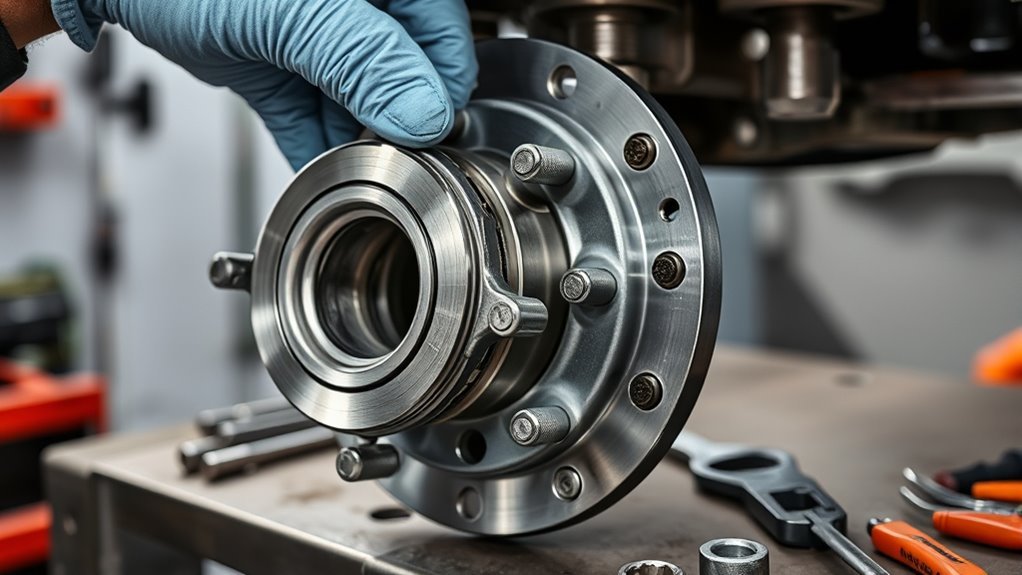
Now that the hub is off and the bearing is exposed, prepare to fit the new bearing and reinstall the backing plate in the correct orientation. Align the replacement bearing with the axle splines, seating it squarely so splines engage fully; misalignment will bind and compromise freedom of movement. Match all bolt holes before pressing or tapping the bearing into its seat.
Position the backing plate with the caliper cutout facing the brake caliper — correct backing plate orientation is critical for caliper clearance and rotor alignment. Clean mating surfaces, then apply a thin, even layer of copper never seize to the backing plate’s contact face to inhibit corrosion and simplify future removal. Hand-start bolts, verifying fit, then tighten in a criss-cross pattern to distribute clamp load evenly and avoid warping. Recheck spline engagement and bolt torque (per specs in the next section). Inspect the plate and adjacent components periodically for wear or corrosion to preserve liberated, reliable operation.
Torque the Axle Nut, Install Locking Mechanism, and Torque Pattern
Seat the axle nut fully against the bearing flange, then torque it to the specified 173 ft·lb to secure the bearing preload; do not stop at hand-tight. You’ll first snug the nut to 80 ft·lb, then follow with the final torque step, ensuring you meet the torque specifications precisely. Install the locking mechanism aligned with the cotter pin hole so the nut can’t back off — freedom from future roadside failures.
- Use a calibrated torque wrench and verify settings before starting.
- Tighten wheel studs or bolts in a criss-cross pattern to distribute clamping force evenly.
- Align and secure the locking mechanism (cotter pin or tab washer) to mechanical stop points.
- Re-check axle nut and fasteners after initial break-in miles to confirm torque holds.
Work methodically, resisting shortcuts. Accurate torque and a correctly installed locking mechanism preserve bearing preload, prevent loosening from vibration, and give you the control and reliability you deserve.
Reassemble Brakes, Clean Rotor, and Road-Test
Reinstall the cleaned rotor onto the hub, then mount the caliper and secure it with the two 17 mm mounting bolts so it never hangs by the brake hose. With the new bearing seated, complete caliper attachment using the specified torque for the 17 mm bolts; verify bolts are tightened to factory spec and that the caliper moves freely on its slides. Perform rotor cleaning prior to reinstall by removing rust and contaminants; use a wire brush and brake cleaner, then apply a thin coat of copper never-seize to the rotor mating surface to prevent future corrosion.
Reinstall the wheel and torque the lug nuts in the recommended pattern to spec. Lower the vehicle and pump the brake pedal until firm to reset caliper piston position. Conduct a controlled road test: accelerate, apply progressive braking, and listen for abnormal noises or vibration. After the test, recheck wheel nut torque and inspect for leaks or loosened hardware to guarantee safe, liberated mobility.
Frequently Asked Questions
How Much Does It Cost to Replace Wheel Bearings on a Toyota Tacoma?
You’ll typically pay $300–$600 to replace wheel bearings on a Toyota Tacoma; costs vary by wheel bearing types, OEM versus aftermarket, required replacement tools, labor hours, and potential extra parts or alignment fees.
Conclusion
You’ve methodically replaced the Tacoma wheel bearing, and the truck’s front end now hums true instead of whining. Like a watchmaker resetting gears, you restored precise contact between hub, axle, and brake hardware—measure, torque, and secure every fastener as if timing an engine. Trust the torque specs and locking mechanisms; they’re the quiet language that keeps components aligned. Drive gently on the first miles, then recheck everything—your diligence is the bearing’s warranty.