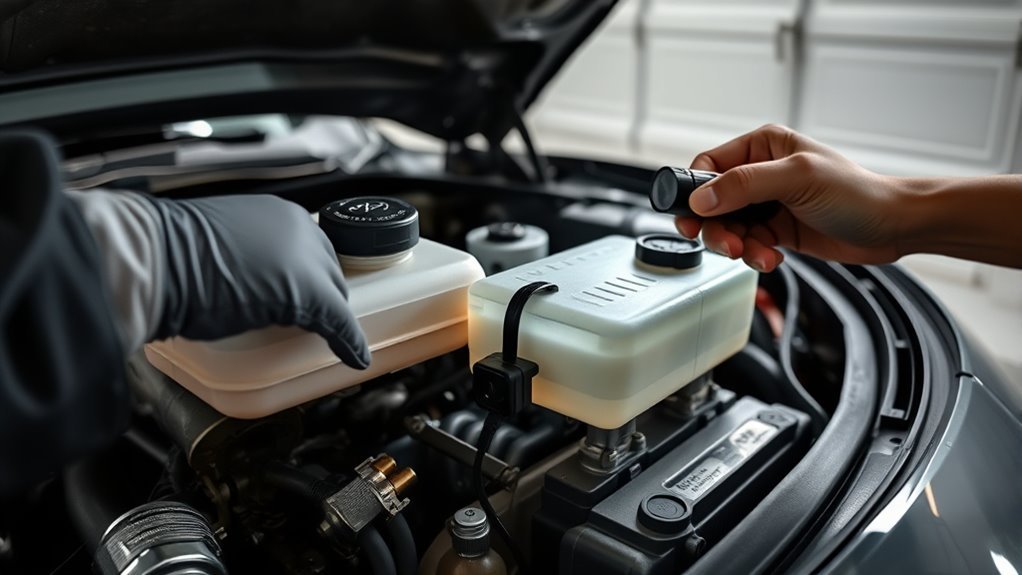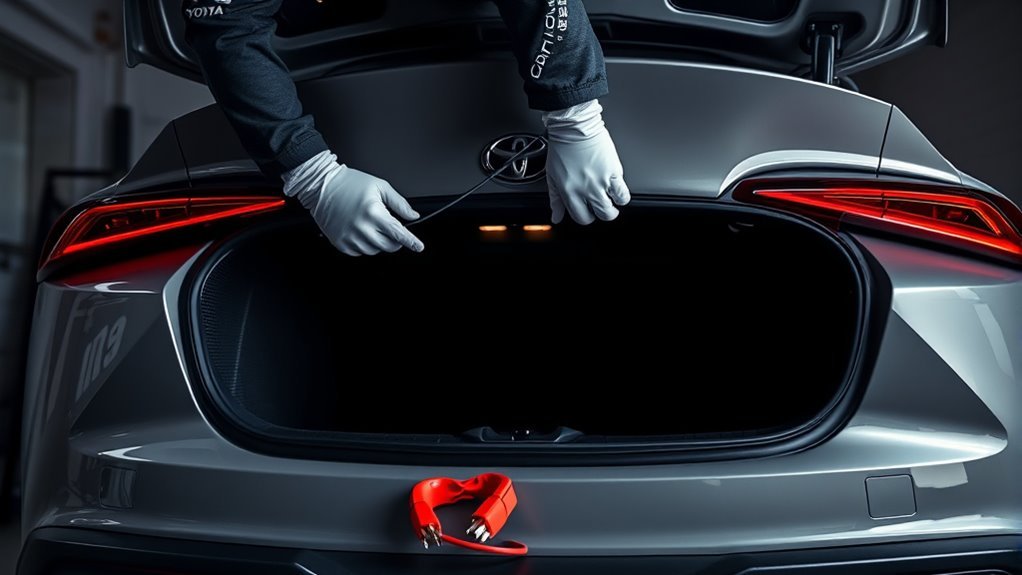
If your Toyota Supra trunk will not open with a dead battery, do not pry the hatch. Use the integrated mechanical key to unlock the driver door, pull the interior hood release twice, and supply 12-volt power through the designated under-hood starting-aid terminals. Once the vehicle electronics wake up, unlock and open the trunk normally. On U.S.- and Canada-market GR Supra (A90/A91) models, an emergency release handle is also located inside the cargo area, though equipment varies by country and production date.
Last updated: July 31, 2026 · Reviewed against Toyota’s current 2026 GR Supra owner-manual listings and official vehicle information.
Quick Answer: How to Open a Dead Supra Trunk
- Unlock Door: Release the mechanical key blade from the fob, pop the driver’s door handle lock cover, and unlock the door manually.
- Pop the Hood: Pull the driver footwell hood release lever twice (pull-pull mechanism; there is no secondary latch under the hood).
- Supply 12V Power: Connect a 12V jump pack or donor cables to the red positive (+) terminal under the hood and the dedicated chassis ground (-) stud.
- Release Hatch: Once vehicle power returns, press the key fob or interior trunk release button.
Key Takeaways
- Do not pry between the trunk lid and body. The latch, paint, trim, glass, or weather seal will suffer severe damage before the electronic latch releases.
- The 2020–2026 GR Supra (A90/A91 platform) is a two-seater with an integrated chassis cross-brace, meaning instructions about folding rear seats do not apply.
- Always jump-start or charge through the under-hood terminals. Connecting directly to the battery negative post in the trunk can damage the Intelligent Battery Sensor (IBS).
- A 12V jump pack provides sufficient current to wake the locks and electronic latch without needing to run the engine.
- The emergency cargo-area release handle is standard on North American models (FMVSS 401 compliant), but availability varies on European and JDM specifications.
At a Glance
| Safest First Method | Restore temporary 12-volt power under the hood, then use the normal trunk release |
| Time Required | 5–15 minutes with a jump pack or donor vehicle |
| Difficulty | Easy to moderate |
| Tools Needed | Integrated key blade, flashlight, gloves, 12V jump pack or jumper cables |
| Stop Immediately If | The battery is swollen, leaking, hot, smoking, frozen, or emitting a strong sulfur odor |
Toyota Supra Trunk Won’t Open: Is the Vehicle Battery Actually Dead?
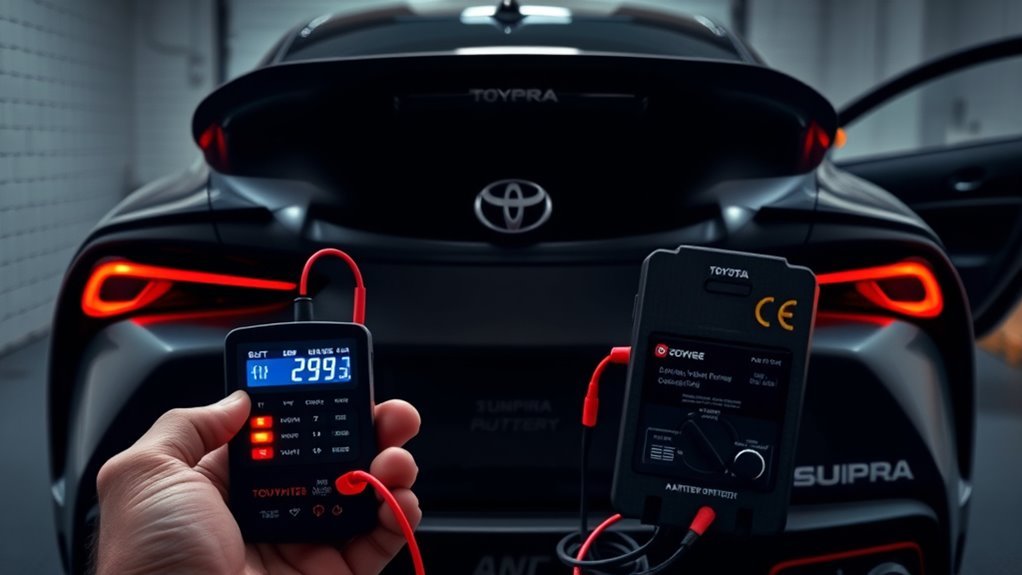
A dead key-fob battery (CR2032), a discharged vehicle 12V AGM battery, and a mechanically jammed trunk latch present similar symptoms. Verify electrical symptoms across the vehicle before attaching jump leads or reaching into the cargo area.
| What You Notice | Most Likely Cause | Best Next Check |
|---|---|---|
| Fob buttons fail, but cabin lights and dashboard displays work | Depleted CR2032 fob battery, RF interference, or remote fault | Use the mechanical key blade and replace the fob battery |
| Locks, cabin lights, windows, and digital cluster are totally dark | Discharged 12-volt vehicle AGM battery or poor main connection | Supply 12V power through the under-hood starting-aid terminals |
| The latch clicks audibly, but the trunk lid stays shut | Cargo pressure, frozen weather seal, weak struts, or alignment bind | Apply gentle downward pressure while pressing release; do not pry |
| Power returns, but electronic trunk release buttons do not respond | Blown fuse, body control module lock, or faulty latch actuator | Use the emergency release handle if equipped and accessible |
When measuring resting voltage at the under-hood terminals, remember that the GR Supra uses an Absorbent Glass Mat (AGM) battery. A fully charged resting AGM battery measures approximately 12.8V to 12.9V. A reading of 12.4V indicates roughly 50% state of charge, while anything near or below 12.0V represents a deeply discharged condition requiring an AGM-compatible recharge cycle.
Note: Do not condemn the battery from resting voltage alone. Perform an AGM load test and check for parasitic draw if the battery discharges repeatedly while parked.
[Products Worth Considering]

This all-in-one roadside emergency kit is designed to help drivers handle common breakdowns, minor repairs, and first aid needs with confidence. It includes a portable air compressor with tire pressure measuring and memory settings, safe jumper cables, and a versatile 14-in-1 pliers tool set, all organized for easy trunk storage. With a wide range of emergency supplies packed into one compact case, it is a practical choice for new drivers, daily commuters, and anyone preparing for unexpected roadside situations.

This portable 12V tire inflator delivers quick, reliable inflation with up to 150 PSI for cars, motorcycles, bicycles, RVs, and more. A built-in pressure gauge and bright LED light help you inflate accurately in low-light conditions, while the compact design and extended hose setup make it easy to reach all areas of your vehicle. Quiet operation and durable construction make it a practical choice for travel, home use, and emergency roadside needs.
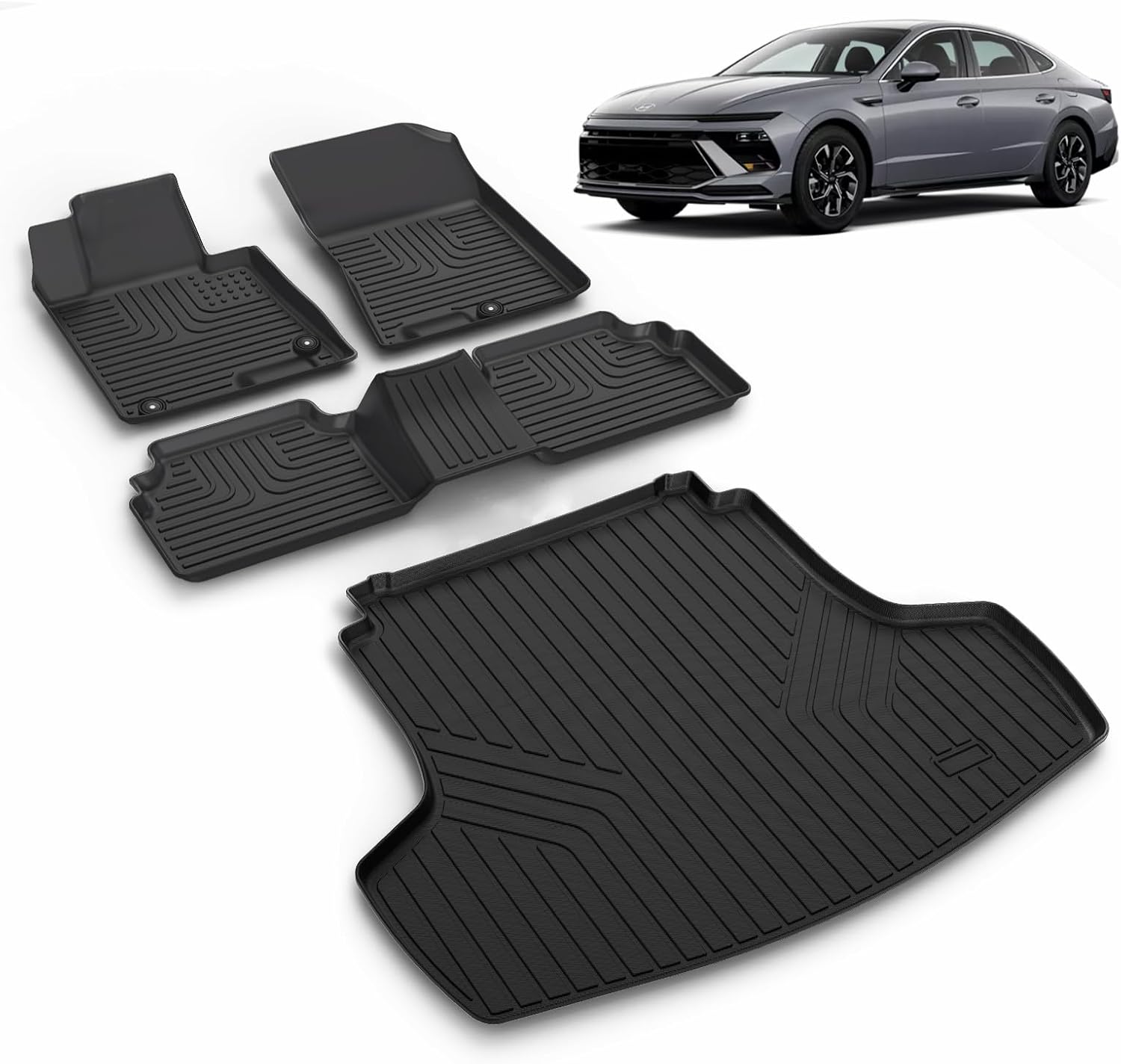
This custom-fit floor mat and cargo liner set is designed for select Kia K5 and Hyundai Sonata models to help protect your interior from dirt, spills, snow, and everyday messes. Made with durable TPE and shaped with raised edges and precise channeling, it offers secure coverage, easy cleanup, and reliable all-weather performance. The set includes front, rear, and cargo protection for a cleaner, safer driving experience.
How Do You Unlock a GR Supra With a Dead Battery?
When the vehicle battery is fully drained, proximity entry and remote key fob signals cease to function. The concealed mechanical key blade grants manual access to the driver cabin.
- Press the release catch on the back of the key fob and slide out the mechanical key blade.
- Pull and hold the exterior driver-door handle outward.
- Locate the small slot underneath the lock cylinder cover at the rear of the handle. Insert your finger or key blade tip to gently release the retaining tab, pushing the cap outward.
- Remove the cap to expose the physical lock cylinder. Insert the mechanical key and turn it clockwise to unlock the driver door manually.
- Remove the key blade before letting go of the door handle to prevent scratching the paintwork.
After opening the driver door, locate the interior hood release lever in the driver footwell. Pull the lever twice (the BMW-engineered “pull-pull” mechanism unlatches the primary and secondary safety catches from inside the cabin). You do not need to feel around under the front edge of the hood for a release catch.
Pro Tip: If the vehicle alarm arms before power failure, it may trigger the moment under-hood 12V power is restored. Keep the key fob nearby and press the unlock button immediately once power returns.
[Products Worth Considering]

This battery terminal maintenance kit helps remove corrosion fast and adds ongoing protection for cleaner, more reliable electrical connections. The dual-ended brushes restore terminal contact surfaces while the color-coded anti-corrosion washers help prevent future buildup on cars, trucks, RVs, boats, and other 6V or 12V batteries.

This smart automatic battery charger and maintainer helps keep automotive batteries charged and ready by delivering a full charge before switching to float mode for long-term maintenance. It supports 6V and 12V batteries with broad compatibility for lead-acid, AGM, gel, and lithium types, while built-in safety features like reverse polarity detection and spark-proof connection help ensure reliable use. Compact construction, included connection cables, and indicator lights make it a convenient choice for cars, SUVs, trucks, and storage maintenance.
How Do You Restore Power to Open the Supra Trunk?
Although the 12-volt battery resides beneath the cargo area floor panel, Toyota provides dedicated positive and negative starting-aid points in the engine bay. These terminals allow full electrical energization without accessing the trunk.
Warning: Never attempt to jump-start or charge a battery that is swollen, leaking, hot, emitting a rotten-egg sulfur odor, or frozen. Keep sparks, loose metallic objects, and open flames clear of all connection points.
Use a 12-Volt Jump Pack for Temporary Power
- Ensure the jump pack is switched OFF before connecting the leads.
- Open the hood and flip open the red plastic protective cover over the positive (+) starting-aid terminal on the passenger side of the engine bay.
- Connect the red positive (+) clamp to the starting-aid terminal post.
- Connect the black negative (-) clamp to the dedicated hex-shaped chassis grounding bolt located on the inner fender or strut tower.
- Switch ON the jump pack. The vehicle electronics, interior lighting, and instrument cluster will illuminate.
- Press the unlock button on the key fob or use the interior central-locking switch to wake all body control modules.
- Press the trunk-release button on the fob, the driver door switch, or the rear exterior release button to pop the hatch.
- Once the hatch opens, switch off and disconnect the jump pack (negative black clamp first, followed by positive red clamp).
Use Jumper Cables and a Donor Vehicle
- Position the donor vehicle so jumper cables reach comfortably without tension. Ensure the vehicles do not touch, set both parking brakes, and shut off the donor engine.
- Connect one red positive clamp to the donor battery’s positive (+) terminal.
- Connect the other red positive clamp to the Supra’s under-hood positive (+) terminal.
- Connect one black negative clamp to the donor vehicle’s battery negative (-) terminal or bare engine block ground.
- Connect the remaining black negative clamp to the Supra’s designated chassis ground stud.
- Start the donor vehicle and let it idle for 3–5 minutes to supply steady voltage.
- Unlock the Supra and press the trunk release button. Disconnect cables in exact reverse order (negative off Supra first).
Can You Use a Smart Charger?
Yes. If you are not in an emergency rush, connect an AGM-compatible smart battery maintainer or charger to the under-hood terminals. Ensure the charger is set to AGM mode (typically 14.4V–14.7V absorption profile).
Critical IBS Warning: Once the trunk is opened, do not clamp battery chargers directly to the negative battery terminal on the battery casing in the rear. Connecting downstream of the negative terminal bypasses the Intelligent Battery Sensor (IBS), which causes inaccurate state-of-charge tracking in the engine management system. Always use the under-hood chassis ground point.
Supplying 12V current to the under-hood terminals instantly powers the electronic trunk solenoid. You do not need to start or crank the engine simply to pop the rear hatch.
How Do You Open the Trunk After Power Returns?
With electrical power restored through the engine bay, trigger the latch using any standard release method:
- Unlock all vehicle doors via the key fob or driver-door central locking button.
- Press and hold the dedicated trunk release button on the remote key fob for approximately 1.5 seconds.
- Press the exterior hatch release switch above the rear license plate while carrying the active remote.
- Press the trunk release switch located in the driver’s door interior pocket panel.
If the solenoid releases with an audible click but the hatch remains seated, gently lift the trailing edge of the hatch by hand. Cold weather can cause the perimeter rubber seals to adhere to the body, and aging gas lift supports may lack sufficient initial force to pop the heavy glass lid upward.
Does the GR Supra Have an Emergency Trunk Release?
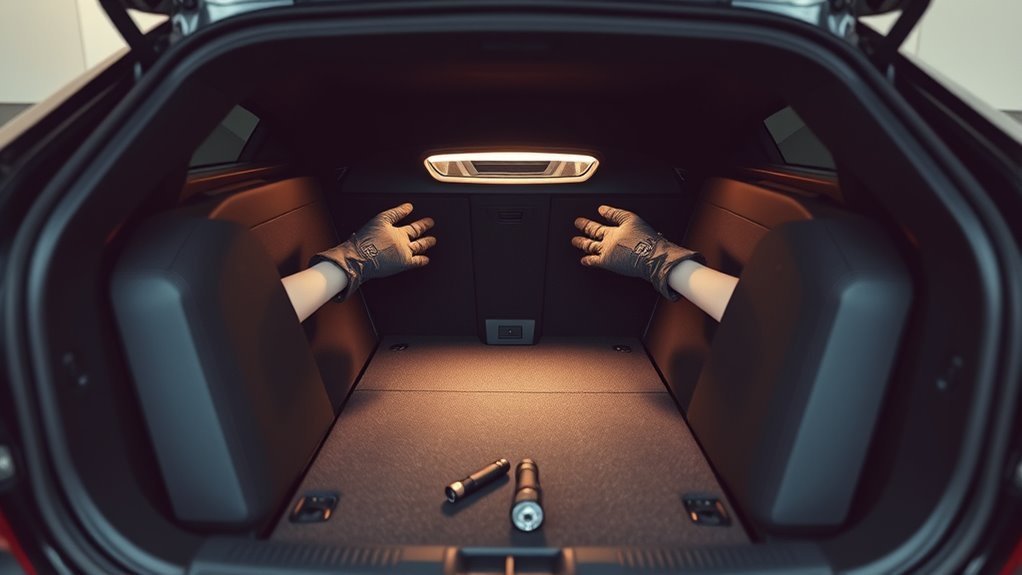
North American market GR Supra models (U.S. and Canada) feature a phosphorescent (glow-in-the-dark) emergency trunk release handle mounted inside the rear cargo area latch trim to comply with federal safety regulations. European, Japanese (JDM), and other international market vehicles may not include this physical handle.
Because the A90/A91 Supra has a two-seat cockpit with a structural aluminum chassis cross-brace located directly behind the seatbacks, reaching the handle requires specific clearance:
- Slide both driver and passenger seats fully forward and tilt the seatbacks forward.
- Shine a high-powered flashlight over the structural cross-brace into the rear hatch cavity.
- Locate the T-shaped release handle positioned near the center of the rear hatch latch assembly.
- Using a long reach tool or your arm (ensuring you do not place excessive body weight on the center brace trim), pull the emergency handle firmly toward the front of the vehicle.
- The mechanical latch will click open, allowing the hatch to be lifted from outside.
Note: Under-hood electrical energization is significantly faster and safer than attempting to climb over the rear cockpit brace. Use the interior mechanical handle only as a secondary failsafe.
What If Cargo Blocks the Emergency Release?
If luggage or track gear blocks the rear release handle, do not force yourself into the cargo compartment. The structural bulkhead and sloping rear glass create a severe entrapment and injury risk.
- Maintain a secure footing inside the main cabin; never crawl entirely over the cross-brace.
- Use a flashlight to identify and carefully pull out small, soft items with a mechanical grabber tool.
- Avoid prying or pulling against the defroster grid lines embedded in the rear hatch glass.
- If luggage cannot be moved without violent pulling, abandon interior access and restore 12V power through the engine bay.
Warning: Never allow anyone to crawl into the enclosed cargo compartment while attempting trunk latch maneuvers. Keep hands and tools clear of the motorized latch cinch zones.
What Should You Never Do to a Stuck Supra Trunk?
- Do not pry the hatch lid: Prying between the rear quarter panels and hatch lid will bend aluminum body panels, chip paint, and shatter the tempered rear glass.
- Do not drill or cut interior trim: The latch mechanism is tied into the vehicle’s body control network; damaging wiring harnesses can cause CAN-bus communication faults.
- Do not backfeed through interior 12V auxiliary sockets: The 12V accessory ports are relay-isolated and switch off when the ignition is dead. Forcing current through auxiliary sockets can blow internal fuses or damage control modules.
- Do not bypass the Intelligent Battery Sensor: When charging the battery in the trunk, never clamp negative leads directly to the battery’s negative terminal post.
- Do not jump-start a physically damaged battery: If the battery case shows swelling, bulges, or cracks, connecting high amperage can trigger an explosion or acid fire.
When Should You Call Roadside Assistance or a Toyota Dealer?
If under-hood power fails to wake the electronic trunk latch and the mechanical interior handle is inaccessible, contact Toyota Roadside Assistance, an automotive locksmith, or an authorized service center. Professional assistance is critical if you suspect wiring harness damage, water intrusion in the rear body control module, or a failed mechanical latch motor.
Call for Professional Service When
- Under-hood jump terminals spark heavily or blow main fusible links immediately upon connection.
- The central locking system wakes up, but the hatch solenoid produces no sound or movement.
- The mechanical driver’s door lock cylinder spins freely or will not unlock the door.
- The vehicle battery repeatedly drains to zero within 24–48 hours of a full charge, indicating a parasitic control module draw.
- The battery case shows physical deformity, frost buildup, or acid leakage around the terminal posts.
Safety and Prevention
Perform basic electrical maintenance to ensure you are never stranded with an inoperable hatch:
- Keep a compact lithium jump pack inside the glove box or center console storage—not in the rear trunk floor.
- Store a replacement CR2032 key fob battery in the glove compartment.
- Connect an AGM-compatible smart trickle charger through the under-hood terminals during winter storage or extended parking.
- Review dedicated battery maintenance and charging tips to preserve the factory AGM cell life.
- Verify open technical service bulletins using the Toyota Recall Lookup or the NHTSA Recalls Portal.
- Reference your specific vehicle build manual via Toyota Owners Manuals & Warranties.
Frequently Asked Questions
Can you open a Toyota Supra trunk with a dead battery?
Yes. Unlock the driver door using the mechanical key blade concealed in the fob, pull the interior hood lever twice, and attach a 12V jump pack or jumper cables to the engine-bay starting-aid terminals. Once power returns, open the hatch using the fob or interior release button.
How do you pop the hood on a GR Supra with a dead battery?
Unlock the driver door with the physical key blade, then pull the hood release handle in the driver footwell twice in succession. The A90/A91 Supra uses a double-pull mechanism that fully unlatches the hood from inside the car, requiring no secondary under-hood safety catch.
Where are the under-hood jump start points on the Supra?
The positive (+) terminal is housed under a red plastic flip cover on the passenger side of the engine compartment. The negative (-) terminal is a dedicated unpainted hex-shaped metal grounding bolt located on the chassis strut tower.
Can you fold down rear seats in a GR Supra to get into the trunk?
No. The 2020–2026 GR Supra is a two-seat sports coupe without rear seats. There is a small gap above the rear aluminum chassis cross-brace behind the front seats, but the seats themselves do not fold.
Why shouldn’t you charge the Supra battery directly at the negative terminal?
Connecting a charger directly to the battery’s negative terminal post in the trunk bypasses the Intelligent Battery Sensor (IBS). This prevents the vehicle’s computer from tracking charging current, leading to improper battery management and potential fault codes.
Does every Toyota Supra have an interior emergency trunk release handle?
No. U.S. and Canadian specification GR Supras are equipped with a glow-in-the-dark interior release handle per North American safety standards. European and Japanese domestic market (JDM) models often omit this internal handle.
Can you charge the Supra battery through the 12V cigarette lighter port?
No. The 12-volt auxiliary power ports in the Supra are electronically isolated through relays when the ignition is off. Attempting to backfeed charge through these sockets can blow internal fuses and will not reach the main battery.
Why does the Supra trunk click but refuse to pop up?
This occurs when the electronic actuator unlocks, but the hatch is held down by sticking rubber weatherstripping, weak gas struts, or internal cargo pressure. Press down gently on the hatch while activating the release, then lift upward by hand.
Conclusion
When a Toyota GR Supra trunk will not open due to a dead 12V battery, avoid forcing or prying the rear hatch lid. Use the integrated key blade to enter the cabin, pull the hood release twice to open the engine bay, and apply 12-volt power to the designated under-hood starting-aid terminals. Supplying power instantly wakes the body control modules and releases the electronic trunk latch safely. If electrical methods fail, utilize the interior emergency release handle or contact roadside assistance to prevent damage to the vehicle’s aluminum bodywork and electronic locking systems.
Sources
- Toyota Owners Manuals & Warranties — official vehicle documentation portal for GR Supra model years.
- Toyota Supra Owner’s Manual: Opening and Closing — mechanical key blade, hood double-pull, and hatch operation.
- Toyota Supra Owner’s Manual: Cargo Area — cargo capacity, bulkhead guidelines, and emergency release handle.
- Toyota GR Supra Full Specifications — factory technical equipment and chassis details.
- Toyota Recall Lookup — official Toyota VIN campaign and service lookup.
- NHTSA Recalls — official National Highway Traffic Safety Administration vehicle safety database.