Charge nightly with a Level 2 charger and start days at full SOC, use Eco/EV modes and precondition while plugged in to cut HVAC draw, and keep steady speeds around 55 mph with gentle acceleration to avoid ICE engagement. Favor routes under ~40 miles with fewer stops and low gradients, monitor battery temp/SOC, raise tire pressure and remove extra weight or roof racks, and prefer heated seats over cabin heat. Follow these steps and you’ll access more practical range optimization tips.
Quick Wins: Charge, Mode, and Speed Checklist
If you want to maximize the RAV4 Prime’s ~42-mile electric range, start each day with a full charge and use a Level 2 charger whenever possible (brings charging to ~4.5 hours). You’ll prioritize charging locations that fit your schedule—home Level 2 first, workplace or public chargers second—to guarantee daily full capacity. Adopt eco or EV drive modes to moderate throttle and reduce power draw; these settings measurably improve energy conservation by smoothing acceleration profiles. Keep speeds at or below 55 mph to minimize aerodynamic losses and avoid frequent gas-engine engagement. Adjust your driving habits: gentle throttle inputs, anticipate traffic, and limit rapid lane changes. Use route planning to select paths with fewer stops and modest elevation change; that planning reduces start-stop energy penalties and regenerative braking inefficiencies. Together, these checkpoints let you reclaim mobility norms, using data-driven tactics to extend pure-electric miles and preserve freedom from fossil dependence.
Charge Smarter : RAV4 Prime Level 2 & Overnight Tips
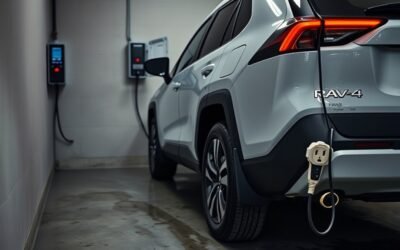
Set a nightly routine to top off the 18.1 kWh pack using a Level 2 charger so a full charge is ready in ~4.5 hours, ensuring you start with up to 42 miles of electric range for daily commutes. Position the Level 2 unit where the cable reaches the charge port without stretching or tripping hazards, and record charge start/stop times to verify consistent overnight fills. While plugged in, precondition the cabin to shift HVAC load off the battery during departure and preserve usable range.
Overnight Charging Routine
Because an RAV4 Prime reaches a full charge in about 4.5 hours on a Level 2 charger, you can reliably start each day with up to 42 miles of electric range—ideal for most commutes—by plugging in overnight; using Level 1 is feasible but typically requires around 12 hours, which can leave you with less available electric range the next morning. You should set a predictable overnight routine: schedule charging to finish before your first trip, prioritize Level 2 when available, and avoid partial-charge habits that undermine charging benefits and battery longevity. Regular nightly charging stabilizes state-of-charge and readiness, increasing electric-mode utility.
| Action | Result |
|---|---|
| Plug in Level 2 | Full charge ~4.5 h |
| Plug in Level 1 | Full charge ~12 h |
| Nightly schedule | Consistent SOC |
| Full morning SOC | Up to 42 miles |
| Habitual charging | Better longevity |
Level 2 Charger Placement
When you install a Level 2 charger, place it as close to your regular parking spot as practical so you minimize cable stress and make nightly charging frictionless; a short run to the vehicle reduces wear on plugs, lowers tripping risk, and makes you far more likely to charge consistently enough to use the RAV4 Prime’s ~42-mile electric range daily. Choose a charger location that allows a straight cable path and secure mounting. Use a dedicated 240V circuit sized per manufacturer specs to avoid overloads and preserve charge rate—typical full charge in ~4.5 hours. Activate smart charging to shift sessions to off-peak hours, cut costs, and guarantee morning readiness. Regularly inspect connections and follow installation tips to maintain reliability and autonomy.
Set Drive Modes and Precondition the Cabin
Select Eco or EV mode before you start driving to prioritize electric energy use—these modes remap throttle response and boost regenerative braking for measurable efficiency gains. Precondition the cabin while plugged in to heat or cool the interior using grid power, which can cut on-road battery HVAC draw substantially. Keep cabin temperature moderate and anticipate stops to maximize recovered energy and extend your EV range.
Choose Eco/EV Modes
Anyone aiming to maximize electric range should use Eco and EV modes together and precondition the cabin while plugged in to minimize on-road battery draw. Use EV mode for trips within the EPA-rated 42-mile electric range; the car runs solely on battery power, eliminating ICE losses. Switch to Eco mode to remap throttle control and soften climate outputs—this yields measurable reductions in instantaneous power draw and supports eco driving via the eco gauge. Monitor the gauge to keep acceleration within efficient bands; steady, moderate throttle inputs preserve kilowatt-hours. Before you finish a trip, toggle HV briefly to warm the ICE and protect downstream range and battery health. These mode choices give you technical control, lower consumption, and more autonomy over your electric miles.
Precondition While Plugged In
If you plug in and precondition the RAV4 Prime before you drive, you save onboard energy and keep the battery at an ideal temperature for efficiency—using grid power for cabin heating or cooling preserves state-of-charge and can measurably increase usable electric miles. Preconditioning benefits are quantifiable: by shifting thermal load to the grid you avoid battery draw that would otherwise reduce electric range. Set drive mode to EV or Eco before departure so propulsion logic is tuned for low consumption. Practically, schedule preconditioning via the app or vehicle timer while plugged in, monitor state-of-charge, and confirm cabin temperature reaches target before unplugging. This data-driven workflow improves energy efficiency, extends all-electric range (up to ~42 miles ideal), and frees you from range anxiety through predictable, optimized preparation.
Drive Habits That Keep Your RAV4 Prime in EV Mode
While keeping your speed near 55 mph and using eco/EV mode, you’ll minimize gas-engine interventions and get the highest percentage of miles on battery power. Use a technical, measured approach: monitor speed, battery state, and throttle demand. Apply gentle acceleration and anticipate slowdowns to reduce power spikes that force the engine on.
- Maintain steady speeds near 55 mph; aerodynamic losses rise with the square of velocity, so small increases cost substantial electric range.
- Engage eco/EV mode to limit throttle maps and conserve energy; the control logic favors electric propulsion under moderate load.
- Practice gentle acceleration and controlled deceleration; avoiding rapid torque demands prevents SOC depletion and compressor/engine wakeups.
- Anticipate slowdowns and use regenerative braking strategically to recover kWh, smoothing inputs to maximize net energy recovered.
These habits give you operational freedom: predictable range, fewer combustion cycles, and consistent electric-only miles without sacrificing safety.
Plan Routes to Maximize EV Miles and Avoid Hills
Having refined your driving inputs to stay in EV mode, you should now plan routes that preserve state of charge by minimizing stops and elevation changes. Use route planning to select trips ≤40 miles when possible—this aligns with the RAV4 Prime’s EPA-rated electric range and maximizes pure-EV mileage. Prioritize roads with fewer signals and steady speeds; each full stop and restart can cost measurable kWh.
Leverage navigation apps to map low-gradient alternatives and perform elevation management: compare cumulative ascent values and choose the route with lower total climb. Favor scenic backroads over congested highways when they reduce stop-and-go and steep grades. Monitor the battery gauge en route and set alerts for when remaining EV range approaches ~10 miles so you can switch to hybrid proactively. Quantify benefits by tracking energy use per mile on candidate routes and iteratively optimize; this data-driven approach frees you from range anxiety while maximizing electric miles.
Reduce HVAC and Accessory Drain (Heating, Cooling, Seats)
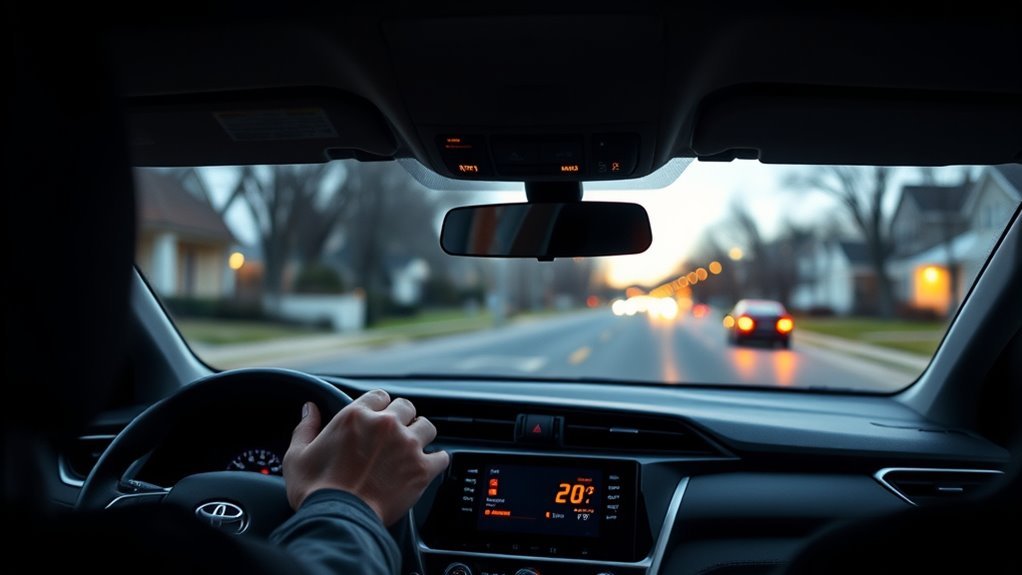
Because HVAC and accessory loads can dominate consumption on short EV trips, you should prioritize low-power solutions like heated seats and steering wheel use instead of running full cabin heat—seats draw roughly 50 W versus up to 3,000 W for the heater. You’ll get tangible range gains by adopting efficient climate habits and clear accessory optimization strategies: precondition while plugged in, limit fan speed, and avoid heavy accessory draws.
Prioritize low-power climate choices—use heated seats and wheel, precondition while plugged in, limit fan and accessory use.
- Use heated seats and steering wheel as primary heat sources; they target you directly at ~50 W each.
- Precondition the cabin while plugged in to eliminate heater or A/C load during the drive.
- Avoid rear window heater and wiper de-ice unless essential; they consume surprising power.
- Monitor HVAC settings, minimize idling with climate on in EV mode, and favor eco-mode to constrain blower and compressor usage.
These data-driven, practical steps give you control and liberation from range anxiety by reducing HVAC energy waste and optimizing accessory use.
Tires, Weight, and Aero Tweaks to Squeeze Extra Range
After cutting HVAC and accessory losses, focus on the mechanical and aerodynamic side: tires, vehicle mass, and drag together determine a large share of rolling and aerodynamic energy losses at typical RAV4 Prime speeds. You’ll raise tire pressure toward the higher end of door-jamb recommendations—staying below sidewall limits—to lower rolling resistance and gain measurable electric efficiency without compromising safety. Fit low rolling resistance tires engineered for EVs when the tread needs replacing; they shift energy loss curves in your favor.
Pursue weight reduction by removing unnecessary cargo and heavy accessories so the gasoline engine isn’t summoned as often; each kilogram saved reduces consumed energy per kilometer. Remove roof racks and other protrusions to achieve aerodynamic improvements; smoother airflow cuts drag at highway speeds. Keep tire alignment within factory tolerances to prevent uneven wear and preserve low rolling resistance. These targeted, data-driven tweaks free you from range anxiety by extracting pragmatic gains from systems you control.
Manage the Battery in Cold or Hot Weather
When temperatures stray far from the ideal ~20°C, battery efficiency and usable range fall noticeably, so you should proactively manage pack temperature—precondition while plugged in to heat the battery in cold weather (pushing range from ~2.2 mi/kWh back toward nominal values) and use scheduled cooling or shaded parking in heat to avoid thermal derating. You’ll use battery management strategies and temperature monitoring to preserve usable energy and maintain predictable performance.
- Precondition while plugged in to raise pack temp in cold climates; this reclaims range lost to cold-induced internal resistance.
- In heat, schedule cabin cooling and park in shade to limit high pack temperatures and avoid charging/drive power limits.
- Prefer heated seats/steering wheel over cabin heater (which can draw ~3 kW) to minimize energy loss during winter.
- Keep tire pressure within spec; underinflation compounds weather-related range loss.
Implement these measures, monitor battery temperature, and you’ll liberate more electric miles with quantifiable gains.
Troubleshooting: Why the ICE Wakes and Fixes
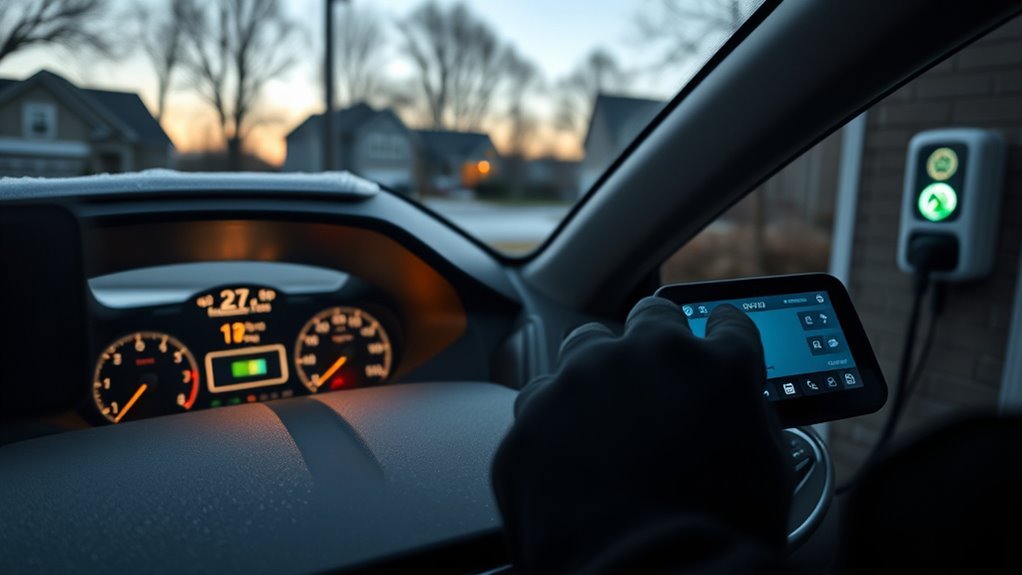
Managing battery temperature and state-of-charge helps prevent unexpected engine starts, but you still need to understand why the ICE wakes and how to stop it. You’ll see ICE engagement when battery temperature is low—cold starts force the engine on to protect battery chemistry, reducing electric range until temps normalize. High instantaneous power demand (hard acceleration, heavy HVAC) also triggers ICE engagement; use Eco mode and moderate acceleration to stay electric. If SOC falls below roughly 10%, the system shifts to hybrid mode to preserve battery health, so maintain 80–91% SOC for maximum electric miles. Steep grades or sustained high loads prompt the engine to assist the motor; plan routes with fewer elevation changes when possible. For practical fixes, monitor SOC and battery temp, precondition the cabin while plugged in, use regenerative braking to recover energy, and employ Eco drive settings. These data-driven steps give you control and reduce unwanted ICE activation.
Frequently Asked Questions
How to Drive RAV4 Prime Most Efficiently?
You’ll drive the RAV4 Prime most efficiently by using eco driving, sticking below 55 mph, preconditioning while plugged in, applying regenerative braking, and accelerating gently; these data-driven tactics extend electric range and free you from frequent refueling.
How Do I Increase My EV Battery Range?
Charge nightly and maintain battery health: a commuter who charged to 100% only when needed extended range. You’ll optimize battery maintenance and charging habits, use eco/EV modes, gentle acceleration, and preconditioning to free your commute.
Is It Better to Use EV Mode on the Highway?
No — you shouldn’t use EV mode at highway speeds; it’ll hurt battery management and deplete range rapidly. Drive hybrid above 55 mph, prioritize smooth inputs and speed control to conserve energy and retain operational freedom.
How Far Can the RAV4 Prime Go on Electric?
Like a reliable clock, you’ll get about 42 EPA miles electric, sometimes over 50 under ideal conditions; optimize charging habits and account for terrain impact, and you’ll technically extend usable range while staying practically liberated.
Conclusion
You’ll squeeze every possible EV mile out of your RAV4 Prime if you treat charging, modes, and habits like lab variables: plug in nightly, favor EV/EV Auto, precondition, drive smooth under 55 mph, and trim HVAC, weight, and aero. Small changes—2 psi more in tires, 5 mph less speed, 2-minute heat-saver—compound into double-digit range gains. Do it consistently and you’ll practically make gasoline extinct for your commute.