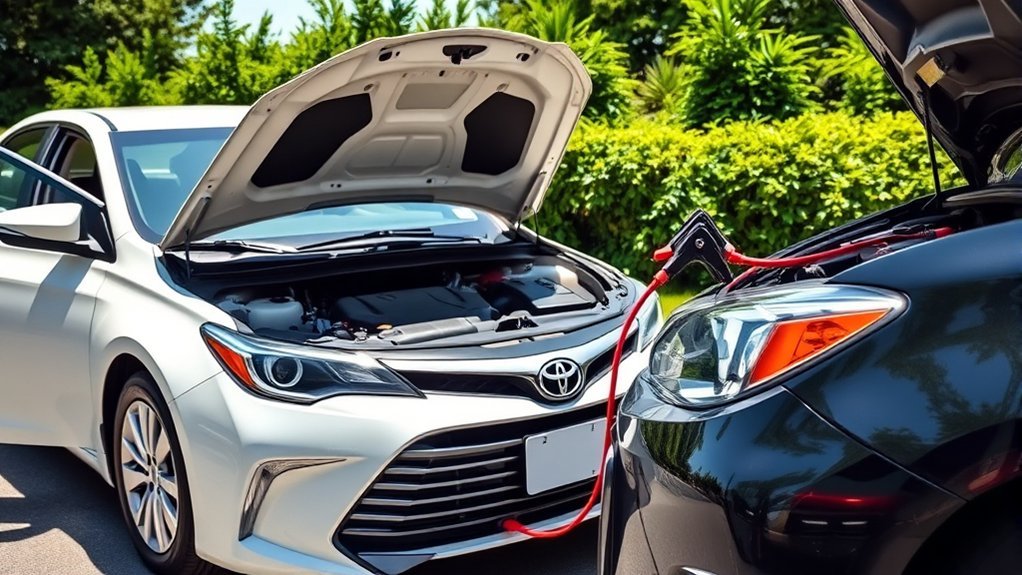
To jump start your Toyota Camry safely, first connect the positive clamp (red) to the Camry’s positive terminal and then to the donor vehicle’s positive terminal. Next, attach the negative clamp (black) to the donor’s negative and the other end to a metallic point on the Camry’s engine block. Start the donor vehicle at 2,000 RPM for sufficient charge. After a successful jump, drive your Camry for 15-20 minutes to recharge the battery. There’s more to guarantee safety and efficiency.
Understanding Jump Starting Basics for Your Toyota Camry
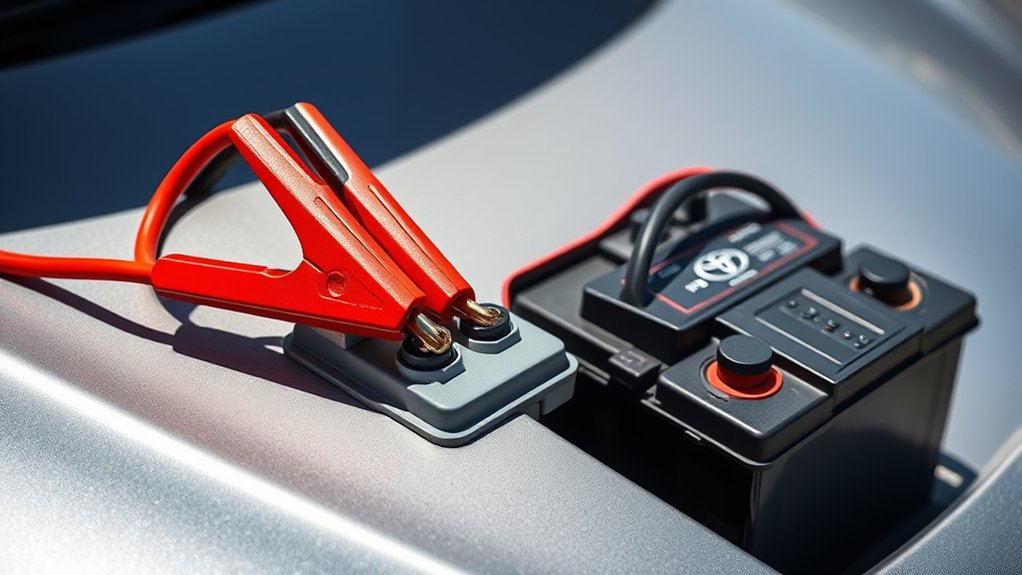
Jump starting your Toyota Camry safely requires understanding a few key basics. First, identify your battery terminals: the positive terminal has a red cover, while the negative is often unmarked or black. Always use the red clamp for the positive connection to avoid confusion and potential short circuits. When you’re ready to connect the negative clamp, attach it to a metallic point on the engine block instead of the battery; this minimizes the risk of sparks and explosions.
Follow the correct order for connecting clamps: start with the Camry’s positive terminal, then the donor vehicle’s positive, followed by the donor’s negative, and finish with the Camry’s negative. After successfully jump starting, drive your Camry for 15-20 minutes to guarantee effective battery maintenance and recharge your electrical systems. This knowledge empowers you, making you more self-sufficient and confident in managing your vehicle.
What You’ll Need to Jump Start Your Car
To jump start your Toyota Camry, you’ll need a set of jumper cables, safety gear, and a donor vehicle. Guarantee the jumper cables have red and black clamps for proper connections and wear gloves and goggles for protection. Also, confirm that the donor vehicle has a compatible 12-volt battery and is parked close enough for the cables to reach.
Jumper Cables Specifications
When selecting jumper cables for your Toyota Camry, it’s important to take into account several specifications to guarantee a safe and effective jump start. Aim for cables with a gauge rating of 4 to 8 AWG for efficient current transfer, particularly in colder climates. Length matters, too; choose cables at least 16 feet long to reach comfortably between vehicles. Prioritize heavy-duty, insulated clamps that offer strong grip and clamp efficiency to guarantee secure connections while minimizing spark risks. Look for durable, weather-resistant insulation to enhance cable durability and withstand environmental conditions. Finally, make sure cables are color-coded—red for positive and black for negative—to prevent accidental reverse connections during use.
Safety Gear Essentials
Having the right safety gear is essential for a successful jump start of your Toyota Camry. Start with safety goggles to shield your eyes from battery acid splashes or sparks. Insulated gloves are critical, protecting your hands from accidental contact with electrical terminals. Always keep a fire extinguisher nearby, ideally rated for electrical and flammable materials, to handle emergencies. Make sure you have a set of jumper cables that are 4 to 6 gauge for effective conductivity and safety. Finally, if you’re jump starting in low-light conditions, a flashlight is important for visibility. By equipping yourself with this essential equipment, you’ll enhance your safety and confidence during the jump start process.
Donor Vehicle Requirements
Selecting the right donor vehicle is essential for a successful jump start of your Toyota Camry. Confirm the donor vehicle has a fully charged battery with a compatible voltage of 12 volts. Ideally, it should be of similar size or larger, as this provides adequate power for the jump-start process.
| Donor Vehicle Requirement | Description |
|---|---|
| Battery Condition | Fully charged, 12 volts |
| Vehicle Size | Similar or larger than Camry |
| Engine Status | Must be running at ~2,000 RPM |
Check that both vehicles are parked close enough for jumper cables to reach but not touching. Always use a vehicle in good working condition to avoid complications during the jump-start.
Step-by-Step Guide: Connecting Jumper Cables
To connect jumper cables safely, start by ensuring you follow the correct order for clamp connections. Begin with the positive terminal of your Camry’s battery, then proceed to the donor vehicle’s positive terminal, followed by the negative terminal of the donor. Finally, attach the negative clamp to a metallic point on the Camry’s engine block, keeping a safe distance from the battery to avoid any risk of explosion.
Proper Clamp Connection Order
When jump-starting a Toyota Camry, it’s crucial to connect the jumper cables in the correct order to guarantee safety and efficiency. Start by attaching the positive clamp (red) to the positive terminal of your Camry’s battery. Next, connect the positive clamp (red) to the positive terminal of the donor vehicle’s battery. After that, take the negative clamp (black) and attach it to the negative terminal of the donor vehicle’s battery. For the final connection, attach the negative clamp (black) to a metallic point on the Camry’s engine block, avoiding any contact with the battery. Following this specific clamp connection order minimizes the risk of sparks or explosions, ensuring a smooth jump-start process.
Safety Precautions During Jumping
While jump-starting your Toyota Camry, following essential safety precautions is vital to prevent accidents and guarantee a successful start. Here’s a step-by-step guide to enhance your emergency preparedness:
- Connect the positive clamp (red) to the Camry’s positive terminal first, ensuring a safe connection.
- Attach the second positive clamp to the donor vehicle’s positive terminal, making sure both vehicles are off.
- Connect the negative clamp (black) to the donor vehicle’s negative terminal to complete the circuit.
- For the last connection, attach the negative clamp to a metallic point on the Camry’s engine block, avoiding direct contact with the battery to prevent explosions.
Always maintain a safe distance from the battery during the final connection to minimize the risk of sparks igniting any gases emitted.
Safe Starting Procedures for the Donor Vehicle
Before you begin the jump-start process, make certain the donor vehicle is parked safely with the engine off and in either neutral or park mode. Check the battery compatibility, confirming the donor battery meets the specifications required for your Toyota Camry. This is vital for effective charging and to prevent damage.
Next, open the donor vehicle’s hood securely to allow easy access to the battery terminals. After connecting the jumper cables, start the donor vehicle first, letting it run for a few minutes at approximately 2,000 RPM. This helps establish a sufficient charge to the dead battery.
While the donor vehicle is running, monitor its electrical systems for any irregularities, which could indicate maintenance issues. Following these safe starting procedures guarantees a smooth and efficient jump-start, empowering you to take control of your vehicle situation confidently.
Jump Start Success Indicators
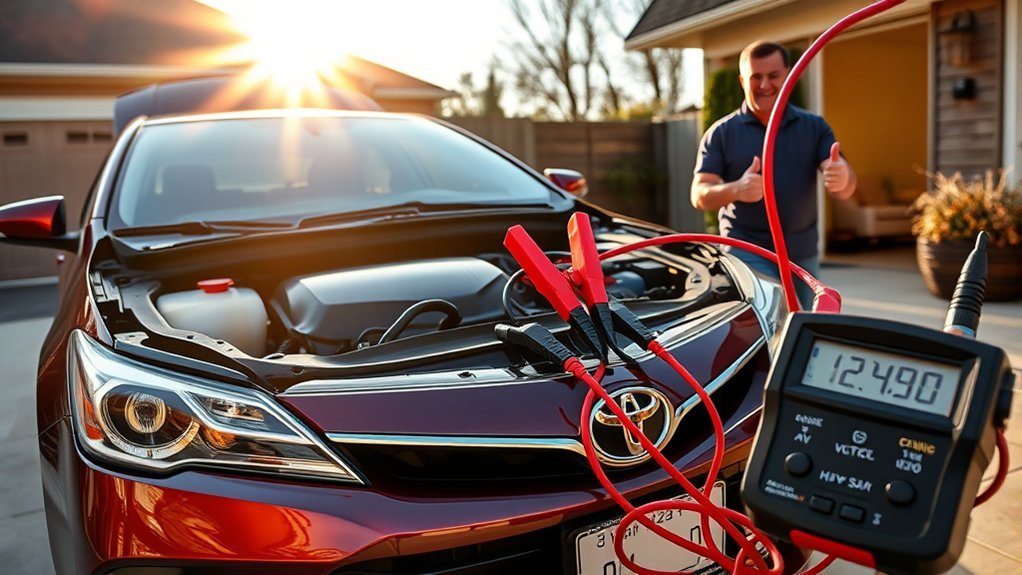
A successful jump start reveals itself through several clear indicators. Recognizing these jump start signs can help confirm your battery recovery is effective. Here’s what to look for:
- Engine Cranking: The engine should crank smoothly and start within a few attempts after connecting the cables.
- Stability: If the vehicle runs without stalling, it indicates the battery has regained sufficient charge.
- Sound Check: Listen for any unusual sounds, like clicking or grinding, which could signal further electrical issues.
- Dashboard Monitoring: After starting, keep an eye on the dashboard for warning lights that may indicate battery or alternator problems.
If your vehicle maintains idle stability and operational accessories shortly after starting, it suggests a healthy electrical system. Recognizing these signs will empower you to confirm your jump start was successful and your vehicle is ready to go.
How to Disconnect Jumper Cables Safely
To safely disconnect jumper cables, follow a specific order to minimize risks of sparks or damage. Adhering to the correct sequence is essential for effective cable maintenance and spark prevention.
| Step | Action |
|---|---|
| 1 | Remove negative clamp from the Camry. |
| 2 | Detach negative clamp from the donor vehicle. |
| 3 | Remove positive clamp from the donor vehicle. |
| 4 | Finally, take off the positive clamp from the Camry. |
| 5 | Confirm all connections are fully separated before storing. |
Caring for Your Camry After a Jump Start
Once you’ve successfully jump-started your Toyota Camry, it’s crucial to take immediate steps to guarantee its long-term performance. Follow these guidelines to facilitate effective battery maintenance and performance monitoring:
- Drive Your Camry: Take a 15-20 minute drive to allow the alternator to recharge the battery effectively.
- Check the Battery Cover: Securely reinstall the red cover on the battery to protect it from debris and accidental contact.
- Monitor Performance: Over the next few days, watch for any recurring starting issues; these could signal a deeper problem.
- Inspect Regularly: Routinely check the battery’s condition for signs of corrosion or wear to maintain peak performance.
If starting problems persist, consider having the battery tested at an auto parts store. This proactive approach guarantees your Camry remains dependable and ready to go.
Troubleshooting Common Jump Start Issues
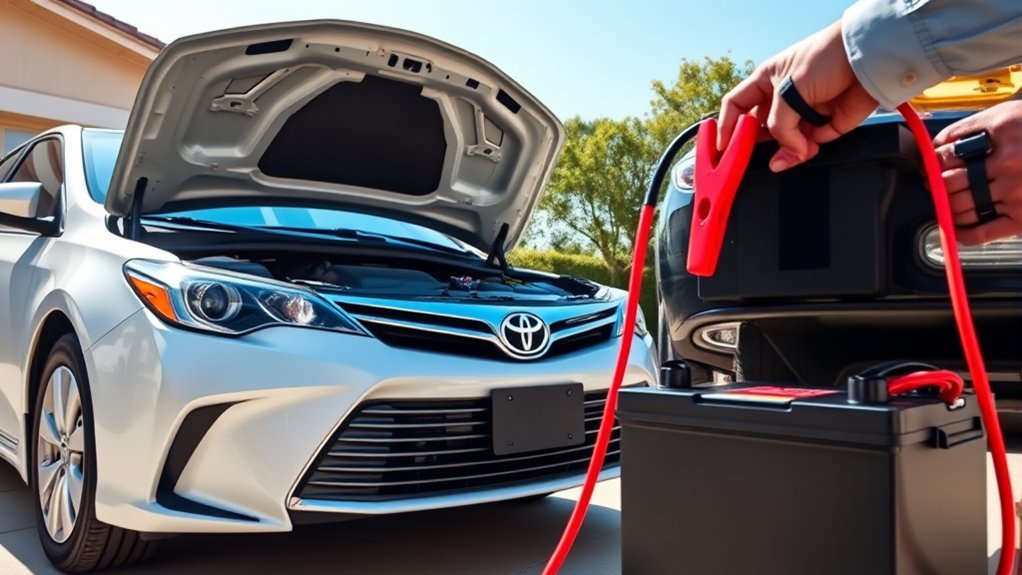
While jump-starting your Toyota Camry can be straightforward, several issues may arise that hinder its successful restart. First, verify all connections are secure, particularly the negative terminal on the engine block. If the Camry doesn’t start, listen for clicking sounds; this suggests a weak battery or starter issues, indicating the need for starter troubleshooting. If the donor vehicle isn’t revving to at least 2,000 RPM, it may not supply enough charge, so adjust accordingly.
If your Camry starts but dies quickly, you likely have a failing battery; perform a voltage test to check its health. In cold weather, batteries lose power, so allow the donor vehicle to charge the Camry longer before retrying. Regular battery maintenance can prevent many of these issues, guaranteeing smoother jump starts in the future.
Frequently Asked Questions
Can You Damage Your Alternator by Jump-Starting a Toyota?
Yes, you can damage your alternator by jump-starting a Toyota. If your battery health isn’t ideal or you use an incompatible jump starter, you risk voltage spikes that stress the alternator, leading to failure.
Should I Press the Gas When Jumping a Car?
Jumping a car’s like reviving a faint heartbeat; you don’t need to press the gas. Instead, focus on proper jumping techniques and battery safety. Let the donor vehicle’s alternator do the work for you.
Conclusion
Jump starting your Toyota Camry doesn’t have to feel like rocket science. By following the steps outlined, you’ll breathe life back into your vehicle in no time. Just remember, safety’s your co-pilot—always connect and disconnect cables with care. Once you’re back on the road, keep an eye on your battery’s health to avoid future hiccups. With a little knowledge and the right tools, you’ll keep your Camry humming like a well-tuned engine.