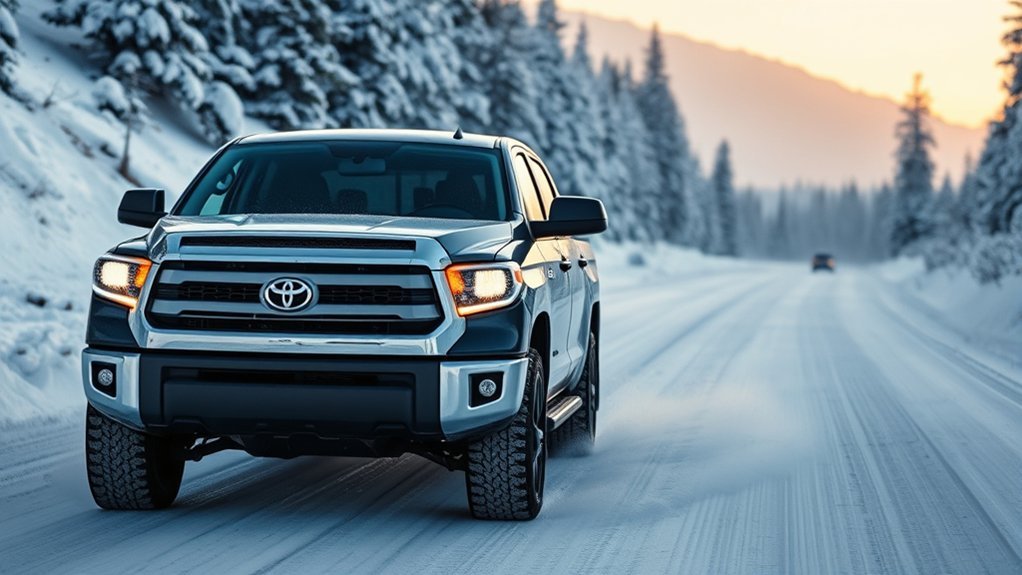
You’ll prepare your Tundra with winter tires, 35 psi inflation, good battery and fluids, and an emergency kit, then choose 4H for snowy roads or 4L for steep/deep snow. Drive smoothly: gentle throttle, early braking, wider turns, and engine braking downhill. Stay in tracks, double following distance, and keep TCS/VSC on. Add secured weight over the rear axle if needed. Follow these steps now and you’ll find detailed tips for every situation ahead.
Quick Action Steps for Driving a Toyota Tundra in Snow
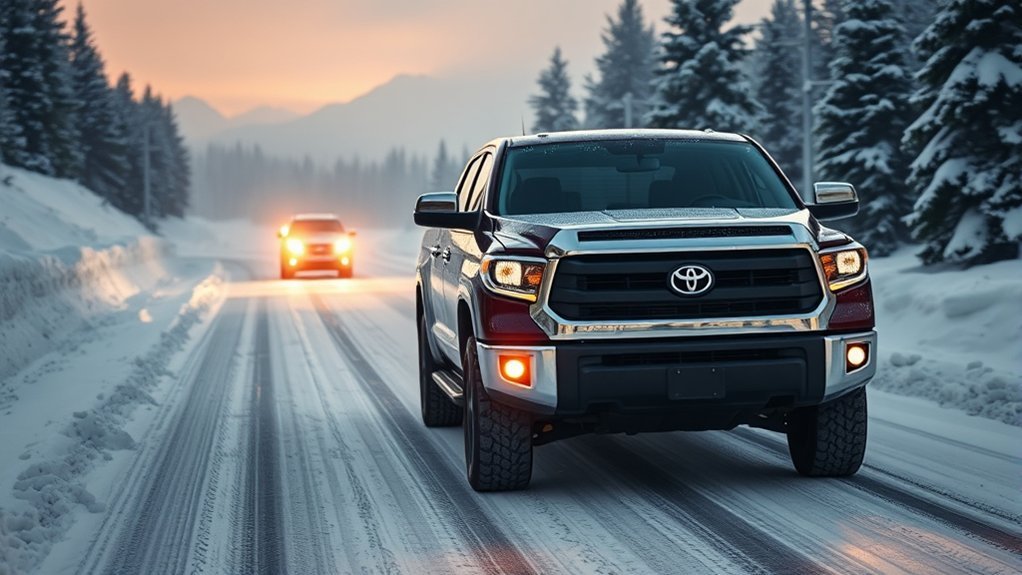
Start by engaging 4H on your 2017 Toyota Tundra with BFG KO2s to get improved traction, then maintain a steady speed and gentle acceleration to minimize sliding on icy roads around 23°F. You’ll follow existing tire tracks when possible to exploit the aggressive tread and preserve momentum; that simple driving technique reduces wheelspin and keeps you moving. Double your usual following distance—stopping takes far longer on 1–3 inches of snow—so you can respond without panic. Use engine braking and downshift before descents to control speed instead of relying solely on the pedals. Avoid sudden steering or throttle inputs; smoothness preserves grip and prevents loss of control. Monitor snow visibility constantly and slow when it drops; clear sightlines let you choose safer lines and anticipate hazards. These quick action steps give you practical autonomy on icy roads, letting you move deliberately, reduce risk, and retain command of your Tundra in winter conditions.
Pre-Trip Checklist for Your Toyota Tundra
You’ve covered the on-road techniques; now make sure the truck itself is ready before you leave. Start with winter-rated tires such as BFG KO2s inflated to 35 psi for peak traction and improved fuel efficiency; correct pressure saves fuel and maintains control. Check antifreeze and windshield washer fluid levels so cold won’t compromise engine cooling or road visibility. Inspect brakes for responsiveness and test all lights—headlights, taillights, and brake lights—so others can see you in snow and low light. Verify the battery’s condition; replace a weak battery because cold drains capacity and can strand you. Pack a compact emergency kit: warm blanket, flashlight, jumper cables, basic tools, and a scraper. Secure loose items so they won’t shift and distract you. This checklist doesn’t limit you; it empowers you to leave confidently, taking control of safety and mobility when winter conditions challenge your freedom on the road.
Decide Between 4H vs. 4L (When to Use Each)
When conditions turn slippery, decide between 4H and 4L based on speed and resistance: you’ll use 4H for normal snowy roads where you need better traction and the ability to maintain higher speeds without losing control. 4H supports quicker acceleration and responsive handling, so it’s your default for packed snow, light ice, or city driving. Engage 4L when resistance increases — steep hills, deep snow, or crawling over obstacles — because it multiplies torque and lets you move deliberately at low speeds. 4L helps prevent wheel spin and gives you stability when starting from a stop in deep drifts. Shift deliberately: don’t stay in 4L on clear pavement, and return to 2H once road conditions normalize to conserve fuel and spare the drivetrain. These driving techniques keep you mobile and free on winter roads while prioritizing snow safety and preserving your truck’s capability.
Choose & Maintain Tires for Your Tundra
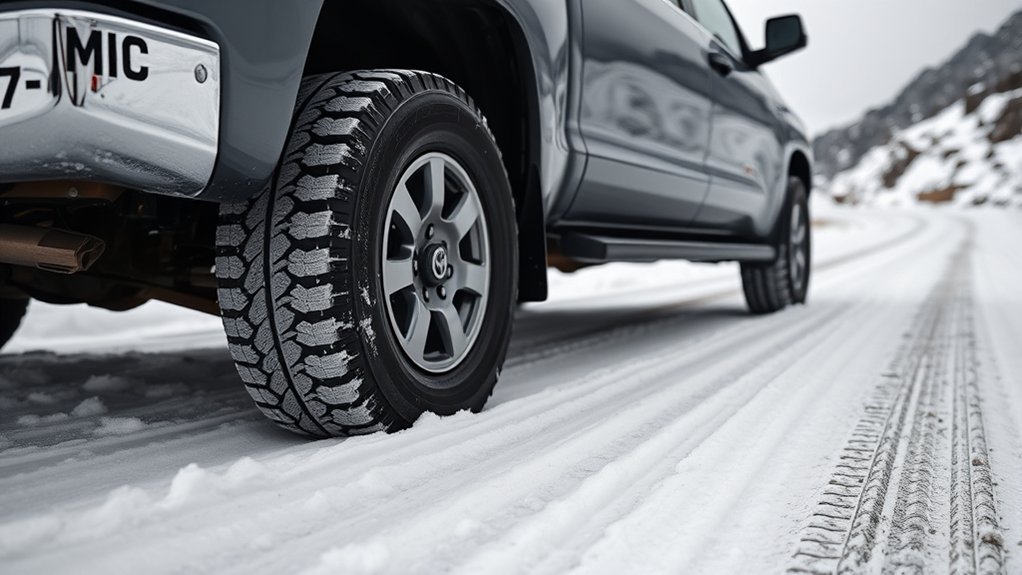
Choose winter tires like the BFG KO2 for their aggressive tread and superior grip on snow and ice. Keep your tires inflated to the recommended 35 psi and rotate them every 5,000–7,500 miles to preserve traction. Inspect tread depth regularly and replace tires at 4/32″ or less, storing off-season winter set in a cool, dry place and checking for damage before reuse.
Winter Tire Selection
Four key tire practices will keep your 2017 Toyota Tundra stable in snow: fit aggressive winter tires like the BFG KO2, maintain them at 35 psi, monitor tread depth (keep at least 6/32″), and rotate every 5,000–7,500 miles. Choose tire types built for winter: studdable or directional winter tires with deep sipes and open tread patterns bite snow and shed slush. You’ll gain control and confidence when you prioritize matching tread patterns to typical conditions—packed snow, fresh powder, or icy roads. Check tread depth and overall condition before each season and rotate regularly to maintain even wear. When you swap tires, store your summer set in a cool, dry place inflated to avoid flat spots, so you’re free to switch back safely.
Proper Tire Pressure
Keep your Tundra’s tires at the recommended 35 psi to preserve traction, handling, and tire life in cold, snowy conditions. You’ll maintain control because tire pressure affects contact patch and responsiveness; cold cuts pressure and reduces grip, so check often to guarantee winter readiness. Use durable winter tires like BFG KO2 for improved bite on ice and snow, and rotate and balance tires to prevent uneven wear that undermines stability. Watch tread depth—aim for at least 6/32 inches for reliable performance.
- Check tire pressure weekly with a quality gauge.
- Reinflate to 35 psi when pressure drops.
- Fit winter-rated tires before sustained cold sets in.
- Rotate and balance every 5,000–7,000 miles.
Stay empowered: precise tire pressure supports your freedom on winter roads.
Tire Inspection Routine
Before you head out this winter, make a quick, consistent tire inspection part of your routine so your Tundra stays safe and predictable on snow and ice. Check your BFG KO2s for tread depth importance: measure and keep at least 4/32″ for grip on snow and ice. Verify tire pressure at the recommended 35 psi; cold drops pressure and harms traction. Rotate tires every 5,000–7,500 miles to promote even wear and extend life. Inspect for visible damage or irregular wear patterns that signal alignment or suspension problems—address them promptly. If you drive in severe snow regularly, swap to dedicated winter tires for superior traction. These tire maintenance tips free you to drive confidently and responsibly.
Add and Secure Weight in the Bed for Traction
Place at least 100 lbs of weight over the rear axle to improve rear-wheel traction and stability in snowy conditions. Secure those sandbags or Quikcrete with heavy straps so they can’t shift and upset your handling. Check them periodically for water buildup and remove the weight during warm months to preserve fuel economy.
Position Weight Over Axle
If you want better rear traction in deep snow, add at least 100 lb of weight directly over the rear axle—sandbags or water-filled bases work well—and secure them with heavy straps so they won’t shift. Positioning weight over the axle optimizes weight distribution for traction enhancement, lowering the center of gravity and improving rear-wheel bite. Pyramid-stack sandbags centered on the axle for stability, and check water-filled weights for leaks or ice accumulation to avoid hazards. Remove excess weight in warm months to reclaim efficiency and control.
- Center mass over the rear axle for predictable handling
- Use durable, weatherproof containers for water-filled weights
- Stack low and compact to maintain a low center of gravity
- Inspect weights regularly for damage or leaks
Secure With Heavy Straps
After centering your sandbags or water weights over the rear axle for better bite, you’ll need heavy-duty straps to keep them from shifting while you drive. Secure a minimum of 100 lbs using ratchet straps anchored to bed tie-downs; this delivers measurable traction improvement without sacrificing control. Pyramid-stack bags over the axle for stability, then strap across and around the stack to lock lateral movement. Check that weight distribution is even side-to-side to avoid pull or understeer. If you use water-filled bases, inspect them for leaks and extra water accumulation before each trip and drain or top off as needed. Re-tension straps after a short drive and periodically during long trips to maintain secure, liberated control in snow.
Start, Stop, and Accelerate Smoothly on Snow
When driving your Toyota Tundra on snow, start by engaging 4H to give all four wheels better traction and then apply the accelerator gently so you don’t break traction; smooth, gradual inputs are essential for predictable movement. You’ll adopt snow driving techniques that prioritize controlled power and deliberate stopping. Begin braking early, double your following distance, and let engine braking slow you on descents to avoid lockup. If you start to slide, steer gently toward your intended path and resist over-correction.
- Engage 4H before you accelerate on packed snow.
- Apply throttle smoothly; abrupt inputs cause spin.
- Brake well in advance and use engine braking downhill.
- If sliding, steer calmly in the desired direction.
These are practical winter vehicle preparation steps that free you from fear of the road. You’ll move with intent, knowing your Tundra responds predictably when you control acceleration and stopping with restraint and purpose.
Steer, Corner, and Keep Lane Control Safely
Although snow changes how your Tundra responds, you can maintain control by steering smoothly, taking corners wide and slow, and staying in existing tire tracks whenever possible; these practices let your BFG KO2s bite the surface and reduce the chance of sudden slides. Keep speed steady and gentle inputs to the wheel — abrupt steering breaks traction. When you approach a corner, widen your line and roll the steering slowly; that conservative arc preserves lateral grip and keeps momentum predictable. Use engine braking on descents to control speed without frantic braking, especially when payload adds rear traction. Stay in established tracks for better bite, and adjust following distance to give yourself room to regain control if needed. Constantly scan for ice, patches of loose snow, or vehicles changing lanes; anticipate rather than react. These snow driving techniques center on deliberate actions and good traction management so you can move freely and safely even when roads try to confine you.
Use Toyota Traction & Stability Features Correctly
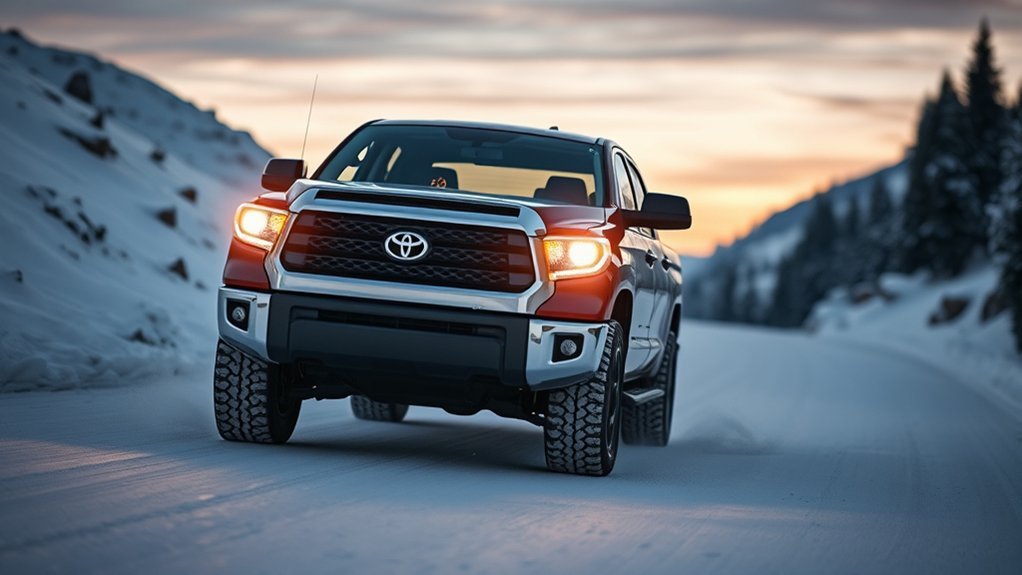
Engage Traction Control (TCS) to prevent wheel spin when accelerating on ice or packed snow, and watch the Traction Control light—it’s telling you the system’s working. Switch to 4H when conditions require extra grip, and use Auto LSD to send power to the wheels with the best traction. Keep Vehicle Stability Control (VSC) on to reduce skidding in turns and maintain directional control.
Engage Traction Control Properly
Because snow and ice can suddenly reduce grip, you should turn on your Tundra’s traction control system (TCS) and stability features before you need them. TCS activation gives immediate traction benefits by cutting wheel spin and letting you power through slick spots without losing control. Use stability control to steady the truck during sudden steering corrections. Activate Auto LSD when terrain is uneven so power shifts to the wheels that can bite. Watch the traction control light; frequent flashes mean you must slow down and change your approach.
- Engage TCS and stability systems before slippery sections.
- Enable Auto LSD for uneven, packed snow.
- Monitor the TCS light and adjust speed.
- Practice conservative throttle and steering inputs.
Use 4WD And Stability
When roads turn slick, switch your Tundra into 4H to send power to all four wheels and improve traction and stability for safer acceleration and cornering. Embrace the 4WD benefits: engage four-wheel drive to distribute torque, reduce wheel slip, and give you the control needed to move confidently through snow. Use traction control to prevent spin during starts and on icy patches, and keep stability control active to correct oversteer or understeer when turning. Learn Toyota Safety Sense alerts so you’re warned of hazards early. Monitor tire pressure—cold robs psi—keeping BFG KO2s at 35 psi for consistent grip. These stability enhancements free you to drive with authority while respecting winter limits and avoiding unnecessary risk.
Fix Skids, Get Unstuck, and Handle Ice
If your Tundra starts to skid, steer gently into the direction of the slide and avoid slamming on the brakes so you can regain control without further loss of traction; use controlled throttle and let the wheels roll until you feel grip return. For effective skid recovery in snow driving, stay calm, aim the nose where you want to go, and let stability systems assist you.
Use rocking motions to get unstuck: shift between Drive and Reverse, gently apply throttle to build momentum, and avoid spinning wheels. Engage 4H for better traction on slippery surfaces. On ice, reduce speed, increase following distance, and trust traction control to limit wheel spin.
- Steer into the slide, don’t overcorrect.
- Rock vehicle by alternating Drive/Reverse with light throttle.
- Use 4H and traction control for grip.
- Slow down and extend following distance on ice.
You’ll reclaim control, move freely, and drive with confident liberation.
Emergency Gear + Winter-to-Summer Maintenance
Although severe weather can strand you, carrying the right emergency gear in your Tundra keeps you safe and ready to act: pack a warm blanket, jumper cables, non-perishable snacks, a flashlight with spare batteries, and a first-aid kit, and keep basic tools, a tow strap, and a compact shovel within reach. You’ll practice emergency preparedness by routinely checking that kit and replacing expired supplies. Inspect battery, brakes, and lights during winter; swap worn parts before they fail. Top off antifreeze, windshield wiper fluid, and engine oil to preserve performance in cold temperatures.
As spring arrives, make decisive seasonal shifts: remove stored sandbags or weights, drain any collected water, and change winter tires for summer tires to improve traction and fuel efficiency. Use the changeover as a maintenance checkpoint—verify tire pressure, test charging system, and confirm lights. These actions free you from avoidable breakdowns and give you control, so your Tundra serves reliably whether roads are icy or clear.
Frequently Asked Questions
Can I Tow a Trailer in Deep Snow With My Tundra?
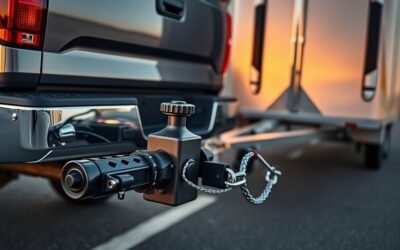
Yes—you can, but check your Tundra’s towing capacity first and guarantee trailer stability with proper weight distribution, chains, and reduced speed; stay prepared to abandon the tow if conditions endanger you, reclaiming freedom and control.
Will BFG KO2S Perform Well on Packed Ice Without Chains?
They’ll help, but they won’t match chains on packed ice; you’ll get improved tire traction and confident snow handling for freedom to roam, yet you should carry chains and adjust speed, anticipating reduced grip in extreme patches.
How Does Payload Affect Electronic Stability Control Performance?
Heavier payloads and uneven payload distribution reduce stability control effectiveness; you’ll need to rebalance loads, slow down, and let stability control intervene sooner so the system can regain traction and keep you confidently in command.
Should I Switch to Winter Oil or Fluids for Cold Starts?
Yes — you should switch to winter oil or fluids for cold starts. You’ll preserve engine freedom by using lower oil viscosity and winter-grade fluids, ensuring quick lubrication, reliable starts, and confident control in cold weather conditions.
Can Hill-Start Assist Be Used on Icy Inclines?
A driver in Salt Lake City used hill start techniques with hill-start assist on a slick driveway. You can rely on it, but you should combine icy surface precautions, gentle throttle, and quick clutch control for safe liberation.
Conclusion
You’ve got the tools and the know-how to keep your Tundra steady in winter; stay proactive, check systems, pick the right tires, and use 4H/4L and traction aids when conditions demand. Add bed weight, drive smooth, and practice skid recovery so responses are instinctive. If you get stuck, stay calm and use recovery gear or call for help. Like a lighthouse in a blizzard, your preparation guides you safely through.