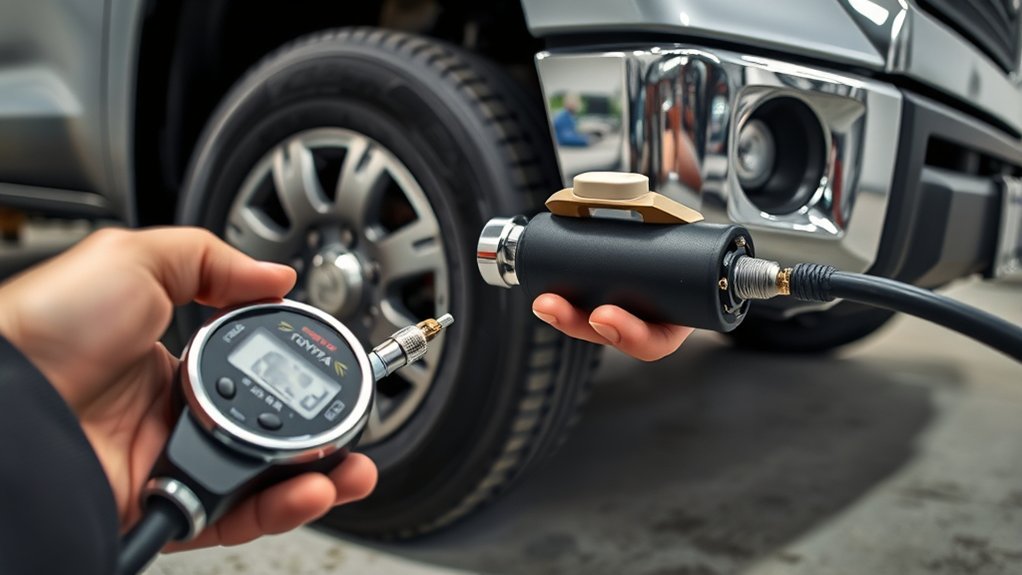
You’ll check cold pressures with a reliable gauge, set each tire to the driver‑door PSI, and reset the Tundra’s TPMS so the system reads correctly. Park three hours so tires are cold, remove valve caps, press the gauge firmly, and record all four tires plus the spare. Add or release air to match the placard PSI, reinstall caps, then perform the TPMS reset procedure for your model year. Continue for troubleshooting and maintenance steps.
Quick TPMS Reset: The Short Answer for Toyota Tundra Owners
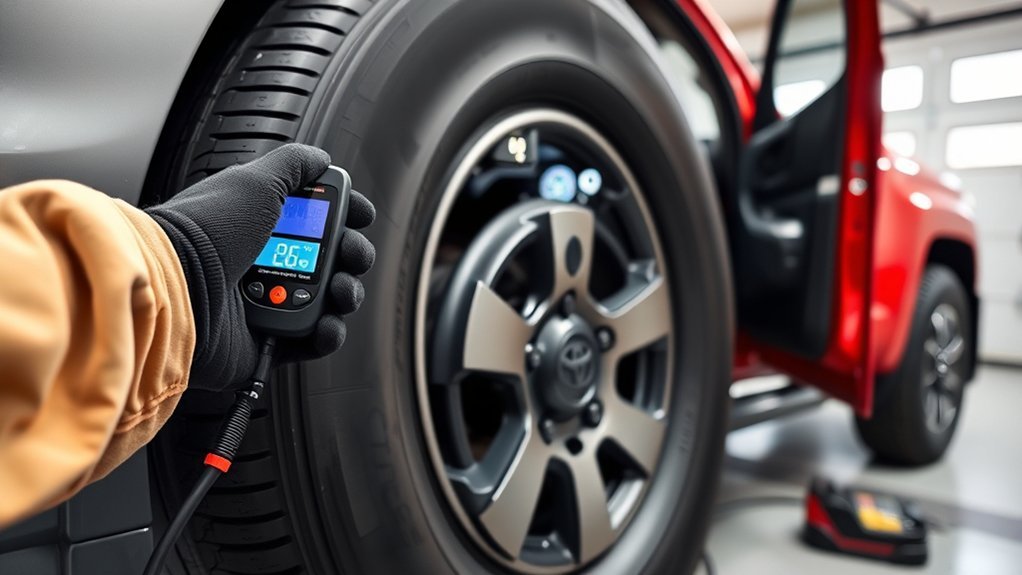
Before you start, make certain all tires are inflated to the recommended cold pressure and the truck sits on level ground with no visible tire damage. You’ll reset TPMS functions differently by model year: for 2006–2021 Tundras, inflate tires correctly, turn the ignition to the “arm” position, locate the tire reset button under the steering wheel, and press until the TPMS indicator blinks three times slowly. For 2022–2025 Tundras, adjust pressures, turn the vehicle on, open the Gear tab via the navigation button, go to vehicle settings, select TPWS, and hold “okay” on the pressure menu until reset completes. After either procedure, walk around to confirm tire safety visually and verify no dashboard warning remains. These steps restore accurate sensor readings so you can move freely without false alerts. If the light persists, inspect sensors or seek professional service; don’t ignore warnings that compromise your freedom to travel safely.
Tools and Prerequisites: What You Need Before Checking Pressure
Before you start, gather a reliable digital or analog tire pressure gauge, an air compressor or portable inflator, and gloves for safe handling. Have the Tundra’s recommended PSI handy from the owner’s manual or the driver’s door jamb and verify the tires are cold (vehicle parked for at least three hours). With tools and prep confirmed, you’ll be ready to measure and adjust pressure accurately.
Essential Tools List
Start with five basic items to make checking your Tundra’s tire pressure quick and accurate: a reliable tire pressure gauge (digital preferred for precision), an air compressor or access to a station compressor for inflation, a valve stem tool for removing caps, safety gloves for grip and protection, and your Tundra’s owner’s manual to confirm the recommended pressure values. Use a digital gauge for repeatable readings and faster checks—digital gauge advantages reduce human error and speed up tire pressure maintenance. Keep the compressor with a pressure regulator and hose adapter for Tundra valves. Store a small valve stem tool and spare caps in the glove box. Wear gloves when handling cold or hot components. Verify recommended PSI from the manual before inflating.
Pre-Check Vehicle Prep
When you’re preparing to check your Tundra’s tire pressure, gather a reliable gauge (digital preferred), an air compressor or access to one, the owner’s manual or the door-jamb sticker for the recommended PSI, and a tire repair kit in case you find damage; also make sure the tires are cold — either before driving or at least three hours after parking — so your readings are accurate. Inspect each tire visually for cuts, bulges, or embedded objects that could compromise integrity. Confirm the recommended PSI for your load and trim. Position the vehicle on level ground and engage the parking brake. Keep the gauge, compressor hose, and repair kit within reach. With tools ready and cold tires verified, proceed to measure and adjust pressure systematically.
Measure Cold Tire Pressure: Step‑by‑Step for Your Tundra
If your Tundra has been parked at least three hours or overnight, check each cold tire with a reliable pressure gauge by removing the valve cap, seating the gauge firmly on the valve stem, and reading the PSI. Use tire maintenance tips and pressure monitoring discipline: work in sequence—front left, front right, rear left, rear right, spare. Record readings and compare to the recommended cold PSI for your model.
| Tire Position | Measured PSI | Action Required |
|---|---|---|
| Front Left | ___ PSI | Inflate/deflate/OK |
| Front Right | ___ PSI | Inflate/deflate/OK |
| Rear Left | ___ PSI | Inflate/deflate/OK |
| Rear Right | ___ PSI | Inflate/deflate/OK |
If low, add air incrementally and recheck to avoid over-inflation. If high, release air cautiously. Replace valve caps to seal the system. Keep a log for ongoing pressure monitoring; this procedural habit frees you from unexpected failures and maintains control over vehicle safety.
Set Tire Pressure to Recommended Cold PSI
Set the recommended cold PSI (typically 32–36 PSI for Tundras) as shown on the driver’s door jamb or owner’s manual. Using a reliable gauge, confirm each tire’s cold pressure and add or release air until it matches the specified value. Recheck pressures after adjustment to verify accuracy and repeat regularly to maintain fuel efficiency, tire life, and handling.
Recommended Cold PSI
Check your Tundra’s tires in the morning or after several hours parked and inflate them to the vehicle’s specified cold PSI—typically 32–36 PSI depending on model and tire—to guarantee correct handling, fuel efficiency, and safety. You’ll embrace tire pressure essentials and cold tire benefits by setting exact PSI from the owner’s manual or the driver’s door placard. Don’t over- or under-inflate; both degrade performance and safety. Maintain pressure regularly to free yourself from unexpected failures and wasted fuel.
| Step | Action | Note |
|---|---|---|
| 1 | Find placard/manual | Exact PSI for model |
| 2 | Use reliable gauge | Calibrate if needed |
| 3 | Inflate to spec | 32–36 PSI typical |
| 4 | Recheck later | After cooling period |
Checking Tire Pressure
Now that you’ve confirmed the correct cold PSI from the door placard or manual, measure each tire with a reliable gauge while the tires are cold (after the truck has been parked for several hours or first thing in the morning). Use a digital gauge for precision. Remove valve caps, press the gauge straight onto the valve, note PSI, and compare to the placard. Record values and inspect sidewalls for damage.
- Check all four tires plus spare.
- Note uneven tire wear patterns.
- Verify recent tire alignment history.
If a tire reads outside the recommended 32–36 PSI range, plan to adjust to the specified cold PSI (covered next). Regular checks protect efficiency, extend tire lifespan, and reinforce your control over safety and mobility—critical for those seeking freedom on the road.
Adjusting To Specs
Adjust your tire pressure to the cold PSI listed on the driver’s door placard using a reliable gauge and an air source, working one tire at a time. Check tires cold—before driving or after sitting three hours—since heat raises readings. Remove the valve cap, press the gauge firmly, note psi, and compare to the placard (usually 32–36 PSI for Tundra models). If low, add air in short bursts and re-measure; if high, release air slowly until target is reached. Repeat for each tire and reinstall valve caps. Maintaining proper pressure yields tire pressure benefits: better handling, fuel economy, and longer tread life. Avoid common mistakes like measuring hot tires or using an unreliable gauge; be deliberate and free.
Reset the TPMS on 2006–2021 Toyota Tundra
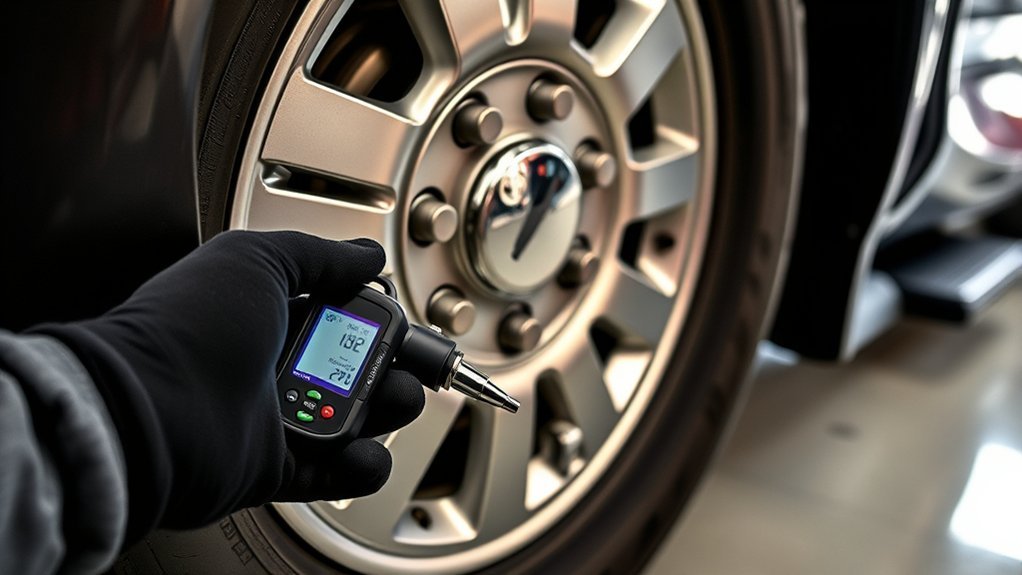
Reset the TPMS by inflating all four tires to the cold pressures in your owner’s manual, then turn the ignition to the “arm” position (without starting the engine) and press the tire reset button under the steering wheel until the TPMS indicator blinks slowly three times; release the button and wait several minutes for the system to record the new pressures. You’ll confirm the system has relearned the baseline pressures when the warning light extinguishes. Use precise gauges and follow TPMS calibration methods to guarantee repeatable results. If a sensor fails, follow Sensor replacement tips to swap with OEM-equivalent units and reset again.
- Inflate all four tires to recommended cold pressure.
- Turn ignition to “arm”; press reset until three slow blinks.
- Release and wait several minutes for system confirmation.
Maintain pressure regularly to avoid uneven wear and lost fuel efficiency. This procedural reset is your immediate, do-it-yourself step to regain control and keep the vehicle operating efficiently and safely.
Reset the TPMS on 2022–2025 Toyota Tundra
Start by inflating all four tires to the cold pressures listed in your owner’s manual, then start the vehicle and go to the navigation system’s Gear tab. In the Gear menu, open Vehicle Settings and select TPWS; this prepares the system to record new baseline pressures. Highlight the setting pressure menu so the display shows current sensor readings. When the pressures match the recommended values, press and hold the OKAY button to confirm the reset. The system will clear stored warnings and re-learn the tire pressures.
Stand by for a few minutes while the TPMS updates; verify the TPMS indicator turns off. If the light stays on, consider TPMS malfunction causes such as a dead sensor or communication fault. You’ll want to evaluate sensor replacement options before further diagnostics. This procedure restores correct TPMS calibration and keeps you free to drive without false warnings, maintaining safety and autonomy over your vehicle.
Troubleshooting TPMS: Why the Light Won’t Reset
If the TPMS light stays on after you’ve set the tire pressures, first confirm every tire—including the spare if it’s monitored—is inflated to the manufacturer’s cold PSI; any mismatch or slow leak will prevent the system from clearing. Check for pressure discrepancies with a calibrated gauge, then drive a short distance to allow the system to re-evaluate. Rapid temperature shifts can trigger warning lights temporarily.
If the TPMS light stays on, confirm every tire (including monitored spare) is at the manufacturer’s cold PSI, then recheck.
- Inspect tires for punctures or bead leaks; even small tire leaks keep the TPMS active.
- Scan or have a technician read TPMS sensor issues; dead batteries or damaged sensors won’t report pressure.
- Follow the vehicle reset procedure in the owner’s manual; if the light persists, seek professional diagnostics.
You want control: fix leaks, correct pressures, and verify sensor health. If you’ve eliminated tire leaks and pressure discrepancies yet the warning lights remain, a faulty sensor or module likely needs replacement to restore reliable TPMS function.
Inspect Tires and Routine Maintenance to Avoid TPMS Alerts
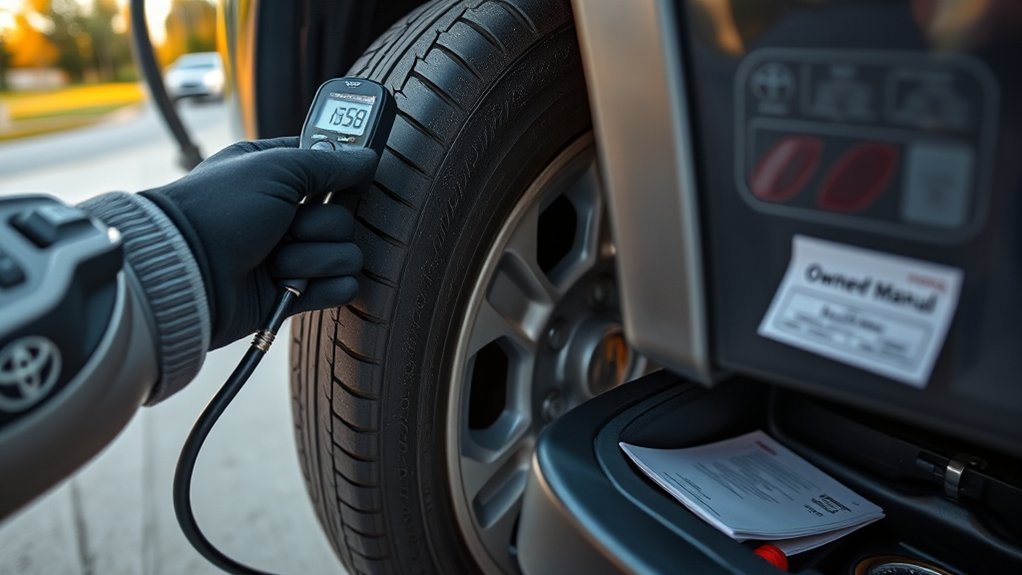
After you’ve ruled out leaks and sensor faults, inspect tires regularly to prevent TPMS alerts: check tread for uneven wear, cracks, or bulges; verify pressures against the spec on the driver’s door jamb with a calibrated gauge when tires are cold; and examine valve stems for corrosion or damage that can cause slow leaks.
| Task | Frequency |
|---|---|
| Visual tread and sidewall check | Weekly |
| Tire rotation and alignment check | Every 5,000–7,500 miles |
| Valve stem and pressure gauge inspection | Monthly |
You’ll perform pressure maintenance to retain control and freedom on the road. Use a calibrated gauge, set cold pressures to spec, and correct deviations immediately. Rotate tires on schedule to prevent uneven tire wear and extend life. Replace tires showing cracks, bulges, or tread depth below limits. If a valve stem leaks, swap it before it creates recurring TPMS alerts. Log inspections and actions; documentation frees you from repeated diagnostics. Routine, precise maintenance minimizes TPMS activations and keeps your Tundra reliable and independent.
Frequently Asked Questions
How Do You Check the Tire Pressure on a Toyota Tundra?
You check tire pressure by using a reliable gauge on cold tires: remove the valve cap, press the gauge, read PSI, then add or release air to match recommended specs. Use this maintenance tips routine for freedom.
What PSI Should My Toyota Tundra Tires Be At?
Set your Toyota Tundra tires to 32–36 PSI for peak performance. You’ll follow tire maintenance steps: check cold, adjust with a gauge, and monitor regularly. Safety tips: maintain correct PSI to preserve handling and efficiency.
Conclusion
You’ve learned how to measure cold tire pressure, set recommended PSI, and perform TPMS resets for 2006–2025 Tundras. Do the checks when tires are cold—underinflation by just 10% can reduce fuel economy by about 1–2%—so accurate PSI matters. Keep a calibrated gauge, adjust to the placard PSI, and follow the model‑specific reset steps. If the TPMS light persists, troubleshoot sensors, valves, and battery life before replacing components.