Use hub-to-fender measurements to compare your 5th-gen Toyota 4Runner before and after a lift, diagnose sag, and plan tire clearance without guessing. This guide applies to 5th-gen 4Runners, commonly treated as 2010–2024 models; Toyota identifies the 2025 4Runner as the start of the sixth generation, so 2025+ fitment should be checked separately.
Quick Answer
Measure from the center of each wheel hub straight up to the lower edge of the fender flare. Many stock 5th-gen 4Runners measure around 19.5–20.5 inches in front and 21.5–22.5 inches in the rear, but your own baseline matters most because tires, load, trim, age, and suspension parts vary.
Key Takeaways
- Hub-to-fender height measures suspension/body position; tire diameter changes ground clearance but does not change hub-to-fender height.
- Common stock owner-measured baselines are about 20 inches front and 22 inches rear, but Toyota does not publish official hub-to-fender specs.
- A 285/70R17 is about 32.7 inches tall and may need minor liner or mud-flap work depending on wheel offset and tire model.
- A 315/70R17 is about 34.4 inches tall, not 35.4 inches, and usually requires more than lift height alone: trimming, body mount work, caster adjustment, and careful test fitting may be needed.
At a Glance
| Time Required | 10–20 minutes for measuring; longer if test-fitting tires |
| Difficulty | Easy for measuring; moderate for fitment checks |
| Tools Needed | Tape measure, flat level surface, notepad or phone, tire pressure gauge, flashlight |
| Cost | Free for measurement; alignment and trimming costs vary by shop |
How to Measure Stock 4Runner Ride Height (Hub-to-Fender)
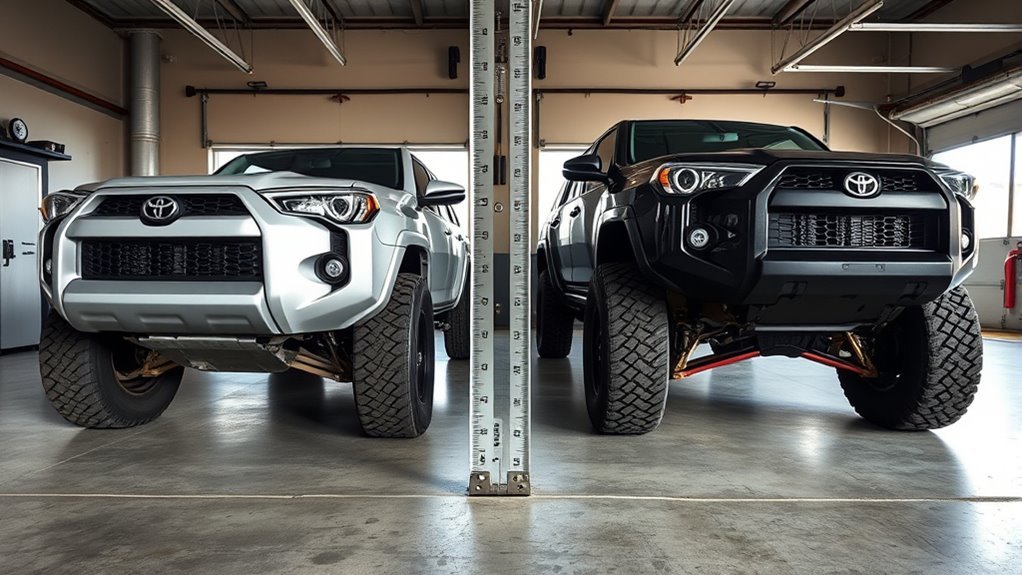
Park the 4Runner on a flat, level surface with normal tire pressure and a normal load. Measure from the exact center of the wheel hub straight up to the lower edge of the fender flare. Do this at all four corners: front driver, front passenger, rear driver, and rear passenger.
- Set the steering wheel straight and make sure the vehicle is unloaded unless you are measuring a normal overland or daily-driving load.
- Hold the tape measure vertically from the hub center to the fender flare edge.
- Read to the nearest 1/8 inch and write the number down immediately.
- Repeat at all four corners using the same measuring point each time.
- Take photos of the tape at each corner if you want a record for a shop or future comparison.
Pro Tip: Hub-to-fender is better than ground-to-fender for lift comparisons because it removes tire diameter from the measurement. Use ground-to-fender only when you also want to know how the tire size changed total vehicle height.
Stock 5th-Gen 4Runner Baseline Numbers
Many stock 5th-gen 4Runners measure around 19.5–20.5 inches in front and 21.5–22.5 inches in the rear from hub center to fender flare. Treat those as common owner-measured baselines, not official Toyota specifications. Toyota’s published specs focus on items such as factory tire size, suspension design, approach/departure angle, and ground clearance.
For 2024 models, Toyota lists ground clearance at 9.0 inches on some trims and 9.6 inches on several 4WD/TRD trims. Toyota also lists P265/70R17 tires on many 17-inch trims and P245/60R20 tires on 20-inch-wheel trims in the official 2024 4Runner eBrochure.
| Measurement | Typical / Published Reference | What It Means |
|---|---|---|
| Front hub-to-fender | About 19.5–20.5 inches on many stock trucks | Useful owner baseline for front lift, sag, and leveling |
| Rear hub-to-fender | About 21.5–22.5 inches on many stock trucks | Useful owner baseline for rear coil height and load sag |
| Factory tire size | Common 17-inch setup: P265/70R17 | Starting point for tire-diameter comparisons |
| Ground clearance | 9.0–9.6 inches, depending on trim/drivetrain | Different from hub-to-fender; affected by tires and underbody points |
Measure Lifted 4Runner Height After Suspension or Body Lift
After installing suspension parts or a body lift, re-measure all four corners the same way you measured stock. Write down the immediate result, then measure again after the springs and bushings have settled.
A suspension lift changes the distance between the hub and fender by moving the body/frame relative to the suspension. A body lift also raises the fender opening relative to the hub, but it does not raise the frame, skid plates, control arms, or differential. Bigger tires can raise axle and body ground clearance, but they do not increase hub-to-fender height.
| Setup Example | Front Hub-to-Fender Example | Rear Hub-to-Fender Example | Notes |
|---|---|---|---|
| Stock baseline | 20.0 inches | 22.0 inches | Measure your own truck first |
| 2.5-inch front / 1.5-inch rear suspension lift | About 22.5 inches | About 23.5 inches | Actual results vary with spring rate, preload, bumper weight, and cargo |
| 2.5-inch front / 2.5-inch rear suspension lift | About 22.5 inches | About 24.5 inches | Less common for leveling because factory rear rake is already higher |
Recheck the truck immediately after installation, after 24 hours, and again after 500–1,000 miles. If one corner differs by more than about 1/4 inch from the matching side and the ground is level, inspect spring seating, preload, added weight, control-arm position, and installation torque.
How Tire Size & Wheels Affect 4Runner Ride Height
Tire size affects ground clearance and rubbing, but not the hub-to-fender number. The wheel hub is the center of the tire, so a taller tire raises the hub and fender together when measured from the ground. That is why hub-to-fender is the preferred way to compare suspension lift.
The factory 265/70R17 is about 31.6 inches tall. A 285/70R17 is about 32.7 inches tall, which adds roughly 0.55 inch of radius compared with stock. A 315/70R17 BFGoodrich All-Terrain T/A KO2 is listed at about 34.4 inches tall, which adds roughly 1.4 inches of radius compared with a 31.6-inch stock tire.
| Tire Size | Approx. Diameter | Approx. Width | Ground-Clearance Change vs. 265/70R17 | Fitment Notes |
|---|---|---|---|---|
| 265/70R17 | 31.6 inches | About 10.4 inches | Baseline | Common factory 17-inch size |
| 285/70R17 | 32.7 inches | 11.2 inches | About +0.55 inch radius | Often needs liner push-back, mud-flap removal, trimming, or more caster depending on wheel offset |
| 315/70R17 | About 34.4 inches | About 12.7 inches on some models | About +1.4 inches radius | 35-class fitment; expect major clearance work |
Wheel offset and width matter as much as tire diameter. A more negative offset pushes the tire outward, which can improve upper-control-arm clearance but increase fender, bumper, mud-flap, and body-mount rubbing. A wider tire also has more sidewall bulge, especially when aired down off-road.
Compare Typical Stock Vs Common Lift Numbers for 5th Gen
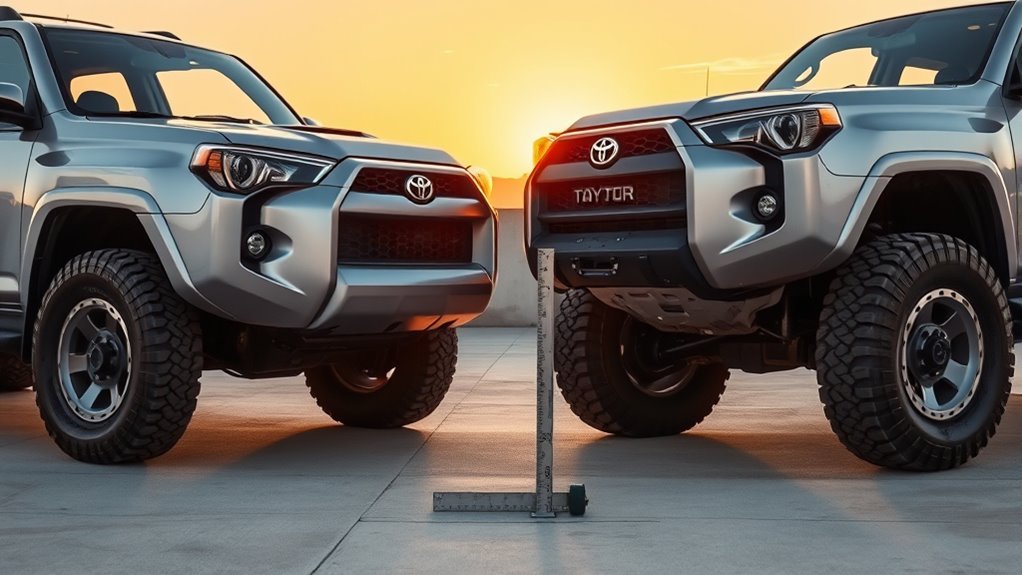
Stock Hub-To-Fender
A useful stock reference is about 20 inches in front and 22 inches in the rear, measured from hub center to fender flare. Some trucks sit lower or higher because of trim differences, worn coils, KDSS or non-KDSS components, cargo weight, aftermarket bumpers, skid plates, sliders, tire pressure, or previous suspension work.
Record front and rear separately. A truck can be “lifted” in front only, sagging in the rear, or sitting uneven side-to-side. Hub-to-fender readings show those differences better than eyeballing the stance.
Lifted Height Ranges
Common mild lifts add about 2–3 inches in front and 1–2 inches in the rear. A 2.5-inch front / 1.5-inch rear setup often levels the factory rake while keeping the truck practical for daily use. Larger setups can work, but they usually need more attention to alignment, caster, CV axle angles, brake-line clearance, bump stops, and tire/body interference.
- Measure hub-to-fender before the lift.
- Record tire size, wheel specs, front bumper/skid weight, rear cargo weight, and fuel level.
- Measure immediately after installation.
- Get an alignment after the suspension settles or after the shop’s recommended settling period.
- Recheck after 500–1,000 miles and after the first heavy off-road or cargo load cycle.
Predict Clearance for 315s and 285/70R17 (Trims & Mods Needed)
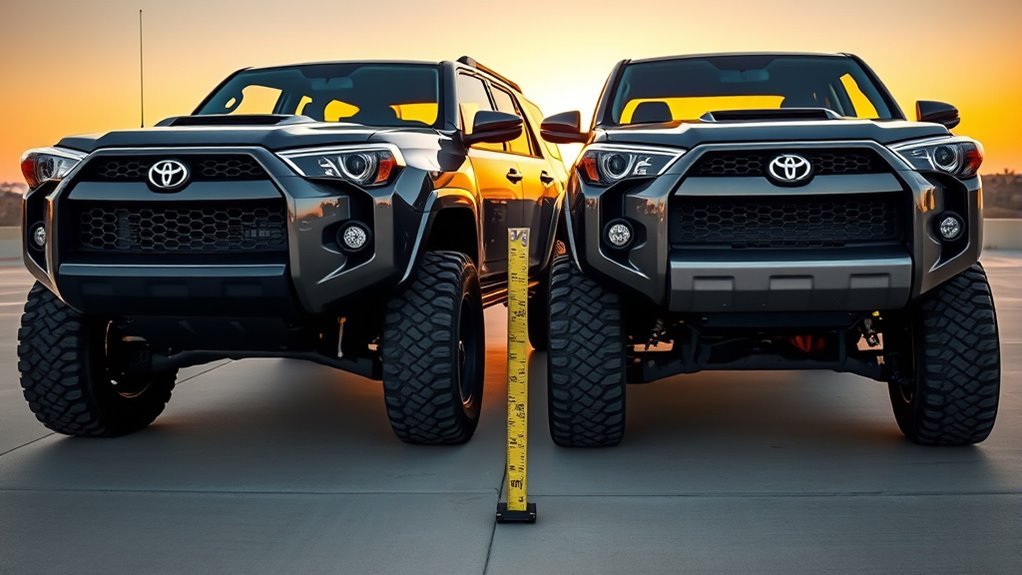
Do not choose tires by lift height alone. Tire clearance depends on tire diameter, actual section width, tread shoulder shape, wheel offset, alignment caster, fender liner position, mud flaps, body mount clearance, bumper clearance, suspension compression, and how much the tire deflects when aired down.
Clearance With 315s
A 315/70R17 is a 35-class tire, but many real specs are about 34.4 inches tall. On a 5th-gen 4Runner, this is a serious fitment change. A 3-inch suspension lift may help vertical clearance, but it does not automatically solve turning clearance or compression clearance.
Expect to evaluate these areas before committing to 315s:
- Front bumper and lower valance at full steering lock.
- Front fender liner and mud flaps.
- Pinch weld and body mount area behind the front tire.
- Upper control arm clearance.
- Brake line and ABS wire clearance.
- Rear of the wheel well during compression.
- Bump-stop and shock travel limits.
Trimming For 315s
Plan 315 fitment as an iterative test-fit project, not a simple “install lift, mount tires, done” job. Many builds need aggressive fender liner movement, trimming, mud-flap removal, body mount chop or relocation, bumper trimming, aftermarket UCAs for caster correction, and careful alignment.
Warning: Toyota does not recommend modifying original tire size or suspension, and warns that changes can affect vehicle safety, operation, federal compliance, and warranty coverage on affected components. Review your owner information and use a qualified alignment or off-road suspension shop before cutting, welding, or changing safety-related systems.
285/70R17 Fitment
A 285/70R17 is a common 5th-gen 4Runner upgrade because it is close to a 33-inch tire without jumping to a 35-class setup. It is still not a guaranteed no-rub fit on every truck. Stock wheels, positive offset, factory mud flaps, low caster, and aggressive tread shoulders can all create rubbing.
For many trucks, a 2-inch front lift or leveling setup plus a careful alignment makes 285/70R17 fitment easier. You may still need to push the front fender liner forward, remove or trim mud flaps, trim small plastic edges, or adjust caster. Test-fit before cutting metal.
Plan 4Runner Lifts: Body Lift + Suspension, Settling, Alignment
A suspension lift, body lift, and larger tire all change different parts of the clearance picture. Combine them carefully:
| Change | Raises Hub-to-Fender? | Raises Frame / Skids? | Raises Differential? | Main Benefit |
|---|---|---|---|---|
| Suspension lift | Yes | Yes, mostly | No on solid rear axle center section | More fender clearance and improved stance |
| Body lift | Yes | No | No | More tire-to-body clearance |
| Larger tires | No | Yes, by added tire radius | Yes, by added tire radius | More ground clearance and larger contact patch |
After a lift, alignment is not optional. Ask the shop to check caster, camber, toe, steering wheel centering, and tire clearance at full lock. For 285s and larger, caster becomes especially important because moving the tire slightly forward can reduce contact at the rear of the front wheel well.
Troubleshoot Rubbing & Fitment: Trimming, UCAs, and Testing
Mount the intended tire and wheel package before making permanent cuts. Then cycle the steering lock-to-lock and inspect the tire at normal ride height. If possible, compress the suspension safely or use a shop lift to check the tire’s path through travel.
The right sequence is measure, mount, steer, compress, mark contact points, align, then trim only what the test fit proves you need.
- Check front bumper, fender liner, mud flap, pinch weld, body mount, sway bar, brake lines, and upper control arm clearance.
- Mark rubbing spots with painter’s tape or a paint pen.
- Verify tire pressure because sidewall shape changes with pressure.
- Confirm wheel offset and backspacing before blaming the lift height.
- Use alignment to add safe caster where appropriate.
- Trim plastic before metal where possible.
- For structural cutting or body mount work, use a qualified fabricator.
Note: If the tire only rubs in the driveway, it will usually rub harder off-road. Suspension compression, steering angle, aired-down sidewalls, and body roll all make clearance tighter on the trail.
Frequently Asked Questions
How do you measure stock 4Runner ride height?
Park on level ground and measure from the center of each wheel hub straight up to the lower edge of the fender flare. Record all four corners. This gives you a repeatable baseline that is not affected by tire diameter.
What is the best lift height for a 5th-gen 4Runner?
For most daily-driven and weekend-trail 5th-gen 4Runners, a 2–3 inch front suspension lift with a smaller rear lift is the practical range. It improves stance and tire clearance without making alignment, CV angles, and rubbing as difficult as taller setups.
What model years does this 4Runner ride-height guide apply to?
This guide is written for the 5th-gen Toyota 4Runner, commonly referenced as 2010–2024. The 2025+ 4Runner is sixth generation and uses different factory specs, suspension packaging, tire options, and trim setups.
How can you tell if your 4Runner already has a lift?
Measure hub-to-fender height, inspect the shocks and coils for aftermarket branding or adjusters, check for spacer lifts, look for aftermarket upper control arms, and compare tire size and wheel offset against factory specs. A front reading well above about 20 inches usually suggests a lift or leveling setup.
Do bigger tires change hub-to-fender height?
No. Bigger tires raise the hub and fender together when measured from the ground, so hub-to-fender height stays essentially the same. Bigger tires do increase ground clearance by about half the tire-diameter increase.
Does a body lift improve ground clearance?
A body lift raises the body and fender openings, which can help tire-to-body clearance. It does not raise the frame, skid plates, suspension arms, or differentials. For underbody clearance, tire diameter and suspension setup matter more.
Conclusion
Good 4Runner lift planning starts with numbers. Measure hub-to-fender at all four corners, record your baseline, and then separate the effects of suspension lift, body lift, and tire diameter. A mild 2–3 inch suspension setup can work well for many 285/70R17 builds, while 315/70R17 tires demand a much more serious fitment plan. Test before trimming, align after lifting, and use your measurements to make every change intentional.
Sources
- Toyota 2024 4Runner eBrochure — factory tire sizes, ground clearance, suspension, and trim specifications.
- Toyota Support: changing tire size or suspension — Toyota’s safety, compliance, and warranty caution for modifications.
- Toyota USA Newsroom: 2025 4Runner — confirms the 2025 model as sixth generation.
- TireSize.com 285/70R17 specs — tire diameter, width, wheel range, and revolutions per mile reference.
- TireSize.com BFGoodrich KO2 315/70R17 specs — real 315/70R17 diameter and width reference.
- TrailBuilt Off-Road 5th-gen 4Runner build guide — real-world tire fitment, trimming, and body-mount clearance context.