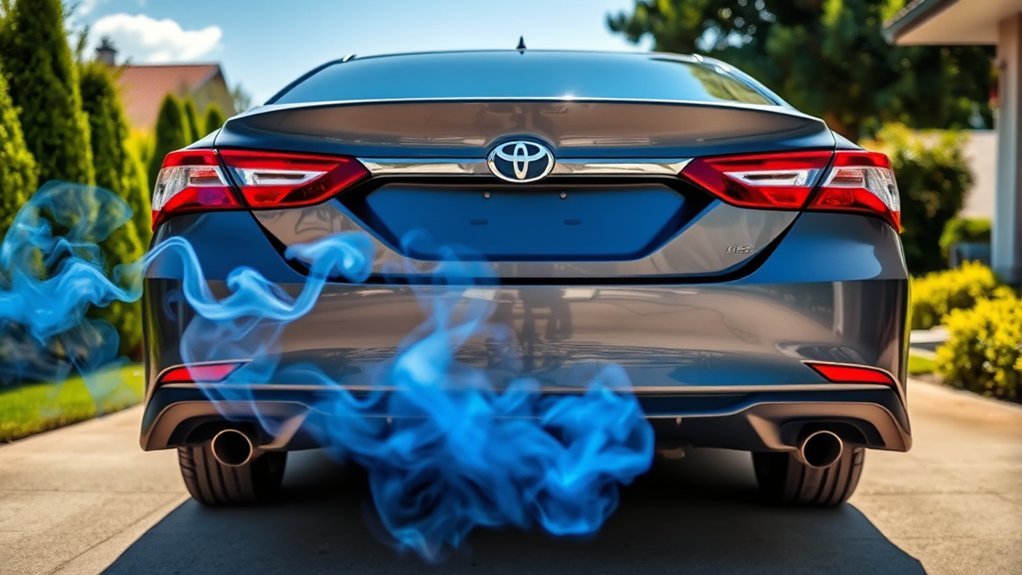
If your Toyota Camry is blowing blue or blue-gray smoke from the exhaust, treat it as an oil-burning warning until proven otherwise. The cause may be simple, such as a clogged PCV system, or expensive, such as worn piston rings, valve-stem seals, or cylinder wear. The key is to note when the smoke appears, check the oil level correctly, and test the cheapest causes before approving major engine work.
Quick Answer
Blue smoke from a Toyota Camry’s exhaust usually means engine oil is entering the combustion chamber or exhaust stream and burning. Common causes include a faulty PCV valve, worn valve-stem seals, stuck oil-control rings, worn piston rings, cylinder wear, or—only on turbo-equipped setups—failed turbo seals.
Key Takeaways
- Blue smoke usually means oil burning, while white smoke often points to coolant or condensation and black smoke points to excess fuel.
- Smoke timing matters: startup smoke often points to valve-stem seals, acceleration smoke can point to rings, and smoke with rough idle can point to PCV problems.
- Check the oil level first. Low oil can turn a repairable problem into engine damage.
- Do not assume turbo failure unless your Camry actually has a turbocharger. Most U.S. Camrys are not factory turbocharged.
- Start with low-cost checks such as PCV inspection, external oil leaks, oil level tracking, and spark-plug inspection before approving engine teardown.
At a Glance
| Time Required | 15–45 minutes for basic checks; longer for compression, leak-down, or shop diagnosis |
| Difficulty | Beginner for oil/visual checks; intermediate for PCV access; professional for internal engine work |
| Tools Needed | Clean rag, gloves, flashlight, owner’s manual, OBD-II scanner, basic hand tools, optional compression/leak-down tester |
| Cost | Low for inspection and PCV parts; moderate to high for valve seals; high for piston rings or engine overhaul |
Warning: Stop driving and shut the engine off if the oil-pressure light comes on, the engine knocks, the temperature gauge climbs, smoke becomes heavy and constant, or the dipstick shows little or no oil. Do not work around hot exhaust parts, belts, fans, or a running engine unless you know the safe procedure.
What Causes Blue Smoke in Your Toyota Camry?
Blue smoke happens when engine oil reaches a place where it should not be burning. In a Camry, that oil can enter through worn piston rings, stuck oil-control rings, worn valve-stem seals, a clogged or stuck PCV valve, worn cylinder walls, overfilled oil, or an external leak dripping onto hot exhaust parts.
Before replacing parts, make sure the smoke is actually blue or blue-gray. White vapor that disappears quickly on a cold morning may be normal condensation. Thick, sweet-smelling white smoke after warm-up can point to coolant entering the engine. Black smoke usually points to a rich fuel mixture, misfire, or fuel-control issue. Persistent blue smoke points most strongly to oil consumption.
| When the Blue Smoke Appears | Most Likely Area to Check | What to Do Next |
|---|---|---|
| Brief puff after sitting overnight | Valve-stem seals or valve guides | Check oil level trend, spark plugs, and smoke after idle |
| Smoke after idling, then pressing the accelerator | Valve-stem seals or PCV oil pull-over | Inspect PCV hoses and intake for oil film |
| Smoke during hard acceleration | Piston rings, oil-control rings, cylinder wear | Request compression and leak-down testing |
| Smoke after long downhill deceleration | Valve-stem seals or valve guides | Have a technician confirm before engine disassembly |
| Smoke nearly all the time | Severe oil burning, low oil, internal wear, or major PCV fault | Check oil immediately and avoid extended driving |
Note: Toyota’s official owner resources recommend using the correct owner’s manual for your exact year and model. Oil capacity, oil viscosity, dipstick procedure, and service intervals can vary by engine and model year. See Toyota Manuals and Warranties for year-specific guidance.
Quick Diagnosis Steps Before Replacing Parts
Use this order so you do not spend money on major engine work before ruling out simpler causes.
- Check the oil level on level ground. Let the engine sit for a few minutes, pull the dipstick, wipe it clean, reinsert it fully, and read it again. Add only the correct oil type if the level is low.
- Look for external leaks. Inspect the valve cover area, oil filter, drain plug, timing cover area, and underside of the engine. A leak dripping onto hot exhaust parts can smell or smoke without the engine actually burning oil internally.
- Track oil use. Record the odometer reading, oil level, and how much oil you add. Recheck every few hundred miles until you know whether the level is dropping quickly.
- Scan for codes. Blue smoke itself may not trigger a check-engine light, but misfire, fuel-trim, oxygen-sensor, or catalyst-efficiency codes can help guide diagnosis.
- Inspect the PCV system. Look for cracked hoses, loose connections, sludge, oil pooling in the intake hose, and a stuck PCV valve.
- Inspect spark plugs if accessible. One oily plug can point to a cylinder-specific issue. All plugs oily can point to broader oil consumption or PCV oil pull-over.
- Ask for compression and leak-down tests when needed. These tests help identify ring, cylinder, valve, or head-gasket sealing problems before expensive repairs.
Pro Tip: If the smoke is light and the oil level is still safe, take a short video showing the tailpipe during cold start, idle, acceleration, and deceleration. A mechanic can often narrow the cause faster when they can see exactly when the smoke appears.
How to Diagnose and Fix a Faulty PCV Valve
The PCV valve is part of the positive crankcase ventilation system. It routes crankcase vapors back into the intake so they can be burned instead of building pressure inside the engine. When the PCV valve or hose sticks, clogs, cracks, or pulls too much oil mist into the intake, your Camry may idle poorly, use oil, leak oil, or smoke.
Symptoms of PCV Valve Failure
PCV problems can overlap with other oil-burning causes, so treat these as clues rather than a final diagnosis:
- Rough idle or misfire: A stuck-open PCV valve can act like a vacuum leak and disturb the air-fuel mixture.
- Oil leaks: A clogged PCV path can raise crankcase pressure and push oil past gaskets or seals.
- Oil in the intake hose or throttle body: A PCV system that is pulling too much oil mist can feed oil into the intake stream.
- Blue smoke after idling: Oil may collect in the intake and burn when you accelerate.
- Whistling or hissing: A cracked hose or stuck valve can create unusual vacuum sounds.
Steps for Visual Inspection
Start with the safest checks. Let the engine cool, wear gloves, and keep fingers, sleeves, and tools away from belts and fans.
| Step | Action | What It Means |
|---|---|---|
| Visual Inspection | Check PCV hoses, grommets, and fittings for cracks or loose connections. | Cracks can create vacuum leaks and rough idle. |
| Sludge Check | Look for heavy sludge around the valve or hose opening. | Sludge can block crankcase ventilation. |
| Shake Test | If your Camry uses a removable rattling-style PCV valve, remove it and shake it. | No rattle can suggest sticking, but this is not a perfect test for every design. |
| Vacuum Check | With the engine idling and the correct hose safely accessed, check for light vacuum using the repair-manual method. | No vacuum can mean blockage; too much can mean a stuck-open valve or wrong part. |
| Manual Check | Confirm the PCV location and procedure for your exact engine. | Some model years use different layouts, and access can affect labor time. |
Replacement Process Overview
If the PCV valve is accessible and your manual shows it as serviceable, replacement is usually straightforward:
- Let the engine cool completely.
- Locate the PCV valve and hose using your exact Camry year and engine information.
- Label or photograph the hose routing before removal.
- Remove the hose carefully so you do not crack brittle plastic or rubber.
- Replace the valve with the correct part number for your engine.
- Replace cracked hoses or hardened grommets at the same time.
- Recheck idle quality, smoke, and oil level over the next few drives.
If the valve is buried under other components, if the hose breaks, or if smoke continues after replacement, stop guessing and have a shop perform crankcase-pressure, compression, leak-down, and intake-inspection tests.
Only If Equipped: How Turbocharger Issues Cause Blue Smoke
A turbocharger can cause blue smoke when its internal oil seals fail and allow oil to enter the intake or exhaust side. However, this section applies only if your Camry actually has a turbocharger, such as an aftermarket turbo kit or a market-specific turbocharged engine. Current U.S. Toyota Camry information emphasizes hybrid performance and does not list a factory turbo setup for the mainstream Camry lineup. You can confirm current specifications at Toyota’s official Camry page.
Turbocharger Seal Failure
When turbo seals fail, oil can leak into the compressor or turbine housing. That oil may burn in the engine or exhaust, creating blue smoke, oil smell, and sometimes a drop in boost or a whining noise. A turbo problem is more likely if smoke appears after boost, after idling, or after a long downhill coast, and if there is fresh oil in the charge pipes.
Symptoms of Turbo Problems
- Blue smoke after boost or after idle: Oil may be entering the turbo housing.
- Oil in intercooler or charge piping: A light film can be normal, but pooling oil is not.
- Whining, scraping, or siren-like noise: The turbo may have bearing or shaft wear.
- Loss of power: Damaged seals or bearings can reduce boost.
Do not replace a turbo based only on tailpipe smoke. PCV faults can also push oil into the intake and mimic turbo seal failure.
How to Spot Bad Valve Seals and What to Do
Valve-stem seals control oil around the valve stems. When they harden or wear, oil can drip into the intake or exhaust ports and burn during startup, idle, or deceleration.
A brief blue puff after overnight parking or after a long idle often points to oil entering from the top of the engine, but a technician should confirm the pattern before replacing valve-stem seals.
Look for these signs:
- Blue smoke at cold start: Oil may have seeped past the seals while the engine sat.
- Blue smoke after idling: Oil can collect during high-vacuum idle and burn when you press the accelerator.
- Blue smoke after downhill deceleration: High engine vacuum can pull oil past worn seals.
- Dropping oil level: You may need to top off oil more often even when there is no visible external leak.
- Oily spark plugs: Oil deposits on plugs can help identify affected cylinders.
A compression test is useful, but it does not confirm bad valve-stem seals by itself. Low compression points more toward cylinder sealing problems, worn rings, valve sealing issues, or head-gasket problems. If compression and leak-down results are acceptable but smoke timing still fits valve-seal behavior, valve-stem seals move higher on the suspect list.
Valve-stem seal replacement can be labor-intensive because the valve cover, valvetrain parts, and related gaskets may need to come off. On some engines, the cylinder head may need to be removed. Get a written diagnosis before approving the repair.
How Engine Components Affect Oil Consumption
Several internal engine parts can let oil reach the combustion chamber:
- Piston rings: Worn compression rings can reduce cylinder sealing, while worn or stuck oil-control rings can leave too much oil on the cylinder wall.
- Cylinder walls: Wear, scoring, or out-of-round cylinders can prevent rings from sealing correctly.
- Valve-stem seals and guides: Worn top-end parts can let oil run down the valve stems.
- PCV system: A blocked or stuck PCV system can upset crankcase pressure and pull oil mist into the intake.
- Oil viscosity or overfill: Using the wrong oil or overfilling can worsen oil consumption, foaming, leaks, or smoke.
- Air filter and intake restrictions: Severe intake restrictions can affect engine breathing and should be corrected during diagnosis.
For older, high-mileage Camrys, stuck oil-control rings are a common suspect when smoke appears under load and the oil level drops with no major external leak. A shop may recommend compression testing, leak-down testing, borescope inspection, and an oil-consumption test before deciding whether the engine needs internal work.
Model-Year Note: Older 2AZ Engine Oil Consumption
Certain older Toyota vehicles equipped with the 2AZ engine had documented excessive oil-consumption coverage through Toyota’s Warranty Enhancement Program ZE7. The NHTSA-hosted Toyota document lists certain 2007–2009 Camry and certain 2007–2011 Camry Hybrid vehicles among the covered models and describes dealer oil-consumption testing and eligibility rules. You can review the document here: Toyota Warranty Enhancement Program ZE7 — Engine Oil Consumption.
This does not mean every Camry in those years has the problem, and it does not mean your vehicle is still eligible today. Coverage depended on VIN, engine, testing results, time, mileage, and program terms. If you own one of those years, ask a Toyota dealer to check the VIN history, previous repairs, and applicable service information.
Cost-Effective Repairs vs. Major Overhauls: What to Expect
The cheapest repair is not always the correct repair, but the diagnostic order should still start with lower-cost checks. Use this table as a planning guide, not a guaranteed quote.
| Possible Fix | Typical Cost Level | When It Makes Sense |
|---|---|---|
| Oil level correction and leak inspection | Low | First step for any blue-smoke complaint |
| PCV valve or hose replacement | Low to moderate | Rough idle, vacuum leak, oil in intake, clogged hose, or failed PCV test |
| Valve-stem seals | Moderate to high | Blue puff after startup, idle, or deceleration with otherwise healthy lower-end test results |
| Piston rings or oil-control rings | High | High oil consumption, smoke under load, blow-by, low compression, or failed oil-consumption testing |
| Engine rebuild or replacement | Very high | Severe cylinder wear, major internal damage, or repair cost exceeding vehicle value |
Note: The PCV valve itself may be inexpensive, but professional replacement cost depends heavily on access, engine layout, and labor rate. Kelley Blue Book’s PCV valve replacement cost guide is a useful starting point for current pricing context.
Frequently Asked Questions
What is the most common cause of blue smoke from a Toyota Camry exhaust?
The most common broad cause is engine oil burning. The exact failed part depends on when the smoke appears. A PCV fault is a smart first check because it is usually cheaper than internal engine repair. Blue smoke during acceleration often points more toward rings or cylinder wear, while smoke after startup or idling often points toward valve-stem seals.
How do mechanics diagnose blue smoke?
A mechanic will usually confirm the smoke color and timing, check the oil level, look for external leaks, inspect the PCV system, scan for diagnostic trouble codes, check spark plugs, and perform compression or leak-down testing if internal wear is suspected. For older Camrys with oil-consumption history, the shop may also perform a measured oil-consumption test.
Can I keep driving my Camry if it blows blue smoke?
You may be able to drive a short distance if the smoke is light, the oil level is correct, and there are no warning lights, knocking, overheating, or loss of power. Do not keep driving if the oil-pressure light comes on, the dipstick shows very low oil, the smoke is heavy, or the engine sounds abnormal.
Can changing to thicker oil stop blue smoke?
Thicker oil may reduce visible smoke in some worn engines, but it is not a real fix and may be wrong for your engine. Always use the oil viscosity listed for your exact Camry unless a qualified technician recommends otherwise. The better approach is to find why oil is entering the combustion chamber.
Will blue smoke always trigger a check-engine light?
No. Oil consumption can happen without a check-engine light, especially early on. A light may appear later if oil burning causes misfires, oxygen-sensor issues, or catalyst-efficiency codes. That is why checking the dipstick and tracking oil use are important even when the dashboard looks normal.
Conclusion
Blue smoke from a Toyota Camry should not be ignored because it usually means oil is being burned or reaching hot exhaust parts. Start with the basics: verify the smoke color, check the oil level, look for leaks, inspect the PCV system, and track oil consumption. If those checks do not reveal the cause, have a shop perform compression, leak-down, spark-plug, and oil-consumption testing before approving major repairs. Catching the problem early can protect the engine, catalytic converter, and your repair budget.
Sources
- Toyota Manuals and Warranties — owner manual and year-specific maintenance guidance
- Toyota Camry Official Page — current U.S. Camry powertrain and specification context
- Toyota Warranty Enhancement Program ZE7 via NHTSA — older 2AZ engine oil-consumption coverage details
- U.S. EPA Motor Vehicle Emissions Control: Positive Crankcase Ventilation — PCV system purpose and emissions context
- SAE International: Engine-Based Catalytic Converter Poisoning Test — oil-derived phosphorus and catalyst-efficiency impact
- U.S. Department of Energy / ORNL: Exhaust Phosphorous Chemistry and Catalyst Poisoning — catalyst poisoning and increased oil-consumption context