If your Camry overheats at idle, first check coolant level, radiator cap and for air pockets, then confirm radiator fans run when the engine warms and A/C is off. Test thermostat and upper hose temp to verify flow, inspect the water pump, hoses and radiator for leaks or clogs, and perform a pressure and combustion-gas test if you see bubbles or low compression. Replace failed parts based on priority and cost, and continue for step‑by‑step fixes and diagnostics.
How to Stop a Camry From Overheating at Idle: Immediate Triage
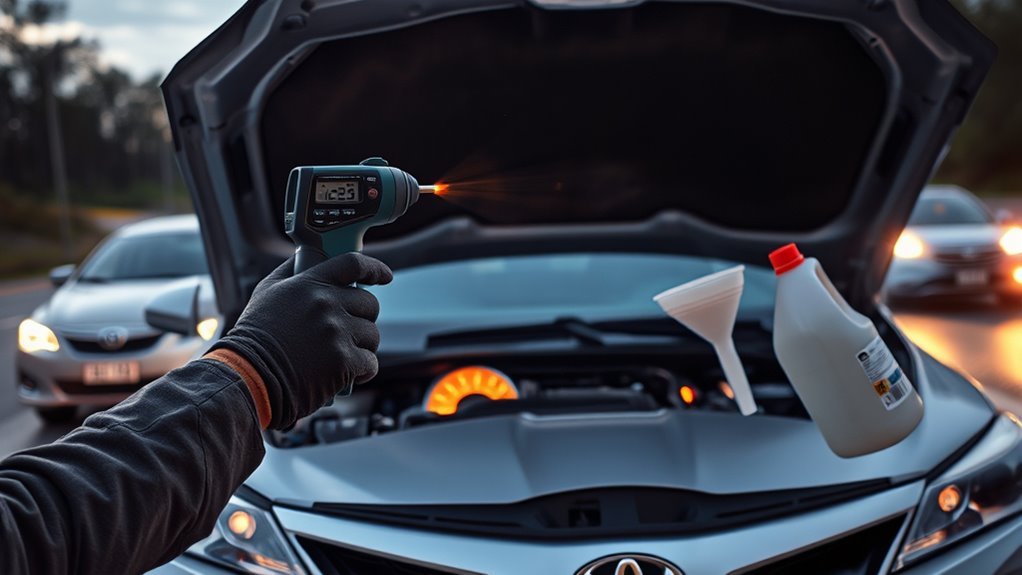
When your Camry starts to overheat at idle, first confirm coolant level and top it off if it’s low—insufficient coolant is a common cause because you don’t get airflow through the radiator while stopped. Next, inspect radiator fans: they must engage as temperature rises; if they only run with A/C on, suspect a faulty fan relay or temperature switch and replace it. Bleed the cooling system to remove trapped air that prevents proper circulation. Scan for bubbles in the radiator or reservoir—these can indicate a blown head gasket, which undermines cooling efficiency and causes persistent engine overheating at idle. Visually check hoses, the water pump, and the radiator for leaks or damage; any coolant loss worsens idle overheating. Use approved coolant additives only when specified by service guidance to address minor corrosion or sealing needs, not as a cure-all. Follow this methodical triage to regain control and preserve your freedom to move without breakdowns.
Quick Checklist: Camry Overheating at Idle or Stoplights
If your Camry overheats at idle or stoplights, use this quick checklist to pinpoint the likely causes and next steps. First, verify radiator fan operation: with engine idling and A/C off, watch for fan engagement as engine warms. If fans run only with A/C, suspect a relay, temperature sensor, or wiring fault—plan fan replacement or electrical diagnosis. Next, test the thermostat: a stuck unit prevents circulation at low flow; replace if it fails to open. Inspect for trapped air after recent cooling-system work; properly burp the system to restore circulation. Confirm coolant level and look for visible leaks or damaged hoses. Consider whether coolant additives have been used recently; some can alter flow or sensor readings—flush and replace with manufacturer-spec coolant if needed. Prioritize actions by ease: fan/electrical check, thermostat swap, bleed system, then fluid flush. Each step returns you to controlled, liberated operation.
Check Coolant Level, Radiator Cap, and Air Pockets First
Start by checking the coolant level in both the radiator (when cold) and the overflow tank, since low coolant is a common cause of overheating at idle. You’ll perform a basic coolant maintenance routine: verify levels, top with the correct mixture, and note any rapid loss that signals a leak. Next, perform a radiator inspection focused on the cap: confirm the seal, spring tension, and absence of corrosion or debris that lets pressure escape. A defective cap allows coolant to boil at lower temperatures and invites air.
Air pockets degrade circulation and raise idle temperatures. After any coolant change, thermostat, or water pump replacement, follow burping procedures to purge trapped air—open bleed valves or use elevated fill techniques per service manual. Finally, monitor for recurring level drops or overheating; persistent symptoms mean deeper faults. These methodical checks free you from needless parts swapping and restore reliable cooling performance.
Test Radiator Fans and Relay : A/C Quick Test
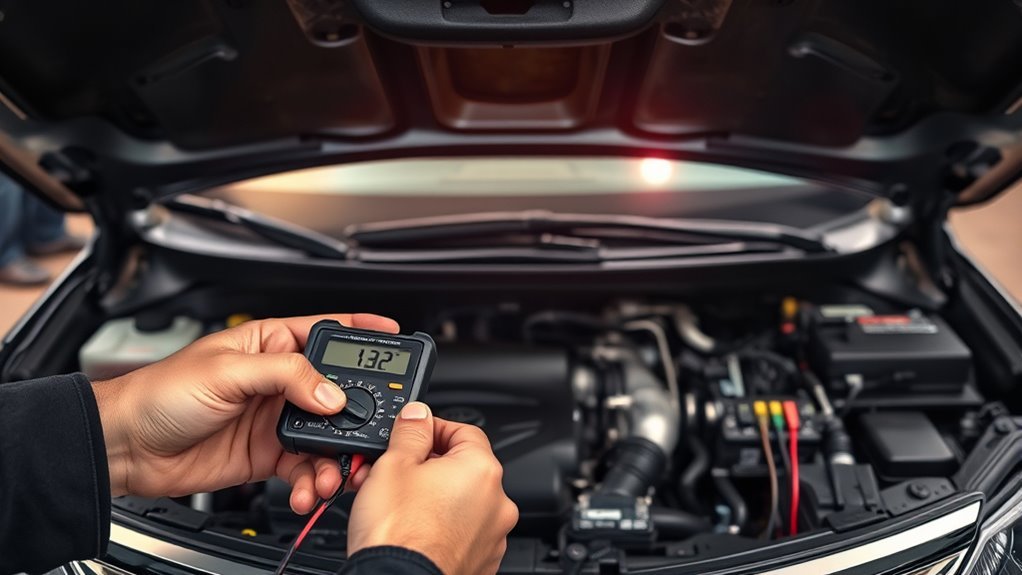
Although the engine cooling fans often kick on in response to coolant temperature, you can quickly verify fan and relay operation with an A/C quick test: turn the ignition to ON (engine off), switch the A/C to ON and observe fan operation. If both fans spin, the system’s fan operation and relay functions are likely intact. If they don’t, isolate the fault.
First, disconnect the temperature switch connector at the radiator base and repeat the A/C test; if the fan runs now, replace the temperature switch. Next, inspect wiring and connectors for tightness and corrosion—poor connections frequently mimic component failure. To verify the fan relay, swap it with a similar relay in the fuse box or measure continuity with a multimeter; a bad relay will prevent current flow despite correct control signals. After any repair, retest fan operation under A/C and thermal load. Regular, methodical checks protect your freedom from roadside breakdowns and maintain reliable engine temperature control.
Find and Test the Camry’s Temperature Sensors and Connectors (1999)
Locate the temperature sensors near the bottom of the radiator and confirm which one controls the cooling fan, since some Camrys have multiple sensors. Disconnect the sensor connector and turn the key to “on” to see if the fan runs—if it does, the sensor likely needs replacement. Inspect the connectors for looseness, corrosion, or damaged wiring before moving on to relay and wiring diagnostics.
Locate Temperature Sensors
When you inspect a 1999 Camry’s temperature sensors, focus on the thermostat housing and nearby coolant passages where the Engine Coolant Temperature (ECT) sensor and any auxiliary sensors are mounted; these sensors monitor coolant temperature and feed data to the ECU and fan controls. Locate sensor locations visually, note harness routing, and plan testing methods. Disconnect only to test resistance with a multimeter and observe fan behavior with ignition ON. Check connectors for looseness or corrosion; poor contacts mimic sensor failure.
| Component | Typical Mount | Diagnostic Action |
|---|---|---|
| ECT sensor | Thermostat housing | Measure resistance vs spec |
| Auxiliary sensor | Coolant passage | Verify location, then test |
| Connector | Harness near sensor | Inspect for corrosion or play |
Test Sensor Connectors
Start by visually inspecting each temperature-sensor connector around the thermostat housing and coolant passages, looking for loose pins, cracked housings, or corrosion that will degrade signal integrity. Next, identify every sensor in the cooling circuit—there may be multiple—and label them for systematic testing. Disconnect a connector, switch the ignition to ON, and measure voltage or continuity with a multimeter per the service manual spec. Note any intermittent readings; they indicate poor contact. If you find corrosion or damage, perform connector cleaning with contact cleaner and a small brush, or replace the connector if housing or pins are compromised. Maintain a log of readings and actions. This sensor maintenance approach frees you from guesswork and prevents idle overheating.
Diagnose Coolant Flow: Thermostat, Water Pump, and Radiator Tests
Because overheating often stems from restricted coolant flow, you should methodically test the thermostat, water pump, and radiator to pinpoint the failure mode. Begin by verifying thermostat operation: with a cold engine, feel the upper radiator hose as the engine warms—if it stays cool while engine temp rises, the thermostat may be stuck closed, blocking coolant circulation and thwarting temperature regulation. Next, inspect the water pump for leakage, shaft play, or absence of flow; remove the radiator cap (hot engine precautions observed) and run the engine briefly to confirm coolant movement or use a pressure-driven flow test tool. Examine the radiator: look for external debris, internal clogging, or collapsed fins that restrict flow; a flush and flow-rate test will reveal blockages. Perform a cooling-system pressure test to find leaks or weak seals that reduce efficiency. After any repair, thoroughly bleed air from the system—air pockets will interrupt circulation and recreate overheating at idle.
Test for Head Gasket or Combustion-Gas Leaks (Compression & Block Tests)
Start by performing a compression test with the engine at operating temperature and the fuel system disabled; record peak psi for each cylinder and compare to the manufacturer’s 120–180 psi range. If readings are low or vary widely, follow with a leak-down (combustion-gas) test by pressurizing each cylinder and listening for air at the radiator, intake, or exhaust to locate the leak. Interpret results: uniform low compression suggests worn rings, large differences or air at the coolant indicate a head-gasket or head-seal failure, and exhaust/intake leaks point to valve issues.
Compression Test Procedure
Check the engine at operating temperature, remove all spark plugs, and attach a calibrated compression gauge to each cylinder in turn to measure peak pressure; these readings let you assess head gasket integrity and locate combustion-gas leaks. You’ll crank the engine with the throttle wide open, record peak psi, and compare results across cylinders. Use different compression gauge types as needed for accuracy and durability. Watch for cylinder pressure variations: a healthy Camry shows ~120–200 psi with ≤10–15 psi spread. Low readings in one or more cylinders suggest blown head gasket, worn rings, or damaged valves. Follow with a leak-down test to isolate the failure and reclaim control over your vehicle.
- Prepare tools, battery charged, and throttle open
- Use a calibrated gauge and adapters
- Record three cranking tests per cylinder
- Note ambient temperature effects
- Compare readings against spec
Combustion Gas Leak
Diagnose combustion-gas leaks by combining compression testing with a chemical block test to confirm whether exhaust gases are entering the cooling system through a compromised head gasket or cylinder head. You’ll perform combustion diagnostics by recording cylinder pressures; note any cylinder with considerably lower psi versus the bank, which suggests a seal breach. Follow with a block test: draw cooling-system gases through the reagent; a color change confirms combustion products in coolant. Also watch coolant loss and white steam from the exhaust as corroborating signs. If tests indicate a leak, plan gasket replacement or cylinder-head service immediately to prevent warped heads or catastrophic failure. Work methodically, document readings, and free yourself from uncertainty with decisive repair action.
Interpreting Test Results
Having confirmed suspect cylinders with compression and block tests, you’ll now interpret those results to pinpoint whether combustion gases are breaching the head gasket or cylinder head. Read compression values across cylinders: consistent low values suggest wear; a single low cylinder adjacent to a coolant passage points to head gasket failure. Use leak down analysis to localize leaks—air escaping into the cooling system or visible bubbles in coolant confirms combustion-gas intrusion. Always test cold to avoid thermal expansion skewing numbers. Compare readings to factory specs and to other cylinders to decide repair scope.
- Note magnitude and pattern of compression values for trend insight
- Watch for coolant bubbling during leak down analysis
- Record cold-test baselines for future monitoring
- Correlate low readings with coolant passages
- Prioritize repairs based on failure localization
Step-by-Step Bleeding (Burping) and Coolant Top‑Off Procedure
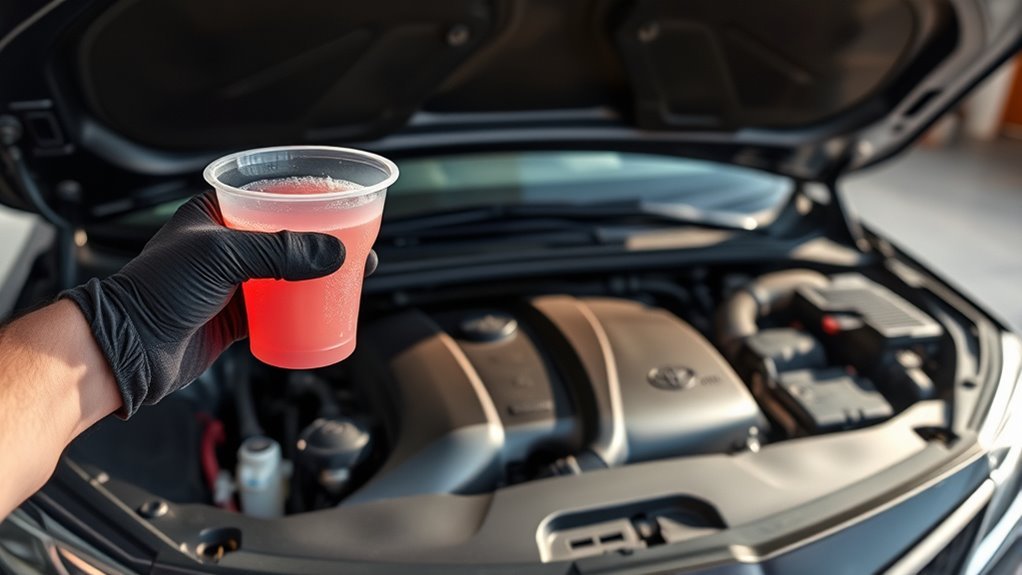
1. You’ll perform a controlled bleed (burp) and top off to purge air and restore pressure. Set the heater to max so coolant circulates through the heater core. Use the correct coolant types and follow radiator maintenance practices.
| Step | Action |
|---|---|
| 1 | With engine cold, remove radiator cap. |
| 2 | Start engine; watch for rising coolant and bubbles. |
| 3 | Add coolant gradually, keeping level above fill neck. |
| 4 | Close cap once steady flow, no bubbles. |
Run the engine until the thermostat opens and you see steady coolant flow; air will escape as bubbles. Add coolant slowly whenever level drops, preventing new air pockets. When bubbling stops, secure the radiator cap and verify overflow tank level; top off as required. Afterward, monitor engine temperature and coolant levels over several days to confirm no leaks and stable operation. This methodical approach gives you control and freedom from guesswork while preserving system integrity.
Repair Priorities, Estimated Costs, and When to Get Professional Help
Start by prioritizing checks that most often cause overheating at idle: verify the cooling fans operate and test the coolant temperature sensor, since a failed fan or sensor commonly prevents adequate radiator airflow and proper ECU control. You’ll then follow methodical repair strategies: confirm coolant level, pressure-test the system, and inspect thermostat and water pump function. Replace cheap, quick-fix items first to restore safe operation.
- Verify fan motors, relays, and fuses; measure airflow and RPM under idle.
- Test coolant temperature sensor resistance and ECU input/output.
- Inspect for external leaks; perform coolant system pressure test.
- Replace thermostat or water pump as needed; track parts/labor for cost breakdown.
- If overheating persists, perform a leak-down/compression test for head gasket integrity.
Estimated costs vary: thermostat/water pump $100–$900, head gasket notably higher. Get professional help when diagnostics exceed your tools or when head gasket repair or thorough ECU-driven testing is required to guarantee lasting freedom from repeat failures.
Frequently Asked Questions
What Causes a Car to Overheat Only When Idling?
You’re overheating at idle because cooling system circulation and airflow issues occur: fans, thermostat, leaks, trapped air, or faulty sensors stop proper coolant flow and fan activation, so heat builds when the car isn’t moving.
How to Tell if It’s a Bad Thermostat or Water Pump?
You’ll distinguish thermostat failure by stagnant overheating, no cabin heat, and a thermostat that won’t open when hot; you’ll spot water pump issues by leaks, noises, or poor coolant circulation despite a working thermostat—test both methodically.
Why Does My Toyota Camry Keep Overheating?
Because your cooling system’s failing: the thermostat’s stuck, the radiator fan isn’t engaging, coolant’s leaking, or passages are clogged. You’ll inspect components, replace faulty parts, and perform engine maintenance to reclaim reliable, liberated driving.
How Do You Fix an Idle Engine Overheating?
You fix idle engine overheating by methodically restoring the cooling system: check fans, coolant level, thermostat, relays, and sensors; use a scanner, repair leaks, perform compression/leak-down tests, and keep disciplined engine maintenance for lasting freedom.
Conclusion
You’ve run through the basics—coolant, fans, sensors, flow—and you’re close, but don’t relax yet. One overlooked air pocket, a sticky thermostat, or a failing head gasket can turn a quick fix into a breakdown. Methodically prioritize bleeding, fan and pump tests, then pressure and combustion checks. If any step shows abnormal readings, stop and call a pro. Keep tools, test results, and notes ready—your Camry’s next move depends on them.