If your Toyota Camry stalls when you slow down or stop, treat it as both a drivability problem and a safety issue. The cause is usually found in one of a few systems: air entering the engine, idle control, fuel delivery, ignition, sensors, vacuum leaks, or low electrical voltage. Start with the simple checks, read any OBD-II codes, and avoid replacing parts until a test points to the problem.
Quick Answer
A Toyota Camry that stalls at stops commonly has an idle-air, vacuum-leak, throttle-body, MAF sensor, fuel-pressure, ignition, or crank/cam sensor problem. First, check for warning lights and OBD-II codes, inspect the intake hose and air filter, clean the throttle body carefully, and stop driving if the car stalls repeatedly in traffic.
Key Takeaways
- Do not guess. Scan for OBD-II codes first, then inspect the intake, throttle body, vacuum hoses, ignition parts, fuel pressure, and sensor wiring.
- A dirty throttle body, cracked intake boot, vacuum leak, weak fuel pump, misfire, or failing crankshaft/camshaft sensor can all feel like the same “stall at a stop” symptom.
- Specs vary by model year and engine. Use the owner’s manual, under-hood label, or repair database for spark plug, fuel-pressure, and idle-control specifications.
- Repeated stalling, a fuel smell, a flashing check-engine light, or stalling in traffic means the Camry should be professionally diagnosed before you keep driving it.
At a Glance
| Time Required | 20 minutes for basic checks; 1–2 hours for deeper DIY testing |
| Difficulty | Beginner to intermediate, depending on the test |
| Tools Needed | OBD-II scanner, flashlight, throttle-body cleaner, MAF-safe cleaner, basic hand tools, multimeter, and smoke tester or professional leak test when needed |
| Cost | About $0–$40 for basic inspection/cleaning supplies; more if parts, specialty tools, or professional diagnostics are needed |
Warning: If the Camry stalls while moving, loses power steering/brake assist, smells like fuel, shows smoke, or has a flashing check-engine light, pull over safely, turn on the hazard lights, and arrange a tow or professional inspection. Do not keep driving a car that may stall in traffic.
Why a Toyota Camry Stalls at Stops

A Camry stalls at stops when the engine can no longer maintain a steady idle. That can happen because the engine is getting the wrong amount of air, too little fuel pressure, a weak spark, incorrect sensor information, or unstable electrical voltage.
The most common stop-stall pattern is this: the car drives normally at speed, then the RPM drops too low when you come to a red light, shift into gear, turn on the air conditioning, or brake to a stop. That points you toward idle control, intake leaks, throttle-body deposits, fuel-pressure problems, or sensor inputs before you start looking for rare computer faults.
Note: Camry designs vary. Older models may use an idle air control valve, while many newer models use electronic throttle control instead of a separate serviceable IAC valve. Hybrid Camrys also need extra care because high-voltage systems should not be serviced by DIYers.
Start With This Diagnostic Order
Use this order so you do not waste money replacing good parts:
| Step | What to Check | Why It Matters |
|---|---|---|
| 1 | Safety, warning lights, fuel smell, overheating | Confirms whether the car is safe to test |
| 2 | OBD-II stored and pending codes | Shows which system the ECU is flagging |
| 3 | Air filter, intake boot, clamps, vacuum hoses | Finds leaks and restrictions that upset idle |
| 4 | Throttle body, MAF sensor, idle-control parts | Corrects common low-idle airflow problems |
| 5 | Spark plugs, coils, misfire data | Rules out weak ignition at low RPM |
| 6 | Fuel pressure and pump operation | Confirms the engine is not starving for fuel |
| 7 | Crank/cam sensors, charging system, parasitic draw | Finds intermittent shutdown or low-voltage faults |
Inspect Throttle Body, MAF, Intake Tube, and Air Filter
Airflow problems are a smart first stop because they are common, visible, and often inexpensive to fix. Inspect the throttle body, mass airflow sensor, intake tube, hose clamps, and air filter before buying parts.
| Component | Action |
|---|---|
| Throttle body | Look for carbon around the bore and plate; clean gently with throttle-body cleaner |
| MAF sensor | Use only MAF-safe cleaner; do not touch the sensing wires |
| Intake tube | Check for cracks, soft spots, loose clamps, and tears after the MAF sensor |
| Air filter | Replace if dirty, oil-soaked, collapsed, or the wrong size |
| Vacuum hoses | Inspect for brittle rubber, missing caps, split elbows, and disconnected lines |
A torn intake boot after the MAF sensor can let unmeasured air enter the engine. That often causes a lean idle, rough running, and stalling when RPM drops at a stop.
Pro Tip: Before cleaning anything, take photos of hose routing and electrical connectors. Many “new” idle problems after a repair are caused by a loose clamp, unplugged sensor, or vacuum hose left off during reassembly.
Check Idle Control and EGR the Safe Way
Idle control keeps the engine running when your foot is off the accelerator. Depending on the year and engine, your Camry may use a separate IAC valve or rely on the electronic throttle body to control idle speed.
Clean the IAC Valve if Your Camry Has One
If your model uses an idle air control valve, carbon buildup can make the valve stick. A sticking IAC may cause low idle, surging, rough idle, or stalling when the car is stopped in gear.
Remove and clean it only if your service procedure allows it. Protect the electrical connector, use the correct cleaner, avoid soaking electronics, and reinstall the gasket correctly. If the idle remains unstable after cleaning, test the valve and wiring before replacing it.
Check Throttle Body Function
On many newer Camrys, the throttle body does the idle-control work. Carbon around the throttle plate can reduce airflow at idle. Clean the bore carefully without forcing the throttle plate by hand unless the service procedure allows it.
After cleaning, some vehicles may need an idle relearn. If the idle is high, low, or unstable after the repair, check the owner’s manual or service information for the correct relearn procedure.
Inspect EGR-Related Problems
An EGR valve that sticks open can act like a vacuum leak and make the engine stumble or stall at idle. Do not randomly disconnect emissions components as a “test” unless you are following a service manual. Instead, check for related codes, inspect vacuum lines or wiring, and have the EGR commanded/tested with a capable scan tool if needed.
Toyota Camry Fuel & Ignition Checks: Pump, Filter, Plugs, Coils, Wiring
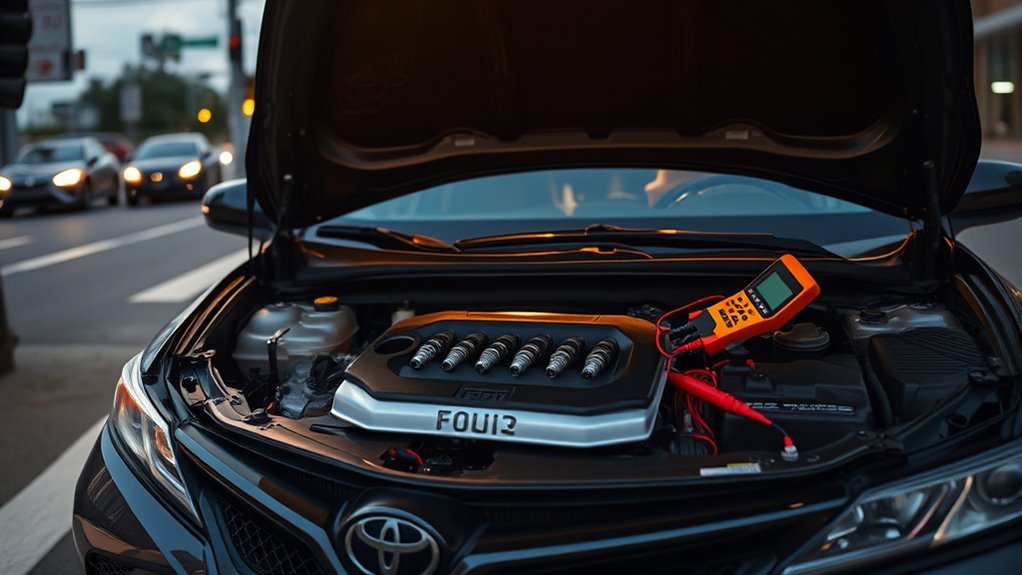
If airflow checks do not reveal the problem, move to fuel delivery and ignition. Weak fuel pressure and misfires can both show up most clearly at idle, especially when the engine is warm or under extra load from the air conditioning.
Fuel Pump Health
A weak pump, restricted filter, poor pump ground, or failing relay can let the Camry run at speed but stall when demand changes. The correct test is fuel-pressure testing at the rail or specified test point, compared with the service-manual pressure for your exact engine.
Warning: Fuel systems can stay pressurized after the engine is off. Work only in a ventilated area, keep sparks and flames away, wear eye protection, and do not open fuel lines unless you know the correct pressure-relief procedure.
| Test | What You Want | Next Step |
|---|---|---|
| Fuel pressure | Pressure within the exact spec for your engine | If low, test pump power/ground before replacing the pump |
| Filter or strainer | No flow restriction | Replace restricted serviceable filters |
| Pump wiring | Clean terminals and stable voltage | Repair corroded connectors or weak grounds |
Ignition Coil Condition
Weak ignition coils can cause misfires at idle, hesitation, poor acceleration, and stalling. Inspect coils for cracks, swelling, corrosion, oil contamination, and carbon tracking. If your scanner shows misfire codes such as P0300, P0301, P0302, P0303, or P0304, use the data to identify which cylinder is affected.
Do not replace every coil automatically. Swap testing, resistance checks where applicable, and live misfire data can help confirm whether a coil is actually failing.
Spark Plugs & Wires
Worn spark plugs can cause rough idle, hard starts, misfires, and stalling. Toyota notes that spark plugs commonly last around 80,000 miles, but the correct interval varies by vehicle and should follow the manufacturer’s maintenance schedule. You can review Toyota’s spark-plug guidance at Toyota.com.
Use the correct plug type and gap for your exact Camry year and engine. Many modern Camrys use coil-on-plug ignition and do not have traditional spark plug wires, while older models may still have wires that can crack, corrode, or develop high resistance.
Sensor & Electrical Checks: MAF, MAP, Crank/Cam, ECM, and Battery Draw
Sensors tell the engine computer how much fuel and spark timing to use. A bad signal can make the engine stall even when the mechanical parts are fine.
| Code or Symptom | Likely Area | What to Check |
|---|---|---|
| P0101 / P0102 / P0103 | MAF sensor or intake air leak | MAF connector, intake boot, sensor contamination |
| P0171 | Lean condition | Vacuum leak, unmetered air, low fuel pressure |
| P0300–P0304 | Misfire | Spark plugs, coils, compression, injector operation |
| P0335 | Crankshaft position sensor circuit | Sensor, wiring, connector, signal dropout |
| P0340 | Camshaft position sensor circuit | Sensor, wiring, timing signal |
| P0505 or idle-control code | Idle control system | IAC valve if equipped, throttle body, wiring, relearn procedure |
OBD-II systems monitor emission-related components and alert the driver when a fault is detected. You can learn more from the California Air Resources Board OBD program and Toyota’s Camry emission inspection and maintenance information.
Codes are a starting point, not a final diagnosis. For example, a MAF code may be caused by a dirty MAF sensor, a cracked intake boot, poor wiring, or an air leak after the sensor. Always inspect the circuit and related parts before replacing the sensor.
Battery, Charging, and Parasitic Draw
Low system voltage can make sensors and control modules behave unpredictably. Check battery terminals for corrosion, confirm the battery passes a load test, and verify the alternator is charging correctly.
A parasitic draw test can find a battery drain, but it must be done carefully. Use a fused meter, let modules go to sleep, and never crank or start the vehicle while the meter is connected in series.
Targeted Home Tests: OBD2 Scan, Smoke Test, Vacuum Check, Battery Test
You can narrow the problem at home with a few careful tests. Start with the least invasive checks and record the results.
1. Run an OBD-II Scan
Scan for stored, pending, and permanent codes. Write them down before clearing anything. Also look at freeze-frame data, fuel trims, idle RPM, coolant temperature, MAF readings, and misfire counters if your scanner supports live data.
2. Look for Intake and Vacuum Leaks
A smoke test is the cleanest way to find hidden leaks. Pay close attention to the intake boot, vacuum hoses, brake booster hose, PCV hose, and gasket areas. If you use any spray or mist method, keep it away from hot exhaust parts and electrical connectors, and never use flammable sprays around ignition sources.
3. Test Throttle and Idle Response
Watch idle RPM with the engine warm, transmission in Park and then Drive, and accessories on. If RPM dips sharply when the A/C turns on or when the steering is loaded, focus on idle control, throttle-body cleanliness, vacuum leaks, and electrical load.
4. Check Electrical Health
Measure battery voltage with the engine off and running. Inspect grounds and main battery cables. A weak battery or poor ground can mimic sensor and idle problems, especially during warm restarts or stop-and-go driving.
Check for Recalls and Service Information
Before paying for a major repair, check whether your Camry has an open recall or service campaign. Use the VIN lookup at NHTSA.gov/recalls, then check Toyota’s owner resources or ask a Toyota dealer to review your VIN.
A recall is not the most common reason for a stall, but it is worth checking because safety recalls are tied to specific VINs and are handled through the manufacturer process. NHTSA also lets owners report safety problems if they believe a defect may exist.
When to See a Mechanic: What to Ask, Costs, Dealer vs Independent

If basic checks do not find the cause, get a professional diagnosis before replacing parts. A good shop can test fuel pressure, smoke-test the intake, command idle-control components with a scan tool, inspect live sensor data, and verify crank/cam signals.
A written diagnostic plan is better than a parts list. Ask the shop what tests will confirm the failure before authorizing repairs.
- Ask what tests they will run. Good answers include scan data, smoke test, fuel-pressure test, charging-system test, and circuit checks.
- Ask for the exact codes and freeze-frame data. This helps separate real faults from guesses.
- Ask for a written estimate. The FTC’s Auto Repair Basics recommends being prepared, comparing shops, and understanding repair terms before authorizing work.
- Ask whether diagnosis applies to your exact model year and engine. Camry idle-control, ignition, and hybrid systems differ by generation.
- Choose the right shop. A dealer may be best for software updates, warranty concerns, hybrid-system issues, or VIN-specific campaigns. A trusted independent shop may be more cost-effective for intake leaks, ignition, fuel-pressure testing, and routine repairs.
Auto repair labor rates vary by region and facility. AAA explains that shops set rates based on technician pay, equipment, overhead, training, and local costs, so ask the shop for its diagnostic rate and whether any part of that fee applies to the repair.
Preventive Maintenance and Routine Checks to Avoid Future Stalls
Prevention is mostly about keeping air, fuel, spark, and voltage stable. Follow the maintenance schedule for your Camry’s year and engine. Toyota’s owner information says scheduled maintenance should be performed at the specified intervals in the maintenance guide, and general problems should be brought to a Toyota dealer or qualified service shop for advice.
Use this simple routine:
- Inspect the air filter and intake tube at oil-change intervals.
- Clean the throttle body when deposits are visible or idle quality drops.
- Use the correct spark plugs and replace them at the scheduled interval.
- Keep battery terminals clean and tight.
- Scan the car when the check-engine light appears instead of clearing codes blindly.
- Record mileage, codes, symptoms, weather, fuel level, and repairs so patterns are easier to spot.
You can find Toyota owner manuals and maintenance information through Toyota’s manuals and warranties portal.
Frequently Asked Questions
What causes a Toyota Camry to stall when coming to a stop?
Common causes include a dirty throttle body, idle-control fault, vacuum leak, cracked intake boot, dirty or failing MAF sensor, weak fuel pressure, misfires, crank/cam sensor signal loss, or low electrical voltage. Start with an OBD-II scan and visual inspection before replacing parts.
How do I diagnose a Camry stalling problem at home?
Read stored and pending OBD-II codes, inspect the air filter and intake hose, check for vacuum leaks, clean the throttle body if dirty, look for misfire signs, and test battery voltage. If the car still stalls, a shop should test fuel pressure, sensor signals, and idle-control operation.
Can a dirty throttle body make a Camry stall at stops?
Yes. Carbon around the throttle plate can reduce idle airflow and make RPM drop too low when you stop. Cleaning can help, but use throttle-body-safe cleaner and follow the correct procedure for your model because some electronic throttle bodies may need an idle relearn.
Can bad spark plugs cause stalling at idle?
Yes. Worn or incorrect spark plugs can cause misfires, rough idle, hard starts, and stalling. Use the plug type and gap listed for your exact Camry year and engine, and follow Toyota’s maintenance schedule rather than using a one-size-fits-all mileage or gap.
Is it safe to keep driving if my Camry stalls at red lights?
Not if it happens more than once, happens in traffic, or comes with a flashing check-engine light, fuel smell, smoke, overheating, or hard restart. Repeated stalling can create a traffic hazard, so have the car diagnosed before continuing normal driving.
Conclusion
If your Camry stalls at stops, start with the basics: scan the codes, inspect the intake hose and air filter, clean the throttle body only when needed, and check for vacuum leaks, misfires, weak fuel pressure, and low voltage. The best fix comes from a measured diagnosis, not a parts swap. When the symptom repeats or affects safety, stop DIY testing and have a qualified shop confirm the cause.
Sources
- Toyota Camry Owner’s Manual: Emission Inspection and Maintenance Programs — supports OBD/MIL guidance.
- Toyota Camry Owner’s Manual: Maintenance Requirements — supports following scheduled maintenance intervals.
- Toyota Camry Owner’s Manual: General Maintenance — supports bringing noticed problems to a dealer or qualified shop.
- Toyota: How Often To Change Spark Plugs — supports spark plug lifespan, symptoms, and manufacturer-recommendation caveats.
- California Air Resources Board: On-Board Diagnostic Program — supports OBD system explanation.
- NHTSA Recall Lookup — supports VIN-based recall checking and safety-defect reporting.